Why High School Students Still Misspell Familiar Words
The Gap Between Reading a Word and Writing It Correctly
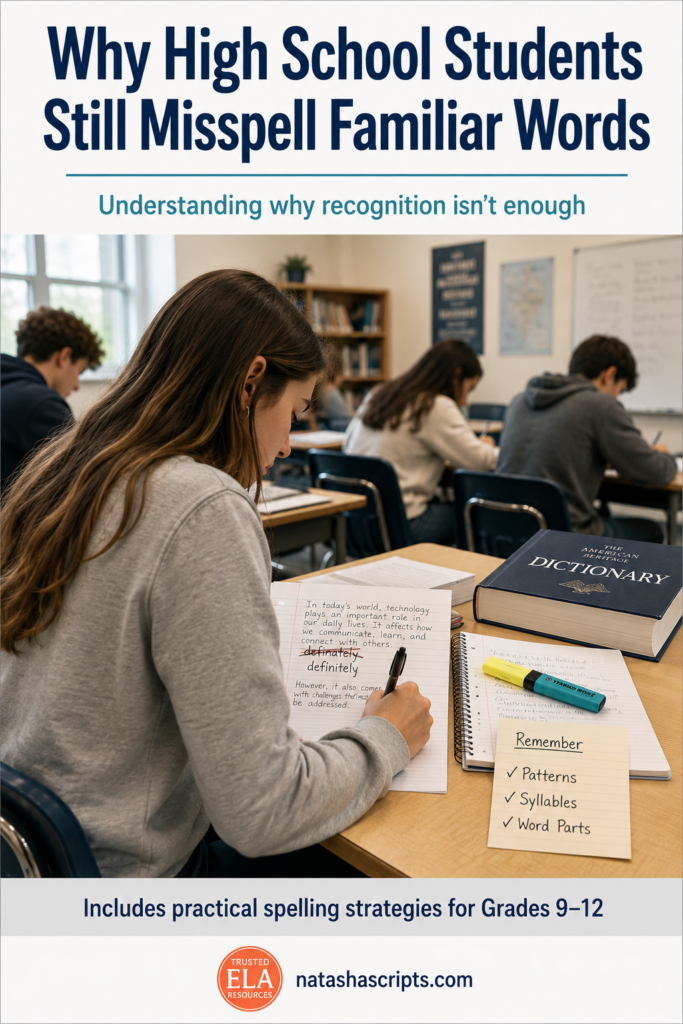
Students in grades 9 through 12 may read sophisticated texts and write at length about complex topics, yet still misspell words they have seen hundreds of times. Words such as separate, necessary, definitely, and conscientious appear regularly in academic reading and student writing. They also continue to appear in teachers’ and parents’ corrections.
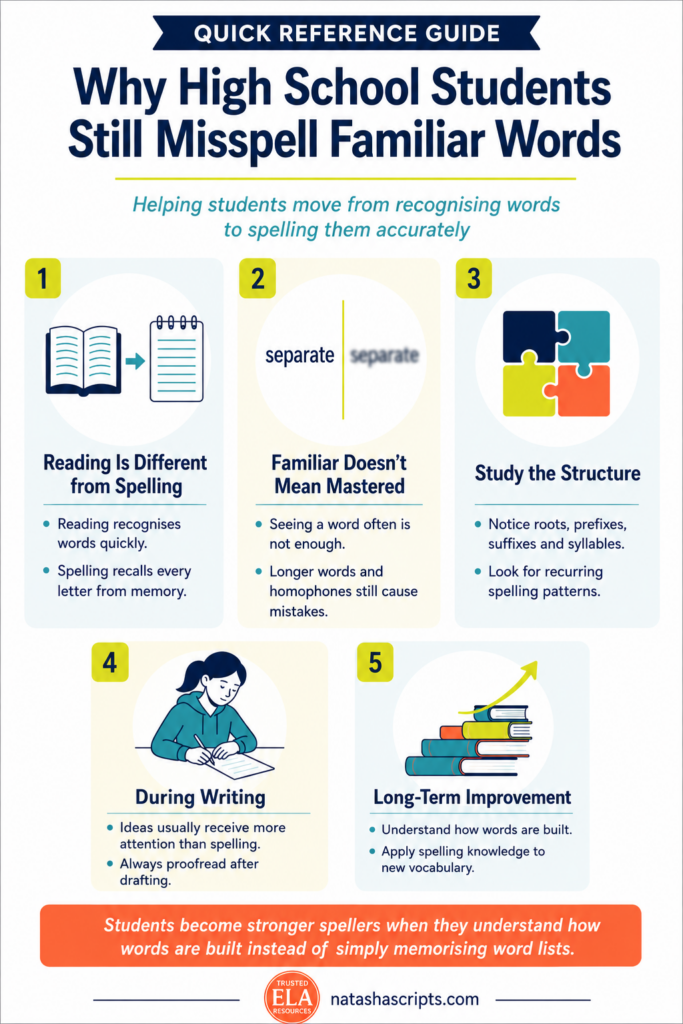
Prefer a quick overview? Jump straight to the Quick Reference Guide for this article.
These errors can be puzzling, especially when a student understands the word and uses it correctly in context. However, recognising a word while reading and reproducing it accurately in writing require different skills.
When students read, they often recognise familiar words from their overall shape, key letter patterns, and the surrounding sentence. They do not necessarily examine or remember every letter. Spelling requires something more precise. The student must retrieve the complete sequence of letters without the word being visible and without context providing the answer.
A student may recognise environment immediately on the page but still hesitate over whether an n appears before the m when writing it from memory. Repeated exposure helps students recognise words more quickly, but recognition alone does not always build the detailed knowledge of letter patterns needed for accurate spelling.
This is why telling a student, “You have seen this word many times,” does not always solve the problem. Students often need focused opportunities to examine the word, notice its structure, and practise retrieving it accurately.
A student may recognise environment immediately on the page but still hesitate over whether an n appears before the m when writing it from memory.
Why Familiarity Can Create a False Sense of Mastery
One reason high school students continue to misspell familiar words is that repeated exposure through reading can create a false sense of mastery. A student who has seen occurrence many times may feel certain they know how to spell it. That confidence can reduce the careful attention they give to the word’s structure when writing. The word feels familiar, so there seems to be little need to think through each letter.
This pattern is often more noticeable with longer, multisyllabic academic words than with shorter ones. Students are less likely to misspell words such as fact or claim because the entire spelling is easy to hold in memory. Longer words like exaggerate or privilege, however, contain more complex letter patterns. The features that are easiest to overlook while reading, such as a double consonant or an unstressed middle syllable, are often the same features that cause spelling mistakes during writing.
If your student frequently struggles with double consonants, you may also find it helpful to read Double Consonant Spelling Rules for High School: A Repeatable Decision-Making Routine.
Homophone errors follow a similar pattern, although they involve an additional layer of confusion. A student who writes their when they mean there may know how to spell both words perfectly well in isolation. The mistake occurs because fluent reading focuses on meaning rather than on the exact spelling of each word. As a result, even strong readers can develop writing habits that reflect incomplete attention to spelling. This idea is explored further in the related article on Homophone Mistakes High Schoolers Keep Making (And How to Fix Them).
The Role of Unstressed Syllables
One reason many familiar words remain difficult to spell is that English pronunciation does not always reveal every vowel clearly. In many words, an unstressed syllable is pronounced with a neutral vowel sound (known as a schwa), making it difficult to identify the correct vowel simply by listening to the word.
When a student tries to spell words such as desperate or category by sounding them out, the unstressed syllables provide very few clues. Several spellings may seem possible, so without a clear mental picture of the word, the student can make a perfectly logical choice that is still incorrect.
This is where paying close attention to word structure becomes valuable. Instead of relying on pronunciation alone, encourage your student to examine words syllable by syllable, noticing where the unstressed vowels occur and which letters are actually used. Over time, this deliberate attention helps students build more accurate mental representations of longer words and makes correct spelling easier to retrieve.
If unstressed syllables are a recurring source of spelling errors, you may also find How Syllables Help Teens Spell Long Words useful. It explores practical strategies for helping students break longer words into manageable parts and remember their spelling more accurately.
What Spelling Practice Actually Needs to Do
For spelling instruction to address this gap effectively in grades 9 through 12, it needs to do more than ask students to memorise a weekly list of words. Studying a list for a spelling test may help students remember those words for a short time, but that learning does not always transfer to everyday writing. Students may achieve full marks on a Friday and still misspell the same words in an essay the following week. This happens because the words have been learned individually rather than as examples of spelling patterns that can be applied more widely.
A more effective approach is to help students notice how words are built. Looking at prefixes, suffixes, roots, syllables, and common letter patterns encourages students to make connections between words instead of treating each one as something completely new. For example, a student who recognises the suffix -ance in words such as acceptance, attendance, and performance is more likely to remember the spelling of other words that follow the same pattern. The emphasis shifts from memorising individual words to recognising how English spelling works.
The good news is that this kind of instruction does not require long, separate spelling lessons. Whether you’re teaching a class or working with one or two students at home, short, focused word-study sessions can easily become part of regular reading and writing activities. Spending five to ten minutes exploring the structure of three or four words that students have recently misspelled, or are about to encounter in their reading, is often far more effective than asking them to memorise another list. The goal is to help students understand why words are spelled the way they are so they can apply that knowledge whenever they write.
The Writing Context Problem
Another reason spelling mistakes persist in high school is that students are often concentrating on many things at once when they write. During an essay, they are thinking about ideas, evidence, sentence structure, organisation, and what they want to say next. With so much happening at once, spelling naturally receives less attention. As a result, students may misspell words in a full essay that they could easily spell correctly in a spelling activity or short exercise.
This doesn’t necessarily mean the student hasn’t learned the word. More often, it reflects the demands of extended writing. For this reason, strong spelling instruction should combine two complementary habits. First, students need regular word study so that common spellings become familiar and easier to recall while writing. Second, they need to develop a consistent proofreading routine that gives them an opportunity to focus solely on spelling once their ideas are on the page. Together, these two practices help students improve both their spelling knowledge and their ability to spot mistakes before submitting their work.
For students in grades 9 and 10, this combination of spelling, vocabulary, reading, and writing practice is built into the Spelling High School Workbook Grades 9–10. Students first study spelling patterns and vocabulary before applying them in reading passages and writing activities, helping them use new words in context rather than simply memorising them. Students in grades 11 and 12 who are preparing for college-level reading and writing may find the Spelling High School Workbook Grades 11–12 equally useful, with a particular focus on the academic vocabulary that appears regularly in advanced coursework and standardised assessments.
Addressing the Gap Directly
Once teachers and homeschool parents understand that many persistent spelling mistakes are caused by the difference between recognising a word and spelling it from memory, it becomes much easier to choose the right kind of practice. Rather than asking students to memorise more word lists, the focus shifts to helping them understand how words are built, recognise recurring spelling patterns, and develop reliable proofreading habits.
Students who regularly examine why words are spelled the way they are, make connections between related words, and set aside time to check spelling during revision usually make steady progress over time. The improvement may not happen overnight, but it is often more lasting because students are building understanding rather than relying on short-term memorisation.
This approach also strengthens vocabulary development. When students explore related words such as ambiguous, ambiguity, and ambivalence, they are not only more likely to remember the spelling of each word, but they also develop a clearer understanding of how the words are connected and when each one should be used. Spelling and vocabulary grow together because students are learning patterns rather than isolated words.
When students understand how words are built, spelling becomes much more than remembering individual words. It becomes a skill they can apply whenever they encounter new vocabulary.
Teachers and homeschool parents looking for free sample lessons and worksheets on high school spelling and vocabulary can also explore the Free ELA Resources page, where you’ll find downloadable materials to try before deciding whether a full programme is the right fit for your students.
Quick Reference Guide