Double Consonant Spelling Rules for High School: A Repeatable Decision-Making Routine
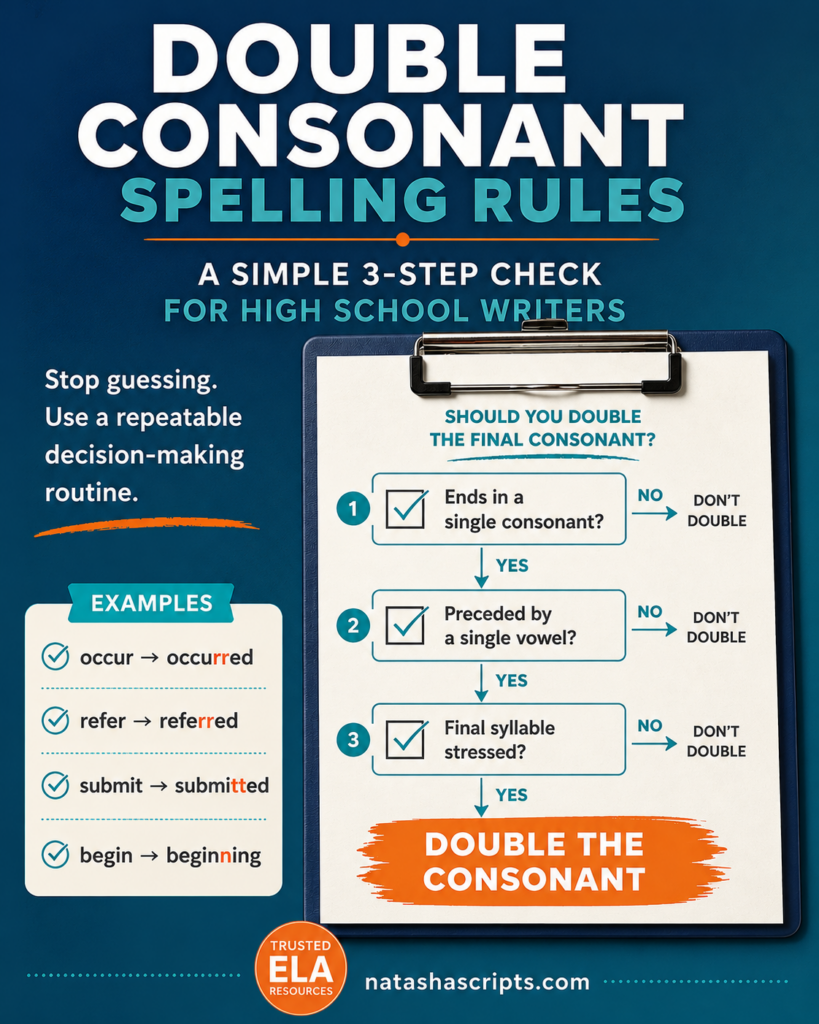
Why Double Consonant Errors Persist into High School
Spelling errors involving double consonants are among the most persistent patterns seen in high school writing. They most often appear when students add endings such as -ed, -ing, or –er to a word. A student writing an analytical essay might produce occured instead of occurred, or begining instead of beginning, and then spell happening correctly in the very next sentence. That inconsistency is a useful signal. It suggests the student has absorbed some correct spellings through repeated exposure but has not yet developed a reliable process for making the spelling decision. When a spelling decision depends on familiarity rather than a clear process, errors are likely to appear inconsistently.
Want the short version? Jump to the
Quick Guide to Doubling Consonants
for a printable reference chart.
This pattern is worth addressing directly at the high school level because the words most likely to require a doubling decision are also the words students use most often in academic writing: referred, omitted, controlled, occurred, submitted, beginning, and forgetting. These are not obscure vocabulary words. They are the functional words of analytical and expository prose. A student who misspells them repeatedly in formal writing may give the impression of carelessness, even when the underlying issue is simply the absence of a reliable decision-making routine.
The words most likely to require a doubling decision are also the words students use most often in academic writing: referred, omitted, controlled, occurred, submitted, beginning, and forgetting.
The Core Rule and What It Actually Requires
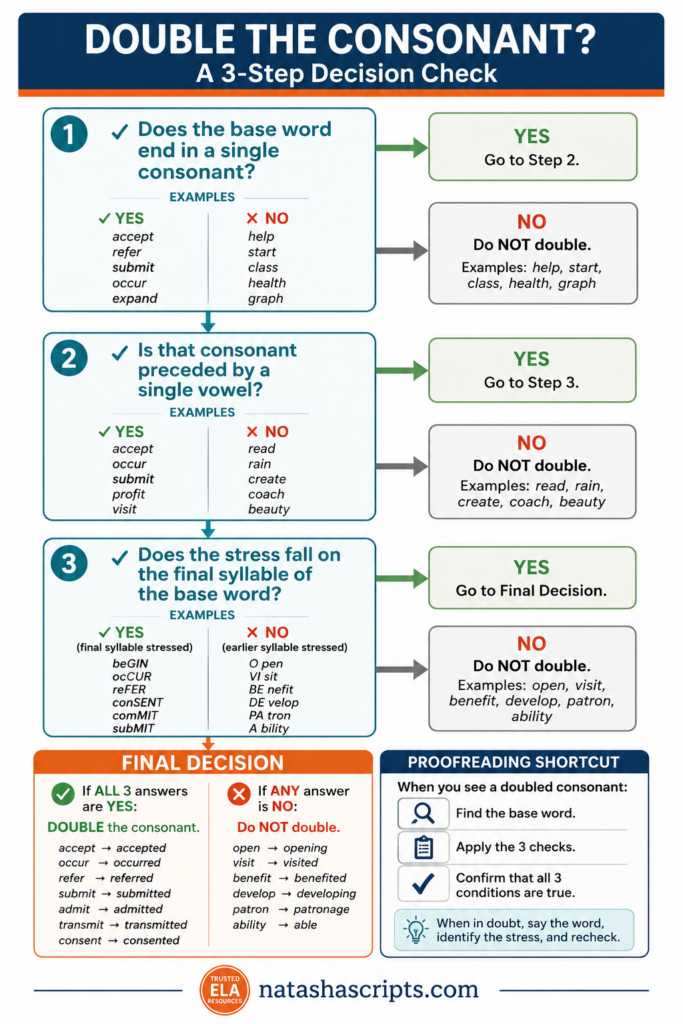
The doubling rule applies when a suffix beginning with a vowel, such as -ed, -ing, -er, or -ence, is added to a base word. Before adding the suffix, students need to check three things about the base word: whether it ends in a single consonant, whether that consonant is preceded by a single vowel, and whether the stress falls on the final syllable. If all three conditions are met, the final consonant is doubled. If any one of them is not met, the consonant is not doubled.
That three-part check is the heart of the routine. The challenge is that students are rarely taught to apply it as a sequential process. They may have encountered the rule in a simplified form, such as “double the final consonant before adding -ing,” without learning the conditions that determine when doubling actually applies. The simplified version works for short, one-syllable words such as run or stop, but it breaks down quickly with two-syllable words, which is precisely where many high school spelling errors occur.
Teaching the Three-Part Check as a Sequence
One approach that tends to help is presenting the three conditions as a numbered checklist that students work through in order, rather than as a rule to be memorized and applied all at once.
If the word ends in two consonants, as in help or start, there is no doubling. Stop here.
If there are two vowels before the final consonant, as in read or rain, there is no doubling. Stop here.
If the stress falls on an earlier syllable, as in open or visit, there is no doubling. If the stress falls on the final syllable, as in begin, occur, or refer, the consonant is doubled before adding the suffix.
Working through this sequence with a word like begin makes the logic visible. The word ends in a single consonant (n), that consonant is preceded by a single vowel (i), and the stress falls on the second syllable (be-GIN). All three conditions are satisfied, so the n is doubled: beginning.
Applying the same sequence to open shows why no doubling occurs. The stress falls on the first syllable (O-pen), so the third condition is not met. The result is opening, not openning.
For students who struggle to identify stressed syllables, “How Syllables Help Teens Spell Long Words” provides additional strategies for using syllable awareness to support spelling decisions.
Where Students Tend to Get Stuck
The stress-identification step is the one that most often causes difficulty, particularly for students who have not had much explicit instruction in syllabification. Identifying whether stress falls on the final syllable of a two-syllable word requires a student to say the word aloud and listen carefully, which is a skill that benefits from practice before it becomes automatic. In a homeschool setting, a parent can model this by saying the base word aloud with exaggerated stress on each syllable in turn (“BEG-in” versus “be-GIN”) so the student can hear which version sounds natural. In a classroom, a similar modeling exercise works well as a brief whole-group activity before students apply the check independently.
A second area of difficulty involves words where the final consonant is w, x, or y, none of which are doubled even when all three conditions appear to be met. Words like flow (flowing), fix (fixing), and play (playing) follow different patterns, and students who encounter these alongside the standard doubling words sometimes become uncertain about whether the rule applies. It is worth addressing these exceptions explicitly rather than leaving students to encounter them through trial and error.
A third area involves words with prefixes, where students sometimes misidentify the base word. For example, a student working with omit may hesitate because the word looks as though it might have a prefix attached to a shorter root. Clarifying that the doubling check applies to the complete base word as it exists before the suffix is added can help prevent this kind of confusion.
Building the Routine Through Structured Practice
Introducing the three-part check is a starting point, but the routine becomes reliable only through repeated application across a range of words. One useful practice structure is to present students with a set of base words and ask them to work through the checklist for each one before adding a given suffix, writing out their reasoning at each step rather than simply producing the final spelling. This slows the process down in a productive way, making the decision visible and easier to examine and correct.
Over several sessions, the goal is for the sequential check to become internalized so that students can apply it quickly when writing without needing to write out each step. That internalization tends to happen gradually, and it is generally more durable when practice includes a mix of words that do require doubling and words that do not. This ensures that students are making a decision each time rather than mechanically applying a rule to a list of words that all follow the same pattern.
For teachers and homeschool parents looking for structured spelling practice at the high school level, the Spelling High School Workbook Grades 9–10 includes activities designed to build this kind of accuracy through varied and contextual practice. Students working at the 11th- or 12th-grade level may find the Spelling High School Workbook Grades 11–12 a useful complement, as it extends spelling practice into the academic vocabulary encountered in more complex texts and writing tasks.
Connecting the Routine to Proofreading
One practical application of the three-part check is proofreading. Students who have learned the routine can use it not only when they are uncertain about a spelling while writing, but also when they are reviewing a completed draft. A student who notices a word ending in a doubled consonant followed by a suffix can run the check: Does the base word satisfy all three conditions? If not, the doubling may be an error. If it does, the spelling is likely correct.
This kind of active proofreading is more productive than simply rereading a draft and hoping errors will stand out. For students who are also working on other aspects of proofreading in their academic writing, “A Proofreading Routine for Apostrophes and Possessives in High School Writing” offers a similarly structured approach to a different category of common error.
Integrating the Rule into Ongoing Spelling Instruction
The doubling rule works best when it is situated within a broader spelling program rather than taught as a standalone lesson. Students who are also developing an understanding of syllable structure, vowel patterns, and word origins are generally better positioned to apply the three-part check accurately because they have the vocabulary needed to think about what a “single vowel,” a “final syllable,” or a “stressed syllable” actually means. For students who find any of those concepts unfamiliar, a brief review of syllabication and vowel patterns may help strengthen their understanding of the routine.
At the same time, the routine does not depend on complete mastery of those concepts before students can begin using it. Many high school students already have an intuitive sense of syllable stress from spoken language, and the three-part check can help make that intuition explicit and usable in writing. Beginning with a small set of high-frequency words that clearly illustrate the pattern, such as occur, begin, refer, and submit, and then expanding to additional examples tends to give students early success and make the broader pattern easier to recognize over time.
When students understand not only what the rule requires but also why each condition matters, the rule becomes something they can reason through rather than simply memorize. They begin to see why two vowels before the final consonant change the outcome, why stress placement affects whether doubling occurs, and why the type of suffix is relevant. That reasoning ability is what makes the routine transferable to unfamiliar words, which is ultimately the goal of spelling instruction at the high school level.
Teachers and homeschool parents looking for free sample lessons and worksheets that explore spelling patterns and strategies at the high school level can find additional materials on the Free ELA Resources page.
Quick Guide to Doubling Consonants