A Proofreading Routine for Apostrophes and Possessives in High School Writing
When high school students proofread their own writing, they often focus on meaning. They check whether their ideas are clear, whether their argument makes sense, and whether their sentences flow smoothly. This kind of proofreading is important, but it often moves too quickly to catch small mechanical errors. Apostrophe mistakes are particularly easy to miss because they rarely interfere with comprehension. A student who reads “the students essay was well organized” may understand the sentence perfectly and therefore overlook the missing possessive. As a result, apostrophe errors in possessives and contractions can remain in a piece of writing even after several rounds of proofreading.
One reason this happens is that students are trying to check too many things at once. By high school, most students have encountered the rules for apostrophes and possessives multiple times. The difficulty is often not remembering the rule but applying it consistently during the proofreading process. A focused routine that checks apostrophes separately from other grammar issues is often more effective than a general reminder to “check your grammar.”
Why Apostrophe Errors Persist in High School Writing
Apostrophe use involves a relatively small set of rules, but students are expected to apply those rules in a variety of situations. Some errors stem from confusion between possession and contraction. The familiar its/it’s distinction is a good example. The possessive form, its, has no apostrophe, while the contraction, it’s, does. Because this pattern differs from the way possessives work with most nouns, it continues to cause problems well into high school.
Other apostrophe errors occur even when students understand the rule. During drafting or revision, attention is often focused on ideas, organization, and sentence structure. In that context, a missing apostrophe can be surprisingly easy to overlook. A student may know that student’s requires an apostrophe and still omit it while writing quickly.
This distinction matters because different errors require different responses. A student who consistently confuses its and it’s may need additional instruction and practice. A student who occasionally omits apostrophes in otherwise correct writing may benefit more from a focused proofreading routine. Recognizing which type of error is occurring can help teachers, tutors, and homeschool parents provide more effective support.
The Logic Behind a Dedicated Apostrophe Pass
A general proofreading pass often catches the most noticeable errors while allowing smaller mistakes to slip through. Apostrophe errors are particularly easy to miss because they rarely affect meaning. A sentence with a missing apostrophe still looks familiar enough that many readers move past it without noticing the problem.
For this reason, it can be helpful to check apostrophes separately from other aspects of proofreading. Rather than trying to review spelling, grammar, punctuation, and sentence structure all at once, students can focus on a single task: identifying every word that might require an apostrophe and checking whether it has been used correctly.
This approach works because it narrows the student’s attention. Instead of reading for meaning or flow, the student is looking for a specific feature of the writing. For students who generally understand apostrophe rules but apply them inconsistently, a dedicated apostrophe pass can be an effective way to catch errors that might otherwise survive the final edit.
A Step-by-Step Proofreading Routine for Apostrophes and Possessives
The following routine is designed to be used after a student has completed a general draft review. It works best as a separate pass, done slowly, ideally on a printed copy or with the document displayed at a comfortable size. The steps move from the most common error types to the less frequent ones, which allows students to build a consistent habit without making the process feel overwhelming.
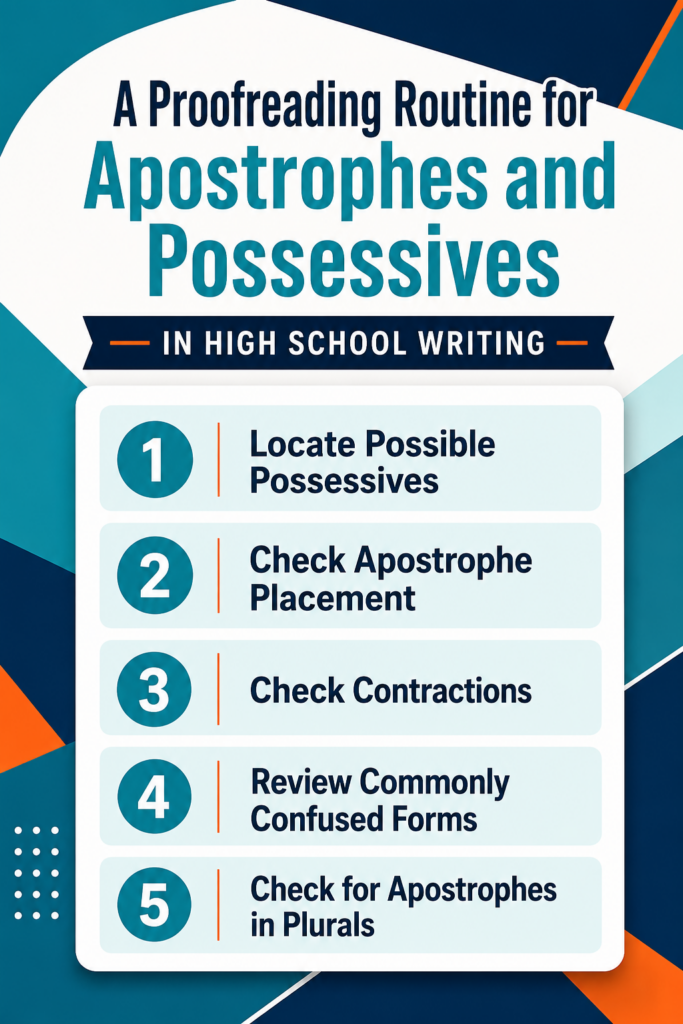
Step 1: Locate possible possessives
Read the draft slowly, sentence by sentence, looking only for nouns and pronouns that might indicate ownership or a relationship between two things. At this stage, the student is not reading for meaning. The goal is to locate any word or phrase where one thing belongs to or is connected to another. Phrases such as the author’s purpose, the character’s decision, a student’s essay, or the government’s response are all candidates for this check. It can help to underline or highlight these phrases as they appear.
Step 2: Check apostrophe placement in possessives
For each possessive phrase identified, confirm that the apostrophe is present and correctly placed. A singular noun, meaning one owner, takes an apostrophe before the s: the teacher’s feedback. A plural noun already ending in s takes the apostrophe after: the teachers’ feedback. A plural noun that does not end in s takes an apostrophe before the s: the children’s responses. Checking placement, not just presence, is an important part of this step because an apostrophe in the wrong position is still an error.
Step 3: Check contractions
Locate every contraction in the draft and confirm that the apostrophe marks the omitted letter or letters. Common contractions in student writing include it’s (it is), don’t (do not), they’re (they are), I’ve (I have), and couldn’t (could not). For each one, the student should briefly identify what the contraction stands for and confirm that the apostrophe is in the correct position.
Step 4: Review commonly confused forms
Check every instance of its, it’s, their, they’re, your, and you’re individually. These six words account for many apostrophe errors in high school writing because they involve possessive pronouns that look similar to contractions. A quick test for each: if the word is meant to show possession, it should have no apostrophe (its, their, your); if it is a contraction, it should have one (it’s, they’re, you’re). Substituting the full form, such as it is or they are, is a reliable way to check whether the contraction form is actually what the sentence requires.
Step 5: Check for apostrophes in plurals
Scan for any apostrophe used to form a plural. Students occasionally add an apostrophe when making a noun plural, writing the 1990’s instead of the 1990s, or several idea’s instead of several ideas. This error tends to appear when a word looks unusual in its plural form, such as with decades, acronyms, or lowercase letters used as nouns. In most standard academic writing contexts, apostrophes are not used to form ordinary plurals.
Working through these steps in sequence, rather than all at once, gives students a concrete way to move through a draft without relying on general attentiveness. The routine takes longer than a single read-through, but it is considerably more reliable for catching the specific errors it targets.
Building the Routine Into Regular Writing Practice
A proofreading routine is most useful when students use it regularly, not only before an important deadline. When students complete an apostrophe pass across several writing assignments, they begin asking the same questions more automatically: Is this a possessive? Is this a contraction? Should this be its or it’s? Over time, those questions become part of the student’s normal editing process.
It can also be helpful for students to keep a brief record of the apostrophe errors they find and correct. A simple log can reveal useful patterns. For example, a student who often misplaces apostrophes in plural possessives may need targeted review of that rule. A student who understands the rule but leaves apostrophes out while writing quickly may benefit more from slowing down during the editing stage.
For students working through a structured grammar program, this kind of routine can be paired with lessons on possessives and contractions. High School Grammar Grades 9–10 provides concise explanations and practice activities that students can return to when proofreading reveals a gap in understanding. Quick Daily Grammar for High School also includes short editing activities that can help students reinforce grammar habits gradually throughout the school year.
When Errors Persist After the Routine
If a student uses the proofreading routine carefully and continues to make the same apostrophe errors, the problem may be a misunderstanding of the underlying rules. For example, the student may be unsure when a possessive requires an apostrophe, how plural possessives differ from singular possessives, or why words such as its, their, and your do not use apostrophes to show possession. In these situations, the routine remains valuable, but students may also need additional review of the specific rules that are causing difficulty.
A visual reference — one that presents the rules clearly alongside examples and non-examples — can be particularly helpful for students who need to revisit the underlying concepts. Grammar High School Grades 9–10: A Simplified Visual Guide with Quick Checks is designed with this kind of reference function in mind, presenting apostrophe and possessive rules in a format that students can consult independently while editing rather than relying on memory alone. Having a reliable reference available during the proofreading pass reduces the cognitive load of the routine and makes it more likely that students will complete it thoroughly rather than guessing when they are uncertain.
What the Routine Accomplishes Over Time
A focused apostrophe proofreading routine does more than reduce errors in a single piece of writing. When students repeatedly slow down and check for possessives, contractions, and apostrophe placement, they become more attentive editors overall. Over time, they begin to notice details that might previously have escaped their attention during revision.
The goal is not perfection on every assignment. Instead, the goal is to help students develop the habit of checking their writing carefully and systematically. As that habit becomes more consistent, students are often better able to catch their own mistakes before submitting a final draft.
Apostrophes and possessives provide a useful starting point because the rules are relatively limited and the errors are easy to identify once students know what to look for. A simple proofreading routine gives students a practical way to apply those rules and build stronger editing habits that can support their writing across subjects and grade levels.
