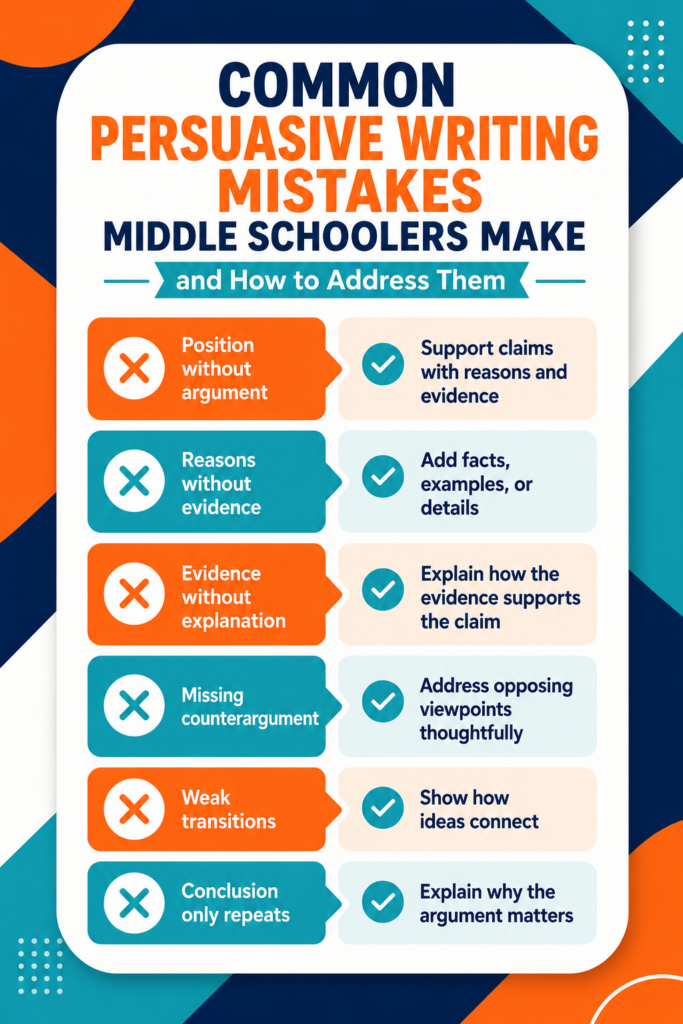
Common Persuasive Writing Mistakes Middle Schoolers Make and How to Address Them
Middle school students often approach persuasive writing with genuine conviction. They have opinions, and they are usually willing to express them. What many students are still learning, however, is that having an opinion and building an argument are not the same thing. Effective persuasive writing requires students to support their position with reasons, evidence, and clear explanations.
Many of the most common persuasive writing mistakes stem from this distinction. Recognizing those mistakes can help teachers, tutors, and homeschool parents provide more focused and effective feedback.
If you’d like a quick overview of the key elements discussed in this article, you can jump ahead to the Persuasive Writing Checklist.
Stating a Position Without Supporting It
One of the most common patterns in middle school persuasive writing is an opening paragraph that announces a position clearly and then stops. The student has identified what they believe, but the essay that follows tends to restate that belief in slightly different words rather than build a case for it. In many cases, students are still developing an understanding of what persuasive writing is designed to accomplish. Expressing a viewpoint is part of the task, but persuasive writing also requires students to support that viewpoint with reasons, evidence, and explanation.
An approach that tends to help is making that distinction explicit before students begin drafting. Discussing what it would take to convince someone who disagrees, rather than someone who already shares the student’s view, can shift the focus in a useful way. When students write with a skeptical reader in mind, they are more likely to recognize that their position needs support rather than repetition.
Offering Reasons Without Evidence
A related pattern appears one step further into the essay: the student provides reasons, but those reasons are not supported by specific evidence. A paragraph might read something like, “School uniforms are a bad idea because they take away students’ freedom of expression.” While this provides a reason, it does not explain why the reader should accept it. The claim is stated, but it is not supported with examples, facts, experiences, or other evidence.
At the middle school level, students are often still learning that a reason and evidence serve different purposes in an argument. A reason explains why the writer holds a particular position. Evidence gives the reader a basis for accepting that reason.
A reason explains why the writer holds a
particular position.
Evidence gives the reader a basis for
accepting that reason.
Helping students understand the relationship among a claim, a reason, and evidence is one of the most useful lessons in persuasive writing instruction. A simple framework, such as claim-reason-evidence, can give students a clear structure to follow when developing body paragraphs. The goal is not to make writing formulaic. Rather, it is to help students see how the different parts of an argument work together to support a position.
Underdeveloped Paragraph Structure
Even when students understand that they need evidence, their paragraphs are often underdeveloped in a specific way: the evidence is presented, but its significance is never explained. A student might include a statistic, quotation, or example and then move directly to the next point, leaving the reader to make the connection between the evidence and the argument.
What is often missing is an explanation of why the evidence matters. Strong persuasive writing does more than present information; it helps the reader understand how that information supports the writer’s position. Students who learn to explain their evidence, rather than simply include it, tend to produce much stronger body paragraphs.
For this reason, paragraph structure often benefits from explicit instruction. Questions such as What does this evidence show? and How does it support the point being made? can help students develop the habit of connecting evidence to their argument. Over time, this habit strengthens both the clarity and the persuasiveness of their writing.
Resources that integrate reading, writing, and vocabulary instruction can provide repeated opportunities to practice these skills in context. For example, the Spelling, Writing and Reading, 7th and 8th Grade: Language Arts Curriculum incorporates writing activities alongside reading and vocabulary work, allowing students to apply these skills as part of a broader language arts program.
Avoiding the Counterargument
Another common feature of middle school persuasive writing is the absence of a counterargument. Many students focus entirely on reasons that support their own position and give little attention to what someone on the other side of the issue might say. As a result, the argument can feel one-sided, even when the student’s reasons are strong.
When students do include a counterargument, they sometimes acknowledge it without engaging with it. A sentence such as “Some people might think uniforms are a good idea, but they are wrong” recognizes an opposing view, but it does not explain why that view is less convincing. Effective persuasive writing requires students to consider the opposing argument and respond to it with reasons and evidence of their own.
One way to develop this skill is to ask students to identify the strongest argument someone on the other side might make before they begin writing a rebuttal. This encourages students to think more carefully about the issue and often leads to stronger reasoning throughout the essay. It also helps students understand that persuasive writing is not simply about defending a position. It is about responding thoughtfully to competing ideas and explaining why one position is more convincing than another.
Weak or Missing Transitions Between Ideas
Persuasive writing depends on the reader being able to follow the writer’s reasoning from one point to the next. In middle school essays, that chain of reasoning is sometimes difficult to follow because ideas are presented without clear connections between them. Students move from one body paragraph to the next without explaining how the new point relates to the previous one, which can make the essay feel like a collection of separate arguments rather than a unified piece of writing.
This is a different issue from paragraph structure. Within a paragraph, students need to connect evidence to their claim. Across an essay, they need to connect one idea to the next.
One way to address this is to encourage students to think about how their reasons relate to one another before they begin drafting. Does the second point build on the first? Does it introduce a different perspective? Does it provide a new type of evidence? Once students understand the relationship between their ideas, they are more likely to choose transitions that reflect that relationship.
As students become more intentional about connecting their points, their essays tend to feel more organized and easier to follow. The goal is not simply to add transition words. It is to help readers see how the different parts of the argument fit together.
Conclusions That Restate Rather Than Synthesize
The conclusion is another area where a common pattern appears. Many middle school students treat the conclusion as a place to repeat what they have already said, often restating the thesis and briefly summarizing each body paragraph. While there is nothing wrong with reminding the reader of the main argument, conclusions can do more than simply repeat earlier points.
As students become more experienced writers, they can begin using the conclusion to consider the broader importance of the topic or leave the reader with a final thought. For example, after arguing in favor of school uniforms, a student might conclude by reflecting on the balance between individual expression and school community rather than simply restating the reasons presented in the essay.
Expectations should be adjusted by grade level, and a straightforward summary conclusion is often an appropriate starting point for younger middle school students. Even so, students in grades 7 and 8 can often move beyond simple repetition when they are encouraged to ask one additional question: Why does this matter? That question can help students connect their argument to a larger idea and develop conclusions that feel more purposeful and engaging.
The Role of Explicit Instruction in Addressing These Patterns
The patterns discussed throughout this article tend to appear for similar reasons. Students may understand some parts of persuasive writing but still be developing others. A student who provides reasons without evidence, or includes evidence without explanation, often needs a clearer understanding of how the different parts of an argument work together.
For this reason, persuasive writing instruction is often most effective when skills are introduced and practiced one at a time. Students can begin by learning how to support a claim with reasons and evidence. Once that foundation is in place, they can move on to more advanced skills such as addressing counterarguments, strengthening transitions, and developing more effective conclusions.
A note for teachers, tutors, and homeschool parents: When reviewing a persuasive essay, it is often helpful to focus feedback on one or two areas for improvement rather than trying to address every weakness at once. A student who learns how to use evidence effectively, for example, is likely to make more progress than a student who receives corrections on every aspect of the essay simultaneously.
Most of the persuasive writing mistakes discussed here can be improved through practice, feedback, and clear instruction. When students understand the purpose of each part of an argument and how those parts work together, they are better equipped to write persuasive essays that are clear, organized, and convincing.
A Quick Persuasive Writing Checklist
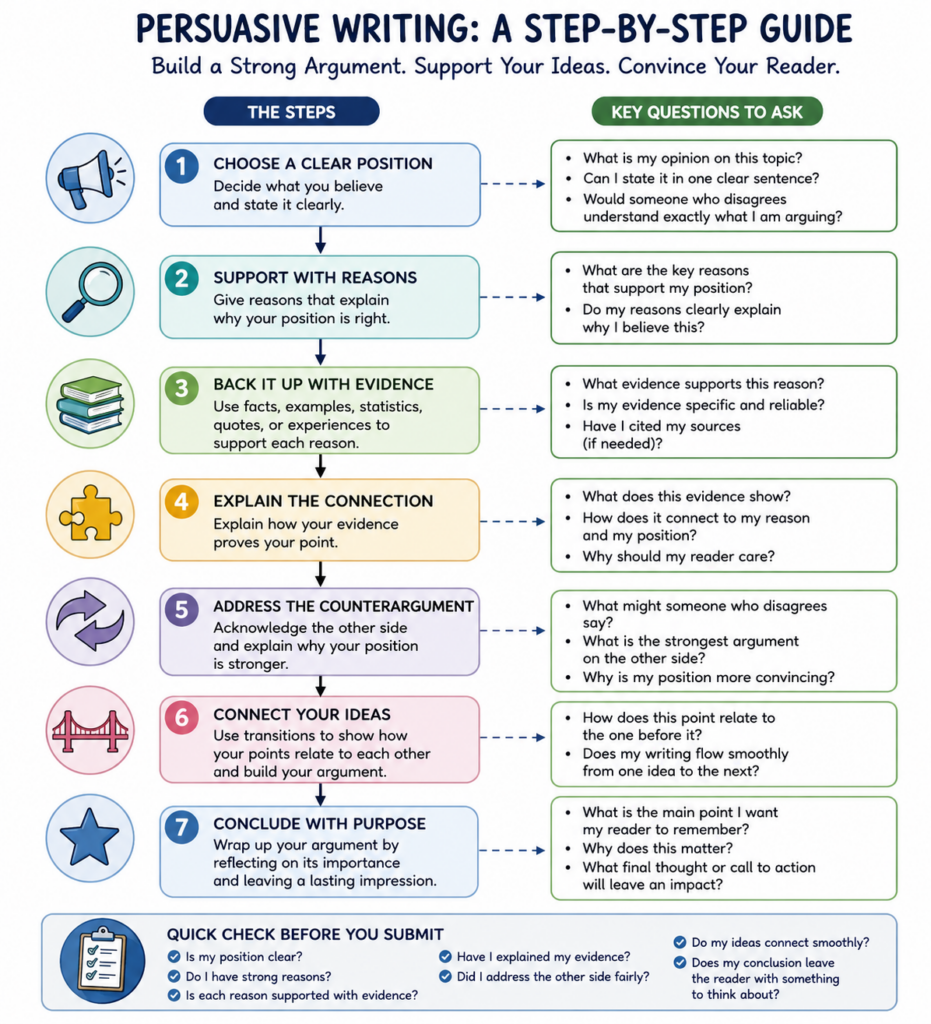
The flowchart below summarizes several of the key questions students can ask themselves when planning, drafting, and revising a persuasive essay.