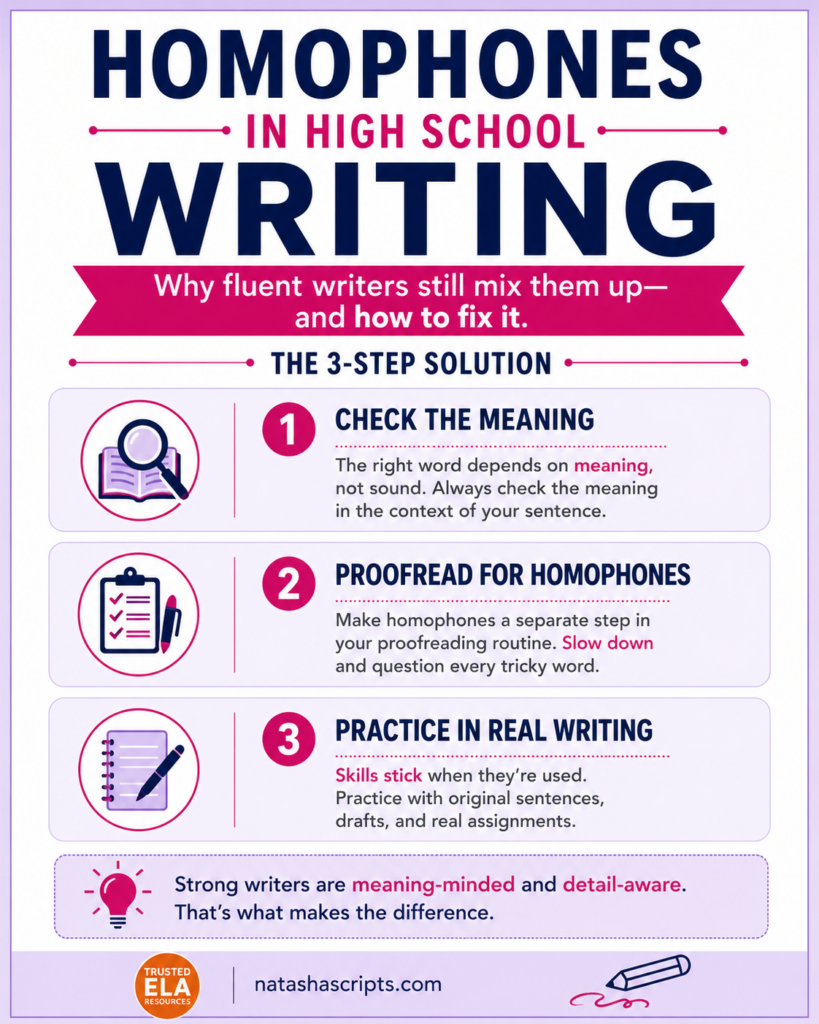
Homophones in High School Writing: Why Fluent Writers Still Mix Them Up and How to Address It
When Fluent Writers Make Spelling Errors That Spell-Check Misses
A student who can write a coherent analytical paragraph, sustain an argument across five pages, and correctly use vocabulary such as juxtaposition and ambivalence may still submit that same paragraph with their instead of there, your instead of you’re, or its instead of it’s. Three homophone errors in a single paragraph is not unusual, and it often catches both teachers and homeschool parents off guard because the student’s overall writing ability suggests the errors should not be there.
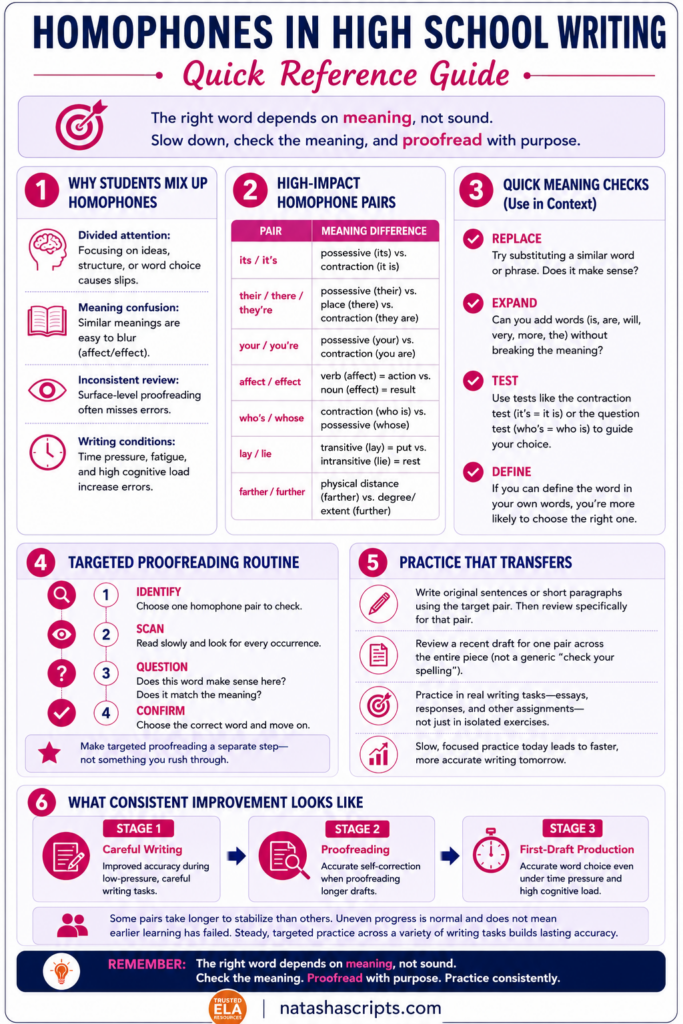
Short on time? Jump directly to the Quick Reference Guide for a visual summary of the key ideas in this article.
What makes this pattern worth examining is that the student almost certainly knows the difference between their and there when asked directly. Present the two words in isolation, and most high school students can explain them without hesitation. The problem is not a lack of knowledge. The problem is what happens to that knowledge during the writing process. When a student’s attention is focused on argument structure, sentence complexity, and idea development, the lower-level task of selecting the correct homophone can slip. The word that appears on the page is often the one the student sees most frequently in reading, or simply the one that comes to mind first. Spell-check offers no warning because both spellings are valid English words.
This pattern persists across grades 9–12 and appears in the writing of students who are otherwise capable and careful. Understanding why it happens is the first step toward addressing it. Once teachers and parents recognize what is causing these mistakes, they can use strategies that help students reduce them over time.
The Cognitive Load Factor in Homophone Errors
Writing a formal essay requires students to manage many things at once. A student drafting a literary analysis may be developing a thesis, selecting evidence, constructing sentences, and making sure the overall argument remains logical and organized. When so much attention is devoted to higher-level writing tasks, choosing the correct homophone often receives less attention than it would during a focused spelling activity. The student is not necessarily being careless. In many cases, they are directing their mental energy toward the parts of the assignment that feel most important in the moment.
This helps explain why homophone errors often appear more frequently in longer, more complex writing assignments than in short, low-stakes responses. When the task is relatively simple and the student’s attention is less divided, the correct word is more likely to appear automatically. As the demands of the writing task increase, however, students are more likely to rely on automatic word choices, and those choices are not always correct.
Recognizing this pattern is important because it helps explain why teaching homophones in isolation does not always lead to improvement in formal writing. Students may perform well on a worksheet or correctly identify homophones during a lesson, yet still make errors in an essay. The conditions are different. To reduce homophone mistakes in authentic writing, students need opportunities to practice identifying and correcting them within the kinds of writing tasks where the errors actually occur.
The Homophones That Cause the Most Damage in Grades 9–12 Writing
Not all homophone errors have the same impact in academic writing. Some occur so rarely in essays that, although they may be noticeable, they do not significantly affect a reader’s impression of the student’s writing. Others appear regularly in analytical, argumentative, and explanatory writing, making mistakes more likely and more visible to teachers, examiners, and college admissions readers.
The following homophone pairs and groups are among the most common sources of error in grades 9–12 writing:
their / there / they’re
All three forms appear frequently in academic writing, especially when students are discussing characters, authors, groups, or ideas. Because the words sound identical, students often choose the wrong form while focusing on the content of their writing.
your / you’re
Although less common in formal essays, this error appears regularly in personal, reflective, and persuasive writing. It is particularly noticeable when it appears in a college application essay or other formal piece of writing.
its / it’s
This is one of the most common homophone errors in high school writing. Many students assume the apostrophe follows the same pattern used in possessive nouns, while others become accustomed to seeing it’s so frequently in informal writing that they begin using it automatically in places where its is required.
affect / effect
Although these words are not perfect homophones in every dialect, many students treat them as though they are. Because the distinction is not always obvious in speech and both words appear regularly in discussions of cause and consequence, confusion is common in analytical writing.
then / than
These words are often confused during fast typing, timed writing, or early drafts. While students may know the difference when asked directly, the incorrect form can easily appear when attention is focused elsewhere.
principal / principle
This pair appears less frequently than some of the others but can create a particularly negative impression when used incorrectly. The word principle often appears in argumentative and persuasive writing when students discuss beliefs, values, or guiding ideas, making accuracy especially important.
Teachers and parents who want to address homophone errors systematically should focus on the pairs students encounter most often in authentic writing. A related article on this site, Homophone Mistakes High Schoolers Keep Making (And How to Fix Them), explores additional examples and teaching strategies that can support this work.
Why Meaning-Based Distinctions Work Better Than Memory Alone
One of the most effective ways to reduce homophone errors is to connect each word to its meaning and grammatical function rather than asking students to rely on memorization alone. When students understand that their is a possessive pronoun, there usually refers to a place or introduces a clause, and they’re is a contraction of they are, choosing the correct form becomes a quick grammatical check instead of a memory exercise.
The contraction test is especially useful for several of the homophone pairs that cause the most problems in high school writing. A student who is unsure whether to write it’s or its can ask whether the word can be expanded to it is or it has. If the expansion works, the apostrophe belongs. If the sentence requires a possessive form, as in the essay has its own logic, no apostrophe is needed. The same strategy works for you’re and your, as well as they’re, their, and there.
The value of this approach is that it gives students a practical proofreading tool they can use during real writing tasks. Instead of trying to remember a rule they learned weeks or months earlier, they can stop briefly and test the word in context. Over time, this turns passive knowledge into an active editing habit.
For affect and effect, meaning-based distinctions are often more helpful than grammatical explanations alone. Although both words can function in more than one way, most high school writing follows a predictable pattern. In the majority of cases, affect functions as a verb meaning to influence, while effect functions as a noun meaning a result or outcome. Teaching students this common pattern, while acknowledging that exceptions exist, gives them a practical guideline that applies to most of the writing situations they are likely to encounter.
Building a Proofreading Habit That Targets Homophones Specifically
One of the most practical ways to reduce homophone errors is to make homophone checking a separate step in the proofreading process. When students try to review content, organization, sentence structure, grammar, and spelling all at once, homophone mistakes are easy to miss. A focused proofreading pass that targets only the homophone pairs a student commonly confuses is often far more effective.
In the classroom, this can become a regular part of the revision routine. After students have reviewed their ideas, evidence, and overall organization, they return to the draft with a short checklist of high-frequency homophone pairs. Rather than scanning for every possible mistake, they focus specifically on words they are known to confuse, such as their/there/they’re, its/it’s, or affect/effect. This targeted approach helps students develop greater awareness of patterns in their own writing.
For homeschool parents and tutors working with one student at a time, the same strategy can be adapted easily. During a brief editing conference, ask the student to read the draft aloud while checking for the words on the checklist. Reading aloud naturally slows the writing process and often makes homophone choices more noticeable than they are during silent review. Students frequently catch mistakes they overlooked when reading quickly through the draft on their own.
Over time, the goal is for students to anticipate these errors before submitting their work. A short, targeted proofreading routine takes only a few minutes, yet it can significantly reduce the homophone mistakes that continue to appear in otherwise strong pieces of writing.
A related article on this site, A Proofreading Routine for Apostrophes and Possessives in High School Writing, explores another common category of errors that often appears alongside homophone mistakes and can be addressed through a similar proofreading process.
One of the most practical ways to reduce homophone errors is to make homophone checking a separate step in the proofreading process.
Practice That Transfers to Real Writing Conditions
Because homophone errors in high school writing are often the result of divided attention rather than a lack of knowledge, practice activities that resemble real writing tasks tend to be more effective than activities that isolate the skill. Asking students to choose between their and there in a worksheet exercise can be a useful introduction, but it does not necessarily prepare them to make the correct choice while drafting an analytical essay or revising a complex piece of writing.
Practice becomes more meaningful when students apply homophone knowledge within authentic writing contexts. For example, students might write original sentences or a short paragraph using a target homophone pair and then review their own work specifically for those words. This more closely reflects the conditions under which homophone errors typically occur.
Another effective approach is to ask students to revisit a recent piece of their own writing and focus on a single homophone pair. Rather than giving a broad instruction such as “check your spelling,” teachers, tutors, and parents can direct students to look specifically for its and it’s throughout an entire draft. This targeted review helps students develop the habit of monitoring common errors during the editing process.
The Spelling High School Workbook for Grades 9–10 includes activities built around this kind of contextual practice. Students apply spelling knowledge within passages, sentences, and writing tasks rather than through isolated exercises alone. For older students, the Spelling High School Workbook for Grades 11–12 extends this approach to more advanced vocabulary and writing situations, including the academic and college-preparatory writing contexts where homophone errors can have the greatest impact.
Practice becomes more meaningful when students apply homophone knowledge within authentic writing contexts.
What Consistent Improvement Actually Looks Like
Improvement in homophone accuracy is usually gradual rather than immediate. Students rarely move from frequent errors to perfect accuracy overnight. More often, progress occurs in stages.
The first stage is increased accuracy during careful, low-pressure writing tasks. The second is the ability to identify and correct homophone errors during the proofreading process. The third stage, which often takes the longest to develop, is consistently choosing the correct form while drafting, even when writing under time pressure.
For teachers, tutors, and homeschool parents, it can be helpful to view these stages as separate milestones. A student who still makes occasional homophone errors in a first draft may nevertheless be making meaningful progress if they are catching and correcting those mistakes independently during revision.
It is also important to recognize that some homophone pairs take longer to master than others. A student who confidently applies the contraction test to they’re and their may continue to struggle with affect and effect for some time. This uneven progress is normal. Different homophone pairs require different kinds of understanding, and writing conditions can influence performance in ways that are not always predictable.
The goal is not instant perfection but steady improvement. Consistent practice, meaningful writing opportunities, and targeted proofreading habits help students develop the accuracy that eventually carries over into everyday writing.
Teachers and homeschool parents looking for free sample lessons and worksheets on spelling and related writing skills can find them at the Free ELA Resources page.
Quick Reference Guide