How to Teach Showing vs. Telling in Middle School Writing
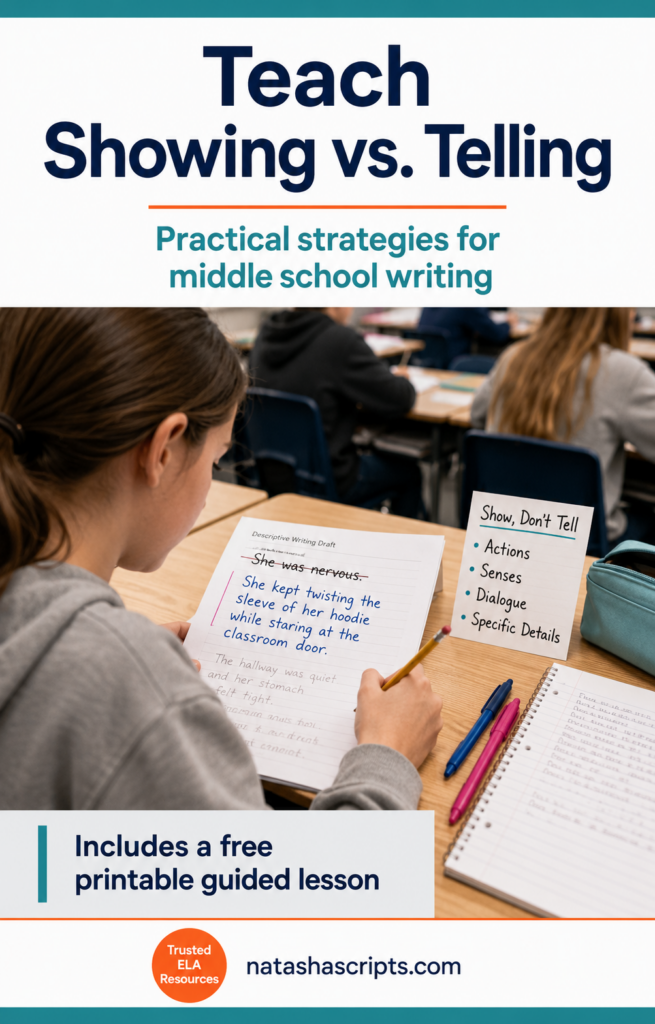
When middle school students receive feedback on their writing, one of the most common comments is “Show, don’t tell.” They hear it during writing lessons, see it on marked assignments, and come across it in writing guides. Yet many students still struggle to know what to do differently.
Note to Parents and Teachers: I’ve included a free Sample Reading and Writing Lesson for 7th and 8th Grade later in this article. The lesson guides students from analysing descriptive writing to applying the same techniques in their own work.
A student who writes, “She was nervous,” and is told to show the nervousness instead may understand that something needs to change, but not how to make that change. Without practical strategies, revision often becomes a process of guessing rather than improving.
This is why showing vs. telling deserves more than a brief reminder during revision. It is not simply a matter of trying harder or being more creative. It is a collection of specific writing techniques that students can learn, practise, and apply with confidence.
What the Advice Is Actually Asking Students to Do
At its core, showing and telling are simply two different ways of communicating information to the reader.
Telling states the conclusion directly. The character is frightened. The room is messy. The afternoon was boring.
Showing, on the other hand, gives the reader clues that lead to the same conclusion. The character’s hands tremble as she reaches for the door handle. The desk is buried under three weeks of unopened mail. The afternoon drags on with nothing but the sound of a ticking clock. Instead of being told what to think, the reader works it out from the details.
For middle school students, this requires a different way of thinking about writing. Most students are comfortable explaining what happened or how a character felt because that reflects the way people naturally talk about events. Showing asks them to slow down, picture the scene clearly, and choose details that allow the reader to reach those same conclusions independently.
This is why showing is much more than simply adding descriptive words. Students need to learn which details matter and how to use actions, dialogue, thoughts, and sensory details to bring a scene to life.
Why Students Often Struggle with “Show, Don’t Tell”
Many students understand that they are supposed to “show more,” yet still find it difficult to put that advice into practice. A student who originally wrote, “The hallway was scary,” might revise the sentence to “The dark, cold, creepy hallway was scary,” adding adjectives without changing the underlying sentence. The reader is still being told the conclusion rather than discovering it through the details.
This kind of revision is perfectly understandable. Students are working with the writing strategies they already know, and adding descriptive words feels like a logical way to respond. The difficulty is that showing depends on choosing details that allow the reader to infer what is happening, not simply on adding more description.
Students become much more confident when they have opportunities to practise this skill in isolation before applying it to a longer piece of writing. Working with individual sentences, comparing examples of showing and telling, and discussing why one version is more effective helps students recognise the difference much more quickly than relying on revision alone.
A related article on this site explores a similar pattern in persuasive writing, where common mistakes persist because the underlying reasoning process has not been made explicit. The same principle applies here. Simply identifying the problem is rarely enough on its own. Students also need opportunities to learn and practise the technique behind the advice.
The Role of Sensory Detail in Descriptive Writing
Sensory details, what a character sees, hears, smells, feels, or tastes, are one of the easiest ways to introduce showing in middle school. They give students something concrete to focus on and make revision feel much more manageable. Instead of asking, “How do I show this?” students can ask, “What would someone see, hear, smell, or feel in this moment?”
At the same time, sensory details are most effective when they have a purpose. A sentence such as, “The kitchen smelled like cinnamon, and the floor was cold under her feet,” includes sensory information, but it does not necessarily create a particular mood or reveal anything about the character. The details students choose are just as important as the number of details they include.
For example, a character who notices the smell of burnt coffee instead of fresh bread, or keeps focusing on the constant hum of a fluorescent light instead of the conversation happening nearby, reveals something through those observations. The chosen details help shape the reader’s understanding of the scene.
This is a more advanced aspect of showing, so it is best introduced gradually. Students who are still learning the difference between showing and telling should first become comfortable using simple sensory observations. Once that habit is established, they can begin thinking more carefully about which details will create the strongest effect.
What Deliberate Practice at the Sentence Level Looks Like
One effective way to teach showing is to give students a telling sentence and ask them to rewrite it as a short showing passage of two to four sentences using only observable details. A prompt such as, “She was embarrassed,” gives students a clear starting point. They then practise showing that emotion through actions, physical reactions, dialogue, or details from the surrounding scene rather than simply naming the feeling.
Exercises like these help students develop the habit of asking, “What would someone see if they were watching this happen?” instead of simply stating what the character is thinking or feeling.
Comparison activities are equally valuable. Presenting students with two versions of the same scene, one told and one shown, encourages them to discuss what has changed and why one version creates a stronger impression. This helps students recognise effective techniques before they are expected to use them in their own writing.
These activities work equally well in the classroom and at home. A short ten-to-fifteen-minute practice session focused on a single sentence or short paragraph is often more effective than expecting students to develop the skill while writing a complete composition. Once students become comfortable with showing at the sentence level, they are much more likely to use it naturally in longer pieces of writing.
The Spelling, Writing and Reading curriculum for 7th and 8th grade integrates writing instruction of this kind alongside vocabulary and reading work, which can be useful for educators who want descriptive writing practice to develop in connection with other language skills rather than in isolation.
Note to Parents and Teachers: To help students practise showing instead of telling, I’ve included a free Sample Reading and Writing Lesson for 7th and 8th Grade from the Spelling, Writing and Reading for 7th and 8th Grade curriculum. Students first analyse how descriptive details are used in a guided reading passage before applying the same techniques in a structured writing activity with four writing options.
Behavioral Detail as a Companion to Sensory Detail
Sensory details help readers picture a scene by describing what can be seen, heard, smelled, felt, or tasted. Behavioral details focus on what a character does. Small actions and habits often reveal thoughts and emotions without the writer having to name them directly. Teaching these two techniques together gives students a much stronger toolkit for showing instead of telling.
For example, a student writing about a character who is nervous while waiting outside the principal’s office might describe the faint ticking of the wall clock and the squeak of shoes in the hallway. The character might keep pulling at the sleeve of a sweatshirt or repeatedly checking the classroom door. None of these details says that the character is nervous, yet together they help the reader reach that conclusion naturally. Students who learn to combine sensory and behavioral details are much less likely to rely on adding extra adjectives when asked to “show more.”
It is equally important for students to understand that showing is not always the best choice. Good writers move naturally between showing and telling depending on the pace and purpose of the writing. Showing slows the reader down and draws attention to an important moment, while telling moves the narrative forward more quickly. Helping students recognise when each approach is most effective is an important part of developing stronger writers. Reading a variety of well-written texts and discussing the choices authors make can gradually build this judgement over time.
Strong writers know when to show and when to tell. Showing draws attention to important moments, while telling helps move the writing forward. Both techniques have an important place in effective writing.
Connecting Writing Instruction to Reading
One of the best ways to help students understand showing instead of telling is to draw their attention to the descriptive choices authors make in the texts they are already reading. When a passage from a novel or short story creates a strong image or emotional response, it is worth pausing to ask how the writer achieved that effect. Which details were included? What was left unsaid? How do actions, dialogue, and sensory details work together to help the reader understand the scene?
Looking at writing in this way helps students recognise that the techniques they are practising are the same ones used by published authors. It also strengthens reading comprehension because students are learning to notice clues and draw conclusions instead of relying only on direct statements. Readers interested in developing these skills further may also find Why Middle Schoolers Struggle to Make Inferences While Reading (And How to Help) useful, as it explores the close relationship between inference and careful reading.
Over time, students who receive regular, technique-focused instruction become much more confident at recognising the difference between writing that simply tells the reader something and writing that allows the reader to experience it. Once students understand how to use word choice, sentence structure, sensory details, and behavioural details deliberately, the advice “show, don’t tell” becomes practical rather than confusing. It becomes a technique they can apply with confidence whenever they revise their writing.
Teachers and homeschool parents looking for free sample lessons and worksheets on descriptive writing and related ELA skills can find them on the Free ELA Resources page.
Sample Reading and Writing Lesson for 7th and 8th Grade
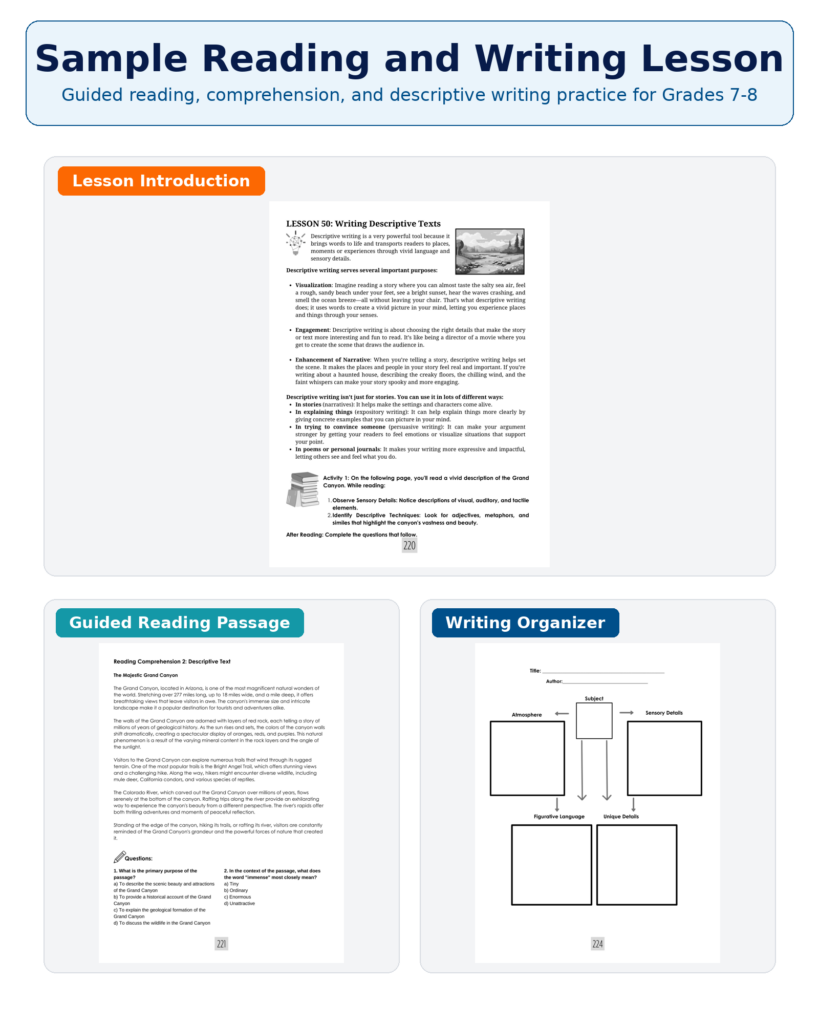
Download the free Sample Reading and Writing Lesson for 7th and 8th Grade and use it to help students move from analysing descriptive writing to applying the same techniques in their own work.
Download the Free Lesson