Author’s Purpose and Tone in High School: A Four-Step Close-Reading Routine
When high school students are asked to identify an author’s purpose, many immediately choose one of three familiar labels: to inform, to persuade, or to entertain. While these answers are often correct, they only scratch the surface of the text.
A student who writes, “The author’s purpose is to persuade,” has made a reasonable observation, but they have not yet explored how the author persuades the reader. They have not considered why particular words were chosen, how the ideas are organised, or what the tone reveals about the author’s attitude and intentions.
Helping students move beyond simple labels and towards this deeper level of analysis is one of the most valuable goals of close reading in high school English. When students begin asking how a text creates its effect, they develop stronger analytical thinking and produce more thoughtful responses in both discussion and writing.
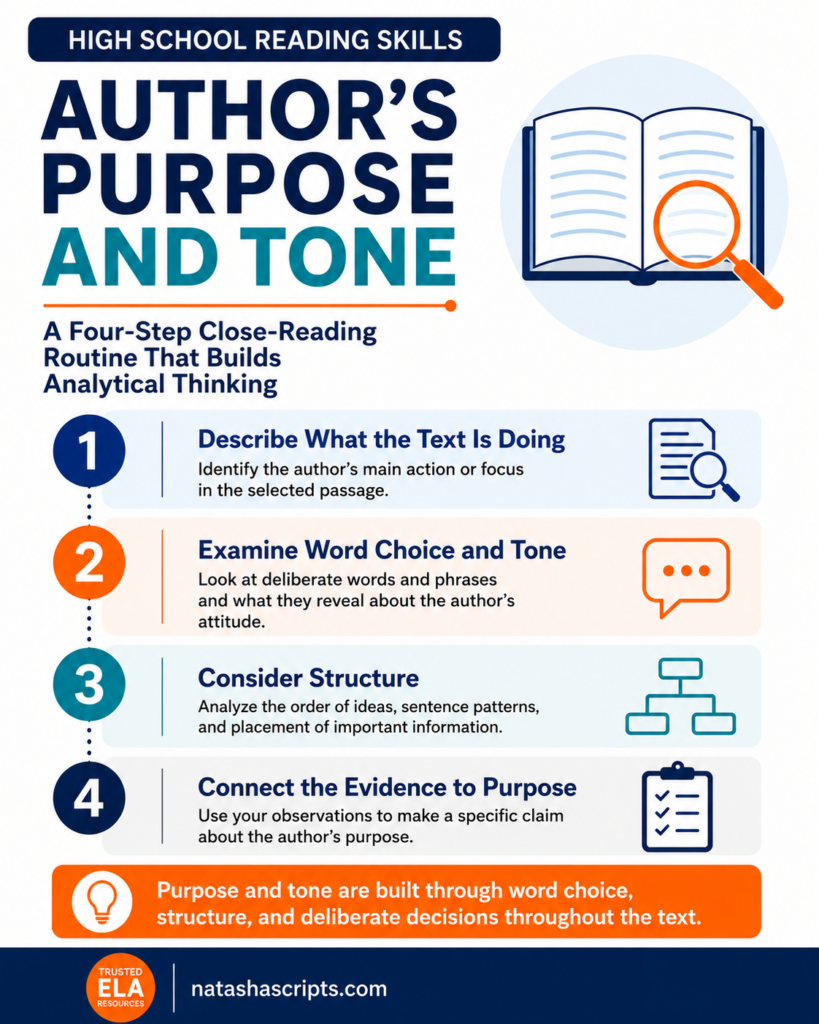
Prefer a quick overview? Jump directly to the Author’s Purpose and Tone Four-Step Summary .
Why Surface Labels Are a Starting Point
The familiar inform, persuade, entertain framework is a useful place to begin. It helps younger students recognise that authors write for different reasons and encourages them to think about a text’s overall purpose.
By high school, however, students need to move beyond these broad labels. Identifying a text as persuasive is only the first step. The more important question is how the author persuades the reader. Two opinion pieces on the same issue, for example, may both aim to persuade, yet one might use a calm, balanced tone while the other relies on urgency and emotional appeal. Those differences reveal important clues about the author’s attitude, intended audience, and purpose.
This is where close reading becomes especially valuable. Instead of simply identifying a text’s overall purpose, students slow down and examine how individual words, sentences, and paragraphs contribute to that purpose. They begin to see that an author’s purpose and tone are built gradually through word choice, organisation, and rhetorical techniques rather than stated outright.
Teaching students a repeatable close-reading routine makes this process much more manageable. Over time, they begin asking not only what the author’s purpose is, but also how the text creates that effect.
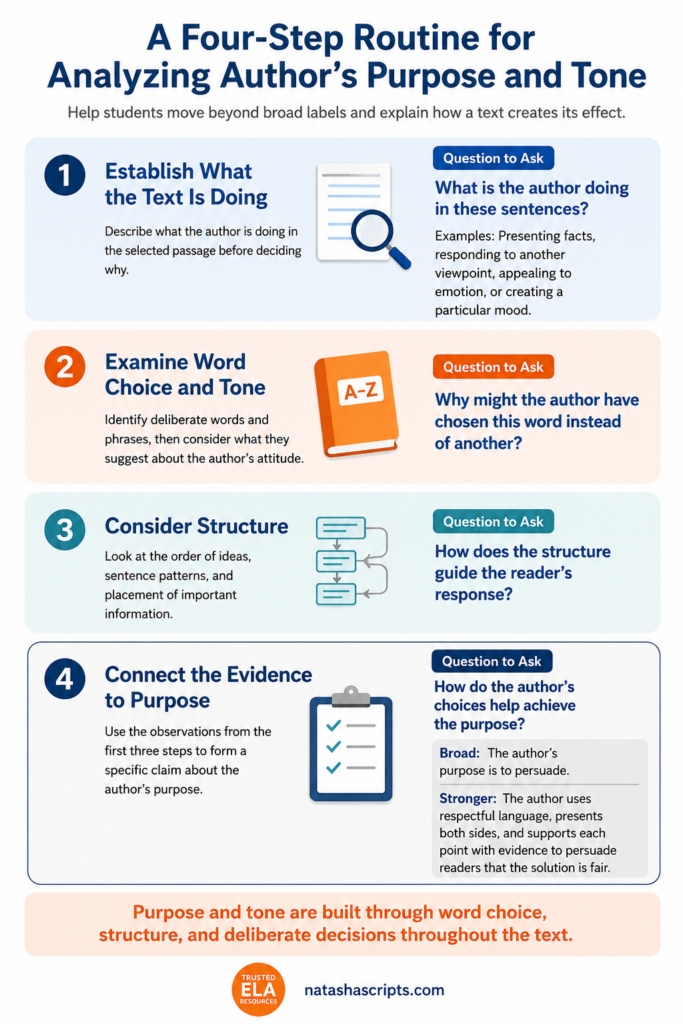
Step One: Establish What the Text Is Doing Before Asking Why
A productive close-reading routine begins with a simple shift in questioning. Instead of asking, “Why did the author write this?”, ask, “What is the author doing in this passage?”
That change matters because it encourages students to observe before they interpret. Asking why often leads students to reach immediately for broad labels such as to inform or to persuade. Asking what encourages them to look closely at the author’s choices and gather evidence before deciding on the overall purpose.
Choose a short passage of three to five sentences and ask students to describe, as precisely as possible, what the author is doing. Is the author presenting facts? Responding to an opposing viewpoint? Appealing to the reader’s emotions? Building credibility? Describing a scene to create a particular mood?
Students who can answer these questions with specific evidence are already reading analytically, even before discussing the author’s overall purpose. Once they have identified what the passage is doing, they are in a much stronger position to explain why the author chose that approach. Beginning with careful observation almost always leads to richer discussion than asking students to choose a purpose label first and then search for supporting evidence.
Step Two: Examine Word Choice as a Window Into Tone
Once students have described what a passage is doing, the next step is to look closely at the author’s word choices and consider what those choices reveal about tone. Students often describe tone using broad labels such as serious, ironic, optimistic, or critical, but it is important for them to recognise that tone is created through the author’s deliberate choices of words and sentence structure, not simply felt as a general impression.
A useful exercise is to ask students to identify two or three words or phrases in the passage that seem especially deliberate, then consider what alternative words the author might have chosen instead. A journalist who describes a government policy as quietly implemented rather than introduced or enacted has made a choice that suggests something about transparency. A memoirist who describes a childhood memory as persistent rather than vivid or clear has chosen a word that highlights its emotional impact rather than simply how well it is remembered.
When students begin noticing these distinctions, they develop the vocabulary awareness needed for stronger reading and writing. Resources that build precise academic vocabulary alongside reading instruction, such as Advanced Vocabulary in High School, can complement this kind of close-reading work by giving students a wider range of language for describing what they notice in a text.
This step works equally well in a classroom discussion or in a one-to-one setting. In the classroom, students can compare the words they selected and discuss why different readers noticed different details. At home, parents can model the process first before encouraging students to identify and explain deliberate word choices independently.
Step Three: Consider How Structure Shapes the Reader’s Experience
Word choice is one way authors shape meaning, but structure is equally important. The order in which ideas are presented, the length and rhythm of sentences, and the placement of key claims all influence how readers respond to a text. These structural choices also contribute to the author’s purpose and tone.
Students in grades 9 and 10 are often surprised to discover how closely structure and purpose are connected. An author who opens an essay by acknowledging an opposing viewpoint before presenting their own argument is making a deliberate structural choice. It signals a willingness to engage with different perspectives and often creates a more measured, balanced tone. By contrast, an author who withholds an important point until the final paragraph creates anticipation and gives the conclusion greater impact.
When students begin identifying these structural patterns and explaining how they support the author’s purpose, they move beyond simple observation and towards deeper interpretation.
Readers interested in strengthening these broader analytical reading skills may also find Reading Textbooks Effectively in High School useful. That article explores practical strategies for actively reading nonfiction texts and complements the close-reading routine described here.
Step Four: Connect the Evidence to a Claim About Purpose
After students have described what the text is doing, examined deliberate word choices, and considered the author’s structural decisions, they are ready to make a well-supported claim about the author’s purpose. At this stage, the claim should grow naturally from the evidence they have gathered rather than from a broad label.
Instead of writing, “The author’s purpose is to persuade,” a student who has followed this routine might write: “The author uses respectful language, gives both sides of the argument, and supports each point with evidence to persuade readers that this solution is the fairest one.”
This kind of response is not simply more detailed. It is more accurate because it explains how the author achieves a particular purpose instead of simply naming it. Encouraging students to support their conclusions with textual evidence, just as they would when analysing theme or character, strengthens both reading comprehension and analytical writing.
It is also worth helping students make the connection between reading and writing. The more they understand how authors use language, structure, and tone to shape a reader’s response, the more deliberately they can make those same choices in their own writing.
Applying the Routine Across Text Types
One of the strengths of this close-reading routine is that it can be applied to a wide range of texts without needing a different approach for each one. The same four steps, describe what the text is doing, examine word choice, consider structure, and form a specific claim, can be used with newspaper editorials, speeches, nonfiction texts, personal essays, and short stories. The observations students make will vary from one genre to another, but the thinking process remains the same.
When reading nonfiction, students are more likely to focus on rhetorical strategies. They might examine how the author presents evidence, responds to opposing viewpoints, or appeals to the reader’s values and assumptions. Literary texts often shift the focus towards narrative voice, imagery, symbolism, and the relationship between what is stated directly and what is implied. Using the same routine across different genres helps students develop flexible analytical skills rather than relying on a separate checklist for each type of text.
The word-choice step also connects naturally with vocabulary development. Students with a broader academic vocabulary are better able to describe tone accurately, recognising the difference between language that is dismissive and skeptical, or between a tone that is earnest and one that is didactic. This is one reason vocabulary instruction and close reading work so well together. The more precise students’ vocabulary becomes, the more precisely they can explain what they notice in a text.
Building the Routine Into Regular Practice
A close-reading routine is most effective when students practise it regularly with short passages rather than using it only occasionally with full-length texts. In the classroom, a ten-to-fifteen-minute discussion based on a paragraph or two from a text students are already reading can gradually build the habit without needing a separate unit of work. At home, the same routine can be used with an editorial, a chapter from a nonfiction book, or even a well-written magazine article, giving students regular opportunities to analyse different writing styles and voices.
With regular practice, students begin asking these questions naturally as they read. Looking closely at word choice, tone, and structure becomes part of the reading process rather than an additional task they complete afterwards. That is when the routine becomes most valuable, because students start applying the same analytical thinking across different subjects, not just in English.
A student who notices how a history textbook presents an event from a particular point of view, or how a science article carefully builds evidence towards a conclusion, is using exactly the same close-reading skills. The context has changed, but the thinking process remains the same.
Readers interested in how inference and comprehension skills develop alongside these analytical habits may also find Why Middle Schoolers Struggle to Make Inferences While Reading helpful. Although that article focuses on younger learners, it explains the foundational reading skills that high school students continue to build on as they develop more advanced analytical thinking.
Developing a reliable, repeatable approach to analysing author’s purpose and tone gives students far more than a set of labels to memorise. It gives them a practical process for reading closely, supporting their ideas with evidence, and thinking more carefully about how texts achieve their purpose. Those are skills that continue to serve students well beyond a single English assignment.
Teachers and homeschool parents looking for ready-to-use lessons and worksheets on high school reading and ELA skills can find free samples on the Free ELA Resources page.
Author’s Purpose and Tone Four-Step Summary