A Pass-by-Pass Revision Process for High School Essays
When high school students are asked to revise an essay, many of them re-read it once, change a few words, and consider the job done. This pattern appears in classrooms and home-based writing alike, and it often persists for a simple reason: students have never been taught exactly what to do when they revise.
A free printable Essay Revision Worksheet is included later in the article to help students work through all four revision passes alongside their own draft.
Without a clear process to follow, revision becomes a vague second look at the same piece of writing. Students may correct a spelling error, replace a repeated word, or adjust a sentence that sounds awkward, while larger problems with the argument, organization, or paragraph structure remain untouched.
The difficulty is that effective revision involves several different kinds of thinking. Students need to ask whether the argument makes sense, whether the paragraphs follow a logical order, whether the evidence supports the main points, and whether individual sentences are clear and grammatically sound. Trying to check all of these things at once makes it easy to overlook important problems.
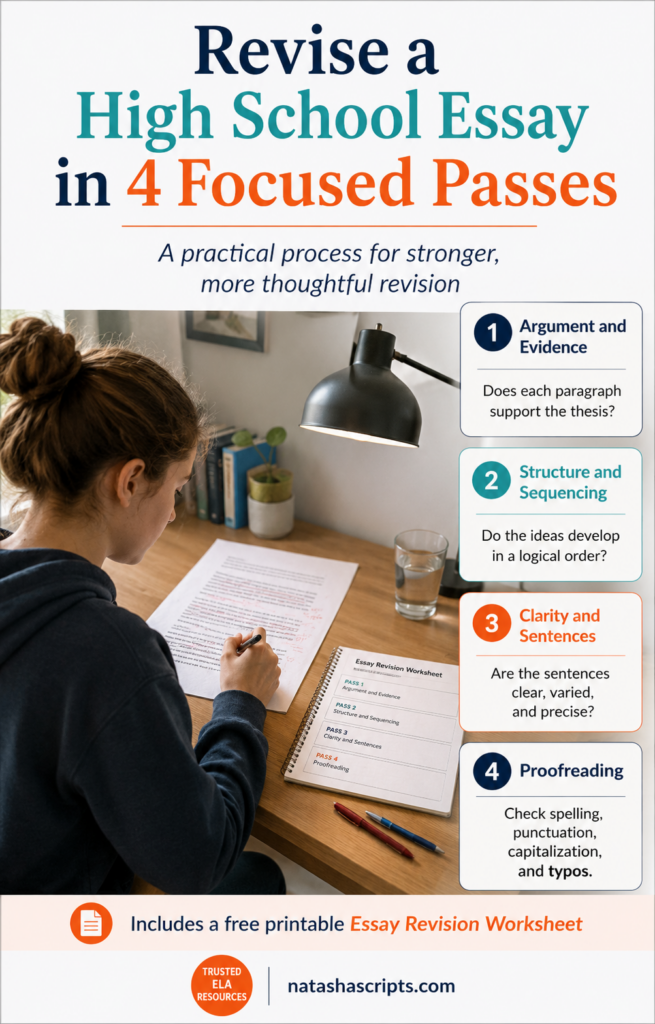
A pass-by-pass revision process gives students a more manageable approach. Instead of trying to fix everything during a single re-read, they make several focused passes through the essay, with each one devoted to a specific aspect of the writing. This allows them to give each layer of the essay the attention it needs and makes revision a concrete process they can learn to carry out independently.
Why Revising High School Writing Requires a Layered Approach
One reason revision so often turns into light proofreading is that students may not yet know what to look for beyond surface-level errors. A student who has not learned to distinguish between an argument that is simply present and one that is well supported will not know to check for that difference during revision. Similarly, a student who has not been encouraged to think carefully about paragraph order may not notice that two body paragraphs would work better if their positions were reversed.
Teaching revision as a layered process makes each of these concerns visible and gives students a clear focus for each stage. When a student knows that the first pass is devoted only to the argument, while sentence-level changes come later, the task becomes much more manageable and the revisions are likely to be more meaningful.
This approach works equally well in the classroom or at home with a parent or tutor. The passes can be completed in one extended session or spread across several shorter ones, depending on the length of the essay and the time available.
Pass One: Argument and Evidence
The first pass focuses entirely on whether the essay does what it sets out to do. At this stage, the student reads with two questions in mind: Does each paragraph support the thesis? Is that support developed well enough?
High school students sometimes write paragraphs that point toward an idea without fully developing it. They may also include a quotation, example, or piece of evidence without explaining how it supports the central argument. This first pass is the time to identify and address those gaps.
One useful strategy is to ask the student to write a single sentence beside each body paragraph explaining what that paragraph is arguing. If they cannot do this easily, or if the sentence does not connect clearly to the thesis, the paragraph may need a clearer focus or further development.
This is also the time to check the thesis itself. Is it specific enough to be argued and supported throughout the essay? A vague or overly broad thesis often leads to body paragraphs that lack direction. The related article How to Write a Thesis Statement in High School: A Repeatable Process That Actually Works explores a step-by-step approach to developing a clear, arguable thesis.
At this stage, students should resist the urge to start fixing individual sentences. The purpose of the first pass is to evaluate the strength of the argument and the evidence supporting it. A beautifully polished paragraph that does not contribute anything useful to the essay is still a problem, and it is far better to identify that problem before spending time refining the prose.
One useful strategy is to ask the student to write a single sentence beside each body paragraph explaining what that paragraph is arguing.
Pass Two: Structure and Sequencing
Once the argument has been evaluated and any gaps have been addressed, the second pass focuses on how the essay is organized. Students examine the order of the body paragraphs, the connections between them, and whether the introduction and conclusion work effectively with the essay as a whole.
Structural problems are often easier to spot when students step back from the individual sentences and look at the essay as a sequence of ideas. One useful strategy is to ask the student to create a brief outline of the essay as it currently stands, rather than as they intended it to be. They can then read through this outline as a sequence of claims or compare it with their original plan. This often makes it much easier to notice paragraphs that are out of order, ideas that do not follow logically, or sections that do not contribute enough to the overall argument.
Common structural problems in high school essays include body paragraphs arranged in an order that does not allow the argument to develop logically, introductions that do not clearly prepare the reader for the essay’s main claims, and conclusions that simply repeat the thesis without adding any final insight.
Transitions between paragraphs should also be examined during this pass. A weak or missing transition can sometimes reveal that the connection between two ideas has not been fully developed. It makes sense to address these larger structural issues before moving on to sentence-level revision. Otherwise, a student may spend time polishing a transition sentence only to delete it later because the order of the paragraphs has changed.
Pass Three: Clarity and Sentence Construction
The third pass focuses on individual sentences: their clarity, variety, and precision. This is often the kind of revision students naturally turn to first when they do not have a structured process to follow. By completing the earlier passes first, however, students can work on individual sentences knowing that the argument and overall structure of the essay are already in place.
During this pass, students should look for sentences that are unnecessarily long or difficult to follow, repeated sentence structures that make the writing sound monotonous, and vague or imprecise word choices that weaken the argument. High school students often rely on a limited range of sentence patterns or use general and abstract language where something more specific would be clearer.
One particularly useful strategy is to ask students to read selected paragraphs aloud. Sentences that are awkward to read, difficult to follow, or require several attempts often deserve a closer look. Reading aloud can also help students notice repetition, missing words, and sentence patterns that may be less obvious when reading silently.
This pass also provides a natural opportunity to look more closely at grammar. Sentence boundaries, punctuation, and usage become much more meaningful when students apply them to their own writing. For students who need additional support in these areas, Quick Daily Grammar for High School provides short, focused practice with grammar concepts that regularly appear in high school writing, helping students develop the grammatical awareness they need to make more informed decisions during revision.
Pass Four: Proofreading
Proofreading is a separate activity from revision, and treating it as a distinct final pass usually produces better results. By this stage, the student has already worked on the argument, structure, and individual sentences. The focus now shifts to surface-level accuracy: spelling, punctuation, capitalization, and typographical errors.
Because these errors are often small and easy to overlook, students benefit from proofreading slowly and deliberately. One useful strategy is to read the essay from the last sentence to the first. This breaks the natural tendency to become absorbed in the meaning of the essay and makes it easier to focus on each sentence individually.
Punctuation deserves particular attention during this pass, especially commas, semicolons, colons, and apostrophes. Students who deliberately check the punctuation marks they are most likely to misuse will often catch more errors than those who simply re-read the essay and rely on intuition. The related article A Proofreading Routine for Apostrophes and Possessives in High School Writing provides a more focused approach to one common source of errors in high school writing.
Implementing the Process in a Classroom or Home Setting
For teachers working with a full class, introducing the four-pass process with a simple checklist can help students see revision as a genuine stage of writing rather than something they complete quickly before submitting an essay. At first, it may be helpful to allocate separate class periods or blocks of time to individual passes so that students learn to give each one a distinct focus.
At home, the same framework can be adapted easily for one-to-one support. A parent might complete the first pass with the student, discussing the argument aloud before the student works through the remaining passes independently. This can be especially helpful for students who find it difficult to evaluate their own reasoning, since a conversation may reveal gaps or assumptions that are harder to notice during a solitary re-read.
The four-pass process works best with a reasonably complete first draft. Although students can certainly reconsider their argument or organization while a draft is still developing, these particular passes are designed for a piece of writing that has already been written through once. Students who struggle to reach that stage may need more support with planning before they begin drafting. The related article How to Plan a Long Writing Project in High School Without Falling Behind explores this earlier stage of the writing process in more detail.
Note to Parents and Teachers: To make the four-pass process easier to use, I’ve created a free Essay Revision Worksheet for high school students. It guides students through each of the four passes, with space to evaluate their argument, review the structure of the essay, revise individual sentences, and complete a final proofreading check. Students can print the worksheet and complete it alongside their draft.
Building Revision as a Habit Over Time
Students will not internalize this process after a single essay. The first few times they use it, many will still try to address everything at once or turn the argument pass into an opportunity to fix commas. With repeated practice and consistent reminders that each pass has its own specific focus, however, students gradually become more deliberate about how they revise.
The aim is not for students to follow a rigid checklist indefinitely. Over time, they should begin to understand that effective revision involves different kinds of thinking and that focusing on one aspect of the essay at a time leads to more thorough and thoughtful changes.
Students who develop this habit in grades 9 and 10 can carry it forward into the more demanding writing tasks of grades 11 and 12, where essays become longer and arguments more complex. Strong grammar skills also support the sentence-level and proofreading passes throughout this period. High School Grammar Grades 9–10, for example, provides structured, progressive practice that helps students build the grammatical understanding they need to make informed decisions about their own writing.
Ultimately, the four-pass process gives students a clear answer to a question that often makes revision difficult: What exactly am I supposed to look for? Instead of re-reading an essay vaguely and hoping to notice problems, students have a concrete process for examining the argument, organization, sentences, and surface-level accuracy one at a time. With practice, this approach can help revision become more purposeful and independent, while also giving students a clearer understanding of what a well-constructed essay actually requires.
Teachers and homeschooling parents looking for ready-to-use lessons and worksheets on writing and grammar topics for high school can find free samples at the Free ELA Resources page.
Free Essay Revision Worksheet
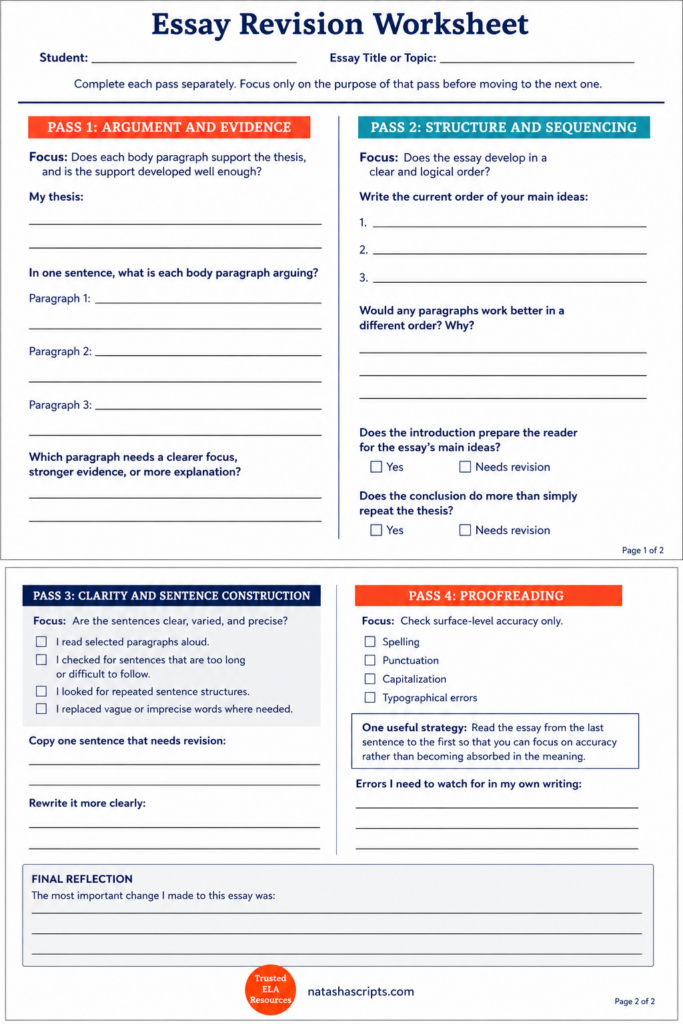
Download the free Essay Revision Worksheet and use it alongside any high school essay draft.
Download the Worksheet