How to Remember Difficult High School Spelling Words with Mnemonics
When Practice Accuracy Doesn’t Transfer to Writing
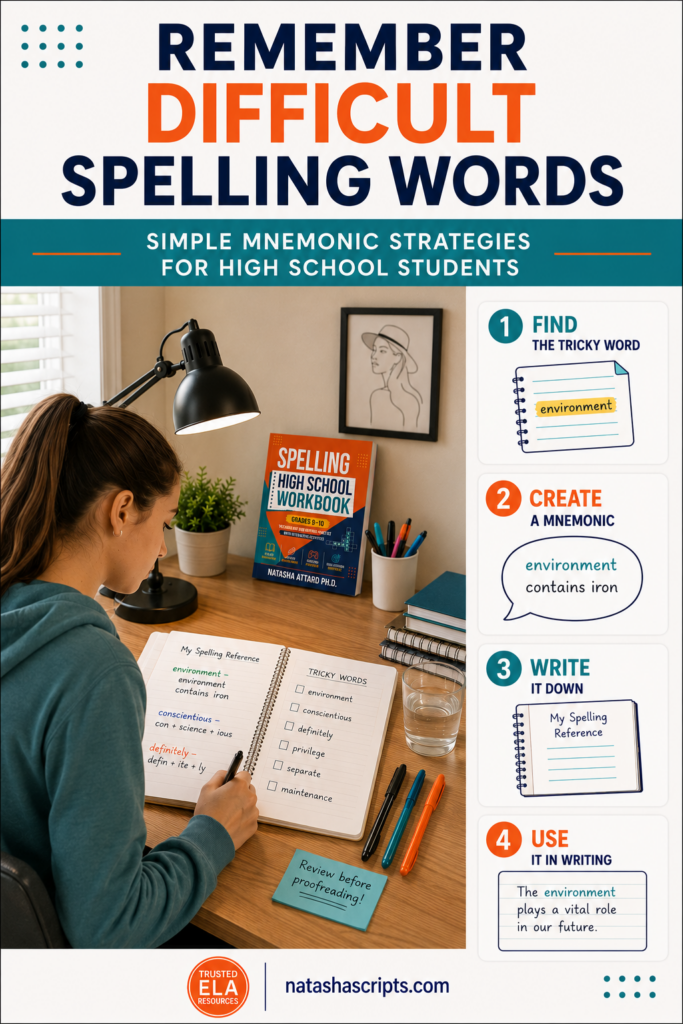
High school teachers and parents sometimes notice a frustrating pattern. A student spells a word correctly several times during spelling practice, only to misspell the very same word a few days later in an essay or written assignment. It is easy to assume they simply weren’t paying attention, but that is not always the case.
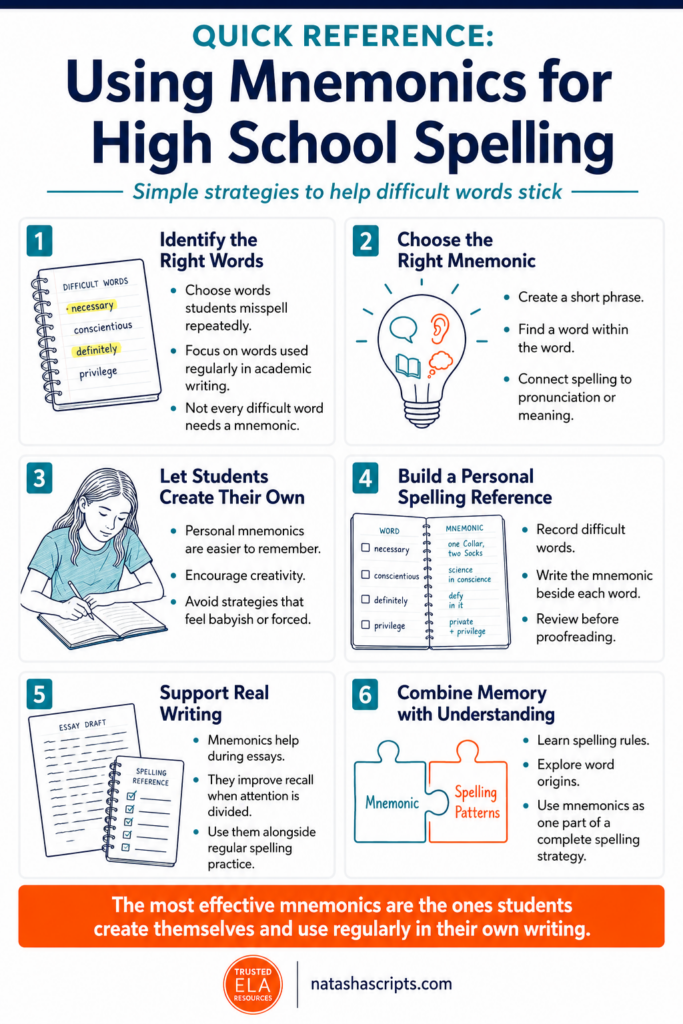
Prefer a quick overview? Jump directly to the Quick Reference Guide .
Often, the student remembers the word well enough during focused spelling practice but has not yet stored it securely enough to recall it while also thinking about ideas, sentence structure, punctuation, and word choice. As a result, a word that seemed fully learned during practice suddenly disappears when it is needed most.
This is where mnemonics can be especially helpful. A mnemonic gives students something memorable to connect to a difficult word, making it easier to retrieve the correct spelling during everyday writing rather than only during spelling exercises. For many high school students, that simple mental connection is what turns a word that is easily forgotten into one they can recall with much greater confidence.
A mnemonic gives students something memorable to connect to a difficult word, making it easier to retrieve the correct spelling during everyday writing rather than only during spelling exercises.
What a Mnemonic Actually Does for a Speller
A mnemonic gives students an extra way to remember a difficult spelling. Instead of relying only on memorizing a sequence of letters, it connects the word to something more memorable, such as a phrase, a picture, a rhyme, or another meaningful association. When a student struggles to recall the correct spelling during writing, that mental connection often helps them retrieve the word more confidently.
Mnemonics are especially useful for words that contain features students regularly find confusing, such as silent letters, unexpected vowel combinations, or letter patterns that look similar to those in other words. Rather than trying to remember the spelling as an isolated sequence of letters, students learn to associate it with something that is easier to recall.
It is important to remember, however, that mnemonics work best alongside a solid understanding of spelling patterns. Students who also understand a word’s origin, syllable structure, or spelling rule develop a much deeper and more reliable understanding of its spelling. If you’d like to explore this approach further, the related article Using Word Origins to Spell Difficult High School Words explains how etymology can strengthen spelling instruction. Mnemonics are most effective when they form one part of a broader spelling strategy rather than serving as the only method students use.
Four Mnemonic Strategies Worth Teaching Explicitly
Not every difficult spelling word is remembered in the same way. Some words are easier to remember through a short phrase, while others become much clearer when students notice a familiar word hidden inside them or connect the spelling to the word’s meaning. Introducing students to a range of mnemonic strategies gives them several ways to approach difficult words rather than relying on a single technique.
1. Sentence mnemonics for tricky letter sequences
A sentence mnemonic uses a short phrase to help students remember a difficult part of a word.
Take the word necessary, for example. Many students remember that it contains one c and two s letters by using the phrase:
One Collar, Two Socks
The phrase does not need to make perfect sense or sound especially clever. It simply needs to be memorable enough to remind the student of the correct spelling pattern. In fact, students often remember mnemonics they invent themselves better than ones they are given.
2. Find a Word Within the Word
Some difficult words contain a smaller, familiar word that students can use as a visual reminder.
For example:
- sepARate contains par
- envIRONment contains iron
- arGUMent contains gum
These smaller words may have nothing to do with the meaning of the larger word, but they give students something concrete to look for whenever they spell the word. It is a simple strategy that works well both at home and in the classroom.
3. Use the Spelling to Guide the Pronunciation
Some words become much easier to spell when students deliberately pronounce them the way they are written rather than the way they are usually spoken.
For example:
- Wed-nes-day
- Feb-ru-ar-y
- gov-ern-ment
This exaggerated pronunciation draws attention to letters that are often overlooked in everyday speech. It is particularly helpful for students who tend to spell words exactly as they hear them.
4. Connect the Spelling to the Meaning
Whenever possible, connect a spelling feature to the meaning of the word.
A well-known example is:
The principal is your pal.
Because a school principal is a person, remembering pal helps students distinguish it from principle.
Meaning-based mnemonics are not available for every difficult word, but when they are, they are often among the most memorable because they connect spelling with understanding rather than simple memorization.
How to Introduce Mnemonics Without Turning Them Into a Gimmick
The way mnemonics are introduced can make a significant difference to how older students respond to them. Teenagers are often quick to dismiss strategies that feel babyish, forced, or patronizing. Giving students the freedom to create their own mnemonics and adapt them to suit the way they think makes them much more likely to use them.
It helps to explain that mnemonics are simply memory aids. Students, teachers, editors, and professionals in many fields use memory techniques to remember information that is difficult to retrieve quickly. Framing mnemonics in this way makes them feel like practical strategies rather than activities designed for younger learners.
It is also worth being selective about when to use them. Not every difficult spelling word needs a mnemonic. They are most useful for words that students misspell repeatedly despite understanding the spelling rule or having practised the word several times. They are especially valuable when the word appears regularly in academic writing and contains a feature that students consistently find difficult to remember.
Words such as occurrence, conscientious, definitely, and privilege are good examples. Investing a few minutes in creating a memorable association for words like these is often more effective than simply writing them repeatedly in the hope that they will eventually stick.
Encourage students to create their own mnemonics whenever possible. Start by identifying the part of the word they find most difficult to remember, then work together to invent a phrase, picture, pronunciation, or association that makes that section easier to recall. Students are usually far more likely to remember a mnemonic they helped create than one they were simply given.
The Transfer Problem: From Practice to Real Writing
This brings us back to the pattern described at the beginning of the article: a student spells a word correctly in practice but misspells it later in real writing. During a spelling exercise, the student’s attention is focused almost entirely on the word itself. During an essay or paragraph, however, they are also thinking about ideas, sentence structure, punctuation, organization, and word choice.
A mnemonic helps because it gives the student something quick to reach for when the spelling is not coming automatically. A student who remembers “one Collar, two Socks” for necessary does not have to rebuild the word from memory each time. The phrase gives them a fast reminder, even when most of their attention is on the writing itself.
This does not mean every spelling error can be solved with a mnemonic. Some errors reflect gaps in phonics, word structure, or spelling patterns that need more systematic instruction. A related discussion of one common transfer problem can be found in the article Homophones in High School Writing: Why Fluent Writers Still Mix Them Up and How to Address It. For words that students understand but still struggle to retrieve during writing, a well-constructed mnemonic can offer more practical support than another round of isolated drills.
Building a Personal Spelling Reference
One practical way to help mnemonics become part of a student’s long-term spelling habits is to encourage them to keep a personal spelling reference. This might be a page in a notebook, a writing journal, or a digital note where they record words they regularly misspell, together with the mnemonic or memory strategy that helps them remember each one.
Unlike a general vocabulary journal, this reference has a very specific purpose. It contains only words that have caused repeated difficulty and the memory aid attached to each one. Reviewing this list before proofreading a piece of writing encourages students to check the words they are most likely to misspell, making revision more focused and efficient than simply reading through the entire piece again.
Students working through a structured spelling program can gradually build this personal reference alongside their regular practice. Resources such as the Spelling High School Workbook for Grades 9–10 and the Spelling High School Workbook for Grades 11–12 provide carefully sequenced word lists and varied practice activities that give students repeated encounters with challenging words. These words can then be added to the student’s personal spelling reference, together with the mnemonic that helps them remember the correct spelling during everyday writing.
A Realistic Expectation for What Mnemonics Can Do
Mnemonics are not a complete solution to spelling difficulties, nor are they intended to replace broader spelling instruction. High school students also benefit from learning about spelling patterns, word origins, word structure, and the relationship between spelling and meaning. Together, these approaches help students develop a deeper understanding of how English spelling works.
Within that broader framework, however, mnemonics serve a practical purpose. They help students remember words that continue to slip away, particularly during real writing, when their attention is divided between generating ideas, constructing sentences, and applying other writing skills. A well-chosen mnemonic can provide the quick mental reminder that allows the correct spelling to come to mind when it matters most.
If you think back to the example at the beginning of this article, the goal is no longer surprising. The student who spells a word correctly during practice should gradually become the student who spells it correctly in essays, assignments, and everyday writing as well. Mnemonics cannot achieve that on their own, but they can play an important part in helping students bridge the gap between spelling practice and confident, accurate writing.
Teachers, tutors, and homeschool parents looking for free sample lessons and worksheets on high school spelling strategies can also explore the Free ELA Resources page for classroom-ready materials and printable activities.
Quick Reference Guide