Coaching Descriptive Writing in Middle School: A Parent’s Practical Guide
You read your child’s paragraph and it’s full of words like beautiful, amazing, really big, and very scary, yet the scene still feels flat. You can tell something isn’t working, but it isn’t always obvious how to explain the problem or what to suggest they change.
This is a common experience for parents helping middle schoolers with descriptive writing. Fortunately, descriptive writing is a skill that can be taught through simple, practical strategies, even if you have never formally studied writing yourself.
Prefer a quick overview? Jump directly to the Descriptive Writing Quick Reference .
Why Middle Schoolers Default to Adjective Stacking
During the elementary years, students are often encouraged to add descriptive words to their writing. At that stage, learning to use adjectives is an important step in developing stronger sentences. By middle school, however, many students have come to rely on adjectives as their primary way of creating description. They assume that adding more descriptive words automatically makes their writing more vivid.
The difficulty is that general adjectives such as beautiful, nice, terrible, and huge rarely help readers picture a scene. They tell the reader what to think rather than showing what the writer actually sees. Strong descriptive writing works differently. It builds a clear picture through carefully chosen details, allowing the reader to draw their own conclusions about what the scene is like.
The difficulty is that general adjectives such as beautiful, nice, terrible, and huge rarely help readers picture a scene.
The Core Shift: From Vague to Specific
One of the most valuable ideas parents can teach is the difference between a vague word and a specific one. This isn’t about using longer or more sophisticated vocabulary. It’s about helping students choose details that allow readers to picture what is happening.
A simple comparison often makes the point much more clearly than an explanation alone.
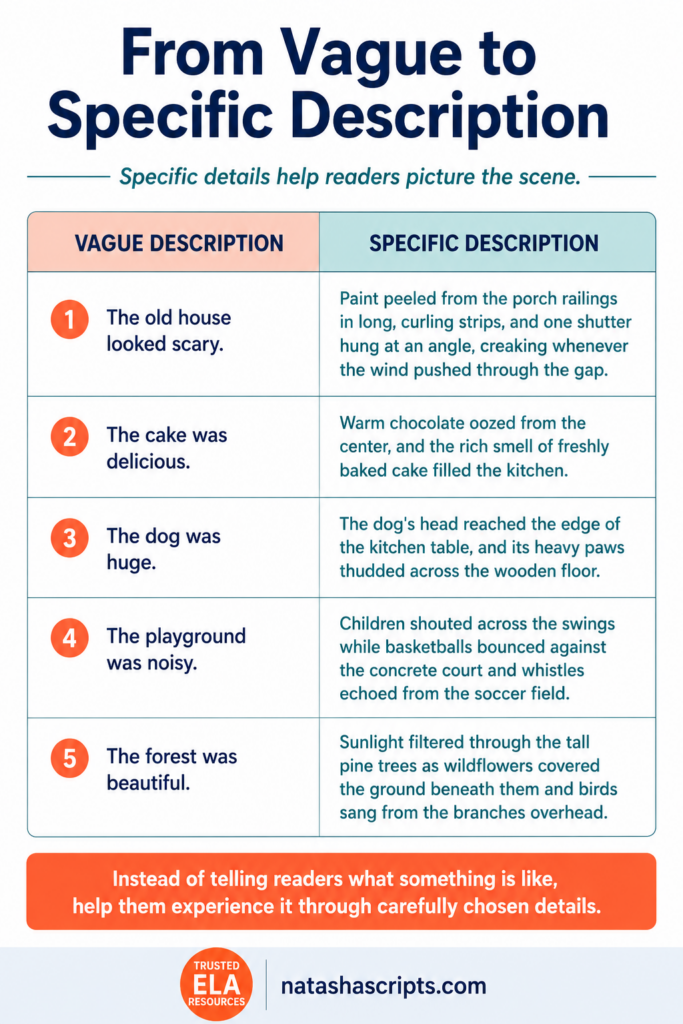
Vague:
The old house looked scary.
Specific:
Paint peeled from the porch railings in long, curling strips, and one shutter hung at an angle, creaking whenever the wind pushed through the gap.
Notice that the second example never uses the word scary. Instead, it creates that impression through details the reader can see and hear. This is one of the most important principles of descriptive writing: carefully chosen details often create a much stronger image than general adjectives ever could.
How to Teach Descriptive Writing at Home Without Formal Training
You don’t need to be a writing teacher to help your child develop stronger descriptive writing. What matters most is having a simple approach and asking thoughtful questions that encourage your child to think more deeply about what they are describing. Rather than trying to provide all the answers, think of yourself as a curious reader who wants to experience the scene more clearly.
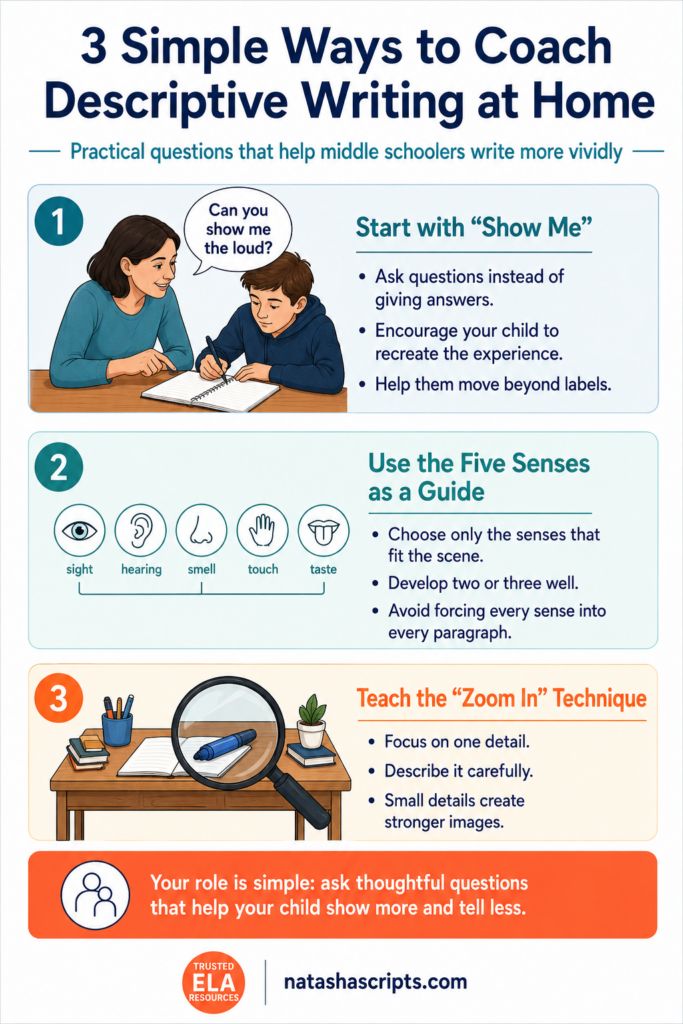
Start With “Show Me”
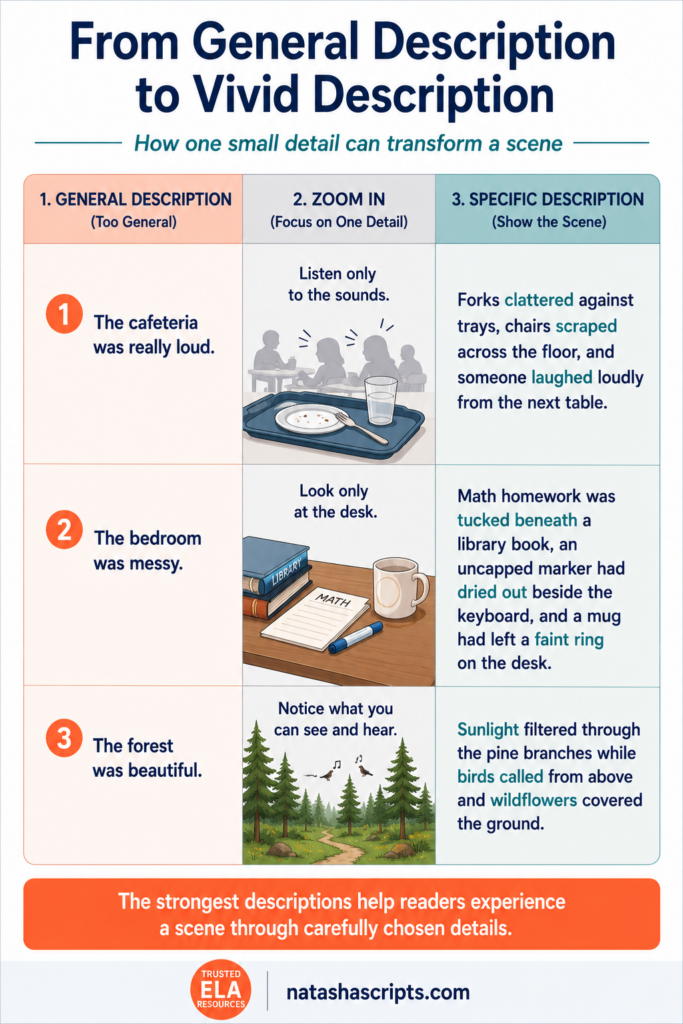
When your child writes something like, “The cafeteria was really loud,” ask, “Can you show me the loud? What could the reader hear?”
Questions like these encourage students to move beyond labeling an experience and begin describing it. With regular practice, many middle schoolers start asking themselves these questions as they write, making their descriptions more vivid without relying on general adjectives.
Use the Five Senses as a Checklist — Selectively
The five senses provide a helpful framework, but students do not need to include all five in every paragraph. Doing so can make their writing feel predictable rather than natural. Instead, encourage your child to choose the two or three senses that best suit the scene and develop those details well.
A scene set in a bakery might focus on smell and sight. A thunderstorm, on the other hand, might rely more heavily on sound and touch. Learning to choose details deliberately is an important part of becoming a stronger writer.
Teach the “Zoom In” Technique
Encourage your child to focus on one small part of the scene and describe it in detail, almost as though a camera were moving in for a closer look.
Instead of describing an entire messy bedroom, they might focus only on the desk: the crumpled homework tucked beneath a library book, the dried-out marker without its cap, and the faint ring left by a forgotten mug.
Very often, one carefully described detail creates a stronger image than a paragraph filled with general descriptions. This technique is especially helpful for students who feel overwhelmed when trying to describe an entire scene at once.
Quick Reference
Some Examples
Word Choice: Helping Students Move Beyond Ordinary Words
One of the simplest ways to strengthen descriptive writing is to encourage students to choose more precise words. This doesn’t require long vocabulary lessons. Instead, it begins with a simple question that parents can ask throughout the writing process:
“Is there a more exact word you could use here?”
Start with Common Verbs
Action verbs are often the easiest place to improve a piece of writing. A word like walked might become shuffled, stomped, drifted, or crept, with each verb creating a different image. Likewise, said might become muttered, announced, snapped, or admitted.
One helpful revision activity is to ask your child to circle the general verbs in a paragraph and brainstorm two or three more precise alternatives for each one. Even replacing a few common verbs can make a description feel much more vivid.
Build a Personal Word Bank
Encourage your child to keep a running list of interesting words they discover while reading. This might be a notebook, a section in a writing journal, or a notes app on a device. Whenever they come across a word that creates a particularly strong image or captures an idea well, they can add it to their collection. Over time, this becomes a valuable resource to revisit during revision.
Reading widely is one of the best ways to develop a richer vocabulary, but structured vocabulary practice can also help students discover and use new words with greater confidence. Resources such as Vocabulary Building 7th Grade introduce students to useful vocabulary in meaningful contexts, making it easier to recognize and apply those words in their own writing.
A Simple Feedback Process That Actually Works
Giving feedback on your child’s writing is often one of the most challenging parts of supporting descriptive writing at home. Too many corrections can leave students feeling discouraged, while too little guidance makes it difficult for them to improve. A simple, focused approach is usually much more effective.
1. Read It Aloud Together
Ask your child to read their writing aloud. Hearing their own words often helps students notice sentences that sound awkward, repetitive, or less descriptive than they intended. In many cases, they will identify areas for improvement before you need to comment.
2. Highlight One Strength
Before suggesting any changes, point out one sentence or detail that works particularly well. Be specific about why it is effective. This helps your child recognize the techniques they should continue using in future pieces of writing.
3. Ask One Thoughtful Question
Rather than marking every weakness, choose the one area that would benefit most from revision and ask a genuine question.
For example:
“I can picture the playground, but I’m having trouble imagining the kitchen. What did it smell like?”
One carefully chosen question often leads to a much stronger revision than a page filled with corrections.
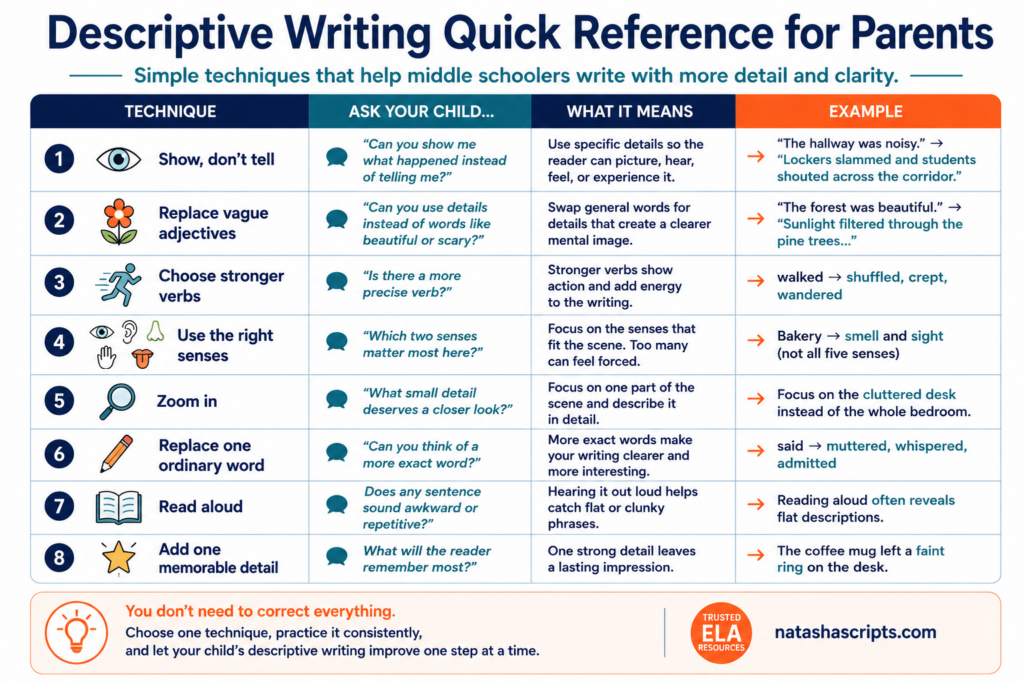
Descriptive Writing Quick Reference for Parents
When helping your child revise a piece of descriptive writing, focus on just one or two of these techniques at a time. As each skill becomes more natural, gradually introduce another. Building strong descriptive writing is a process of developing good habits rather than trying to improve everything at once.
| Technique | Ask Your Child… | Example |
|---|---|---|
| Show, don’t tell | Can you show me what happened instead of telling me? | “The hallway was noisy.” → “Lockers slammed and students shouted across the corridor.” |
| Replace vague adjectives | Can you use details instead of words like beautiful or scary? | “The forest was beautiful.” → “Sunlight filtered through the pine trees…” |
| Choose stronger verbs | Is there a more precise verb? | walked → shuffled, crept, wandered |
| Use the right senses | Which two senses matter most here? | Bakery → smell and sight |
| Zoom in | What small detail deserves a closer look? | Focus on the cluttered desk instead of the whole bedroom. |
| Replace one ordinary word | Can you think of a more exact word? | said → muttered, whispered, admitted |
| Read aloud | Does any sentence sound awkward or repetitive? | Reading aloud often reveals flat descriptions. |
| Add one memorable detail | What will the reader remember most? | The coffee mug left a faint ring on the desk. |
How Vocabulary Work Supports Descriptive Writing
A rich vocabulary gives students more choices when they write. The more words they understand and use confidently, the easier it becomes to describe people, places, and experiences with precision. This is one reason vocabulary development and descriptive writing work so well together during the middle school years.
When students encounter words such as dilapidated, luminous, or acrid in meaningful contexts—and then use those words themselves—they gradually become part of the vocabulary they can draw on naturally in their own writing.
Students who benefit from a complete language arts program may find it helpful to use a resource that combines vocabulary, spelling, reading, and writing into a single course. Spelling, Writing and Reading: Language Arts Curriculum for 7th and 8th Grade is one example of a structured program that develops these skills together rather than treating them as separate subjects.
For families looking to strengthen vocabulary specifically, The Vocabulary and Spelling Practice Workbook for 7th Grade provides systematic practice that moves beyond learning definitions. Students encounter new words in context and apply them through progressively more challenging activities, helping them build a vocabulary they can use with greater confidence in both speaking and writing.
Common Mistakes to Watch For
As students begin experimenting with descriptive writing, it is normal for certain habits to reappear from time to time. Rather than trying to correct everything at once, focus on one area for improvement during each round of revision. This helps students build stronger writing habits without feeling overwhelmed.
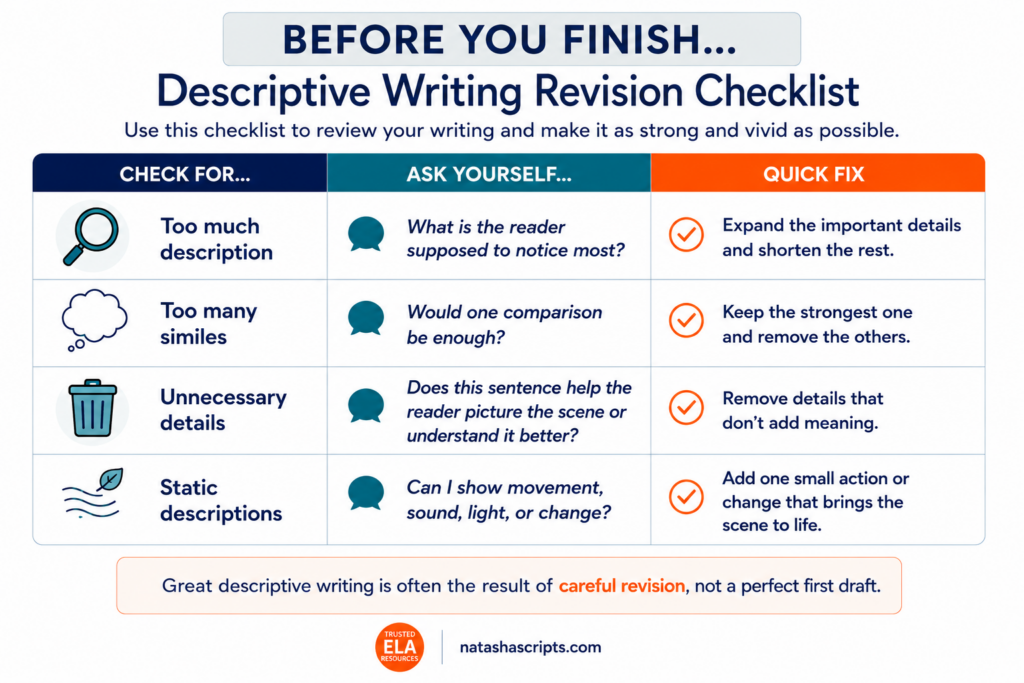
Describing Everything Equally
Not every part of a scene deserves the same amount of attention. If every object receives a detailed description, the writing can become slow and difficult to follow. Encourage your child to decide what the reader most needs to notice, then spend the greatest amount of detail there while keeping less important background information brief.
Using Too Many Similes
Similes can make writing more vivid, but they lose their impact when they appear too often. One well-chosen comparison in a paragraph is usually far more effective than several competing for the reader’s attention. Encourage your child to use similes where they genuinely strengthen the description rather than adding them simply because they have learned how to write them.
Keeping Unnecessary Details
One of the most valuable revision skills is learning what to leave out. If a sentence does not help the reader picture the scene, develop the mood, or reveal something important, it may not need to stay. Remind your child that strong descriptive writing is often clearer because it focuses on the details that matter most.
Writing Descriptions That Feel Static
Descriptions become more engaging when they include movement or change. Instead of describing a scene as though it were a photograph, encourage your child to notice what is happening within it. Light might shift across the room, leaves may rustle in the wind, footsteps can echo down a hallway, or the smell of fresh bread may become stronger as someone walks into a bakery. Small changes like these help scenes feel more natural and alive.
Building the Habit Over Time
Strong descriptive writing develops gradually through regular practice. As students learn to notice small details, choose more precise words, and revise their work thoughtfully, these habits become increasingly natural. Like any writing skill, descriptive writing improves through repeated opportunities to apply what has been learned across many different pieces of writing.practice across many pieces of writing, not one intensive lesson.
Short, consistent practice is often more effective than occasional long writing sessions. Spending ten minutes revising a single paragraph and asking, “Where could I be more specific?” is likely to have a greater long-term impact than completing a lengthy writing activity only once every few weeks.
As you work with your child, look for moments when they include an unexpected detail, choose a particularly strong verb, or create a vivid image that brings a scene to life. Take the time to point out those successes. Specific, encouraging feedback helps students recognize what they are doing well and gives them the confidence to keep developing those skills.
Above all, remember that descriptive writing is built one habit at a time. Each thoughtful revision, carefully chosen detail, and precise word adds to a student’s confidence as a writer. With patience, regular practice, and supportive coaching, vivid description gradually becomes something students do naturally rather than something they have to think about.
If you’re looking for additional worksheets, writing prompts, and printable ELA activities to support your child’s learning at home, you can also explore the Free ELA Resources page, where you’ll find classroom-ready materials across a range of middle school language arts topics.
Descriptive Writing Quick Reference