Reading Textbooks Effectively in High School: A Practical Approach for Active Comprehension
Reading textbooks effectively is one of the most important academic skills high school students develop, yet it is often assumed rather than taught. Many students can read a chapter from a history, science, or English textbook and feel as though they understand it while they are reading. The difficulty becomes apparent later, when they try to recall key ideas, answer questions, or participate in a class discussion. The information may seem familiar, but much of it has not been retained.
This happens because reading a textbook requires a different approach from reading a story or novel. Textbooks are designed to communicate information, explain concepts, and build knowledge. Students who approach them passively often finish the assigned pages without a clear understanding of the most important ideas. A more active approach can make reading more purposeful and improve both comprehension and retention.
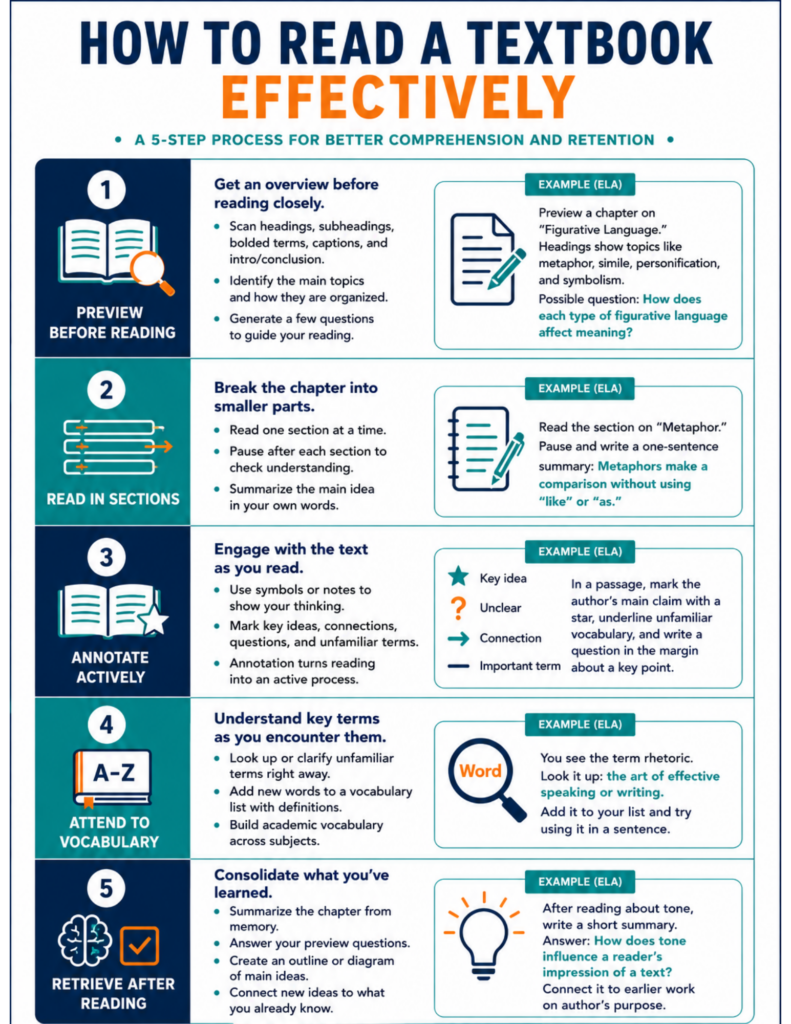
If you’d like a visual summary of the reading strategies discussed in this article, you can jump ahead to the Quick Guide.
Why Passive Reading Tends to Fall Short
Reading a textbook is different from reading a novel. In a story, students naturally follow characters, events, and conflicts from one page to the next. Textbooks place a different demand on the reader. Instead of following a narrative, students are expected to understand concepts, recognize relationships between ideas, and retain important information. A student who reads a chapter about the causes of World War I in the same way they read a novel may reach the end of the chapter without a clear understanding of the key causes or how they relate to one another.
One reason this happens is that passive reading can feel productive. The student has read the assigned pages and may even have highlighted parts of the text, so it appears that the work has been completed successfully. The problem often becomes visible later, when the student tries to answer questions, study for a quiz, or explain what they have learned. At that point, much of the material may be difficult to recall.
Effective textbook reading requires students to actively preview important information, ask questions, identify key ideas, and review what they have read. These habits help students engage with the material while they are reading rather than trying to reconstruct their understanding later.
The Value of a Pre-Reading Orientation
Before reading a textbook chapter in detail, students can benefit from spending a few minutes becoming familiar with its structure. This does not mean reading the chapter twice. Instead, it involves scanning headings, subheadings, bolded terms, captions, and introductory or concluding sections. These features provide an overview of the chapter and help students understand how the information is organized before they begin reading more closely.
This preview can make comprehension easier because students already have a sense of the chapter’s main topics. For example, a student who knows that a grammar chapter is organized around coordinating conjunctions, subordinating conjunctions, and conjunctive adverbs is more likely to notice how those concepts relate to one another while reading. Instead of trying to piece the structure together afterward, they can follow it as the information is presented.
The preview stage is also a good opportunity to identify a few questions to keep in mind while reading. A heading such as “Subordinating Conjunctions” might prompt questions such as: What makes a conjunction subordinating? How does it affect sentence structure? Which words function this way? Questions like these give students a purpose for reading and encourage them to engage more actively with the material as they look for answers.
Reading in Sections, Not in Sittings
Students often understand textbook material more effectively when they read in sections rather than treating an entire chapter as a single task. Most textbook chapters are already divided into smaller sections with headings, making this approach easy to implement. After reading one section, the student pauses briefly before moving on. They might summarize the main idea in their own words, jot down a few notes, or answer one of the questions they identified during the preview stage.
These pauses are valuable because they require students to think about what they have just read. Instead of moving directly to the next page, they stop and check whether they can explain the key ideas without looking back at the text. A student who closes the book after each section and writes a brief summary is likely to retain more than a student who reads the same material straight through, even if both spend roughly the same amount of time reading.
For particularly dense material, students may also benefit from reading the chapter summary or review questions before beginning the chapter itself. This builds on the pre-reading orientation discussed earlier and helps students identify the ideas the textbook considers most important. As they read, they can pay closer attention to information that relates to those central concepts.
Annotation as a Thinking Tool
Annotation can be one of the most effective ways for students to stay actively engaged while reading a textbook. The key difference between annotation and highlighting is that annotation requires students to respond to the text. A student can highlight an important sentence without thinking much about it. Annotation, by contrast, asks the student to do something with the information. They might summarize a paragraph in the margin, note a term they do not understand, record a question, or identify a connection to something they have already learned.
The key difference between annotation and highlighting is that annotation requires students to respond to the text.
It asks the student to do something with the information.
There is no single annotation system that works best for every student. Some students prefer a small set of symbols, such as a question mark for something unclear or a star for a key idea. Others prefer brief notes written in their own words. What matters is that the annotation reflects active thinking rather than simply marking information that seems important.
Students should also understand that annotation is a tool for comprehension, not a task to be completed for its own sake. A heavily marked page is not necessarily evidence of careful reading. In many cases, a few thoughtful notes are more valuable than extensive highlighting or pages of comments. Students who are new to annotation often benefit from seeing examples of effective annotations so they can understand how the process supports comprehension rather than simply recording information.
The Role of Vocabulary in Textbook Comprehension
Vocabulary plays an important role in textbook comprehension, particularly at the high school level, where students are expected to read increasingly specialized and academic texts. When several unfamiliar terms appear in a single section, students may be able to follow the topic in a general way while missing important details and connections between ideas. As a result, they may finish reading a chapter without a clear understanding of what they have read.
One useful habit is to treat unfamiliar terms as an important part of the reading process rather than something to skip over. When students encounter a bolded term in a science textbook or a key concept in a history chapter, taking a moment to identify its meaning can make the rest of the section easier to understand. Addressing unfamiliar vocabulary as it appears often prevents confusion later in the chapter and gradually builds the academic vocabulary needed for success across subject areas.
The connection between vocabulary and comprehension is one reason vocabulary development deserves explicit attention in a high school English program. Students who regularly encounter and use academic vocabulary are often better equipped to understand textbook explanations, recognize relationships between ideas, and engage with more complex reading across subject areas. For a closer look at the role vocabulary plays in reading and academic success, see Advanced Vocabulary in High School: Strategies for College-Ready Writing.
After Reading: Making the Material Retrievable
The final stage of reading textbooks effectively is what happens after the reading is complete. A student who finishes a chapter and immediately moves on to another task is likely to retain less than a student who spends a few minutes reviewing what was learned. The goal of a post-reading activity is not to re-read but to retrieve information from memory. Bringing information back without looking at the text tends to strengthen retention more effectively than simply reviewing notes or re-reading highlighted passages.
Several approaches can support this process. A student might write a brief summary of the chapter from memory, identifying the main ideas and key terms. They might return to the questions they generated during the preview stage and attempt to answer them without consulting the text, checking their answers afterward. They might also create a simple outline or concept map that shows how the chapter’s ideas relate to one another. Each of these activities requires students to reconstruct what they have learned rather than simply review it.
Students can also strengthen retention by connecting new learning to material they have already studied. For example, a chapter on subordinate clauses becomes easier to remember when students connect it to their earlier understanding of independent clauses and sentence structure. Similarly, a lesson on persuasive techniques is easier to retain when students relate it to previous work on audience, purpose, and argument. Making these connections explicit helps students build a connected body of knowledge rather than viewing each chapter as a separate piece of information.
Building the Habit Over Time
The approach described here—previewing, reading in sections, annotating actively, attending to vocabulary, and reviewing after reading—includes practices that students can apply across subjects once they become familiar with them. None of these strategies requires special materials or a significant amount of extra time. Instead, they encourage students to engage more actively with what they are reading rather than simply moving through the assigned pages.
Teachers and homeschool parents may find it helpful to introduce these practices gradually rather than all at once. For example, a student might begin by previewing chapters before reading and then add annotation or post-reading summaries once that habit feels comfortable. Building one habit at a time often leads to more consistent use than introducing an entire system at once.
Over time, these small adjustments can make textbook reading more purposeful and productive. Students become more likely to notice key ideas, retain important information, and connect new learning to what they already know. As the habits become more familiar, they require less conscious effort and become a natural part of the reading process.
Quick Guide