How to Write a Strong Thesis Statement in Middle School: A 4-Step Process for Stronger Student Writing
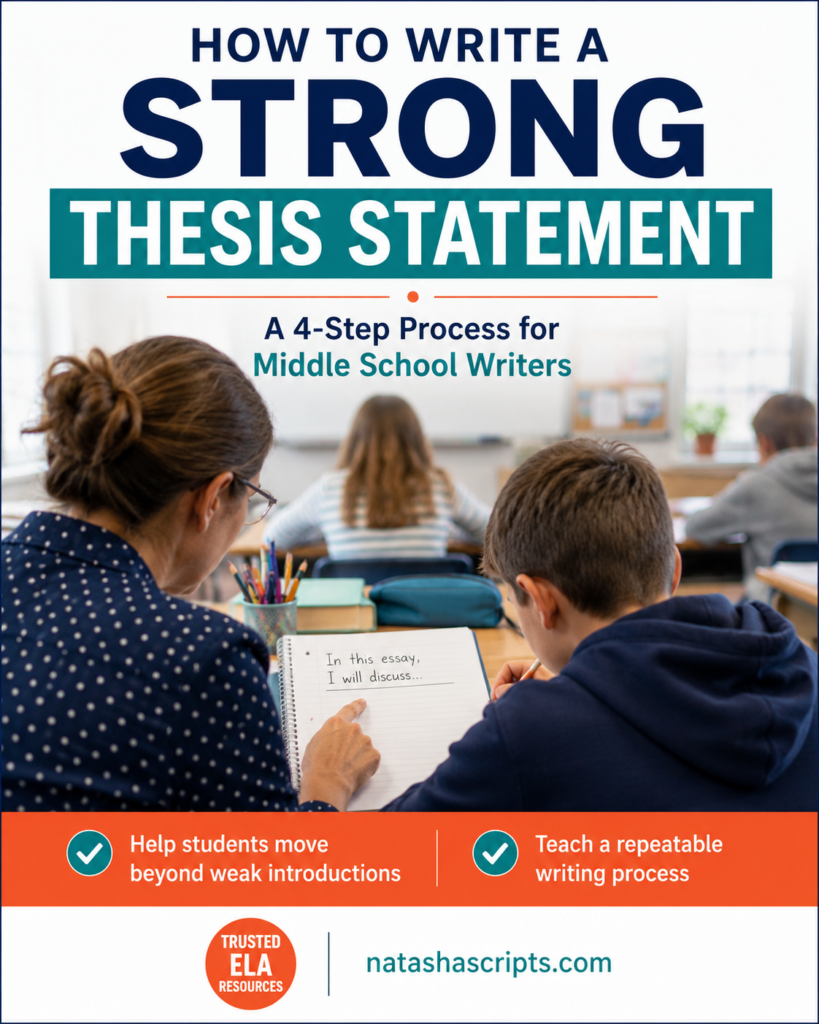
Middle school students often read an essay prompt carefully, think about what they want to say, and then write a thesis statement that simply repeats the topic or restates the question. A student writing about the effects of social media on teenagers, for example, might write, “Social media has many effects on teenagers.” Although the sentence identifies the topic, it doesn’t tell the reader what the writer believes or what direction the essay will take.
In most cases, the problem isn’t a lack of effort. Students simply haven’t yet learned what a thesis statement is meant to do. Once its purpose is explained clearly and students practise the process step by step, they can learn to write thesis statements that are specific, arguable, and provide a clear direction for the rest of their writing.
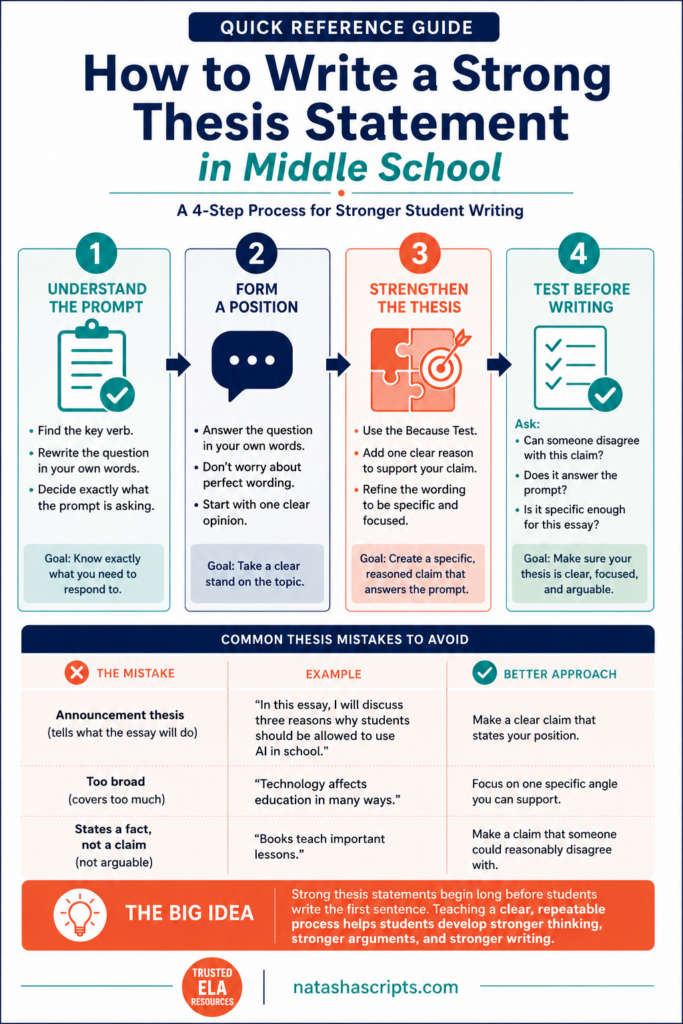
Jump straight to the Quick Reference Guide for a one-page summary of the complete four-step process.
What a Thesis Statement Is and What It Is Not
Before students can learn to write a strong thesis statement, they need to understand how it differs from a topic sentence or a simple restatement of the prompt. A thesis statement makes a claim. It tells the reader not only what the essay is about, but also what the writer believes or argues about that topic. A topic sentence introduces an idea, whereas a thesis statement takes a clear position.
A thesis statement makes a claim. It tells the reader not only what the essay is about, but also what the writer believes or argues about that topic.
A topic sentence introduces an idea, whereas a thesis statement takes a clear position.
One way to help students recognise the difference is to ask whether a sentence could reasonably be argued against. “Social media has many effects on teenagers” is simply a statement of fact. “Social media use among teenagers tends to increase anxiety when it replaces face-to-face interaction” presents a claim that can be questioned, supported, or challenged with evidence. Helping students recognise this difference enables them to evaluate their own thesis statements instead of relying entirely on teacher feedback.
It is also helpful to address the common misconception that a thesis statement must appear at the very end of the introductory paragraph. Although this is the traditional placement in a five-paragraph essay, the more important expectation is that the thesis is clear and easy to identify. Focusing too heavily on where a thesis belongs before students understand what it should do often results in writing that is well organised but lacks a clear argument.
Stage One: Unpacking the Prompt
Many weak thesis statements begin with a misunderstanding of the prompt rather than a misunderstanding of argument. Students sometimes respond to the general topic instead of answering the question the prompt is actually asking. For example, consider this prompt:
“Should students be allowed to use artificial intelligence (AI) tools to help with school assignments? Support your position with reasons and evidence.”
This prompt asks students to take and defend a position. A student who writes, “Artificial intelligence is becoming more common in schools,” has identified the topic but has not answered the question. The response describes the subject instead of making a claim.
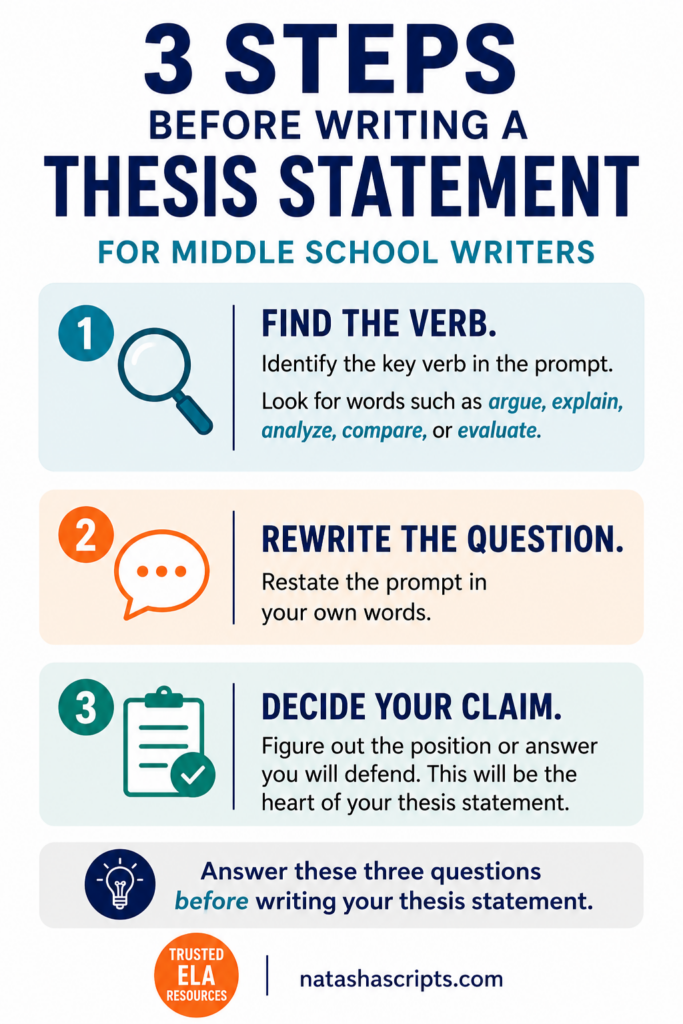
A useful first step is to have students identify the key verb in the prompt, such as argue, explain, analyze, compare, or evaluate. Next, ask them to restate the prompt in their own words before they begin writing. In the example above, students might rephrase it as, “Do I think students should be allowed to use AI for schoolwork?” That simple step helps them focus on the decision they need to make rather than the general topic.
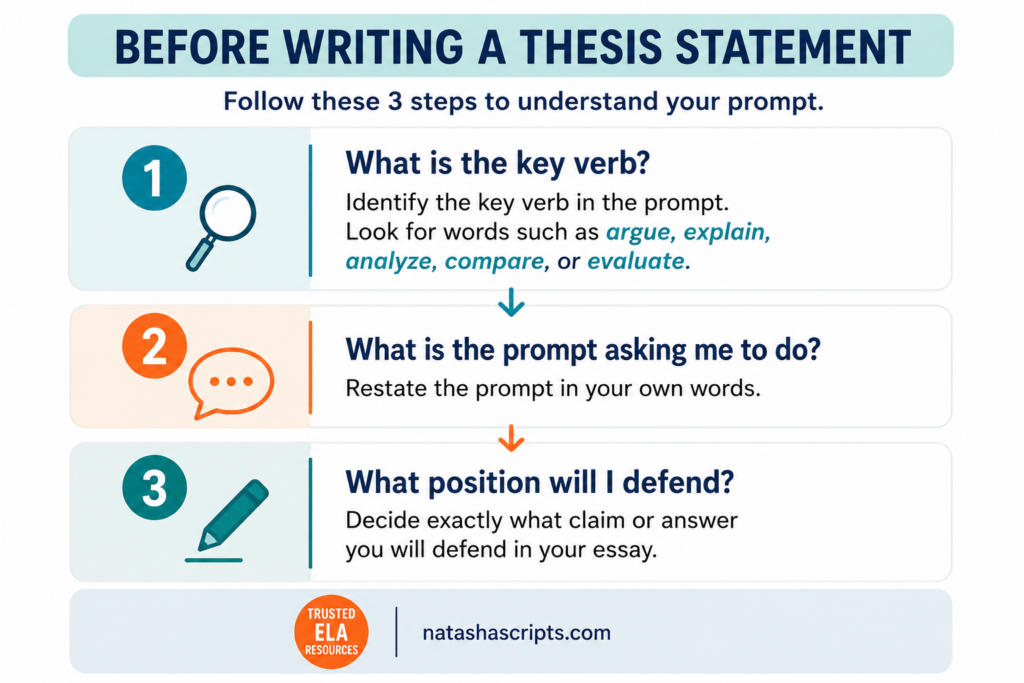
In the classroom, this can be done as a short whole-class discussion before students work independently. At home, a parent or tutor might simply ask, “What is this prompt asking you to decide or explain?” and wait for the student to answer in a complete sentence. Hearing students explain the prompt aloud often reveals misunderstandings before they find their way into the first draft.
“What is this prompt asking you to decide or explain?”
Stage Two: Forming a Preliminary Position
Once students understand what the prompt is asking, the next step is to decide where they stand. This does not need to be the final thesis statement. It is simply a starting point. Many middle school students hesitate at this stage because they are worried about choosing the “wrong” answer or committing to an idea too early. Reassure them that a first position is only a working claim and can be refined as they plan and draft their essay.
One simple question often works better than asking students to write a thesis statement immediately:
“What do you actually think? Answer in one sentence.”
Removing the pressure of writing a formal thesis often produces clearer thinking. For example, after responding to the AI prompt, a student might write:
“I think students should be allowed to use AI for schoolwork if they use it to support their learning rather than replace their own thinking.”
That sentence is not yet a polished thesis statement, but it already contains a clear position. From there, students can refine the wording, make the claim more precise, and prepare to support it with reasons and evidence.
Teachers often find that students write stronger thesis statements when they are encouraged to express their ideas naturally first and focus on formal wording afterwards.
Stage Three: Adding Specificity and Reasoning
Once students have chosen a position, the next step is to strengthen it with a clear reason. At this stage, many students write claims that are either too vague or based on personal preference rather than reasoning. A stronger thesis not only states a position but also gives the reader a sense of why the writer holds that view.
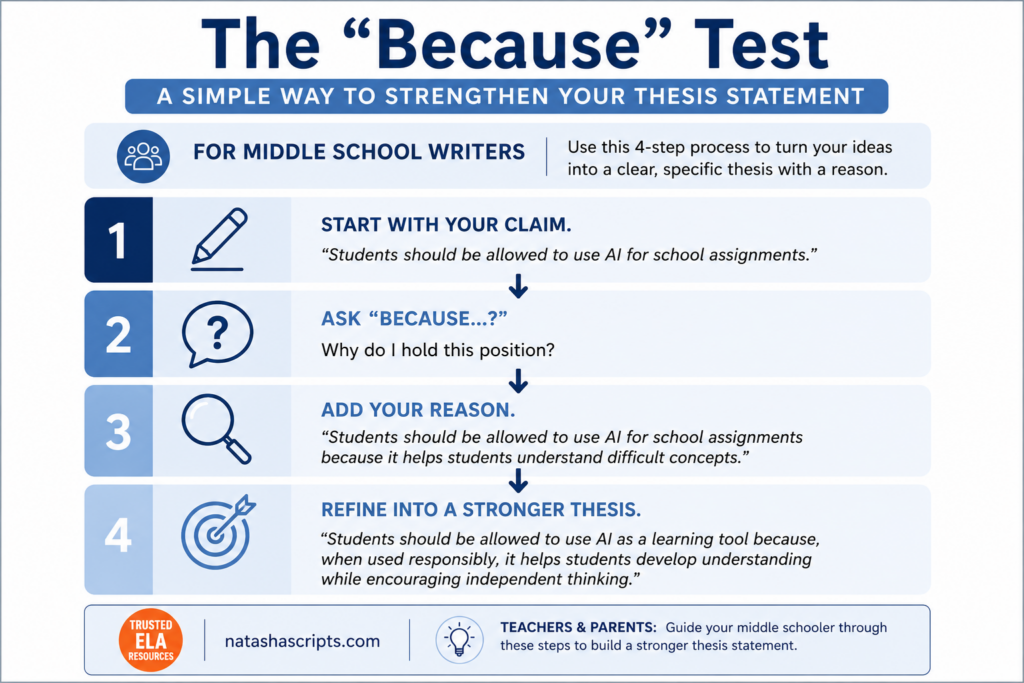
One simple strategy is the “because” test. Ask students to complete the sentence:
“[My claim] because [reason].”
The word because does not need to appear in the final thesis statement, but using it as a drafting tool helps students move beyond unsupported opinions.
For example:
Weak claim:
“Students should be allowed to use AI for school assignments.”
Using the because test:
“Students should be allowed to use AI for school assignments because it can help them understand difficult concepts without replacing their own thinking.”
The final thesis might then become:
“Students should be allowed to use AI as a learning tool because, when used responsibly, it helps students develop understanding while encouraging independent thinking.”
For many 6th-grade students, a thesis that presents one clear position supported by one reason is an appropriate goal. As students become more confident writers, they can begin to develop more nuanced claims by introducing a condition or qualification. For example:
“Although AI should never replace original student work, it can be a valuable learning tool when used to explain concepts, generate ideas, or provide feedback during the writing process.”
Once students can explain why they hold a position, they are well on their way to writing a stronger thesis statement.
Stage Four: Testing the Thesis Before Writing
Before students begin writing the body of their essay, it is worth taking a minute to test the thesis statement. Spending a little time evaluating the thesis at this stage often prevents much larger revisions later.
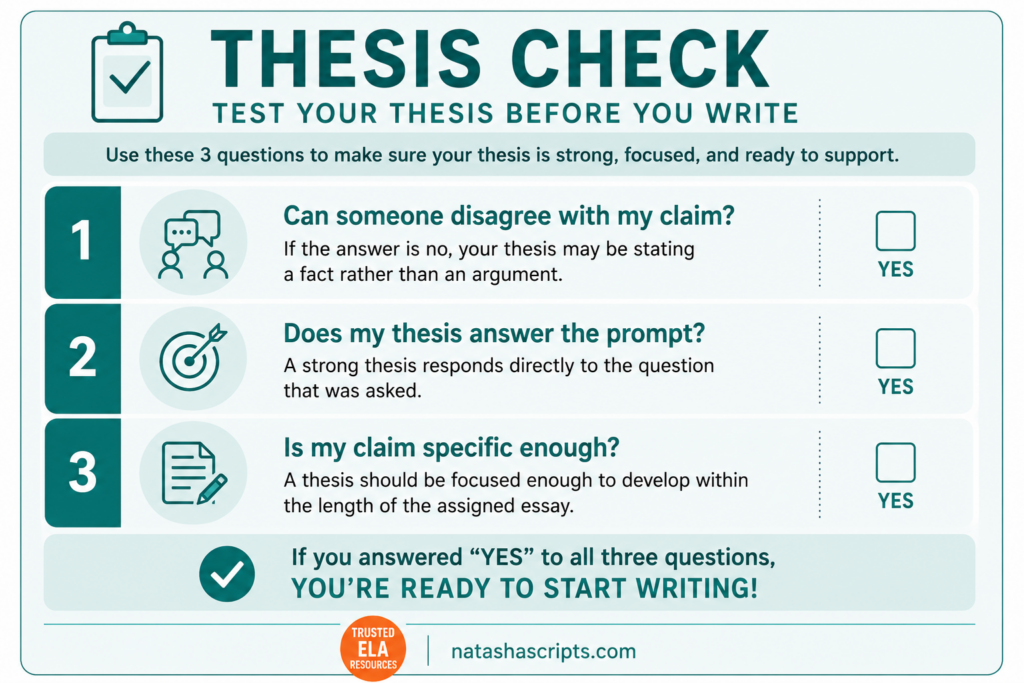
Encourage students to ask themselves three simple questions.
1. Could someone reasonably disagree with my claim?
If the answer is no, the thesis may be stating a fact rather than presenting an argument.
2. Does my thesis answer the prompt?
A strong thesis responds directly to the question that was asked. If it does not, the essay is likely to wander off topic.
3. Is my claim specific enough?
A thesis should be focused enough to develop within the length of the assigned essay. Broad claims usually lead to broad, unfocused writing.
This quick self-check also works well as a peer-review activity. Students can exchange thesis statements and use the three questions to give each other constructive feedback. Parents and tutors can follow the same process by talking through each question with the student before the first draft begins.
Over time, students begin to pause and test their own thesis statements before they start writing. That simple habit often leads to stronger essays and more confident writers.
Common Thesis Statement Mistakes to Address Early
Some thesis statement mistakes appear so often in middle school writing that they are worth teaching before students begin drafting. Addressing these patterns early can save a great deal of revision later.
One of the most common is the announcement thesis:
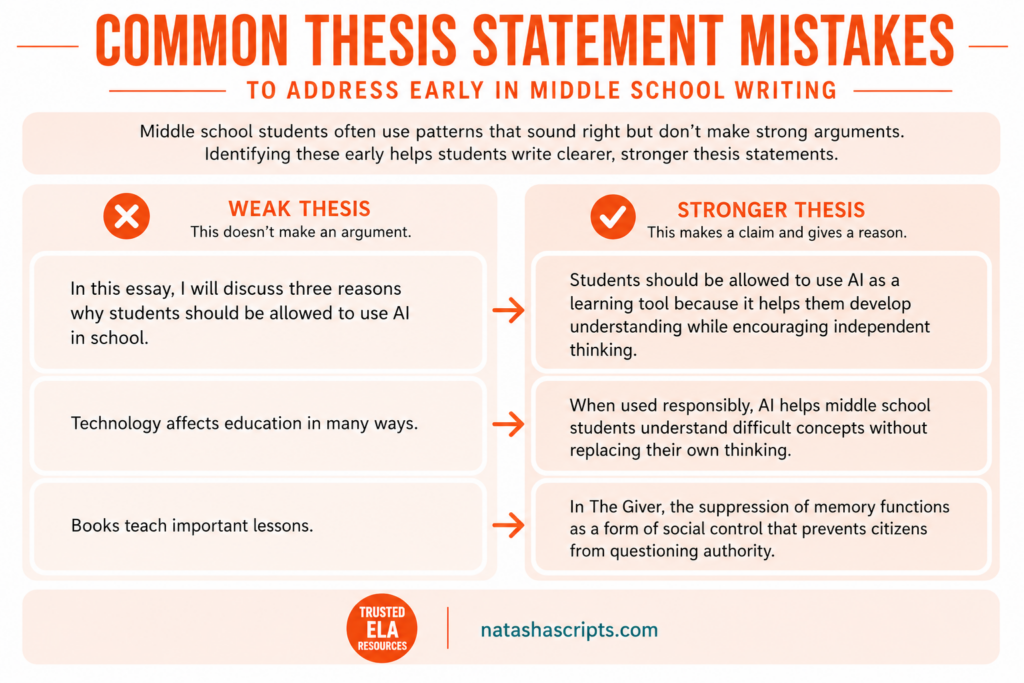
“In this essay, I will discuss three reasons why students should be allowed to use AI in school.”
Although this tells the reader what the essay will cover, it does not actually make a claim. Encourage students to replace announcements with an arguable position, such as:
“Students should be allowed to use AI as a learning tool because it helps them develop understanding while encouraging independent thinking.”
Another common problem is a thesis that is simply too broad.
For example:
“Technology has changed education in many ways.”
While this is true, it is far too general to guide a short essay. Narrowing the claim gives both the writer and the reader a clearer direction.
For example:
“When used responsibly, AI helps middle school students understand difficult concepts without replacing their own thinking.”
Helping students recognise these common patterns makes it much easier for them to identify weak thesis statements before they begin writing.
If you’re working with persuasive writing more broadly, you may also find these related articles helpful:
Colons and Semicolons in Middle School Writing: What Each Mark Actually Does
Common Persuasive Writing Mistakes Middle Schoolers Make and How to Address Them
Building the Process Into Regular Writing Instruction
The four stages outlined in this article—understanding the prompt, forming a preliminary position, adding specificity and reasoning, and testing the thesis before writing—are most effective when they become part of students’ regular writing routine rather than a one-time lesson. Over time, students begin to approach new writing tasks with greater confidence because they know exactly what questions to ask before they start drafting.
Although the examples in this article focus on persuasive writing, the same process applies across almost every type of academic writing. Whether students are responding to a literary text, analysing a historical event, or explaining a scientific concept, they still need to understand the prompt, take a clear position, support it with reasoning, and make sure their thesis is focused enough to guide the essay that follows.
For teachers and homeschool parents looking for structured writing instruction, Spelling, Writing and Reading, 7th and 8th Grade: Language Arts Curriculum provides systematic writing lessons that help students develop these skills alongside reading and vocabulary. Students who are ready for more advanced academic writing can continue building on the same foundation in How to Write a Thesis Statement in High School: A Repeatable Process That Actually Works, where the process is extended to meet the expectations of high school writing.
The goal is not for students to memorise a formula for writing thesis statements. It is to help them develop a thinking process they can apply every time they face a new writing task. Once that process becomes familiar, students are far more likely to begin their essays with a focused, arguable thesis that gives the rest of their writing a clear direction.
Teachers, tutors, and homeschool parents looking for ready-to-use ELA lessons, classroom activities, and printable worksheets can also explore the Free ELA Resources page for additional writing materials and free sample lessons.