Why High Schoolers Still Make Subject-Verb Agreement Errors
Free Download: This article includes a printable Subject-Verb Agreement Diagnostic and Targeted Practice Resource to help you identify the sentence patterns causing your student’s errors and decide what to teach next.
Subject-verb agreement is usually taught well before students reach high school, which makes persistent errors surprising. A student who has learned the basic rule that singular subjects take singular verbs and plural subjects take plural verbs may still write sentences such as The results of the experiment was inconclusive or There was several reasons for the decision in a ninth-grade essay. When this happens, it is easy to assume the student was careless or simply did not apply what they already know. More often, however, the errors have a specific cause. Certain sentence patterns make it harder for students to identify the true subject, and knowing the basic rule does not automatically help them apply it in more complex sentences.
If you would like to review the main points discussed in this article, you can jump directly to the Quick Reference Guide.
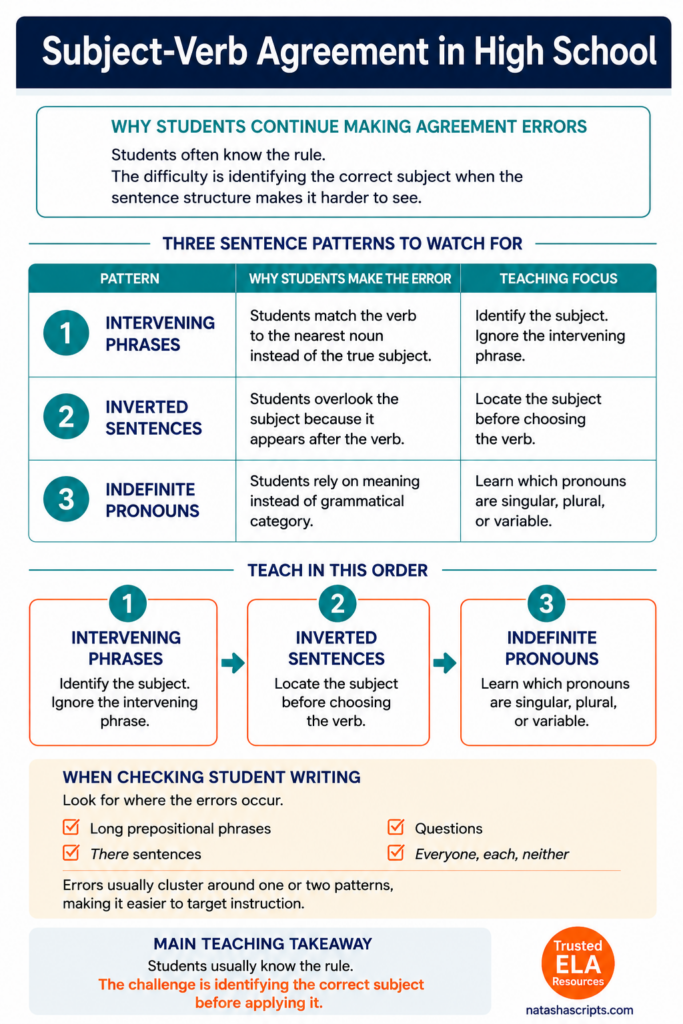
Understanding which sentence patterns cause the most difficulty is usually more helpful than teaching the basic rule again. Three patterns account for many subject-verb agreement errors in high school writing: intervening phrases, inverted sentence order, and indefinite pronouns. Each creates a different kind of confusion, and each benefits from a different teaching approach.
Would you like to identify which sentence pattern is causing your student’s subject-verb agreement errors?
Download the free
Subject-Verb Agreement Diagnostic and Targeted Practice Resource
The printable resource includes a diagnostic, an error-pattern analysis, targeted practice, and answer keys. Enter your email address below to receive your free copy.
How Intervening Phrases Disrupt Agreement
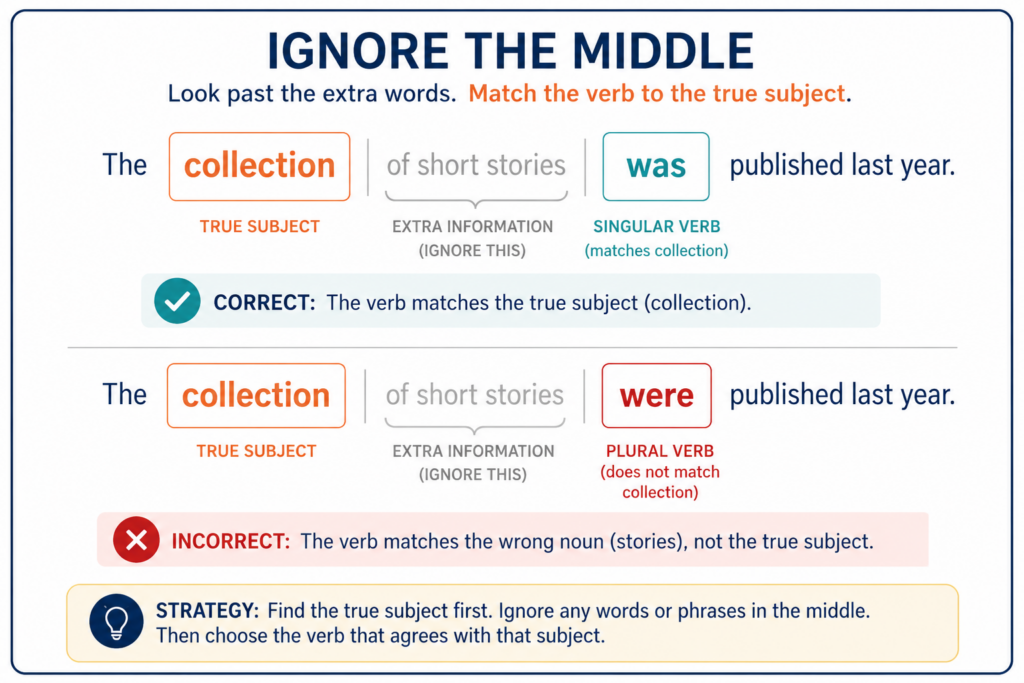
The most common cause of subject-verb agreement errors in high school writing is a prepositional phrase or relative clause that comes between the subject and the verb. When a student writes The collection of short stories were published last year, the error usually happens because stories is the noun closest to the verb, and it is plural. The actual subject, collection, is singular, but by the time students reach the verb, they are often thinking about the nearer noun instead. The intervening phrase shifts their attention away from the true subject.
This pattern is worth looking for before deciding that a student does not understand subject-verb agreement. A student who writes The collection were published without the intervening phrase almost certainly would not make the same mistake. The error usually appears only when extra words separate the subject from the verb. One strategy that often helps is teaching students to identify and mentally ignore the intervening phrase before choosing the verb. If students first locate the true subject by asking what the sentence is really about, they can then match the verb to that subject alone. Practising this strategy with sentences taken from students’ own writing, rather than isolated grammar exercises, makes it much easier to apply in future writing.
One strategy that often helps is teaching students to identify and mentally ignore the intervening phrase before choosing the verb.
Inverted Sentences and the Problem of Verb-First Structures
Most subject-verb agreement instruction begins with sentences in which the subject comes before the verb. That is the most common sentence order in English, but it is not the only one. In sentences beginning with there or here, in questions, and in some stylistic constructions, the verb may appear before the subject. Students who have learned to match the verb with the noun that comes before it can easily make errors when the sentence order changes.
Sentences beginning with there are a common source of difficulty. In There are several unresolved questions in the argument, the subject is questions, which appears after the verb. A student reading from left to right may treat there as the subject and choose is instead of are. The same problem appears in questions. Where is the evidence and the counterarguments? should be Where are the evidence and the counterarguments? because the subject includes two joined elements. The inverted order simply makes that subject harder to identify.
Students need to learn to recognise inversion as a sentence pattern and locate the subject before choosing the verb, regardless of where the subject appears. In a classroom or homeschool setting, short editing tasks that focus only on inverted sentences can help students develop this habit without reteaching the entire subject-verb agreement rule.
Indefinite Pronouns: Where the Rules Are More Complex
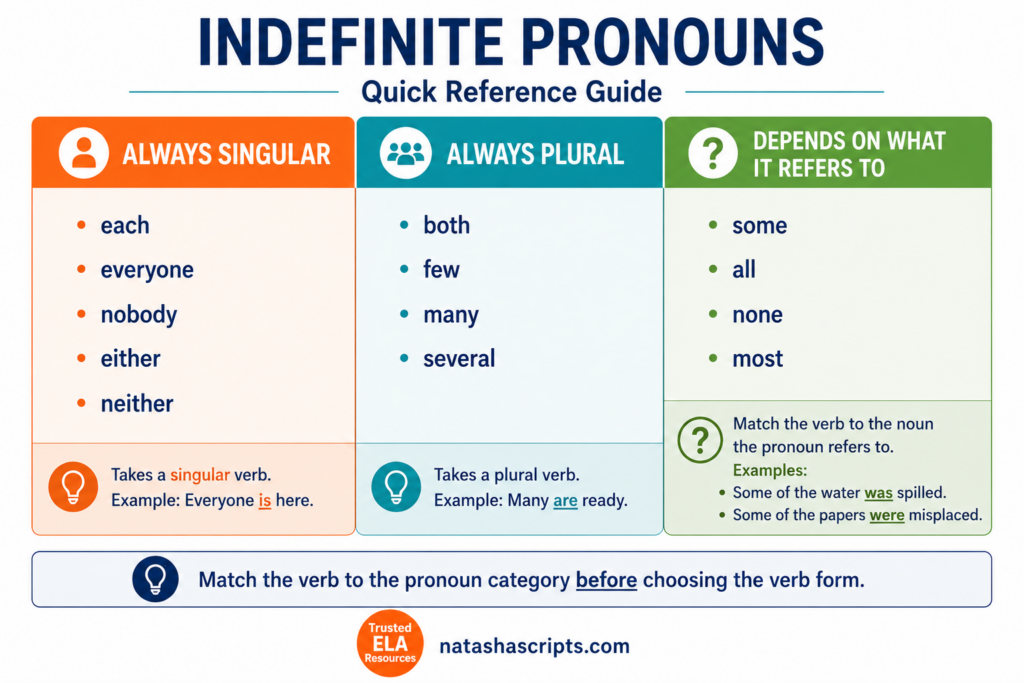
Unlike intervening phrases and inverted sentences, which involve applying the same rule in a different sentence structure, indefinite pronouns introduce rules that are genuinely more complex. Some indefinite pronouns are always singular (each, everyone, nobody, either, and neither). Others are always plural (both, few, many, and several). A third group changes depending on the noun it refers to (some, all, none, and most). This distinction is not always explained clearly when students first learn subject-verb agreement. As a result, many students do not realise that indefinite pronouns do not all follow the same pattern.
The always-singular group causes the most persistent errors because several of these pronouns refer to more than one person or thing. Everyone refers to many people, yet it takes a singular verb. Each of the students refers to multiple students, yet each is singular. Students who rely on meaning instead of grammatical category often choose a plural verb. Helping students recognise the grammatical category of the pronoun is usually more effective than asking them to rely on what “sounds right.” A simple reference chart that groups indefinite pronouns according to how they agree with verbs, and is used regularly during writing lessons, is often more effective than a single grammar lesson on the topic.
The variable group includes pronouns such as some, all, and none. Here, the correct verb depends on the noun the pronoun refers to. Some of the water was spilled is correct because water is a mass noun. Some of the papers were misplaced is also correct because papers is a count noun. Students often find this pattern confusing at first. For that reason, it usually makes sense to teach the variable group only after students are confident with the always-singular and always-plural categories.
Why Rule Memorization Alone Is Not Enough
A student can state the subject-verb agreement rule accurately and still produce errors in complex sentences because the rule, as it is typically taught, does not help students identify the subject when the sentence structure makes that difficult. Matching the verb to the subject sounds straightforward until the subject is separated from the verb, placed after it, or represented by an indefinite pronoun that behaves differently from what students expect.
The three patterns discussed in this article each make identifying the subject more difficult, but in different ways. Intervening phrases draw attention away from the true subject. Inverted sentences place the subject after the verb. Indefinite pronouns sometimes behave differently from what their meaning suggests. In each case, the student is not struggling with the rule itself. The difficulty lies in recognising which word the rule applies to.
This distinction has important implications for teaching. Re-teaching the basic rule to students who already know it is unlikely to reduce these errors. A more effective approach is to teach each pattern separately, show students how to identify the true subject in that type of sentence, and provide enough practice for the process to become familiar. A related article, A Proofreading Routine for Apostrophes and Possessives in High School Writing, explores how a focused proofreading routine can help students identify recurring grammar errors more consistently during revision.
Sequencing Instruction for These Three Patterns
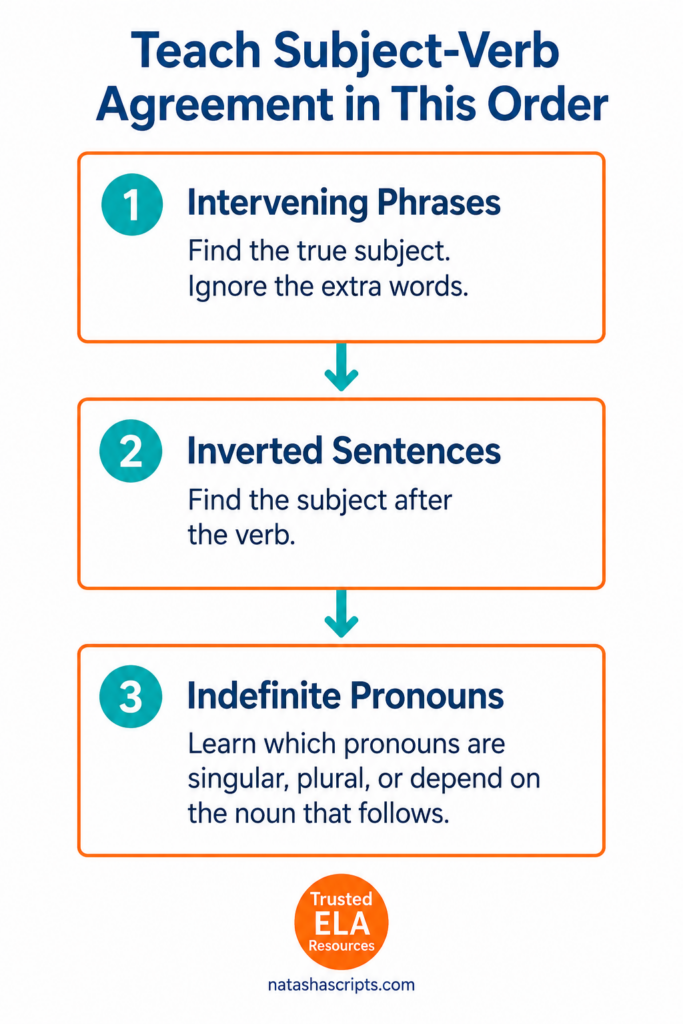
Although these three sentence patterns all affect subject-verb agreement, they are best taught one at a time. Intervening phrases make a good starting point because they are one of the most common causes of agreement errors. They also introduce a simple strategy that students can apply consistently: identify the subject, ignore the intervening phrase, and then check that the verb agrees with the subject.
Once students are comfortable with that process, they are ready to work on inverted sentences. Although the sentence structure is different, the thinking process is much the same. Students still need to locate the true subject before deciding which verb form to use.
Indefinite pronouns are often easiest to introduce after students have developed these subject-identification skills. At that stage, the focus shifts from finding the subject to recognising which indefinite pronouns are singular, plural, or depend on the noun that follows. A simple reference guide can be useful while students are becoming familiar with these patterns.
This sequence works equally well in the classroom, during one-to-one tutoring, or in a homeschool setting. Students first learn to identify the correct subject, and then learn the agreement patterns that apply to indefinite pronouns.
Quick Daily Grammar for High School includes subject-verb agreement as part of its short daily grammar practice, making it well suited to the gradual, pattern-by-pattern approach described in this article. For teachers, tutors, and homeschool parents looking for a more comprehensive grammar programme, High School Grammar Grades 9–10 provides a structured 30-week sequence with regular practice and review throughout the year.
What to Look for in Student Writing
When subject-verb agreement errors appear in a student’s writing, the sentence in which the error occurs often reveals more than the error itself. If mistakes cluster in sentences with long prepositional phrases, intervening phrases are probably the cause. If they appear mainly in sentences beginning with there or in questions, students are likely struggling with inverted sentence structures. If errors occur consistently with words such as everyone, each, or neither, indefinite pronouns are the area that needs attention. In many cases, the errors cluster around one or two of these patterns rather than appearing throughout a student’s writing, making it much easier to focus instruction.
Teachers, tutors, and homeschool parents can identify these patterns simply by reading through a sample of student writing with these three sentence structures in mind. This is often enough to identify where students need the most support and what to teach next. As students gain confidence with each pattern, they become more accurate at identifying the correct subject before choosing the verb. Over time, this process helps them handle the more complex sentence structures they will encounter throughout high school and beyond.
If you are looking for ready-to-use grammar lessons, worksheets, and reference guides, you can download free samples from my Free ELA Resources page.
Quick Reference Guide