How to Teach High School Students to Check Homophones in Essays
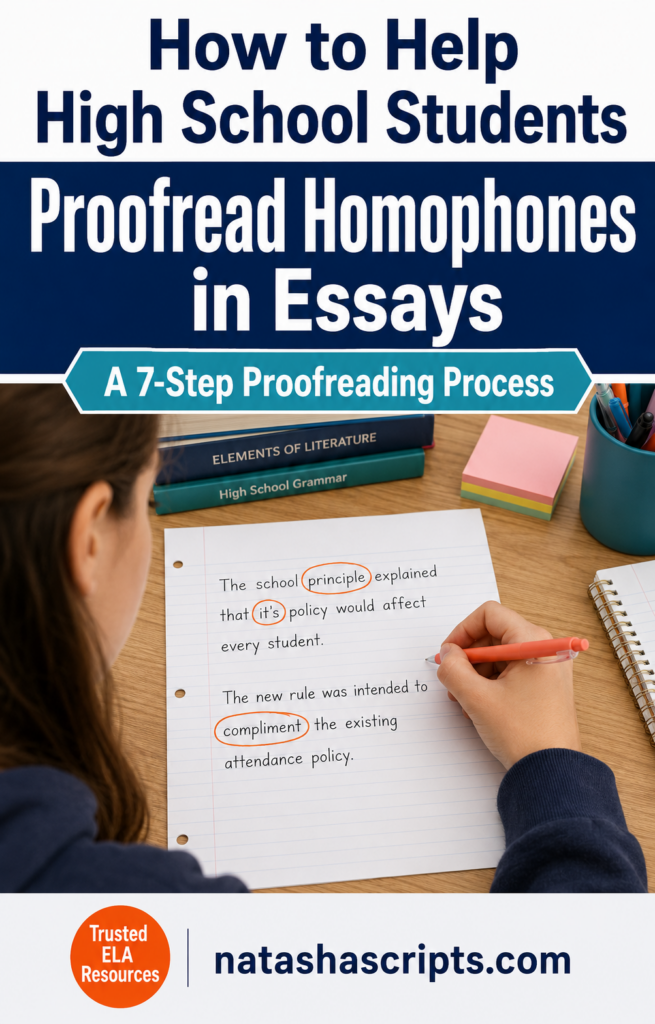
This article provides a step-by-step process to help students reduce homophone errors in their essays.
When a 10th-grade student submits an analytical essay with their where there belongs, or your in place of you’re, it is easy to dismiss the mistake as carelessness. Yet many students can explain the difference between the words when they are presented on their own. The difficulty appears when students must select the correct spelling while also developing ideas, organizing paragraphs, and constructing sentences. Under those conditions, the wrong homophone may come to mind automatically and remain unnoticed during revision.
This distinction matters for teachers and homeschool parents. If students understand the difference between two homophones but do not apply that knowledge consistently in their essays, another worksheet based only on definitions and isolated sentences is unlikely to solve the problem. They need practice retrieving the correct word while writing, together with a focused editing routine that helps them find and correct the homophones they repeatedly confuse.
Why Homophones Behave Differently in Essays Than in Exercises
In a spelling exercise, students usually focus on one word or one distinction at a time. They have enough time to consider the meaning of the sentence, recall the rule, and choose the correct spelling. Writing an essay is very different. Students are developing an argument, selecting evidence, organizing paragraphs, and constructing sentences at the same time. Spelling receives only a small part of their attention.
Under these conditions, students may write the form of a homophone that comes to mind first without checking whether it fits the meaning of the sentence. This explains why a student who can distinguish their, there, and they’re in an exercise may still use the wrong form in an essay. The student may know the difference but fail to apply that knowledge while concentrating on the content of the writing.
These errors do not always disappear as students become more fluent writers. In fact, familiar words can be particularly easy to overlook. Students are more likely to pause over a word they know is difficult than over one they have written hundreds of times. When they reread the essay, the incorrect homophone may still look familiar enough to escape notice.
For this reason, homophone mistakes in high school essays need to be treated as both spelling and proofreading problems. Students need to know the differences between the words, but they also need a focused way to check that they have selected the correct forms in their own writing. A related article explains a pass-by-pass revision process for high school essays, which helps students treat proofreading as a separate stage rather than giving the essay one quick final read.
Common Homophones High School Students Should Already Know
By high school, most students can explain the differences between their, there, and they’re or your and you’re when the words are presented in isolation. Yet these familiar homophones still appear incorrectly in essays. The difficulty often arises when students are concentrating on developing an argument, selecting evidence, and organizing complex sentences. Knowing the distinction does not always mean that the correct form will come to mind automatically during writing.
Their, There, and They’re
Students can check this set by identifying the job the word performs in the sentence:
- Their shows possession: “The characters conceal their intentions.”
- There refers to a place or introduces a statement: “There are several reasons for his decision.”
- They’re is the contraction of they are: “They’re unwilling to accept the consequences.”
A useful check is to substitute they are. If the sentence still makes sense, they’re is correct. If it does not, students should decide whether the sentence requires possession or a reference to a place or situation.
Your and You’re
The distinction between your and you’re follows a similar pattern:
- Your shows possession: “The evidence supports your interpretation.”
- You’re means you are: “You’re expected to support the claim with evidence.”
Students can test you’re by replacing it with you are. However, an error involving this pair may also signal a broader issue. Since direct second-person address is often unnecessary in an academic essay, students should first decide whether you belongs in the sentence at all. In many cases, revising the sentence to remove direct address produces more formal and precise writing.
Its and It’s
The its/it’s distinction can be more difficult because it appears to conflict with the familiar rule that apostrophes show possession:
- Its is a possessive pronoun: “The novel reveals its central conflict gradually.”
- It’s is the contraction of it is or it has: “It’s clear that the narrator is unreliable.”
Students can replace it’s with it is or it has to see whether the contraction works. It also helps to connect its to other possessive pronouns, such as his, her, our, and their. None of these words takes an apostrophe.
A related article on proofreading apostrophes and possessives in high school writing explains this pattern in more detail and provides a structured checking routine for classroom or home use.
To, Too, and Two
Of these three forms, to and too are the most likely to be confused in high school essays:
- To is commonly used before a noun or an infinitive: “The author uses imagery to establish the setting.”
- Too means also or indicates an excessive degree: “The explanation is too general.”
- Two represents the number 2: “The essay presents two contrasting viewpoints.”
Students can check too by asking whether it could be replaced by also or excessively. Because the difference between to and too is only one letter, this error can be easy to overlook during a quick visual scan.
These homophones do not usually require another lesson devoted to memorizing their definitions. Students need a focused proofreading routine that prompts them to locate each form, identify its function in the sentence, and apply the appropriate substitution check.
Affect and Effect
Affect and effect are not exact homophones, but they can sound very similar in ordinary speech and are frequently confused in high school essays. In most academic writing, students can distinguish them by checking the job the word performs:
- Affect is usually a verb meaning to influence: “The setting affects the character’s decisions.”
- Effect is usually a noun meaning a result: “The decision has a lasting effect on the character.”
A useful check is to ask: Is the word describing an influence or naming a result? If it describes what something does, affect is usually correct. If it names what happened as a result, students will usually need effect.
There are less common exceptions. Effect can be used as a verb meaning to bring about, as in “to effect change,” while affect can be used as a noun in psychology. Most students will not need these meanings frequently, but advanced writers may encounter them in academic texts.
This pair often causes difficulty because both forms look familiar. Students may recognize each word without being certain which one fits a particular sentence. That is why simply memorizing the spellings is not enough. Students need to identify how the word is functioning before choosing the correct form.
A related article on why high school students misspell familiar words explores why students may know a word but still write it incorrectly in a formal piece of writing.
More Advanced Homophones in High School Essays
Once students have learned the most common homophones, they begin to encounter less familiar pairs in literature responses, research papers, and argumentative essays. These words may appear less frequently, but they can be more difficult to check because students have not seen or used them often enough for the distinction to feel automatic.
Principal and Principle
Principal and principle are especially likely to appear in essays about history, politics, ethics, or literature:
- Principal can mean most important: “The principal reason for the conflict is the struggle for power.”
- Principle refers to a rule, belief, or standard: “The character refuses to abandon her principles.”
Principal can also refer to the person who leads a school, but that meaning is less likely to cause confusion in an analytical essay. To remember the difference, students can connect principle with rule. Both words end in -le, so the matching ending provides a useful spelling cue: a principle is a rule.
Complement and Compliment
The difference between complement and compliment is useful when students explain how ideas, characters, sources, or literary techniques work together:
- Complement means that one thing completes or works well with another: “The illustrations complement the author’s description of the setting.”
- Compliment refers to praise: “The reviewer compliments the author on the strength of the dialogue.”
To remember the difference, students can connect complement with complete. Both words contain an e, and something that complements another thing helps to complete it.
Cite, Site, and Sight
This set has a particularly strong connection to research and literary analysis:
- Cite means to refer to a source or provide evidence: “Students should cite evidence from the text.”
- Site refers to a location: “The archaeological site provides evidence of an earlier settlement.”
- Sight relates to seeing or something that can be seen: “The narrator loses sight of the original goal.”
Discreet and Discrete
Discreet and discrete are more advanced words, and both can appear in formal writing:
- Discreet means careful, private, or unlikely to attract attention: “The character makes a discreet inquiry.”
- Discrete means separate or distinct: “The researcher divided the results into three discrete categories.”
Council and Counsel
Students may encounter council and counsel in essays about government, history, law, or literature:
- Council is a group that meets to discuss matters or make decisions: “The city council rejected the proposal.”
- Counsel means advice, or the act of giving advice: “The adviser’s counsel influences the king’s decision.”
Counsel can also refer to a lawyer or legal adviser.
These advanced homophones cannot always be checked through a simple contraction test such as replacing you’re with you are. Students need to consider the meaning of the complete sentence and, when necessary, consult a dictionary. Keeping a personal list of frequently confused words can also make proofreading more focused. Instead of checking every word in the essay, students can search specifically for the homophones they know they are likely to confuse.
How Targeted Proofreading Helps Students Catch Homophone Errors
Homophone mistakes are difficult to catch during a general read-through. When students are concentrating on their argument, evidence, and organization, they may read the word they intended to write rather than the one that appears on the page. Proofreading for homophones therefore needs to be a separate, targeted stage of the revision process.
Teachers and homeschool parents can guide students through the following process.
Step 1: Provide the Students With a Homophone Checklist
Give the students a checklist of homophones that are commonly confused. Ask them to identify the pairs they find difficult or are unsure how to use. These words will form the basis of their personal homophone list in Step 2.
Homophone Checklist
- whose / who’s
- were / we’re / where
- principal / principle
- complement / compliment
- cite / site / sight
- council / counsel
- stationary / stationery
- discreet / discrete
- altar / alter
- assent / ascent
- capital / capitol
- canvas / canvass
- coarse / course
- faze / phase
- incite / insight
- precedence / precedents
Step 2: Create a Personal Homophone List
The student should keep these words on a short proofreading list. Each entry can include the meanings of the words, an example sentence, and any useful memory cue.
For example:
- Principle means a rule. Both words end in -le.
- Complement is connected to complete. Both words contain an e.
- You’re can be replaced with you are.
The list should remain short enough to use easily and can be updated when new patterns appear.
Step 3: Complete the Main Essay Revision First
Students should first revise the content and organization of the essay. They can check whether the argument is clear, the evidence is relevant, and the paragraphs are logically arranged.
Only after completing these larger revisions should they begin the homophone check. Separating the tasks allows students to concentrate on one type of problem at a time.
Step 4: Search for Each Homophone Separately
Using their personal list, students should work through the essay and locate every occurrence of each problem word. They can circle, underline, or highlight each one before moving to the next homophone on the list.
Students should check every occurrence, not only the forms they suspect are incorrect. A word may be spelled correctly but still be the wrong homophone for the meaning of the sentence.
Step 5: Read the Complete Sentence and Apply the Appropriate Check
For common homophones, students can often use a substitution test:
- Replace you’re with you are.
- Replace they’re with they are.
- Replace it’s with it is or it has.
- Ask whether too means also or excessively.
Advanced homophones require a closer examination of meaning. Students should read the complete sentence and ask what the word is intended to communicate. Does principle refer to a rule? Does complement mean that one thing completes or works well with another? Does cite refer to evidence or a source?
When the distinction is still unclear, students should consult a dictionary and compare the definitions with the meaning of the sentence. This is more reliable than choosing the spelling that simply looks most familiar.
Step 6: Correct the Word and Explain the Choice
Students should correct any mistake and briefly explain why the new form is appropriate. The explanation does not need to be written every time once the distinction becomes secure, but it is valuable during the early stages of practice.
For example:
I need principle because the sentence refers to a rule or belief.
Requiring students to explain the choice helps them connect the spelling to the intended meaning.
Step 7: Update the List and Repeat the Process
After proofreading, students should update their personal homophone list. They can add words they discovered they were unsure about and cross out words they have used correctly across several essays.
Students should repeat the targeted check with each extended piece of writing. As the list becomes more accurate, they can concentrate on the homophones that still cause difficulty.
A Focused Check Builds More Independent Writers
Students do not need to check every possible homophone whenever they write. They need to recognize the words they personally confuse and follow a reliable process for checking each one in context.
With repeated use, this targeted proofreading pass becomes a familiar part of completing an essay. It takes only a few minutes once students have established their personal lists, and it helps them submit cleaner work while taking greater responsibility for their own writing.
Reinforce Spelling Through Extended Writing
Targeted proofreading becomes more effective when students also have regular opportunities to apply spelling knowledge in their writing. The Spelling High School Workbook for Grades 9–10 and the Spelling High School Workbook for Grades 11–12 connect spelling instruction with sentence development and extended writing activities.
This allows students to practise spelling in the context in which accuracy matters most: communicating their own ideas clearly. The repeated combination of spelling practice, writing, and proofreading helps students carry what they have learned into future assignments.