How to Help High School Students Organize an Argumentative Essay
High school students may write clear sentences and well-developed paragraphs but still need help deciding how to arrange their ideas in an argumentative essay. A paragraph may introduce a point before the reader has enough background to understand it. Another may explain information that was needed earlier. The individual paragraphs make sense, but their order makes the argument difficult to follow.
For students who need practice developing individual paragraphs, Sentence to Paragraph Writing for Teens provides structured lessons in sentence and paragraph writing. Checking how those paragraphs work together is a further step: students need to consider what readers should understand first and how each point prepares them for the next.
When students revise, they often begin with spelling, punctuation, or awkward sentences. These are easier to notice than problems with the order of ideas. Checking that order requires students to step back from individual paragraphs and consider how the argument develops across the essay.
Teachers and homeschool parents can help by making this a separate revision step. Before students edit their sentences, ask them to identify the main point of each body paragraph and explain why the points appear in that order. This gives them a clear starting point for deciding what to move, explain earlier, or develop further.
Common Problems with Paragraph Order
One common problem is an essay that moves between related points without explaining why they appear in that order. In an essay arguing that high school students should be allowed to use their phones during lunch, a student might discuss contacting family members, move to taking a break from schoolwork, and then return to coordinating transport or after-school arrangements. Each point may be relevant, but the two points about practical communication are separated without a clear reason.
Ask students whether bringing those points together would help the reader follow the argument. They may decide to combine them in one paragraph or place the paragraphs next to each other. If they keep them separate, they should be able to explain what each contributes and why another point comes between them.
Another problem occurs when a paragraph depends on information introduced later. A student might propose a change to the school phone policy before explaining what the current policy allows. Readers need that information to understand the proposed change. Moving the explanation earlier, or adding a brief explanation where it is needed, can make the argument easier to follow.
The final body paragraph also deserves attention. An essay may develop several well-supported points about communication and responsible phone use, then finish with a brief point about watching entertaining videos. Students should consider whether that last paragraph adds a reason they can support and explain, and how it prepares the reader for the conclusion. They may need to move it, develop it further, or remove it if it adds little to the argument.
The strongest point does not always need to come last. What matters is whether each paragraph appears where the reader can understand it and see how it supports the argument.
Why Students Need Help Checking Paragraph Order
Students may know how to write a topic sentence, support it with evidence, and explain what that evidence shows. These skills help them develop individual paragraphs, but they also need practice deciding how those paragraphs fit together. The related article How to Help Teens Develop Clear, Focused Paragraphs examines the paragraph skills that support this work.
There is no single correct order for every argumentative essay. Students need to consider what readers already know, what requires explanation, and how each point connects to the next. In the essay about phone use during lunch, for example, explaining the current school policy may help readers understand the reasons for proposing a change.
General advice such as “make the essay flow” gives students little direction. More specific questions help them make decisions: What does the reader need to understand first? Which points belong together? Does this paragraph depend on an explanation that comes later? Discussing these questions gives students a practical way to check their paragraph order.
General advice such as “make the essay flow” gives students little direction. More specific questions help them make decisions:
- What does the reader need to understand first?
- Which points belong together?
- Does this paragraph depend on an explanation that comes later?
Discussing these questions gives students a practical way to check their paragraph order.
A Step-by-Step Process for Checking Paragraph Order
Before students edit individual sentences, give them a separate revision step for checking how their argument develops. Use the following process to help them review the order of their body paragraphs.
-
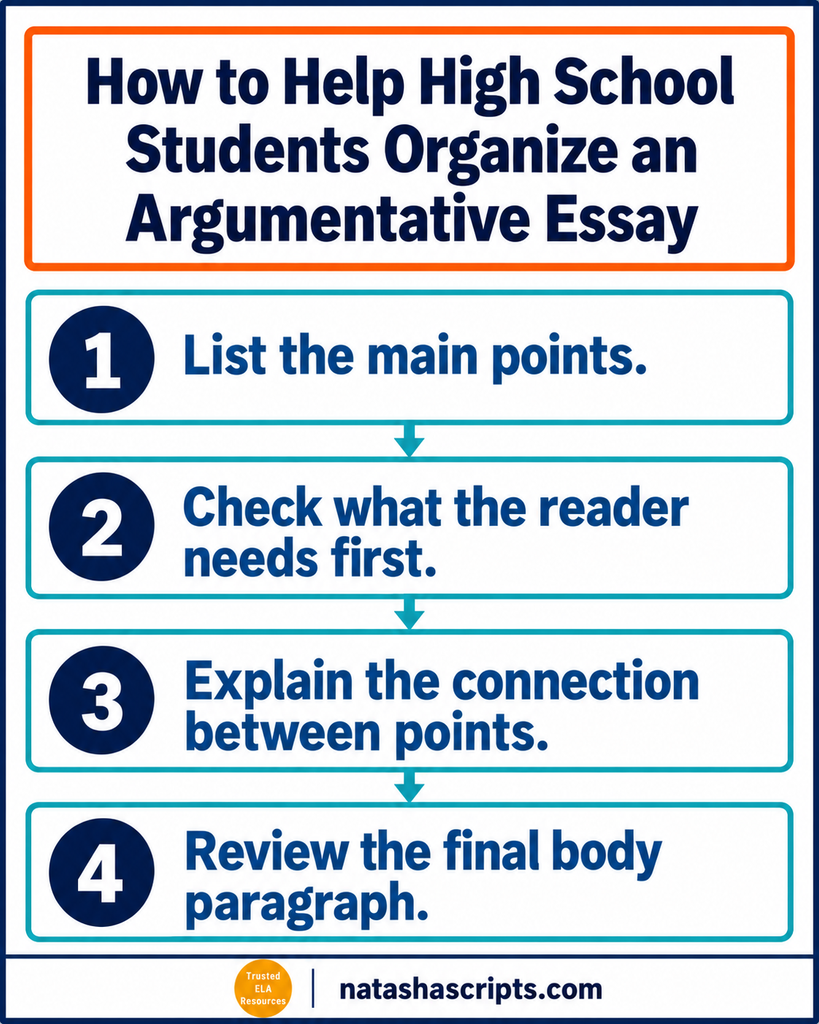
Step 1: List the main points in order.
Write one sentence stating the claim of each body paragraph. Leave out the evidence and explanation for now. Reading this shorter version can help students notice repeated points, gaps, or ideas that belong together.
-
Step 2: Check what the reader needs first.
Read the first claim alongside the introduction and thesis. Does the reader have enough information to understand it? In the essay about phone use during lunch, students may need to explain the current school policy before discussing a proposed change.
-
Step 3: Explain the connection between points.
Ask students to complete this sentence for each point after the first: “I placed this point here because…” If they cannot explain the order, have them try another arrangement and compare the two.
-
Step 4: Review the final body paragraph.
What does this point add, and how does it prepare the reader for the conclusion? Students may need to develop it further, move it earlier, or choose a different point to finish the body of the essay. The strongest point does not always need to come last.
Students can use a printed draft or move paragraphs in a document. After changing the order, ask them to reread the affected paragraphs and adjust any explanations or transitions that no longer fit. They can then turn to sentence editing.
What Moving a Paragraph Can Improve
After checking their paragraph order, students need to decide what to move and why. Each change should help the reader understand the argument.
One useful change is to introduce necessary background information earlier. In the essay about phone use during lunch, readers need to understand the current school policy before they can evaluate a proposed change. If that explanation appears near the end, moving it earlier can clarify the points that depend on it.
Students may also need to bring related points together. A paragraph about contacting family members and another about arranging transport may overlap. Placing them next to each other can help students decide whether each develops a distinct reason or whether the evidence belongs in one paragraph.
Sometimes a specific example needs to come before a broader claim. A student might argue that limited phone use gives students opportunities to make responsible choices. Explaining the proposed limits first, such as using phones only during lunch and putting them away before the next lesson, gives readers a clearer basis for considering that argument. The student still needs evidence and explanation to support the claim.
Finally, students should check what happens when they move the last body paragraph. Would a different point bring the discussion to a clearer stopping place before the conclusion? A paragraph addressing a concern about the proposed policy might work well there, provided the earlier paragraphs have prepared the reader for it.
After moving a paragraph, students should reread it alongside the paragraphs before and after it. A new order may also require changes to the opening sentence, explanation, or transition.
Making Paragraph Order Part of the Revision Process
Checking paragraph order gives students a specific task to complete before they edit sentences. The related article A Pass-by-Pass Revision Process for High School Essays discusses how to organize other revision tasks across a draft. Helping High School Students Plan Long Writing Projects considers how students can organize their ideas before drafting begins.
A teacher, homeschool parent, or peer can help by reading specifically for the order of ideas. Ask the student to explain why one point follows another, then check whether the writing makes that connection clear. Sometimes the order works, but an explanation is missing. In other cases, the conversation reveals that a paragraph needs to move.
Students can also use these questions during planning. Before drafting, they can list their main points, identify any background information readers will need, and consider which ideas belong together. They can revisit those decisions as their argument develops.
For the next essay revision, begin with the list of paragraph claims. Ask students to explain the sequence, make any necessary changes, and reread the connections before turning to individual sentences.
Free ELA Resources for Teachers and Homeschool Parents
Sample lessons and worksheets for writing and other ELA skills are available on the Free ELA Resources page. These samples give teachers and homeschool parents an opportunity to review the materials and consider how they might fit their instruction.
