How to Help Teens Develop Clear, Focused Paragraphs
When Correct Sentences Do Not Form a Strong Paragraph
Students can often write correct individual sentences and still struggle to develop a complete paragraph. Three problems appear repeatedly: the writing repeats the same idea, moves away from the main point, or stops before the idea has been properly developed.
A student may begin with a clear topic sentence and then restate it several times in slightly different words. Another may add an interesting detail that has little to do with the paragraph’s focus. Sometimes the paragraph remains very short because the student does not know how to explain the point, provide a useful example, or add evidence that helps the reader understand it.
From my teaching experience, these problems are easier to address when paragraph writing is taught as a series of decisions. Students need to decide what the paragraph will focus on, how they will develop that idea, which order will help the reader follow it, and what should be changed during revision. Simply asking for a topic sentence and several supporting sentences does not explain what those sentences need to do.
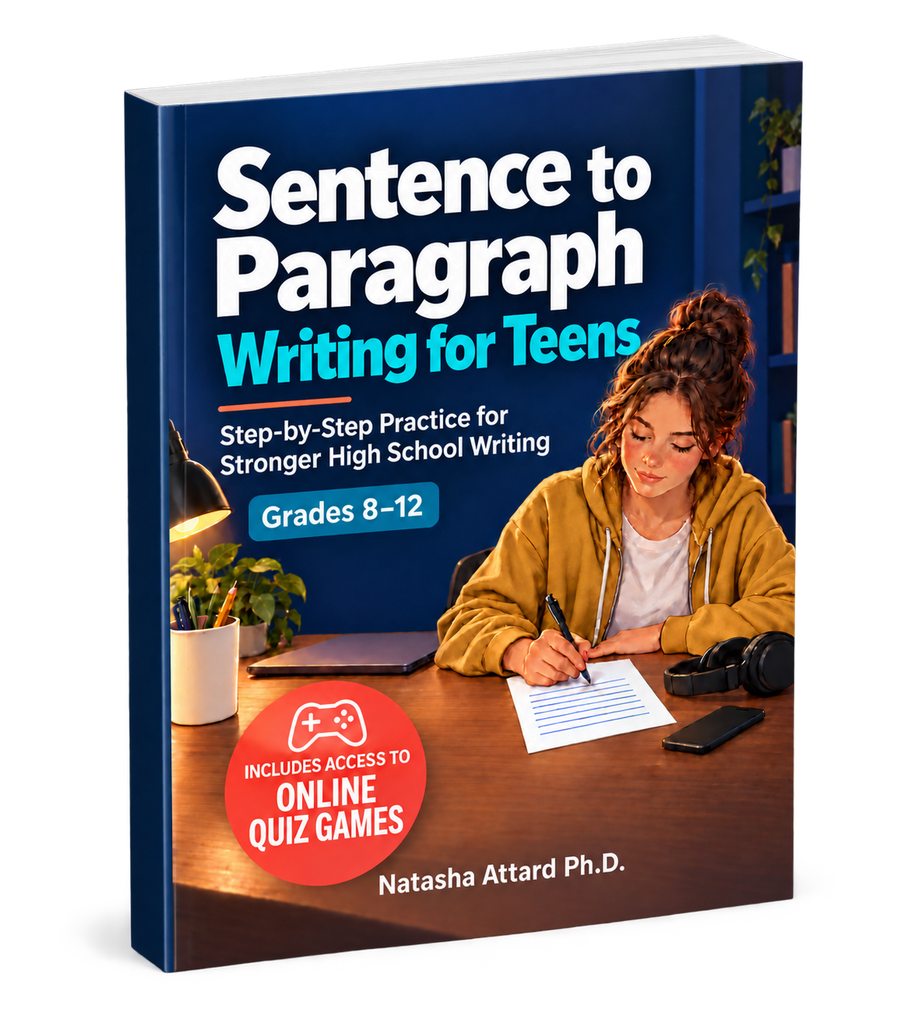
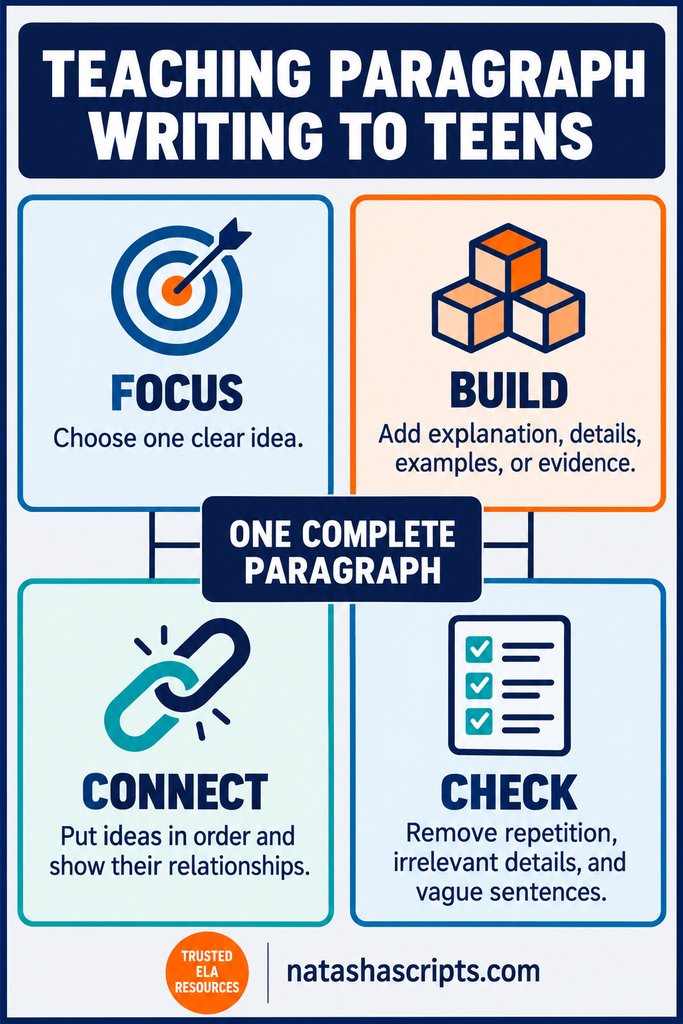
These teaching considerations shaped my new book, Sentence to Paragraph Writing for Teens, which has now been published for students in Grades 8–12. I organized the instruction around four stages: Focus, Build, Connect, and Check. Each stage addresses a different part of paragraph writing, and students practice the skills separately before bringing them together in complete paragraphs.
These problems are easier to address when paragraph writing is taught as a series of decisions.
Focus Begins Before the Topic Sentence
Many paragraph problems begin before students write their first sentence. A topic such as music, sports, or social media contains too many possible directions for one paragraph. If students begin writing immediately, they may move between several ideas because they have not yet decided which one the paragraph will develop.
I teach students to narrow the topic in stages. They begin with the broad subject, identify several possible branches, and then choose one specific claim. For example, the broad topic music might lead to the branch why people replay the same song. From there, the student can form a precise idea: replaying a song allows the listener to notice details that a single listen may miss. That idea is focused enough to become the basis of a paragraph.
This planning step gives the paragraph a clear boundary. As students add supporting sentences, they can ask whether each one explains, illustrates, or supports the chosen claim. A sentence may be interesting and well written, but it does not belong if it develops a different point.
In Sentence to Paragraph Writing for Teens, students practice narrowing topics before they work on topic sentences. This separation is deliberate. It allows them to decide what they want to say before concentrating on how to express it in a clear opening sentence.
Supporting Sentences Need to Add Something New
Once students have established a clear focus, they need to develop it. This is often where repetition begins. Students may understand that a paragraph requires supporting sentences but remain unsure about what those sentences should contain. They repeat the topic sentence with different wording because they have not been given another way to continue.
I teach students several ways to develop an idea. They can explain why or how the claim is true, add a specific detail or example, introduce and explain evidence, show a reason or result, or use a comparison to clarify the point. A paragraph does not need to include every method. The student chooses the kind of support that helps the reader understand the particular idea.
Consider the topic sentence, Learning to repair a bicycle can make a teenager more independent. A sentence stating that bicycle repair is a useful independent skill adds very little. A specific example develops the point: Knowing how to patch a punctured tire allows a teenager to continue a journey without waiting for someone else to solve the problem. The second sentence gives the reader new information and shows what that independence looks like.
In the Build part of Sentence to Paragraph Writing for Teens, students practice these methods separately before using them together. They also work with thin paragraphs that contain a clear main idea but too little support. This helps them recognize that adding more sentences is not enough. The sentences need to explain, illustrate, or support the focus of the paragraph.
Connections Begin With Logical Order
A paragraph becomes easier to follow when its sentences appear in an order that makes sense to the reader. Some sentences depend on information introduced earlier. If they are placed too soon, the reader has to stop and work out what has been missed.
A paragraph about setting up a new phone, for example, should explain connecting to Wi-Fi before describing how the phone restores files from an online account. The second action depends on the first. Students need to notice these dependencies and arrange the sentences accordingly.
They also need to identify the relationship between ideas. One sentence may provide a result, an example, an additional point, or a contrast. Connecting words can make that relationship clear, but the word must express the meaning accurately. However cannot connect two ideas that do not contrast, just as as a result should not be used when the second sentence is not a consequence of the first.
Sentence-to-sentence flow can also be created by carrying a key word or idea forward. A sentence introduces information, and the next sentence begins with something the reader already recognizes before adding a new point. This creates continuity without requiring a transition at the beginning of every sentence.
In the Connect part of Sentence to Paragraph Writing for Teens, students practice logical order, relationships between ideas, and sentence-to-sentence flow as separate skills. They then repair paragraphs in which the ideas are relevant but poorly ordered or weakly connected. This helps them understand that a paragraph can contain useful information and still be difficult to follow.
Revision Looks at the Paragraph as a Whole
Students often associate revision with correcting spelling, punctuation, and grammar. These checks are necessary, but they do not address a paragraph that repeats itself, includes an unrelated sentence, or leaves its main idea underdeveloped.
I teach students to examine the paragraph before concentrating on individual errors. They check that every sentence contributes to the same focus, that each supporting sentence adds useful information, and that the ideas appear in a logical order. One practical method is to cover a sentence and read the paragraph without it. If nothing important is lost, the sentence may be repetitive or irrelevant.
Vague sentences also need attention. A sentence such as The experience taught him a lot may fit the topic, but it does not tell the reader what he learned or why it mattered. Revision asks the student to replace that general statement with the precise idea the paragraph needs.
The ending should also complete the paragraph rather than repeat the topic sentence. It may show why the point matters, draw together the supporting ideas, or leave the reader with a final consequence. The appropriate ending depends on the purpose of the paragraph.
In the Check part of Sentence to Paragraph Writing for Teens, students remove repetition and irrelevant details, strengthen vague sentences, improve endings, and revise complete paragraphs. Grammar and punctuation are checked after the paragraph’s focus, development, and organization are secure.
Independence Comes After Structured Practice
Writing a complete paragraph requires students to manage several decisions at the same time. Asking them to handle all of those decisions from the beginning can make it difficult to see which skill is causing the problem. I therefore teach the stages separately and bring them together gradually.
Most lessons in the book follow the same process. Students first read a clear explanation, study the skill in a model, complete guided practice, and then apply it in their own writing. The repair lessons use a related sequence: students find the problem, connect it with the appropriate skill, repair it with guidance, and finally attempt a similar task independently.
By Part 6, students have already practiced Focus, Build, Connect, and Check in detail. They then use the complete process to write explanation, description, opinion, and response-to-reading paragraphs. The first full-cycle lesson provides planning questions at every stage. Later lessons reduce that support, and the final task removes the planning boxes so that students make their own decisions with only the reference toolkit available.
Self-checks and progress records allow students to identify what they can complete independently, what they can manage with a reminder, and what still needs practice. Each part also includes access to an online quiz game that reviews the skills before students move forward.
This gradual reduction of support is central to the book. The aim is for students to understand what a paragraph requires, recognize where their own writing needs work, and know which part of the process to return to when they are unsure. Sentence to Paragraph Writing for Teens is now published, bringing this complete teaching sequence together for students in Grades 8–12.