How to Teach -able and -ible Spelling in Middle School
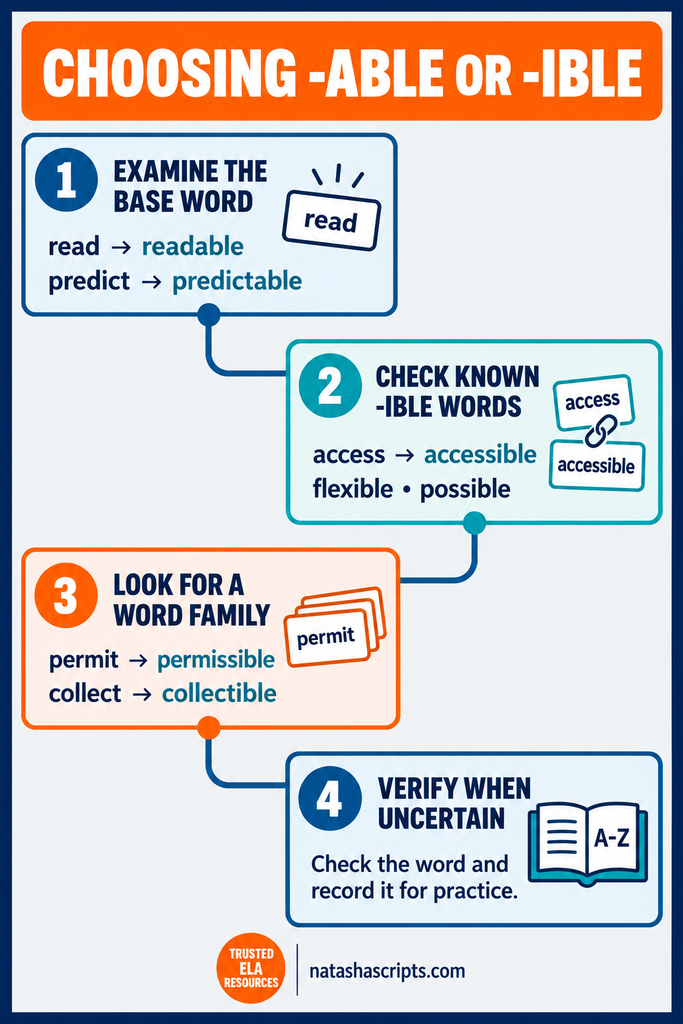
When middle school students spell words such as comfortable and flexible, pronunciation gives them very little help with the ending. Both -able and -ible are usually unstressed and sound much the same in ordinary speech. A student may pronounce the word correctly and still be unsure which ending to write.
Many students choose -able when they are uncertain. It appears in a large number of familiar words, including readable, washable, and breakable, so the choice is often correct. That success can strengthen the habit of guessing until the student encounters words such as possible, responsible, and terrible.
The distinction between the two endings is not random. Several useful patterns can help students make the correct choice, although some words still need to be learned individually. I prefer to teach the patterns first and then introduce a manageable group of common words that require direct practice. This gives students a process they can apply before consulting a dictionary or relying on visual memory.
Why Sounding Out Is Not Enough
Phonics, syllabification, and pronunciation remain useful spelling tools in middle school. With -able and -ible, however, they help students hear the ending without revealing which vowel it contains. The more useful clues come from the structure and history of the word.
The ending -able can be added to many complete English words, as in readable, washable, and enjoyable. Words ending in -ible form a smaller group and often come from Latin roots that do not function as complete English words. Students do not need a detailed study of etymology, but they do need to understand why sound alone cannot settle the spelling.
Because -able is the more common and productive ending, guessing it will work often enough to become a habit. Direct instruction gives students other checks to use. They can examine the base word, look for a related word, and recognize the common -ible words that need to be remembered.
My article on why spelling practice still matters in middle school discusses the broader need to continue developing spelling knowledge as students encounter longer words and more demanding writing.
Start With the Base Word
The first check I would teach is to remove the ending and examine what remains. If students can identify a complete English word, -able is usually the correct choice. This pattern appears in readable (read + able), washable (wash + able), breakable (break + able), and laughable (laugh + able).
Some words require a spelling adjustment when the suffix is added. The final e is removed in manage/ manageable, while it is retained in agree/agreeable. The base word still provides the clue that the ending is -able, even when its spelling changes slightly.
Many common -ible words do not leave a complete English word when the ending is removed. Examples include possible, visible, audible, and credible. Their roots come from Latin, but they are not words that students would normally use on their own.
This test is most dependable in one direction. A recognizable base word points strongly toward -able. When no complete word remains, -ible becomes a possibility, but it is not guaranteed. Capable, durable, and probable also end in -able without leaving familiar standalone words. Students then need to check a related word, consult a dictionary, or learn the spelling through direct practice.
I would introduce this as a useful first check rather than a complete rule. It resolves many familiar words and also shows students when they need another source of information.
Three Additional Patterns Students Can Use
After students understand the base-word check, they can use several additional patterns. These provide useful clues, but they should not be presented as rules that cover every word.
Check a Final Silent e
When -able is added to many complete words ending in a silent e, the final e is removed.
love → lovable
use → usable
desire → desirable
adore → adorable
The e is usually retained after c or g when it is needed to preserve the soft consonant sound.
notice → noticeable
manage → manageable
change → changeable
Recognize the -mit/-missible Family
Several familiar verbs containing -mit form related adjectives ending in -missible. Students can learn these as members of the same word family.
permit → permissible
admit → admissible
dismiss → dismissible
transmit → transmissible
The double s is part of this particular family. It is not a general rule for choosing -ible.
Look for a Related -ion Word
Some -ible words belong to families that also contain a familiar noun ending in -ion. Recognizing the relationship can help students remember the spelling.
digest → digestion → digestible
suggest → suggestion → suggestible
collect → collection → collectible
The -ion noun is a word-family clue. It does not mean that every word ending in -tion produces an adjective ending in -ible.
Teaching point: Ask students to use each pattern as a clue. When the clues do not settle the spelling, they should check the word and record it for direct practice.
High-Frequency Words That Require Memorization
Common -ible Words to Study Directly
The spelling checks described above resolve many words, but they do not settle every case. A short group of common -ible words needs direct study. Students can practice these through syllables, word families, sentence writing, and proofreading rather than trying to learn them as one long, unrelated list.
possible impossible
responsible irresponsible
terrible
horrible
flexible inflexible
visible invisible
sensible
compatible incompatible
eligible ineligible
legible illegible
credible incredible
accessible inaccessible
Teach related forms together: Once students know the spelling of the base form, a prefix changes its meaning without changing the -ible ending. Learning visible with invisible, for example, reduces the number of separate spellings they need to remember.
Building a Five-Step Spelling Check
Students can bring the patterns together in a short spelling check. I would introduce the steps gradually, allowing time to practice each one before asking students to use the complete sequence. The reference should help them examine the word and recognize when they need to verify its spelling.
Choosing Between -able and -ible
- Remove the ending and examine what remains. If a complete English word remains, -able is usually the appropriate starting choice.
- Check for a familiar -ible word or exception. Words such as accessible, digestible, and collectible contain recognizable bases but still take -ible.
- Look for a word-family clue. Connections such as permit/permissible and collection/collectible can help confirm the spelling.
- Apply any necessary spelling change. When adding -able, check whether a final silent e should be removed or retained.
- Verify the word when the clues do not settle it. Check a dictionary, then record the word for direct practice instead of making a final guess.
In a classroom, teachers can display the sequence during word sorting and ask students to explain which clue they used. The same reference can be kept beside a homeschool student during spelling and writing activities. With regular use, students should begin to recognize familiar word families and rely on the reference less often.
Practice the Decision Process
Students need to use the spelling check across several short sessions before they can apply it confidently in their own writing. One lesson followed by a test gives them little time to become familiar with the steps. Five or ten minutes of regular practice is more useful than completing all the work at once.
Teachers and homeschool parents can begin with a mixed group of -able and -ible words from which the endings have been removed. Students choose the ending and briefly explain the clue they used. They might write, “Predict is a complete word, so predictable takes -able,” or “Flexible is on the direct-study list, so I checked its spelling rather than relying on the base-word test.” These explanations show how the student reached the answer and reveal any misunderstanding of the framework.
As students become more familiar with the process, the explanations can be shortened or given orally. They can then proofread a paragraph containing deliberate -able and -ible errors, correct each word, and identify the clue that helped. This brings the spelling work into connected writing, where students will eventually need to apply it independently.
My article on six spelling activities for middle schoolers includes word sorting, proofreading, sentence writing, and other activities that can be adapted for these endings.
For students who benefit from brief daily practice, Daily Spelling Snacks for Grades 7–8 contains 90 spelling and vocabulary words arranged across ten themed units. Each word is studied through its meaning, spelling structure, and use in writing. Teachers and homeschool parents can use the short activities for warm-ups, independent practice, homework, or review.
Regular use of the spelling check helps students recognize familiar patterns, remember common -ible words, and know when a spelling needs to be verified. Over time, these decisions require less conscious attention and guessing becomes less frequent.
What Students Should Be Able to Do
For students in grades 6 through 8, the aim is practical. They should be able to use the base-word check, recognize the word families and spelling patterns they have studied, remember a manageable group of common -ible words, and verify a spelling when the available clues do not provide a secure answer.
Not every word can be resolved through the framework. Contemptible, for example, contains the complete word contempt but still takes -ible. A student who encounters it for the first time may need to check a dictionary and add it to a direct-study list. Knowing when a rule has reached its limit is part of making a sound spelling decision.
Across a semester, regular sorting, sentence writing, proofreading, and dictionary work should reduce the number of words students approach through guessing alone. They will also become more familiar with recurring word families and more independent when checking unfamiliar spellings.
My Back-to-School ELA Roadmap discusses how spelling, vocabulary, and grammar instruction can be included within the wider middle school ELA schedule.
Teachers and homeschool parents can also find sample lessons and worksheets on my Free ELA Resources page
