Helping High School Students Plan Long Writing Projects
This article includes a free High School Writing Project Planner that you can download using the form below.
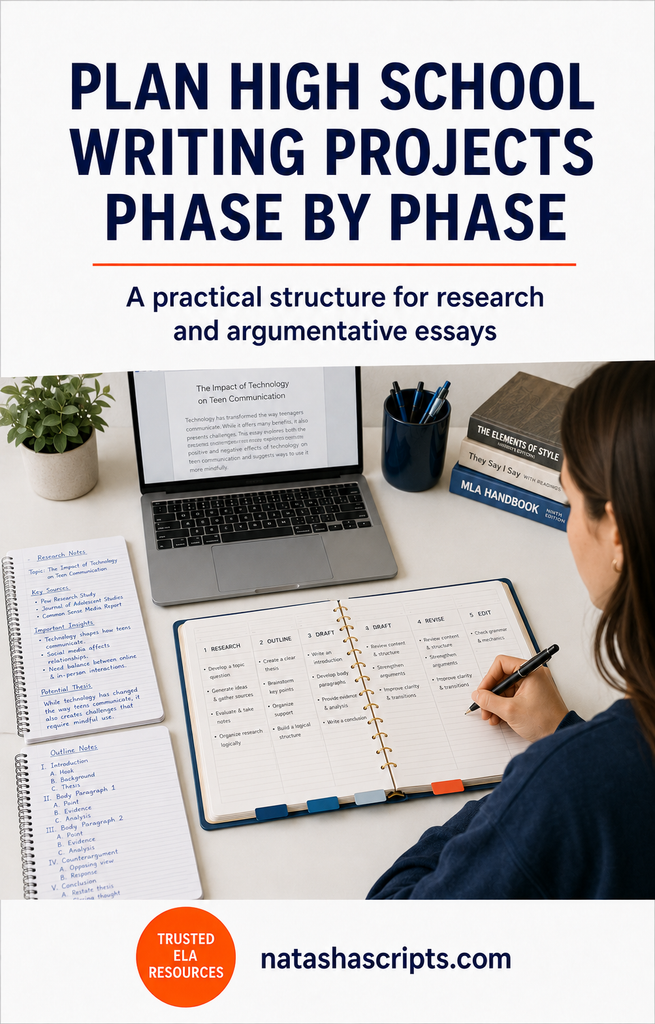
An 11th grader may spend three weeks working on a research paper and still submit a draft that reads as though it was written the night before. The student may have read articles, highlighted passages, and filled pages with notes. However, those activities do not automatically move a paper toward completion. Without a clear outcome for each stage, several weeks of work can produce a collection of material rather than a developed argument.
Planning an extended writing project is a skill in its own right, and students benefit from being taught how to do it. Research papers, literary analyses, argumentative essays, and independent study reports require students to manage several connected tasks over time. They must narrow a topic, develop a question or claim, select evidence, organize ideas, draft sections, and leave sufficient time for revision and editing.
A phase-based plan gives each stage a defined purpose, an expected outcome, and a clear completion point. Students can see what they are working toward, while teachers and homeschool parents can identify delays before the final days of the project. Each completed phase moves the paper closer to a finished draft and makes progress easier to monitor.
Show Students What “On Track” Looks Like
When teachers or homeschool parents introduce a long writing project, they commonly provide a final due date and several intermediate checkpoints, such as topic approval, source submission, or a rough draft. These dates provide a useful framework, but the periods between them may remain largely undefined. Students who are still learning how to manage extended writing may understand the deadline without knowing how to divide the work that leads to it.
The gap between “I have three weeks” and “I know what I need to complete today” is where a project can begin to stall. A student may spend the first week reading without narrowing the research question, recording usable evidence, or deciding how the sources connect. By the second week, the student may sense that the project is behind schedule but have no clear standard for what should already be complete. During the final week, research, organization, drafting, revision, and editing are all competing for the remaining time.
When these answers are clear, progress becomes visible. Students can identify the next task, while teachers and homeschool parents can see where support is needed. Delays can be addressed while there is still time to adjust, and the final days can be reserved for revising and editing a complete draft.
Break the Project Into Clear Phases
A phase-based plan divides a long writing project into stages, with each stage ending in a visible result. Depending on the assignment, these results might include an approved research question, organized source notes, a working thesis, a detailed outline, a complete first draft, and a revised draft. Students can measure their progress by looking at what they have completed and what still needs attention.
These phases give the work an order while allowing earlier decisions to change. A student may return to a source after beginning the draft, adjust the thesis when the evidence points in a different direction, or reorganize part of the outline during revision. The plan identifies the current focus and the work needed before the student moves into the next main stage.
Specific outcomes also reduce the number of decisions a student must make at one time. “Work on the essay” is a broad instruction that requires the student to decide where to begin. “Complete source notes for two articles, recording each author’s main claim, supporting evidence, and relevance to your research question” has a clear beginning and endpoint. This makes the task easier to start, complete, and check.
My related article on how to plan a long writing project in high school presents the process from the student’s perspective. It can be shared with students who need direct guidance in organizing and monitoring their own work.
Five Phases for a High School Writing Project
The following five-phase structure can be adapted for a four- to eight-page research or argumentative essay completed over three to five weeks. The time assigned to each phase should reflect the demands of the project. Research may require several days, while proofreading may require only one focused session. Before work begins, every phase should have a target completion date and a clearly defined output.
Clarify the Assignment and Narrow the Focus
Before beginning research, students should read the assignment carefully and identify its requirements. These may include the type and length of the paper, the number and kind of sources, the required citation style, and the criteria on which the work will be assessed.
Students also need a focus that is manageable within the available time and length. Beginning research with a broad topic can lead to a large collection of sources that never develops into a clear argument. Early attention to the assignment and topic helps students select a direction that suits both the task and the available evidence.
In a homeschool setting, this phase may include a conversation between the parent and student about what the assignment requires, what the student already knows, and which aspect of the subject is most suitable for closer study.
Phase output: A requirements checklist and an approved, manageable focus or research question.
Research With Guiding Questions
Research becomes more focused when students begin with two or three questions that the paper will need to answer. These questions help students decide which sources are relevant and which information deserves to be recorded.
Notes should be grouped according to the research questions or emerging points of the argument. Students should distinguish direct quotations from paraphrases and personal observations. Full bibliographic details, page numbers, and other source locations should be recorded as each note is taken. This prevents students from having to reconstruct citations at the end of the project.
Phase output: A source list and a set of organized notes connected to the project’s guiding questions.
Develop a Working Thesis and Detailed Outline
Once students have gathered sufficient evidence, they can begin shaping the material into an argument. The working thesis should express a claim that the available evidence can support. It may change as the outline and draft develop, but it should be specific enough to give the paper a clear direction.
Students who find this stage difficult can return to their notes and ask, “What claim can I support with the evidence I have gathered?” My article on writing a thesis statement in high school presents a repeatable process that can be used across several essay types.
The outline should identify the main point of each body paragraph, the evidence that will support it, and its connection to the thesis. A list of section headings provides only limited guidance during drafting. A more detailed outline helps students identify missing evidence or weak connections before they begin writing full paragraphs.
Phase output: A working thesis and a paragraph-level outline with supporting evidence.
Draft the Complete Paper
A detailed outline gives students a clear starting route through the paper. During drafting, they expand their points, incorporate evidence, explain how that evidence supports the thesis, and connect one section to the next.
Drafting may reveal a gap in the research or a part of the outline that needs to change. Students can return briefly to an earlier phase, make the necessary adjustment, and continue. They should also include citations as they use source material instead of leaving every reference to be added later.
The aim of this phase is a complete and readable draft from the introduction through the conclusion. Sentence-level refinement can receive closer attention during revision.
Phase output: A complete first draft containing the full argument, supporting evidence, and citations.
Revise, Edit, and Proofread
Revision should begin with the paper as a whole. Students can first examine the strength of the thesis, the order and development of ideas, the use of evidence, and any gaps in the argument. A later reading can focus on paragraph connections, sentence clarity, word choice, and unnecessary repetition.
My article on a pass-by-pass revision process for high school essays explains how students can divide revision into several focused readings. This method adapts well to projects of this length.
Editing and proofreading should take place after the content and organization are settled. During the final checks, students can address grammar, punctuation, spelling, citation accuracy, and formatting requirements.
Phase output: A revised, edited, and proofread paper ready for submission.
Build a Realistic Day-by-Day Schedule
Once students know what each phase should produce, they can assign dates to those outcomes and work backward from the final deadline. Each day should include a task that can reasonably be completed in one work session. “Conduct research” is too broad to guide a student’s time, while “read two sources and record evidence related to the first research question” provides a clear target. During drafting, a daily task might be to complete the introduction and first body paragraph or to turn one section of the outline into a full paragraph.
Many students benefit from guidance as they build this schedule. Research can easily expand to fill the available time, leaving too few days for drafting and revision. Before the project begins, a teacher or homeschool parent can review the proposed plan with the student, consider other school and personal commitments, and help distribute the work more realistically.
For a project lasting three to five weeks, I recommend reserving two or three days near the end as buffer time. These days provide room for the delays that commonly arise during extended projects. A source may be less useful than expected, a section of the argument may require additional evidence, or a revision may take longer than the student anticipated. If the project remains on schedule, the buffer days can be used for another careful round of revision and proofreading.
Brief weekly check-ins also help students monitor their progress. In a classroom or homeschool setting, students can identify the phase they are working in, show what they have completed, name their next task, and decide whether any dates need to be adjusted. These conversations make progress visible while keeping responsibility for the project with the student.
Support Students as They Learn to Plan
Students who are new to extended writing assignments may need direct support in creating and following a project schedule. A simple planning template can provide the structure they need. It might list the main phases, the expected outcome of each phase, target completion dates, and space for daily tasks. Students can then concentrate on deciding what they need to complete instead of designing the entire planning system themselves.
This support should gradually decrease as students become more familiar with the process. A teacher or homeschool parent might build the first schedule with the student, review the next one, and later ask the student to prepare a complete plan independently. Over time, students learn to estimate how long different tasks will take, recognize when they are falling behind, and adjust their schedules before the final deadline.
The student’s study environment can also affect how consistently the plan is followed. Extended writing requires periods of sustained attention, so students may need help identifying a regular time and place for project work. My article on creating a study environment for high school students offers practical guidance for establishing routines and reducing avoidable distractions.
A student can spend three weeks gathering information and still produce a paper that reads as though it was written the night before. Additional time will have little effect if the student does not know how to use it. A phase-based plan connects each period of work to a specific outcome, protects time for drafting and revision, and allows problems to be addressed while there is still time to respond. With repeated practice, students can begin to manage extended writing projects with greater accuracy and independence.
Teachers and homeschool parents can find additional high school writing lessons and worksheets on my Free ELA Resources page.
