How to Help High School Students Understand Complex Academic Text.
High school students may reach the end of a paragraph in a textbook or article and realize they cannot explain what they have read. Long sentences can make it difficult to follow the main idea, especially when they include unfamiliar vocabulary, several clauses, or details that need careful attention.
Teachers and homeschool parents can help students slow down and work through a difficult sentence in smaller parts. Start by identifying the main statement, then examine what the other words and clauses add to its meaning.
The four examples below show how to use this process with students in grades 9–12. Each uses a sample sentence from a different subject area to demonstrate how students can identify the main statement, examine important details, and restate the meaning in their own words.
Why Some Academic Sentences Are Difficult to Read
Academic sentences often include several pieces of information at once. A long subject may separate the beginning of a sentence from its main verb. Other clauses and phrases may explain a detail, introduce a contrast, or limit how broadly a statement applies. Abstract terms can also make the meaning harder to follow.
Consider this example written for instruction:
The extent to which early industrialization contributed to the erosion of pre-existing social hierarchies remains a matter of considerable scholarly debate.
The main verb is remains. To find the subject, ask: What remains a matter of debate? The answer is how much early industrialization changed existing social hierarchies, or the way society ranked different groups.
A simpler version would be:
Scholars still debate how much early industrialization weakened the existing social hierarchy.
This restatement preserves an important detail: the sentence describes a question that scholars continue to debate.
Rereading a difficult sentence can help, but students also need to know what to look for. Ask them to find the subject and main verb, then examine how the remaining words contribute to the meaning. As they restate the sentence, they should retain details that express uncertainty, contrast, or limits.
Students who need further instruction in sentence structure can use High School Grammar Grades 9–10 for grammar explanations and practice. The related article Why Understanding Clauses Improves Student Writing discusses how understanding clauses also supports clearer writing.
Four Steps for Working Through a Difficult Sentence
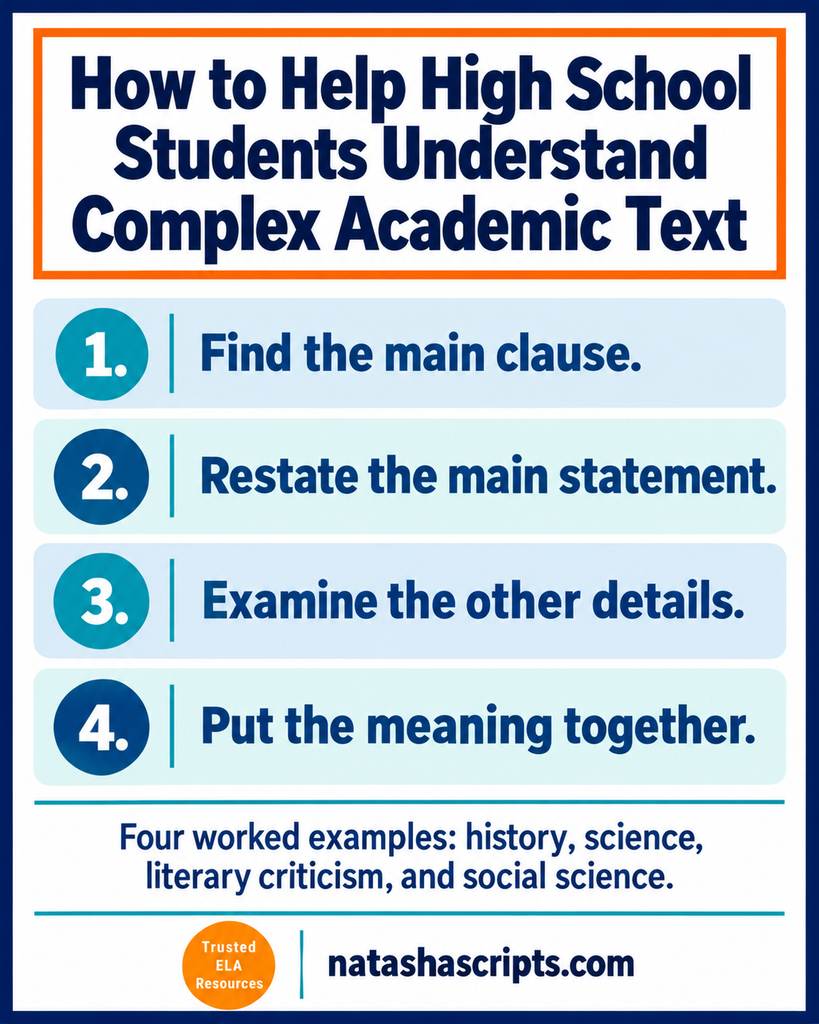
The four examples that follow show how teachers and homeschool parents can guide students through difficult sentences from different subject areas. Each example uses the same four steps:
- Find the main clause. Identify the subject and main verb. Set aside interrupting phrases or clauses briefly, while keeping any words needed to complete the main statement.
- Restate the main statement. Ask students to explain it in simpler language. If unfamiliar vocabulary prevents them from understanding it, clarify those words before continuing.
- Examine the other details. Return to the phrases and clauses set aside. What does each add? Does it explain a term, give a reason, introduce a contrast, or limit the statement?
- Put the meaning together. Ask students to restate the whole sentence in their own words. Check that they have preserved important details, including words that express uncertainty or limits, such as may, some, or not yet.
Work through the examples together first. Students can then practice these steps with a difficult sentence from their own reading.
Worked Example 1: A History Sentence
Historical writing often contrasts how people described events at the time with how historians later interpreted them. Consider this sentence:
Although the political reforms of the late nineteenth century were frequently presented by their proponents as natural extensions of democratic principles already embedded in the constitutional tradition, historians have increasingly argued that they represented, in practice, a strategic consolidation of power by emerging urban elites rather than a genuine broadening of civic participation.
-
Find the main clause.
Set aside the opening clause beginning with although for a moment. The main clause begins with “historians have increasingly argued.” The subject is historians, and the main verb is have argued. Keep the clause beginning with that, because it tells us what the historians have argued.
-
Restate the main statement.
Historians increasingly argue that the reforms gave powerful groups in cities more control rather than giving more people a say in government.
-
Examine the other details.
The opening clause explains how supporters presented the reforms: as a continuation of democratic principles already established in the constitutional tradition. The word although introduces a contrast between that explanation and the interpretation offered by historians. The phrase in practice draws attention to what the reforms actually did, according to those historians.
-
Put the meaning together.
Supporters described the reforms as democratic. However, historians increasingly argue that they gave powerful groups in cities more control rather than giving more people a say in government.
Ask students what changes if they read only the opening clause. They would learn how supporters described the reforms but miss the contrasting interpretation. This is why students need to return to the whole sentence after identifying its main clause.
Worked Example 2: A Science Sentence
Dense academic prose appears in science writing as well, though students may also need help with unfamiliar terms and words that express uncertainty. Consider this sentence:
The mechanisms by which prolonged exposure to elevated cortisol levels disrupts hippocampal neurogenesis are not yet fully understood, though recent longitudinal studies suggest a correlation between chronic stress and measurable reductions in the volume of hippocampal tissue in adult subjects.
-
Find the main clause.
The subject begins with the mechanisms, and the main verb is are. The main statement is “The mechanisms … are not yet fully understood.” The words between the subject and verb explain which processes the sentence refers to.
Clarify the unfamiliar terms before continuing. Cortisol is a hormone involved in the stress response. The hippocampus is a brain region involved in learning and memory. Neurogenesis means the formation of new nerve cells.
-
Restate the main statement.
Scientists do not yet fully understand how long periods of high cortisol levels interfere with the formation of new nerve cells in the hippocampus.
-
Examine the other details.
The clause beginning with though adds a contrasting point. Studies that follow people over time suggest a link between ongoing stress and a smaller hippocampus in adults.
The phrase suggest a correlation matters. It describes a possible relationship; it does not establish that stress caused the difference. The words not yet fully understood also limit how certain the explanation is. Measurable reductions describes a difference that can be measured, rather than uncertainty.
-
Put the meaning together.
Scientists do not yet fully understand how long periods of high cortisol levels interfere with the formation of new nerve cells in the hippocampus. However, studies suggest that ongoing stress is linked to a smaller hippocampus in adults. That link alone does not show that stress caused the difference.
Ask students to compare “studies suggest a link” with “studies prove a cause.” The second statement makes a stronger claim than the example supports. When students restate scientific writing, they need to preserve these differences in certainty.
Worked Example 3: A Literary Criticism Sentence
Literary criticism can combine an interpretation, evidence, and several qualifying details in one sentence. Students need to identify the main statement and examine how the other details affect its meaning. Consider this sentence:
What appears at first to be a straightforward celebration of individual freedom in the closing chapters of the novel is, on closer reading, complicated by the repeated use of collective pronouns by the narrator at precisely those moments when the main character seems most free from social expectations.
-
Find the main clause.
The subject is the whole opening noun clause: “What appears at first to be a straightforward celebration of individual freedom in the closing chapters of the novel.” The main verb phrase is is complicated. Set aside on closer reading briefly to see that connection more clearly.
The sentence says that an apparent celebration of freedom is complicated by the use of collective pronouns. These are words such as we, us, and our, which refer to a group.
-
Restate the main statement.
The ending seems to celebrate personal freedom, but the narrator keeps using words that refer to a group. This makes that interpretation less straightforward.
-
Examine the other details.
The phrases at first and on closer reading contrast an initial impression with what a reader notices after examining the language more carefully.
The final part explains when the collective pronouns appear: at the moments when the main character seems most free from social expectations. That timing matters because it connects references to a group with moments of apparent personal freedom.
-
Put the meaning together.
At first, the ending seems to celebrate personal freedom. A closer reading shows that the narrator repeatedly uses words such as we and our when the main character seems most free from social expectations. These references to a group make the ending harder to interpret as a simple celebration of individual freedom.
Ask students which words describe the initial impression and which introduce the closer interpretation. Then ask what evidence supports that interpretation. This helps them distinguish what the writer argues from the details used to support it.
Using the Four Steps with a Full Paragraph
The four examples focus on individual sentences. Once students are comfortable working through one sentence, choose a short paragraph from their reading and apply the same steps where needed.
After clarifying the sentences, ask students to consider how they connect. Does one give evidence for an earlier statement? Does it explain a detail, introduce a contrast, or place a limit on an idea? Then ask students to explain the main idea of the whole paragraph in their own words. This helps them move from understanding separate sentences to following the discussion.
Teachers and homeschool parents can begin by working through a paragraph together. Ask students to explain what they understand and identify the words or clauses that need another look. As they become more confident, let them take responsibility for more of the process.
This work also connects with paragraph writing. In their reading, students examine how sentences develop an idea; in their writing, they make decisions about how to explain and support their own points. Sentence to Paragraph Writing for Teens offers structured sentence and paragraph writing practice that can support this related work.
Unfamiliar vocabulary may also need attention. For students in grades 9 and 10 who need practice with academic words, Academic Vocabulary for 7th–10th Grade provides a related vocabulary resource. The article Reading Textbooks Effectively in High School: A Practical Approach for Active Comprehension discusses reading strategies for longer textbook passages.
For the next reading lesson, choose one challenging paragraph. Help students identify the main statements, clarify unfamiliar language, and explain how the ideas fit together. Their restatement should make the meaning easier to understand while preserving important details, contrasts, and uncertainty.
Free ELA Resources for Teachers and Homeschool Parents
Sample lessons and worksheets for reading, writing, grammar, and other ELA skills are available on the Free ELA Resources page. Teachers and homeschool parents can review the samples and consider how they fit the needs of their students.
