How to Help Middle School Students Develop Writing Voice
Writing That Has Its Own Character
Middle school students are learning how to organize ideas, support a point, and adapt their writing to different purposes. Alongside these essential skills, they also need opportunities to develop a voice of their own. Voice gives writing its individual character. It can be heard in the details a student chooses, the way ideas are phrased, the rhythm of the sentences, and the perspective the student brings to the subject.
A recognizable voice does not require informal language, humor, or a dramatic personality. It simply means that the writer is making purposeful choices rather than assembling an essay entirely from familiar formulas. Two students may respond to the same prompt, follow the same broad structure, and still produce pieces that sound distinctly different.
Teachers and homeschool parents can help students develop voice by showing them where it appears in writing, helping them recognize the choices that shape it, and gradually giving them greater ownership of how they communicate their ideas.
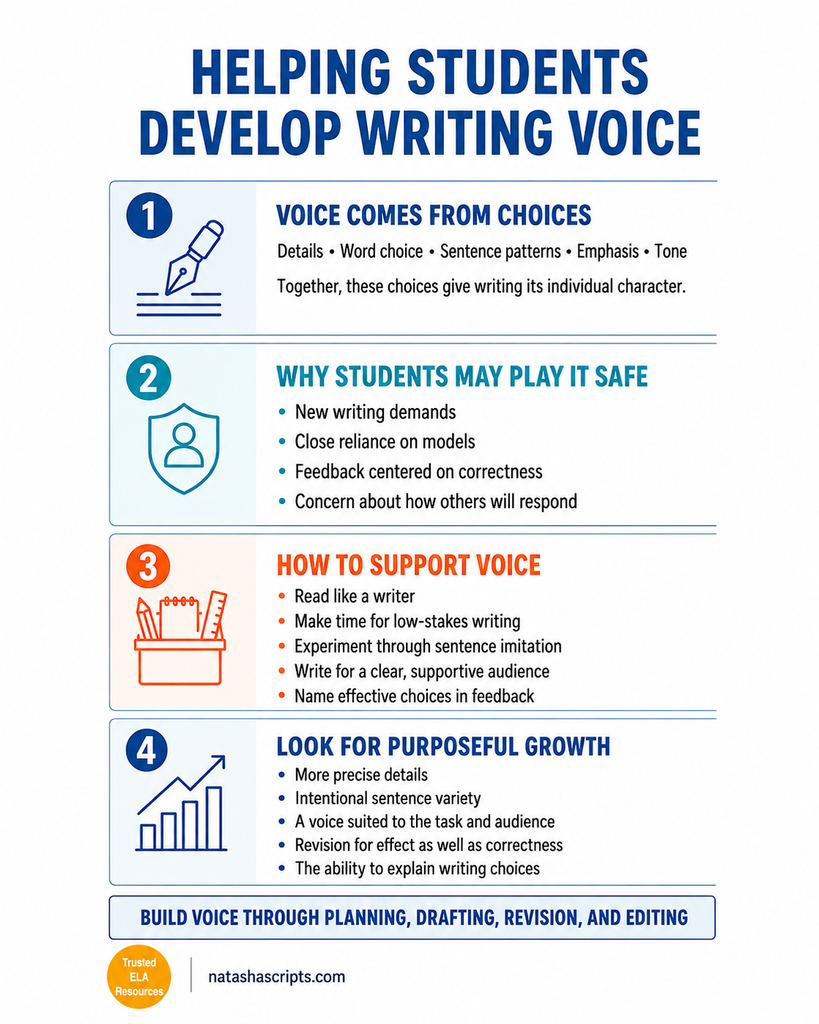
How Writing Choices Create Voice
In middle school writing, voice often appears in small but recognizable ways. One student may choose a concrete detail that makes an observation more vivid. Another may vary sentence length to control pace or draw attention to an important point. A student may select a precise verb, explain a piece of evidence from an individual perspective, or approach a familiar topic from an unexpected angle. Voice does not depend on sophisticated vocabulary or elaborate sentences. Clear, well-chosen language can reveal just as much about the writer.
Voice also changes according to purpose, audience, and genre. A research response may have a measured and objective voice, while an argument may sound confident and direct. A personal narrative may allow greater room for humor, reflection, or emotion. Each can retain the individual character of the writer while remaining appropriate for the task. The instructional goal is to help students make purposeful choices within the form and register their writing requires.
Why Students Begin to Play It Safe in Their Writing
Writing demands increase considerably during the middle school years. Students are expected to organize longer responses, develop claims, use evidence, apply grammatical conventions, and adapt to unfamiliar forms of writing. These skills are essential, but they also require a great deal of attention. While students are concentrating on meeting each requirement, they may rely closely on a model or template because it reduces the number of decisions they have to make.
Models, sentence frames, and paragraph structures can provide valuable support during this stage. The difficulty arises when students begin to see the model as the finished form their writing should take. An interesting word may feel less dependable than a familiar one. A sentence that differs from the expected pattern may seem more likely to be marked wrong. Reproducing the structure they have already seen can therefore feel like the most reliable way to succeed.
Social awareness can also influence these choices. Middle school students are often highly conscious of how their ideas will be received by classmates and adults. Expressing a strong opinion, using humor, or sharing an individual observation can make a piece of writing feel more exposing, particularly when students expect to read it aloud or exchange it during peer review. Some students respond by choosing neutral language, predictable ideas, and familiar sentence patterns that attract less attention.
Help Students Notice the Choices Writers Make
One practical way to develop voice is to help students examine how writers make choices. Often described as “reading like a writer,” this approach draws attention to the construction of a text as well as its meaning. Students begin to notice how details, word choices, sentence patterns, and shifts in tone influence the way a passage sounds and how a reader responds to it.
Questions like these keep the discussion grounded in evidence from the text. They also help students recognize that writers have several possible ways to communicate an idea, with each choice producing a slightly different effect.
This kind of attention connects naturally with the study of author’s purpose and tone. My article on examining author’s purpose and tone through close reading presents a routine for high school students that can also be adapted for the upper middle school grades. It helps students connect individual language choices with the larger effect a writer creates.
The final step is to move from observation to application. After examining a writer’s technique, students can try it in a sentence of their own, compare two possible versions, or explain why they selected one word or structure over another. This brief practice helps turn careful reading into a growing range of choices students can use in their own writing.
Four Practical Ways to Help Students Develop Voice
Students develop voice through regular opportunities to notice, try, and reflect on different writing choices. The following practices can be adapted easily for a classroom, a small group, or a homeschool setting.
Make Time for Low-Stakes Writing
Short, low-stakes writing gives students space to concentrate on ideas and language without treating every sentence as part of a formal assessment. They might respond briefly to something they have read, describe an object from an unusual perspective, explain a character’s decision, or reflect on a question that has several possible answers.
These pieces do not need to be graded, and teachers and homeschool parents do not need to respond extensively to every one. Their value comes from frequency and freedom. Students can test a phrase, try a different sentence pattern, or approach an idea from a new angle without worrying that every choice will affect a grade.
Experiment Through Sentence Imitation
Sentence imitation helps students examine style at a manageable level. A teacher or homeschool parent can select a sentence with a noticeable structure, rhythm, or use of detail and invite students to write a new sentence that follows the same pattern with completely different content.
The purpose is to study how the sentence has been constructed and then experiment with that construction. Students might imitate the arrangement of phrases, the placement of a short sentence after a longer one, or the way a writer builds toward an important detail. Comparing the original pattern with their own version helps students see how sentence structure can shape emphasis and tone.
Write With a Clear and Supportive Audience
A clear audience gives students a reason to think carefully about what a reader needs, expects, or might find interesting. A student might write a book recommendation for classmates, prepare advice for students entering the next grade, send a letter to someone who will respond, or contribute a short piece to a class or family newsletter.
Audience alone does not guarantee stronger voice. Some students become more cautious when they know others will read their work. Students should understand how a piece will be shared and, when possible, have some choice about the topic or audience. Under supportive conditions, writing for an actual reader can make decisions about tone, detail, and explanation feel purposeful.
Choosing which details a reader needs is also closely connected with showing and telling. My article on showing and telling in middle school writing examines how students can develop important moments with precise details while summarizing information that does not require the same attention. These decisions also contribute to the individual character of a piece.
Identify Effective Choices in Feedback
Corrections and suggestions are necessary, but feedback can also identify the choices that are already working. A specific comment helps a student understand both the successful choice and its effect:
- “The verb hesitated shows the character’s uncertainty clearly.”
- “This short sentence gives your main point greater emphasis.”
- “The detail about the empty chairs makes the setting feel unusually quiet.”
Comments like these give students useful language for discussing their own writing. They also show which choices are worth developing, repeating, or adapting in a future piece.
Teach Voice Alongside Structure and Conventions
Voice, organization, grammar, and sentence construction all contribute to effective writing. They can be taught together, although students may concentrate on different elements at different stages of the writing process. A focused sequence helps students manage these demands without treating voice as an additional feature to insert after everything else is complete.
During planning and drafting, students can consider their purpose, audience, perspective, and choice of details. Revision can then be divided into several focused readings. One reading might examine the development and order of ideas, while another considers word choice, sentence patterns, emphasis, and tone. Editing for grammar, punctuation, and spelling can receive its own careful attention. These stages may overlap, but giving each one a clear focus prevents students from trying to solve every problem at the same time.
An integrated curriculum can support this approach by connecting the choices students observe while reading with the choices they make in their own writing. In my Spelling, Writing and Reading: Language Arts Curriculum for 7th and 8th Grade, I combine writing instruction with reading and language study. Students repeatedly examine how written language works and then apply that understanding as they develop sentences, paragraphs, and longer pieces of writing.
Growth in voice usually appears through small changes. A student may begin to choose more precise details, replace a familiar opening with one better suited to the topic, vary a sentence for emphasis, or revise a general statement to express a clearer perspective. These changes may emerge in personal writing before they appear in an analytical response, since voice adapts to different purposes and genres.
Keeping selected writing samples across a semester or school year can make this development easier to see. When students compare similar pieces written several months apart, they can identify changes in their language and explain the decisions they now make with greater confidence. Consistent writing, focused revision, and specific feedback allow these individual choices to accumulate over time.
How to Recognize Growth in Student Voice
A student’s earlier writing provides the most useful point of comparison. Voice will also appear differently across assignments. A personal narrative may reveal it through humor or reflection, while an analytical response may show it through precise explanation, careful emphasis, or an individual interpretation of evidence. Growth does not require every piece to sound equally expressive.
Voice develops through the accumulation of strong writing habits: frequent practice, deliberate reading, focused revision, specific feedback, and purposeful opportunities to communicate with readers. As students become more aware of the choices available to them, they gain greater control over how their ideas take shape on the page.
I have collected free sample lessons and worksheets on my Free ELA Resources page. Teachers and homeschool parents can use these materials to give students additional practice with the reading, language, and writing skills that support clear and purposeful expression.
Quick Reference Guide