How to Teach Students to Integrate Quotations in High School Essays
The Introduce, Quote, Explain Routine
High school students often select a relevant quotation for an analytical essay but place it in the paragraph without showing how it supports their point. They copy the passage, add the citation, and move on to the next idea. The quotation may be accurate and well chosen, but it cannot do the analytical work on its own. The reader needs to know where the quotation comes from, why it has been included, and how it supports the student’s argument.
This pattern can continue even after students have developed a reasonable understanding of argument and paragraph structure. They know how to find evidence, but they need a clear process for incorporating that evidence into their own writing. Without that process, quotations can feel inserted into the paragraph rather than connected to the ideas around them.
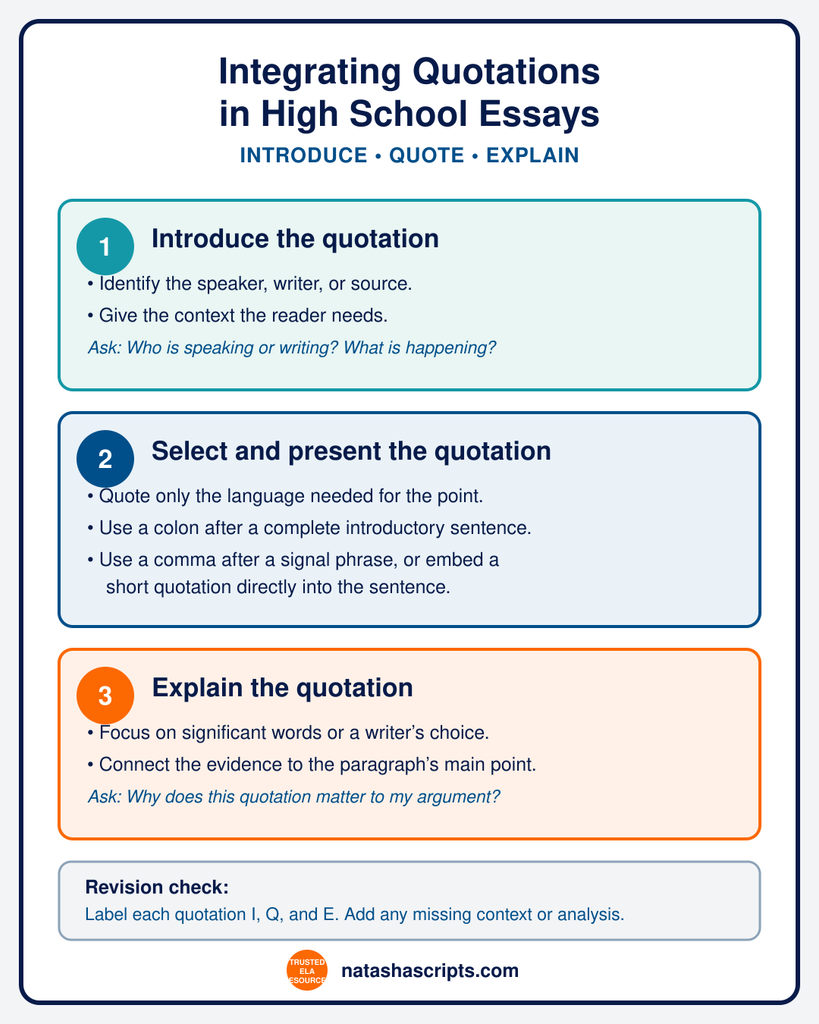
The Introduce, Quote, Explain routine gives students a consistent way to integrate quotations in high school essays. First, they introduce the quotation and provide the context the reader needs. Next, they present the relevant evidence. Finally, they explain what the quotation shows and how it supports the argument. Each step has a distinct purpose, and understanding those purposes helps students use the routine across different texts and essay topics.
What Each Part of the Routine Does
Students sometimes leave quotations unexplained because the connection to their argument seems obvious to them. They have read the text closely and know why they selected the passage. The reader, however, has access only to what appears in the essay. Analytical writing requires students to put their reasoning into words so that the reader can follow the connection between the evidence and the point being made.
The Introduce, Quote, Explain routine gives each part of that reasoning a clear place in the paragraph. The introduction identifies who is speaking and provides the context needed to understand the quotation. The quotation presents the relevant evidence from the text. The explanation shows what the evidence means and how it supports the student’s argument.
If one of these parts is missing, the evidence may not serve its intended purpose. A quotation without an introduction can appear abruptly, while a quotation without an explanation leaves the reader to interpret its significance. Completing all three steps helps students integrate evidence into their own reasoning instead of placing it alongside the argument and expecting the reader to make the connection.
Step One: Introduce the Quotation
Before presenting a quotation, the student needs to prepare the reader for it. The introduction can identify the speaker or source, explain what is happening at that point in the text, or establish why the passage is relevant to the paragraph’s main idea.
For example, a student writing about George Orwell’s Animal Farm might write:
“All animals are equal, but some animals are more equal than others” shows that the pigs have become corrupt.
The quotation is grammatically connected to the rest of the sentence, but it appears without any context. The reader is not told when the words appear, what has happened in the novel, or why this particular passage demonstrates the pigs’ corruption.
A more effective introduction would be:
By the end of the novel, the pigs have rewritten the commandments to protect their own power, and the final version reveals how completely they have abandoned the principle of equality: “All animals are equal, but some animals are more equal than others.”
This version prepares the reader by explaining what has happened and why the moment is significant. The quotation then provides evidence for an idea that the student has already introduced.
The introduction does not always need to answer both questions in detail. It should provide enough information for the reader to understand where the quotation comes from and why it belongs at that point in the essay.
Stage Two: Select and Present the Quotation
Students do not need to reproduce an entire passage when only a few words support their point. The quotation should be long enough to preserve the author’s meaning but focused enough to direct the reader toward the language the student intends to analyze. If the explanation will discuss one particular word or phrase, the student should quote that language rather than several surrounding sentences.
Students must also fit the quoted words grammatically into their own writing. The following three patterns cover many of the situations they will encounter.
A complete sentence can introduce a quotation with a colon:
The narrator’s reluctance to leave becomes clear in his description of the house: “I had packed before sunrise, yet the house seemed determined to keep me there.”
A signal phrase can introduce a complete quotation with a comma:
As he prepares to leave, the narrator admits, “I had packed before sunrise, yet the house seemed determined to keep me there.”
In the third example, the quoted phrase fits directly into the student’s sentence, so it does not need a comma or colon before it. This form is particularly useful when the student plans to analyze a specific word or phrase.
As students become more comfortable working with quotations, they may also use an ellipsis to remove unnecessary words or brackets to add a brief clarification. Both can be useful when handled carefully, provided that the original meaning remains unchanged. At this stage, however, the main priority is helping students choose focused evidence and fit it naturally into their own sentences.
Quotation punctuation is part of the broader grammar and editing knowledge students need in high school. I created Quick Daily Grammar for High School to give students in Grades 9–12 short, consistent practice with punctuation, sentence structure, and editing. Each week begins with explanatory notes, followed by brief daily activities that help students apply the skill. The program can be used alongside essay writing instruction when students need continued practice with the conventions that support clear academic writing.
Stage Three: Explain the Quotation
The explanation is often the part students leave out or reduce to a brief statement. It is also the point at which the quotation becomes part of the student’s argument. After presenting evidence, students need to explain what they notice in the quoted language and why it matters.
Students sometimes follow a quotation with a sentence such as:
This shows that the pigs are corrupt.
This repeats the point without telling the reader anything new. A stronger explanation might focus on a particular word or phrase, examine a choice made by the author, or connect the evidence to the essay’s central claim.
For example, after quoting the revised commandment in Animal Farm, a student might write:
The phrase “more equal” is a contradiction because equality means that everyone is treated the same. By changing the meaning of the word, the pigs make their unfair treatment of the other animals sound acceptable. Orwell shows how those in power can manipulate language to hide inequality and protect their position.
This explanation identifies the significant phrase, explains why it is contradictory, and connects Orwell’s language to a broader idea about power. The student is not simply repeating what happens in the novel but showing how the quotation supports the argument.
If the explanation only repeats what the quotation says, that question has not yet been answered. A complete explanation shows what the evidence reveals about a character, theme, conflict, or author’s choice and then connects that observation to the argument of the essay.
Using the Routine Throughout an Essay
Once students understand the three steps, they can begin using the routine across several body paragraphs. At first, their sentences may follow a similar pattern. This is a useful starting point because it helps them remember the purpose of each step. As they gain confidence, they can vary the length and structure of their introductions and explanations while continuing to provide the context and analysis each quotation needs.
Some paragraphs contain more than one piece of evidence. Students may introduce and explain each quotation separately, or they may present two related quotations and analyze them together. In either case, the reader should be able to understand why each quotation has been included and how the evidence supports the paragraph’s main point.
Two quotations placed one after the other do not automatically create a stronger argument. If students use them together, they need to explain the relationship between them. The quotations might reinforce the same idea, reveal a change in a character, present contrasting viewpoints, or show how a theme develops across the text. Making that relationship clear turns a collection of quotations into a connected analysis.
Quotation integration also depends on the broader structure of the essay. Students need a clear thesis and focused body paragraphs before they can decide which evidence is most relevant. My article How to Write a Thesis Statement in High School: A Repeatable Process That Actually Works provides a practical process for developing a thesis that can guide the selection and explanation of evidence throughout the essay.
Use the Routine During Revision
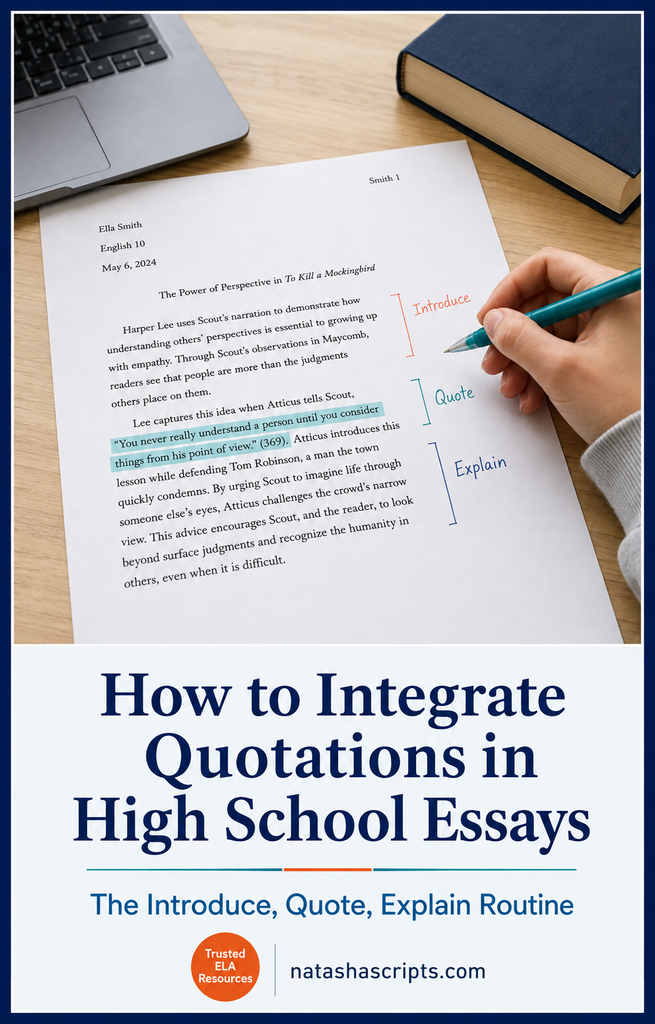
The Introduce, Quote, Explain routine can also become a focused revision check. After completing a draft, students can review one body paragraph at a time, locate each quotation, and label the surrounding parts with I, Q, and E. This gives them a practical way to see what is present and what still needs attention.
If a quotation has no introduction, the student can add the context the reader needs. If the explanation only repeats the quotation, the student can return to the specific language and explain how it supports the paragraph’s main point. A focused check like this is more useful than asking students simply to improve or add more detail to the essay.
My article A Pass-by-Pass Revision Process for High School Essays explains how students can revise one element of a draft at a time. Quotation integration can become one separate pass, followed by other checks for paragraph structure, sentence clarity, grammar, and punctuation. This keeps the revision process manageable and gives each pass a clear purpose.
With regular practice, students begin to introduce and explain quotations as they write rather than adding these elements during revision. The routine then becomes less of a checklist and more of a natural part of constructing an analytical paragraph. The aim is for students to understand that selecting evidence is only the beginning. Their own reasoning is what shows the reader why that evidence matters.
Teachers and homeschool parents looking for free sample lessons and worksheets on high school writing topics can find additional resources on the Free ELA Resources page.
Integrating Quotations in High School Essays