How to Teach Transitions Between Paragraphs in Middle School Essays
Middle school students often begin a new body paragraph with “Another reason is…” or “Also…” and then move directly to their next point. A transition word is present, but the ideas are not truly connected. The reader knows that a new paragraph has started, yet still has to work out how it relates to the paragraph before it.
This pattern is understandable. In the earlier grades, students often learn transitions through lists of words such as first, next, also, and finally. These words give young writers a useful starting point. By middle school, however, students are developing longer explanations and more complex arguments. They now need to learn that a transition does more than introduce the next paragraph. It helps the reader follow the movement from one idea to another.
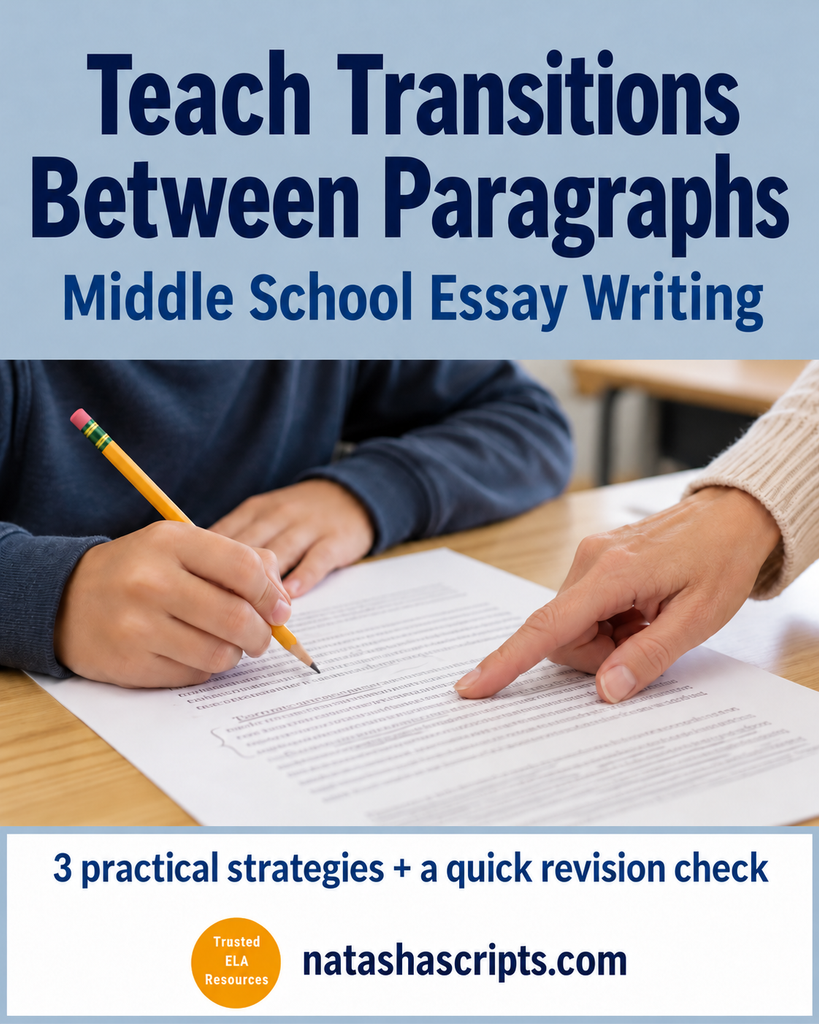
For a quick summary of the three ways to connect paragraphs
and a short revision check, jump to the
Quick Reference Guide.
What Should a Transition Between Paragraphs Do?
A strong transition connects the main idea of one paragraph with the main idea of the next. It may show that the new paragraph adds a related point, presents a contrast, explains a result, considers another perspective, or examines a different part of the same topic.
Consider an essay about extending a school library’s opening hours. One paragraph might explain that students need access to research materials, while the next discusses the need for a quiet place to study after school.
The following opening announces a new point, but it does not show how the two ideas are related:
Another reason extended library hours are beneficial is that students need quiet places to study.
A more useful transition makes the relationship clear:
Access to research materials solves one problem, but some students face another difficulty after school: they do not have a quiet place to complete their work.
The second version looks back briefly at the previous point and then directs the reader toward the new one. The essay begins to feel like one developing discussion rather than a series of separate reasons.
Why Transition-Word Lists Are Not Enough
Words such as also, in addition, furthermore, and finally are not incorrect. The difficulty arises when students use them in place of a meaningful connection.
For example, a student might write:
Furthermore, the character shows courage when she enters the abandoned building.
The word furthermore tells the reader that another point is being added, but it does not explain how this example connects with the idea developed in the previous paragraph. The sentence could begin almost any paragraph in the essay.
Instead of asking students, “Which transition word could you add?”, it is more helpful to ask:
- How does this new point relate to the one before it?
- Does it add to the previous idea, contrast with it, or show a result?
- What does the reader need to understand before moving on?
Once students can answer these questions, they are better prepared to choose suitable language. The relationship between the ideas comes first. The transition word, when one is needed, follows from that relationship.
Three Ways Students Can Connect Paragraphs
Students do not need a large collection of elaborate phrases. A few practical approaches can help them create clearer connections across an essay.
1. Carry a Key Idea Forward
One of the simplest methods is to repeat or refer to an important word or idea from the end of one paragraph in the beginning of the next.
If a paragraph ends with this sentence:
The new policy would affect not only students but also the teachers who work with them.
The next paragraph might begin:
Teachers would face a different set of challenges under the same policy.
Repeating teachers creates continuity. The writer does not need to summarize the whole previous paragraph because the shared key idea is enough to guide the reader forward.
2. Name the Relationship Between the Ideas
Before students write the transition, ask them to describe how the two paragraphs are related. Is the new paragraph:
- adding a similar point?
- showing a contrast?
- explaining a cause or result?
- giving an example?
- considering another viewpoint?
- moving from one aspect of the topic to another?
A student who identifies the relationship as contrast might begin with however, in contrast, or although this may be true. A student explaining a result might use as a result or refer directly to the consequence.
These expressions are only useful when they accurately represent the connection. However should introduce a contrast, while therefore should introduce a result or conclusion. Students need to understand what each expression signals rather than treat transition words as interchangeable.
3. Build the Bridge at the End of the Previous Paragraph
The transition does not always need to appear at the beginning of the new paragraph. Sometimes the final sentence of the previous paragraph can close one point and prepare the reader for the next.
A paragraph about the effect of noise on an individual student might end with:
The effect on one student can be significant, but the problem becomes more difficult to manage when noise disrupts the entire class.
The first part completes the current point. The second introduces the wider classroom problem that the next paragraph will examine.
This approach can be especially helpful for students who struggle to begin a new paragraph. They are still working with the idea they have just explained, so they may find it easier to use that idea as a bridge into what comes next.
Three Ways to Connect Paragraphs
- Carry a key idea forward. Repeat or refer to an important word or idea from the previous paragraph.
- Name the relationship. Show whether the new point adds, contrasts, explains, illustrates, or develops.
- Build a bridge at the end. Use the final sentence of one paragraph to prepare the reader for the next.
Comparing Weak and Strong Transitions
Students usually understand the difference more clearly when they compare transitions within a familiar essay topic.
Expository Example
Suppose a student is explaining how zoos have changed over time. One paragraph discusses changes in animal enclosures, and the next examines the growing focus on conservation.
Weak transition:
In addition, modern zoos focus on conservation.
Stronger transition:
Changes to animal enclosures reflect a wider change in the purpose of many zoos. Alongside improving animal care, modern zoos increasingly support conservation through breeding programs and public education.
The stronger version helps the reader see that improvements in animal housing and conservation work are both part of a broader change in how many zoos operate.
Argumentative Example
Now consider an essay about weekend homework. One paragraph presents the view that regular homework gives students continued practice. The next argues that students also need time to rest.
Weak transition:
Another reason students should not have weekend homework is that they need time to rest.
Stronger transition:
Regular practice can help students remember what they have learned, but practice is not the only factor that affects their work. Time to rest can also help students return to school ready to concentrate.
This transition acknowledges the previous point before presenting a different consideration. The reader can see why the second paragraph belongs after the first.
When discussing examples like these, I would ask students to identify the work performed by the stronger transition. Which earlier idea does it pick up? Which new idea does it introduce? What relationship does it show? This keeps attention on the thinking behind the sentence rather than on copying a particular phrase.
How to Teach Paragraph Transitions Explicitly
Transitions are easier to teach when students can see the structure of the whole essay. If they write one paragraph at a time without considering how their points relate, they are likely to add a general connector only after the draft is complete.
The following sequence makes the relationships more visible.
A. Begin With the Essay Plan
Ask students to write the main point of each body paragraph in a short phrase or sentence. Then have them explain, in plain language, how each point relates to the one before it.
Their notes might read:
- Paragraph 2 explains the academic benefit.
- Paragraph 3 adds a social benefit.
- Paragraph 4 considers a possible disadvantage.
These notes are not the finished transitions. They give students the reasoning they will need when they write them.
B. Model the Decision, Not Just the Finished Sentence
When demonstrating a transition, talk through the choice:
- What did the previous paragraph establish?
- What will the next paragraph explain?
- How are those ideas related?
- Which words will make that relationship clear?
Students often see polished model sentences without seeing the decisions that produced them. Making the process visible gives them something they can repeat in their own writing.
C. Practice With Paragraph Pairs
Before asking students to revise a full essay, give them two short paragraphs and ask them to connect them. They can compare two or three possible transitions and explain which one gives the reader the clearest guidance.
This focused practice reduces the number of decisions students must manage at once. It also allows teachers, tutors, and homeschool parents to correct misunderstandings before students apply the skill independently.
D. Return to Transitions During Revision
After students complete a first draft, ask them to read only the final sentence of one body paragraph and the first sentence of the next. Do the two sentences create a clear movement between ideas?
If the opening sentence could be placed almost anywhere in the essay, it may be announcing a new point without connecting it. The student can then revise by carrying forward a key idea, naming the relationship, or adding a bridge at the end of the previous paragraph.
Common Problems to Look for in Student Writing
Even after direct instruction, several transition problems tend to reappear. Looking for one pattern at a time can make revision more manageable.
1. The Transition Only Summarizes
A student may end a paragraph by restating what it has already explained:
These examples show that the character is determined.
This may provide closure, but it does not prepare the reader for the next idea. Ask the student what the following paragraph will add and whether the final sentence could point toward it.
2. The Connector Signals the Wrong Relationship
Students sometimes choose a familiar word without considering its meaning. However signals contrast, while therefore signals a result. If the ideas do not have that relationship, the transition can confuse the reader.
Rather than correcting the word immediately, ask the student to state the relationship in their own words. Once the meaning is clear, choosing an accurate connector becomes easier.
3. The Link Is Buried Inside the Paragraph
A student may write a useful connecting sentence in the middle of the new paragraph. By that point, however, the reader has already entered the new idea without guidance. Help the student decide whether the sentence belongs at the opening of the new paragraph or at the end of the previous one.
4. Every Paragraph Uses the Same Formula
Repeated openings such as “Another reason…” can make an essay sound like a list. Encourage students to vary the way they create continuity. One transition might repeat a key idea, another might show contrast, and another might explain a result. The form should follow the relationship between the paragraphs.
Building the Paragraph Skills That Transitions Depend On
Students cannot connect paragraphs clearly if the paragraphs themselves do not have a clear focus. A body paragraph needs one main idea, relevant support, a logical order, and sentences that connect with one another. When those elements are weak, writing a transition to the next paragraph becomes much harder.
For Grade 8 students who need more structured work at this level, Sentence to Paragraph Writing for Teens teaches a step-by-step method for developing focused, well-supported paragraphs. Students work on choosing a clear focus, adding relevant support, connecting and ordering ideas, and revising for clarity before writing paragraphs independently. These skills provide a useful foundation for the work of connecting complete paragraphs across an essay.
Teachers and homeschool parents working across Grades 7 and 8 may also use the writing component in Spelling, Writing and Reading, 7th and 8th Grade: Language Arts Curriculum, which places writing practice alongside spelling, vocabulary, and reading work.
Sentence structure also affects the quality of transitions. Students may need to use a subordinate clause to show contrast, cause, time, or condition clearly. The related article Why Understanding Clauses Improves Student Writing looks more closely at how clause knowledge supports sentence construction and revision.
Helping Students Become More Independent
The aim is not for students to replace one fixed formula with another. They need to develop the habit of considering how their ideas relate before choosing the words that connect them.
This habit develops over time. A student may write an effective transition in one essay and return to “another reason” in the next. Brief, repeated attention across different assignments is usually more helpful than one long lesson followed by the expectation that the skill has been mastered.
During feedback, it can also be useful to focus on one or two transitions rather than rewriting every connection for the student. Ask what relationship the writer wants to show, then let the student try a revision. With practice, students begin to recognize that paragraph transitions are part of their reasoning, not an extra feature added after the essay is written.
When students learn to guide readers from one paragraph to the next, their essays become easier to follow and more convincing. Each paragraph still develops its own main point, but the points now work together as part of a complete explanation or argument.
For further discussion of organization and reasoning in argumentative essays, see Common Persuasive Writing Mistakes Middle Schoolers Make and How to Address Them.
Find More Free ELA Resources
You can find free worksheets, sample lessons, games, and other materials for middle school and high school English language arts on the Free ELA Resources page.
Quick Reference Guide