How to Teach -tion, -sion, -ssion, and -cian Endings in High School
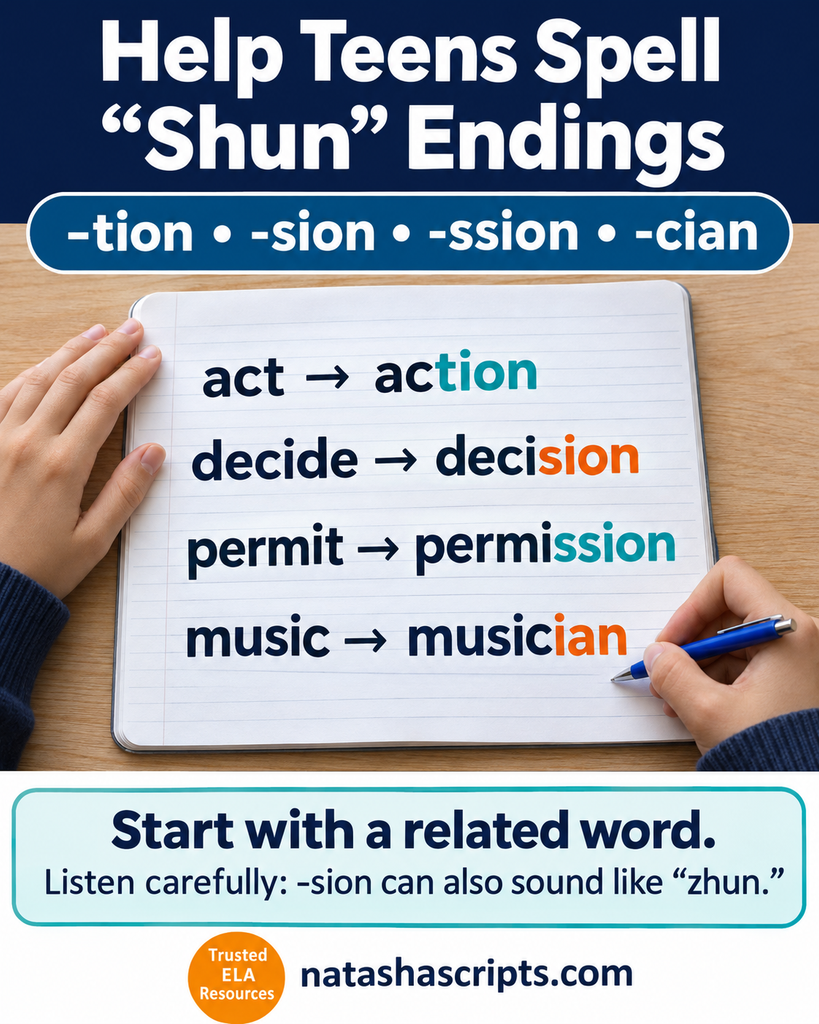
A student may know what apprehension means and use it correctly in a sentence, yet still hesitate over the spelling. Should the final “shun” sound be written -tion or -sion? A similar question arises with transmission, where the student needs to remember the double s, or politician, which ends in -cian.
I like to teach these endings through groups of related words. Comparing apprehend with apprehension, transmit with transmission, and politics with politician gives students something specific to examine. We can discuss which letters remain, which change, and how the words are connected in meaning.
In this article, I’ll look at -tion, -sion, -ssion, and -cian, with examples and teaching suggestions for high school students. These patterns give us useful guidance, although some words need individual attention and a dictionary check.
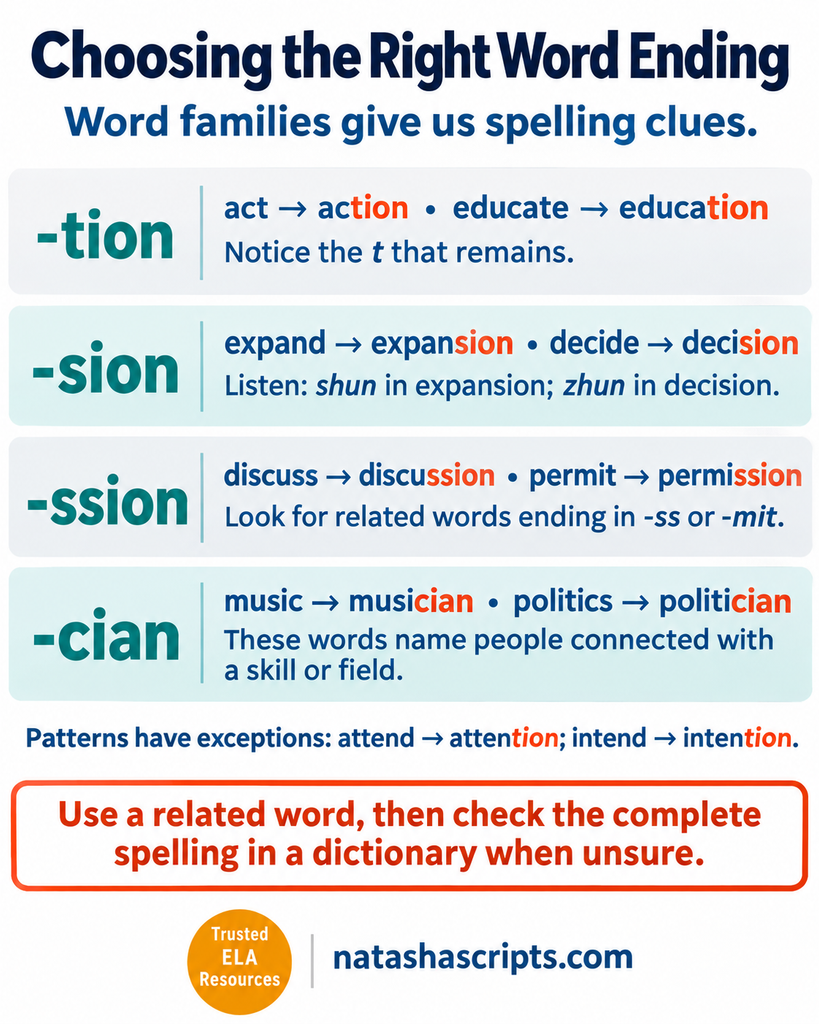
If you would like a visual reminder of the four ending groups
and useful word pairs, you can jump ahead to the
Quick Reference Guide.
Why These Endings Need More Than Listening
Several spellings can represent the final “shun” sound. We hear it in action, expansion, permission, and musician, but the letters are different in each word. Asking students to sound out the ending will therefore take them only part of the way.
There is another distinction to explain before we begin. -sion can also represent the “zhun” sound, as in decision, division, and conclusion. The zh sound is the one we hear in the middle of vision. I would read these words alongside expansion and ask students to listen to the difference.
We can then look at the spelling of a related word. For example, expand helps us examine expansion, while decide helps us examine decision. The spelling changes, but placing the words together gives us a way to discuss that change.
Students encounter these endings in words such as education, comprehension, expression, and admission. I would choose examples from their reading and writing so they can practice with words they need to use. For further discussion, see Why High School Students Still Misspell Familiar Words.
The ending -sion has two sounds to notice:
“shun” in expansion
“zhun” in decision
1. Start with Familiar -tion Word Families
-tion is a common ending, and I would begin with word pairs in which the connection is easy to see:
| Related word | Noun |
|---|---|
| act | action |
| direct | direction |
| construct | construction |
| instruct | instruction |
| connect | connection |
| select | selection |
Ask students to identify the letters that remain in each pair. In act → action, for example, the t is already present in act. We add -ion, producing the written ending -tion. This is why I refer to these as spelling endings when grouping them for practice.
We can then introduce another group:
| Related word | Noun |
|---|---|
| educate | education |
| graduate | graduation |
| celebrate | celebration |
| concentrate | concentration |
Here, the final e is removed, while the t remains. I would have students write each pair side by side and mark the change before practicing the complete noun.
Although -tion is common, I would avoid presenting it as the answer whenever students are unsure. Other endings also follow recognizable patterns. Our aim is to help students examine the word family and learn the correct spelling of the word they need.
2. Look for Related Words When Teaching -sion
A useful group of -sion words has related verbs ending in -d or -de. I would separate the examples into two groups so students can examine both the spelling and the pronunciation.
| Related verb | Noun |
|---|---|
| apprehend | apprehension |
| expand | expansion |
| extend | extension |
| comprehend | comprehension |
| suspend | suspension |
In these pairs, the final d is removed and -sion is added. We can make the change visible by writing expand and expansion together, then asking students which letters they find in both words.
Words with the “Zhun” Sound
| Related verb | Noun |
|---|---|
| conclude | conclusion |
| include | inclusion |
| exclude | exclusion |
| decide | decision |
| divide | division |
| erode | erosion |
In these examples, the final -de is replaced by -sion. I would read the pairs aloud, discuss their meanings, and then ask students to examine the letters that change.
These are useful patterns, but a verb ending in d does not always lead to -sion. Two important examples are attend → attention and intend → intention. I would keep these pairs beside the first group so students can compare them and practice the exceptions explicitly.
Other Useful -sion Pairs
We can also compare tense → tension, disperse → dispersion, and revise → revision. In these pairs, the final -se is replaced by -sion. Again, the purpose is to examine actual word families rather than apply the same change to every word ending in those letters.
I would introduce only a few pairs at a time and check that students understand both words. For example, revise describes an action, while revision can name the process or the change made. A short sentence using each word gives us an opportunity to discuss that difference alongside the spelling.
3. Notice the Double s in -ssion
For -ssion, I would begin with related words ending in -ss:
| Related word | Noun |
|---|---|
| discuss | discussion |
| express | expression |
| obsess | obsession |
| possess | possession |
The two s letters are already present in the related word and remain when we add -ion. Writing discuss beside discussion makes that visible.
Another useful group contains words ending in -mit:
| Related verb | Noun |
|---|---|
| admit | admission |
| submit | submission |
| permit | permission |
| omit | omission |
| transmit | transmission |
Here, the final -mit changes to -mission. I would ask students to compare permit and permission, then use the same observation to examine submit and submission. This gives us a specific spelling change to practice, including the double s.
Words such as passion, mission, and session can be learned as complete words when a familiar related word does not help the student. I would include them in a separate practice group rather than ask students to invent a base word.
4. Use Meaning and Word Families with -cian
Many words ending in -cian name a person with a particular skill or connection to a field. We can introduce this group through pairs such as these:
| Related word | Person |
|---|---|
| music | musician |
| magic | magician |
| electric | electrician |
| clinic | clinician |
| optics | optician |
| mathematics | mathematician |
| politics | politician |
| statistics | statistician |
| pediatrics | pediatrician |
I would discuss the meaning before examining the ending. A musician makes music, while a statistician works with statistics. Students can then mark the c in each related word and compare it with -cian in the word naming the person. Where the related word ends in -cs, as in politics, the final s is not retained.
Naming a person is a useful clue, but it does not settle the spelling on its own. Dietitian, for example, also names a specialist and has a final “shun” sound, yet its usual spelling ends in -tian. I would use the meaning together with the word family, then check an unfamiliar word in a dictionary.
Find a related word. Explain the spelling change.
Check the complete word.
A Spelling Check Students Can Use
1. Find a Related Word
If a student is unsure about permission, ask whether permit helps. For politician, return to politics. If no familiar related word comes to mind, students can look up the word and add it to their practice list.
2. Compare the Letters That Stay and Change
Write the pair side by side. In act → action, the t remains. In permit → permission, -mit changes to -mission. In music → musician, the c remains as part of the written ending -cian. Ask students to explain the change they can see.
3. Check the Complete Spelling
The patterns help us make a choice, but we still need to check exceptions and unfamiliar words. Students can confirm the spelling in a dictionary, cover the word, write it from memory, and compare their version with the correct form.
I would then return to a sentence from their own writing. Ask them to check the target word and explain which word family or spelling detail helped them. This connects the practice with the writing they are already doing.
Give Students Time to Practice the Patterns
I would begin with one group and a few word pairs. Read them aloud, discuss their meanings, and examine the letters together. Students can then complete a short sorting activity or write sentences using both words in a pair.
Once they have practiced the groups separately, mix a few examples from different groups. Ask students to explain their choices, and include a familiar exception such as attention. During proofreading, they can return to the same comparisons when checking words in a paragraph or essay.
More Spelling and Vocabulary Practice for High School
My Spelling High School Workbook Grades 9–10 combines reading passages, definitions, spelling activities, and written responses. The accompanying online games and quizzes give students another way to review the lesson words. Teachers and homeschool parents can view the book details and download a sample lesson before deciding whether it suits their students.
For older students, my Spelling High School Workbook Grades 11–12 offers further academic vocabulary and spelling practice, including creative tasks and online quizzes. These books provide opportunities to use words in context alongside the spelling comparisons we have discussed here.
For further reading about how word history can help explain spelling, see Using Word Origins to Spell Difficult High School Words.
I would finish a lesson by asking students to choose one word pair and explain the spelling change. We can return to that pair in a later lesson, alongside any words that still need practice. Students will have both a useful comparison to remember and an opportunity to check the complete spelling again.
You are welcome to explore my Free ELA Resources page for sample lessons from my books. You can review the material and choose spelling, vocabulary, reading, or writing practice suited to your students.
Quick Reference Guide