Helping Middle School Students Keep Their Paragraphs on Topic
When I review a student’s paragraph, I begin by looking at the main idea and how the sentences develop it. A paragraph may start with a clear point about a character’s courage, then move into details about the character’s appearance or the setting. Those details may belong in the story, but we need to consider what they contribute to this particular paragraph.
This is where paragraph unity becomes useful in our writing discussions. In this article, I’ll explain what unity means, look at three ways a paragraph can lose its focus, and suggest how teachers and homeschool parents can help students in grades 6–8 revise their work. My preference is to discuss a specific sentence with the student so we can decide what needs changing and why.
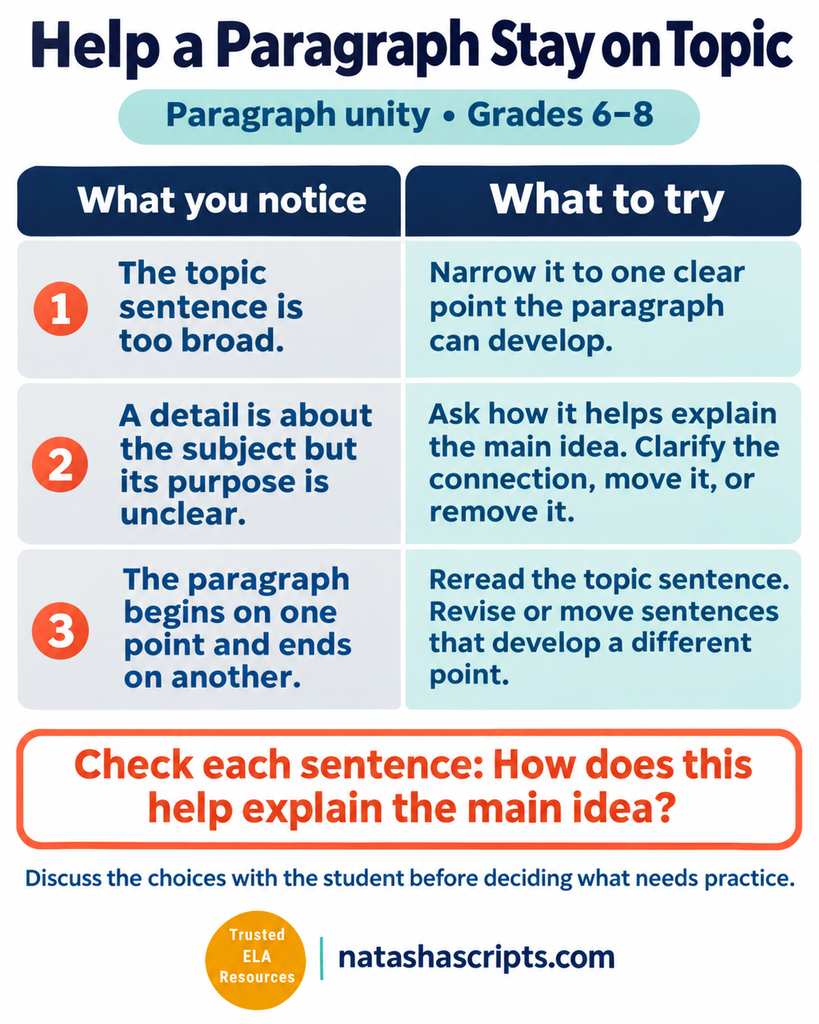
If you would like a visual reminder of what to check and
what to try, you can jump ahead to the
Quick Reference Guide.
What Does Paragraph Unity Mean?
A paragraph has unity when its sentences work together to develop one main idea. In the explanation, opinion, and response-to-reading paragraphs students practice, a topic sentence can make that idea clear. I usually begin by helping students state their point near the beginning, where they can return to it while reviewing the rest of the paragraph.
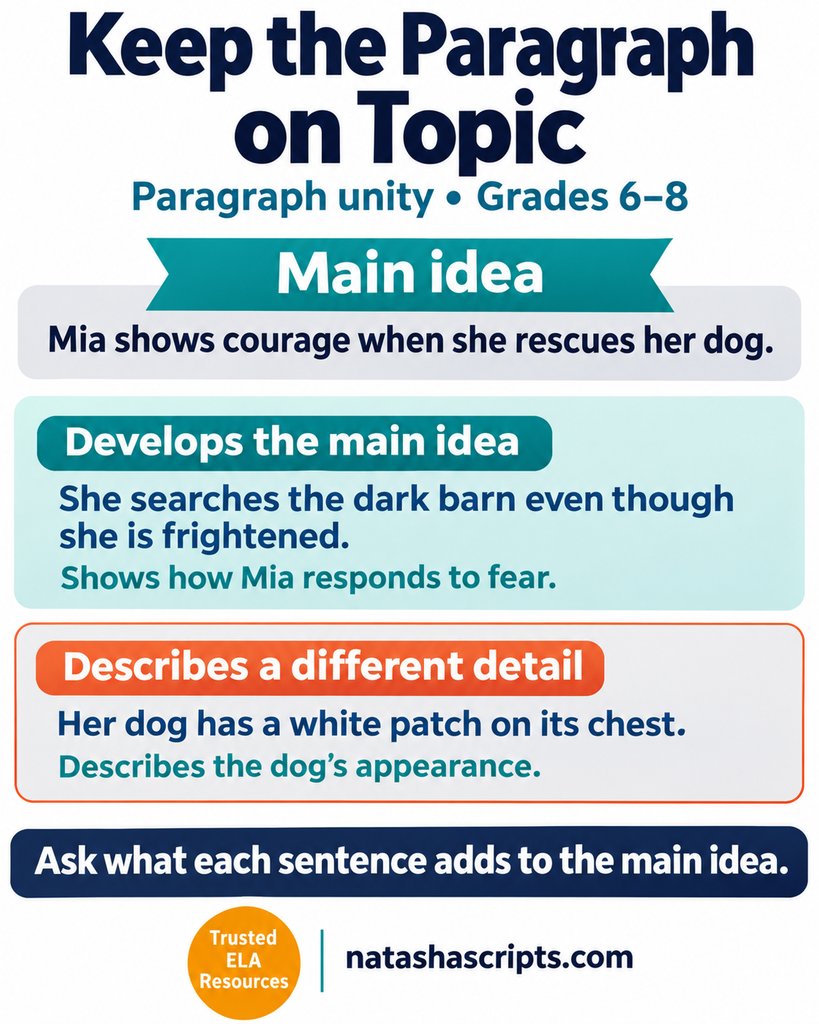
The point needs to be specific enough to guide their choices. “Mia is an interesting character” leaves us with many possible directions. “Mia shows courage when she goes back into the dark barn to find her dog” tells us what the paragraph will explain. We can now look for details about what Mia does, what frightens her, and how she responds.
A topic sentence does not always need to present an argument. It might explain a process or describe a feature. What matters here is that students know which idea they are developing and can explain how their details contribute to it.
For each sentence, ask:
How does this help explain the paragraph’s main idea?
Three Ways a Paragraph Can Lose Its Focus
1. The Topic Sentence Leaves Too Many Possibilities
If a student begins with “There are many interesting things about how animals survive in the wild,” I would first ask which animal and which survival behavior they want to explain. We could narrow the sentence to “A polar bear’s thick fur helps it survive in cold weather.” That gives us a point we can develop with details about warmth and protection.
We can then reread the supporting sentences. Some may fit the revised topic sentence, while others may belong in another paragraph. I would make this decision with the student rather than asking them to remove sentences before we have agreed on the paragraph’s focus.
2. The Detail Is Related, but Its Purpose Is Unclear
Students may include a fact because it concerns the same person, animal, or event. I would ask them to explain what the fact adds to their main point. Sometimes they have chosen a useful detail but have not explained the connection. In that case, we need another sentence or a clearer explanation.
Other details take the paragraph in a different direction. In our paragraph about Mia’s courage, the fact that her dog has a white patch on its chest tells us about the dog’s appearance. It does not help explain her courage in this example. We can save that detail for a description of the dog.
Background information can also belong in a paragraph when it helps the reader understand the point. I would consider the sentence’s purpose before deciding whether to keep it. The student may need to clarify the connection, move the detail elsewhere, or remove it.
3. The Main Point Changes During the Draft
A student may begin with relevant details and then think of something else they want to include. This can leave us with a paragraph that starts by explaining one idea and finishes by developing another.
I would return to the draft after the student has finished writing. We can read the topic sentence aloud and then work through the other sentences, asking what each one contributes. If the later sentences develop a useful new point, we can discuss giving that point its own paragraph. We may also decide that the draft has revealed a better main idea and revise the topic sentence accordingly.
These patterns are starting points for a conversation. Where a sentence appears does not tell us on its own why the student included it. I would ask the student to explain their choice before deciding what they need to practice.
Look at a Paragraph Together
Here is a short classroom example we can use before students review their own writing:
Mia shows courage when she goes back into the dark barn to find her dog. She is frightened by the loud noises but searches every stall until she finds him. Her dog has a white patch on its chest. Mia carries him outside even though her hands are shaking.
The opening sentence tells us that we are discussing Mia’s courage. The next sentence shows that she continues searching despite her fear, and the final sentence develops that same idea. The sentence about the white patch describes the dog without helping us understand Mia’s courage.
I would ask students to identify that sentence and explain their choice. We can then read the paragraph again with it removed:
Mia shows courage when she goes back into the dark barn to find her dog. She is frightened by the loud noises but searches every stall until she finds him. Mia carries him outside even though her hands are shaking.
All three sentences now contribute to the same point. If students are responding to an actual story, they should also check that their details accurately reflect the text.
A Simple Paragraph Review Routine
1. State the Main Idea
Ask the student to explain the point of the paragraph in their own words. Then compare that explanation with the topic sentence. If the sentence is too broad or does not match what the student wants to say, revise it together.
2. Explain What Each Sentence Adds
Read one sentence at a time and ask, “How does this help explain your main idea?” Give the student time to make the connection. Their answer may show that the detail belongs but needs more explanation on the page.
I would mark any sentence that needs another look, then decide with the student whether to clarify it, move it, or remove it. This gives us more useful information than simply labeling every sentence as right or wrong.
3. Read the Revised Paragraph Aloud
After making changes, read the whole paragraph again. Check that the main idea is clear and that the remaining details explain it sufficiently. Removing a sentence may leave a gap that needs filling, so we should also consider whether the paragraph needs another example or explanation.
In a classroom, I would first model the routine with a shared paragraph, then let students apply it to their own work. At home, a parent and student can use a paragraph from a recent assignment and discuss the same questions together.
Keep Practicing with Students’ Own Writing
A paragraph from a reading response, history assignment, or science explanation gives us a useful place to continue. I would begin with one paragraph and one revision goal so the student can see what changed and explain why.
Once the sentences develop the same point, we can look at their order and the connections between them. A transition such as “also” or “in addition” tells the reader that another idea is coming, but the idea still needs to belong in the paragraph. For further discussion, see my article on teaching transitions in middle school writing.
The same question can later be applied to a whole essay: how does each body paragraph develop the thesis? I discuss that larger connection in helping middle school students connect body paragraphs to the thesis.
More Guided Practice with Paragraph Writing
For students in grades 8–12 who need more practice moving from sentences to paragraphs, my Sentence to Paragraph Writing for Teens provides explanations, worked examples, and guided and independent writing activities. Students practice establishing a clear idea, choosing relevant support, connecting sentences, and revising their paragraphs.
The workbook follows my Focus, Build, Connect, Check method and includes paragraph repair activities, model responses, and six online quiz games. Teachers and homeschool parents can discuss the examples with students and use the practice to revisit the parts of paragraph writing that need attention.
I would finish a paragraph review by asking the student to show me one change they made and explain how it helped their main idea. That explanation gives us a useful starting point for the next piece of writing, when we can return to the same check and see what the student can do independently.
You are welcome to explore my Free ELA Resources page for sample lessons from my books. You can review the material and choose writing, grammar, reading, or vocabulary practice suited to your students.
Quick Reference Guide