Phrases and Clauses in Middle School Grammar
Why the Distinction Matters for Every Sentence Students Write
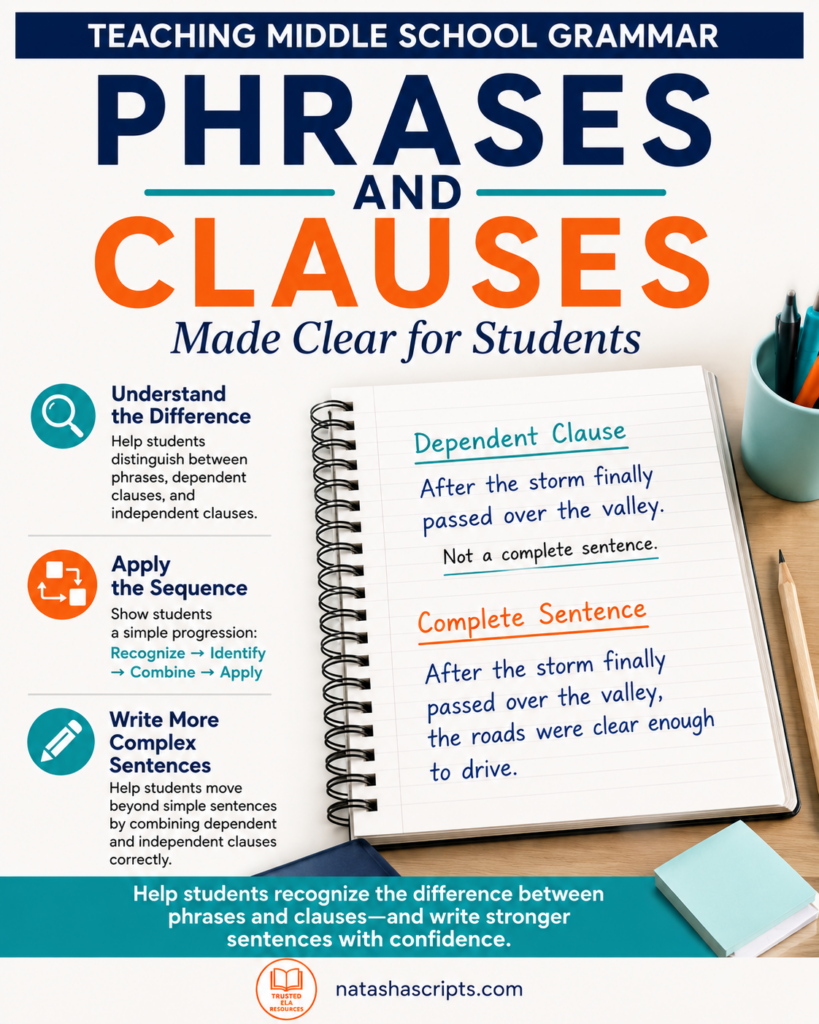
Among the sentence-level errors that appear regularly in middle school writing, one of the most instructive involves a sentence that appears complete but structurally is not. A student might write something like After the storm finally passed over the valley. At first glance, it looks like a finished sentence. It begins with a capital letter, ends with a period, and expresses a clear idea. Yet it has no independent clause, meaning there is no complete thought that can stand on its own. Instead, it is a dependent clause that leaves the reader expecting more.
The difficulty often begins with an oversimplified definition of a sentence. Students are frequently taught that a sentence needs a subject and a verb. While that guideline is useful, it does not tell the whole story. A dependent clause also contains a subject and a verb, yet it cannot stand alone as a complete sentence.
Understanding the difference between phrases and clauses, and between dependent and independent clauses, helps students recognize why some groups of words function as complete sentences while others do not. That distinction is an important step toward writing clear, grammatically complete sentences.
Note to Parents and Teachers
If you’re introducing phrases and clauses for the first time or looking for a structured review, my Introduction to Phrases and Clauses video lesson provides a clear, student-friendly explanation of these concepts. The lesson covers the difference between phrases and clauses, dependent and independent clauses, common conjunctions, basic punctuation cues, and the major phrase types students will encounter in middle school grammar. It also includes a printable worksheet for additional practice.
What a Phrase Is, and What It Is Not
A phrase is a group of words that functions as a unit within a sentence but does not contain both a subject and a predicate. Phrases can be noun phrases (the old wooden bridge), verb phrases (had been waiting), prepositional phrases (under the circumstances), participial phrases (running toward the finish line), or infinitive phrases (to understand the problem), among others. What they share is the absence of a subject-predicate relationship. A participial phrase like exhausted from the long drive contains a verb form, but that verb form does not have a grammatical subject performing the action in the way a full clause does.
Students in middle school are often introduced to phrases through definitions and lists of types, but that approach alone rarely helps them recognize phrases in their own reading and writing. A more effective approach is to show what phrases do within a sentence. They add detail, describe people or things, modify actions, and provide context, but they cannot stand alone as complete sentences.
For example, in the sentence Running toward the finish line, she tripped, the words Running toward the finish line form a participial phrase. The phrase adds information about the subject, but it is she tripped that forms the independent clause and completes the sentence. Examples like this help students see how phrases support sentences without functioning as sentences themselves.
A more effective approach is to show what phrases do within a sentence. They add detail, describe people or things, modify actions, and provide context, but they cannot stand alone as complete sentences.
The Clause Distinction That Middle Schoolers Need to Understand
A clause, unlike a phrase, does contain a subject and a predicate. That is where the definition of a sentence as “a group of words with a subject and a verb” becomes insufficient on its own, because it describes clauses generally rather than independent clauses specifically. The critical distinction for middle school students is not simply between phrases and clauses, but between two kinds of clauses: those that can stand alone and those that cannot.
An independent clause expresses a complete thought and can function as a sentence by itself. The storm passed is an independent clause. She finished her essay before dinner is an independent clause. A dependent clause, by contrast, contains a subject and a verb but is introduced by a subordinating conjunction (because, although, when, after, since, if, unless) or a relative pronoun (who, which, that) that signals its reliance on another clause to complete the meaning. After the storm finally passed over the valley has a subject (storm) and a verb (passed), but the word after subordinates the clause, turning it into a fragment when it appears alone.
One of the most effective ways to illustrate this distinction to middle schoolers is to present the same words in two different contexts: first as a dependent clause standing alone, then as part of a complete sentence.
After the storm finally passed over the valley.
After the storm finally passed over the valley, the roads were clear enough to drive.
Comparing the two examples helps students see that the dependent clause has not changed. What has changed is that it is now attached to an independent clause, creating a complete sentence. This side-by-side comparison is often more meaningful than a definition alone.
Note to Parents and Teachers
Looking for a ready-to-use lesson? My Introduction to Phrases and Clauses video lesson and worksheet provide a clear introduction to the concepts discussed in this article.
Why This Error Is So Common in Middle School Writing
Dependent clauses are not a sign of weak writing. In many cases, they appear because students are beginning to write more complex sentences. Subordinating conjunctions allow writers to show relationships between ideas, including cause and effect, contrast, sequence, and condition. As students begin using these sentence structures more often, they are also more likely to produce dependent clause fragments if they have not yet learned how dependent and independent clauses work together. The error usually reflects a gap in structural understanding rather than a lack of effort.
One reason this error often persists is that dependent clause fragments are more difficult to identify than other kinds of sentence fragments. A fragment such as Ran down the street is obviously missing a subject. A fragment such as Although the evidence was compelling and the argument was well organized is less obvious because it contains both a subject and a verb and expresses a meaningful idea. What it lacks is an independent clause to complete the sentence.
Teaching students to identify the structural components of a sentence, rather than relying on whether a sentence “sounds right,” helps them proofread more effectively and recognize these errors with greater confidence. For more guidance on helping students distinguish between sentence fragments and run-on sentences, see Run-On Sentences and Fragments in Middle School Writing: Identifying Which Error a Student Has and How to Address It, which explores how teachers and homeschool parents can help students distinguish between these two common sentence-level problems.
A Sequence That Tends to Help
When introducing clauses and phrases in grades 6 through 8, a sequence that moves from recognition to application is generally more effective than one that begins with rule memorization. The following progression works well in both classroom and homeschool settings.
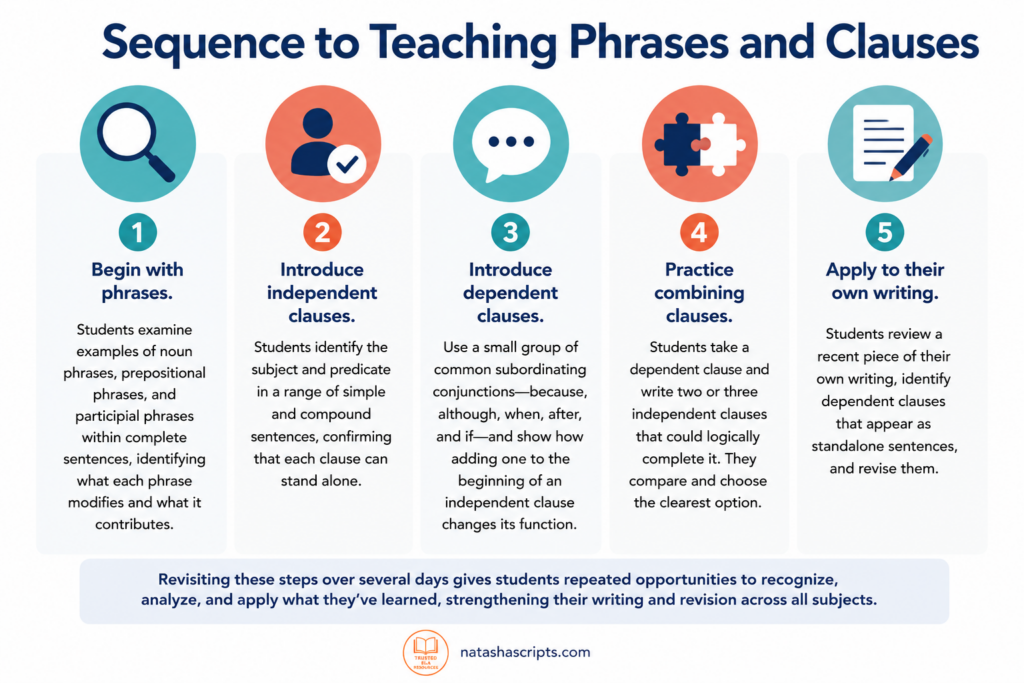
Prefer a quick overview? Jump to the Sequence to Teaching Phrases and Clauses visual guide.
1. Begin with phrases. Students examine examples of noun phrases, prepositional phrases, and participial phrases within complete sentences, identifying what each phrase modifies and what it contributes to the sentence. At this stage, the goal is recognition rather than memorizing terminology.
2. Introduce independent clauses. Students identify the subject and predicate in a range of simple and compound sentences, confirming that each clause can stand alone. This reinforces the subject-predicate relationship before introducing dependent clauses.
3. Introduce dependent clauses. Begin with a small group of common subordinating conjunctions, such as because, although, when, after, and if. Show students how adding one of these words to the beginning of an independent clause changes its function. She finished her essay is a complete sentence. After she finished her essay is a dependent clause. The change is immediate and easy for students to see.
4. Practice combining clauses. Students take a dependent clause and write two or three independent clauses that could logically complete it. They then compare their sentences and discuss which combination communicates the intended meaning most clearly.
5. Apply the skill to authentic writing. Students review a recent piece of their own writing, identify any dependent clauses that appear as standalone sentences, and revise them by attaching them to an independent clause or restructuring the sentence.
Teaching phrases and clauses effectively takes more than a single lesson. Revisiting these concepts over several days gives students repeated opportunities to recognize, analyze, and apply what they have learned. That deeper understanding supports stronger sentence writing and more effective revision across every subject area.
Punctuation as a Connected Skill
Teaching clauses and phrases in middle school also provides a natural opportunity to introduce punctuation, since the relationship between dependent and independent clauses helps explain comma use in complex sentences. When a dependent clause comes before an independent clause, it is typically followed by a comma. When the dependent clause follows the independent clause, the comma is usually omitted. Students who understand the structural difference between these two types of clauses are better equipped to apply this punctuation rule consistently.
Making this connection explicit helps students see punctuation as part of sentence structure rather than as a separate set of rules to memorize. A student who knows to place a comma after an introductory clause but does not understand why is more likely to apply the rule inconsistently, especially in longer or more complex sentences. Readers interested in how punctuation reflects sentence structure may also find Colons and Semicolons in Middle School Writing: What Each Mark Actually Does, helpful, as it explores how punctuation marks signal relationships between ideas and clauses.
How This Fits Into a Broader Grammar Curriculum
Understanding phrases and clauses is not an isolated grammar skill. It supports sentence variety, revision, and the ability to write with greater clarity and precision. Students who understand the difference between a phrase and a clause, and between a dependent clause and an independent clause, are better equipped to vary their sentence structure intentionally. They can combine simple and complex sentences effectively instead of relying on the same sentence pattern throughout a piece of writing.
For 7th and 8th grade students, this structural understanding becomes increasingly important as writing tasks grow in length and complexity. Argumentative essays, literary analysis, and research writing all require students to express relationships between ideas, and dependent clauses are one of the tools that make this possible. Students who understand how these clauses function are more likely to use them effectively and punctuate them correctly.
The Spelling, Writing and Reading, 7th and 8th Grade: Language Arts Curriculum develops these skills as part of a broader program that integrates grammar, reading, writing, spelling, and vocabulary. Rather than teaching grammar in isolation, the curriculum helps students apply sentence-level concepts within authentic reading and writing tasks.
Ultimately, the goal is not simply for students to identify phrases and clauses on a worksheet. It is for them to recognize how these structures work within their own writing so they can compose clearer, more effective sentences and revise with greater confidence.
If you’re looking for ready-to-use lessons and worksheets on sentence structure, clauses, and other grammar topics, be sure to explore the Free ELA Resources page, where you’ll find downloadable samples that you can begin using right away.
Sequence to Teaching Phrases and Clauses
Ready to Teach This Skill?
Explore my Introduction to Phrases and Clauses lesson for a student-friendly video, printable worksheet, and guided practice.
