How to Teach -ance and -ence Spellings in Middle School
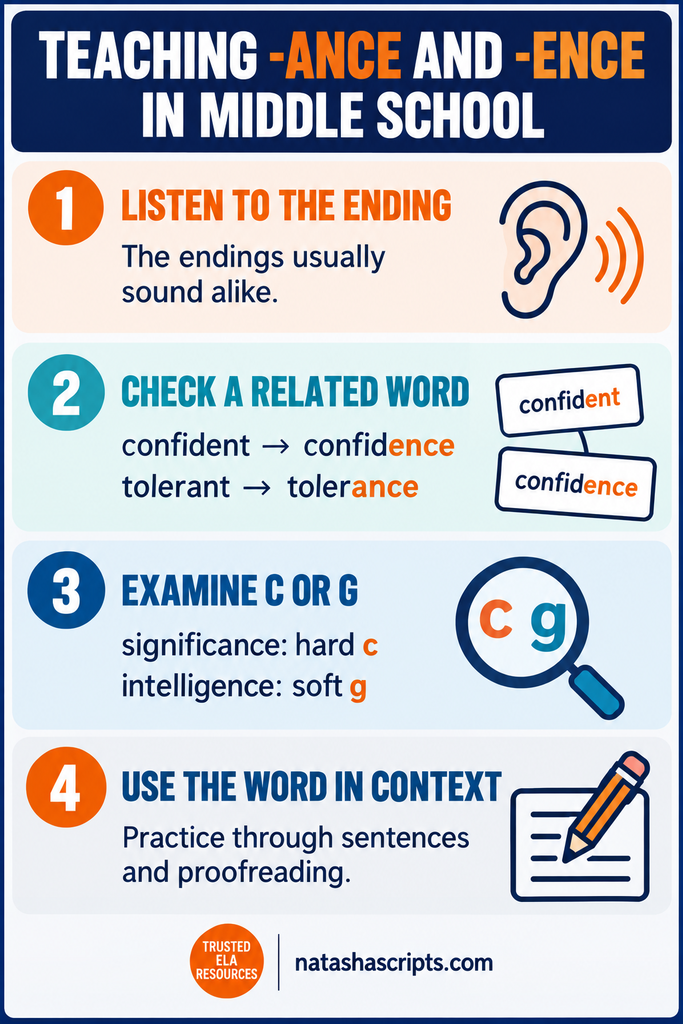
When middle school students spell words such as resistance and confidence, the difficulty often appears at the ending. In everyday speech, -ance and -ence are usually pronounced alike: an unstressed vowel followed by an ns sound. Students cannot reliably hear whether the word requires an a or an e.
This is one of the points at which “sound it out” stops being enough. A student may know the word, pronounce it correctly, and still have no clear way to choose the ending. Familiarity and visual memory may help, but they can also lead to guessing. Effective instruction needs to show students which spelling patterns and related words provide useful clues, while also acknowledging that some words must be learned and practiced individually.
Why -ance and -ence Sound Alike
The main difficulty with -ance and -ence is the unstressed vowel. In both endings, that vowel is commonly reduced to a schwa, the neutral vowel sound heard at the beginning of about. Because the letters a and e can represent the same sound in this position, listening to the word does not reveal which spelling is correct.
Words with these endings are also common in school reading and writing. Some belong to word families that provide a useful clue, such as important/importance and confident/confidence. Others, including sentence and audience, do not give students an obvious base word that settles the spelling. There is also no dependable default ending that can be used whenever students are unsure. They need to know which patterns apply to particular groups of words and what to do when a word does not follow one of those patterns.
What the Rules Can Tell Students
Students can use several patterns to help them choose between -ance and -ence, but no single rule works for every word. The most useful starting point is often a related word.
When a related adjective ends in -ant, the noun usually ends in -ance: important/importance, tolerant/tolerance, and relevant/relevance. When the adjective ends in -ent, the noun usually ends in -ence: confident/confidence, innocent/innocence, and different/difference. This allows students to examine the word family instead of trying to hear a difference between the two endings.
The consonant immediately before the ending can provide another clue. A hard c or hard g is commonly followed by -ance, as in significance, elegance, and arrogance. A soft c or soft g is commonly followed by -ence, as in adolescence, intelligence, and negligence. This pattern is useful, although students should not treat it as a rule that covers every word.
Related verbs can also help when the connection is clear. Comply becomes compliance, tolerate becomes tolerance, cohere becomes coherence, and interfere becomes interference. I would teach these as word families rather than give students a broad rule based on the final letters of the verb. Such a rule soon runs into exceptions. For example, persevere becomes perseverance, not perseverence.
Words such as sentence and audience offer no simple base-word clue. After students have checked for a related word and considered the preceding consonant, some spellings still need to be studied individually. The rules help students reduce the amount of guessing, but direct practice and dictionary checking remain necessary.
A Working Word List for Grades 6–8
A focused word list gives students enough examples to examine the spelling patterns without asking them to learn too many words at once. These -ance and -ence words provide a useful starting point for middle school instruction.
Words Ending in -ance
- distance
- performance
- substance
- importance
- appearance
- resistance
- tolerance
- relevance
- abundance
- dominance
- ignorance
- endurance
- guidance
- nuisance
- arrogance
- significance
- elegance
- ambulance
Words Ending in -ence
- sentence
- confidence
- patience
- audience
- evidence
- difference
- experience
- influence
- intelligence
- violence
- presence
- absence
- silence
- consequence
- preference
- interference
- adolescence
- negligence
- coherence
- persistence
How Students Can Examine the Words
Look for a related word. Compare pairs such as important/importance and confident/confidence.
Check the preceding consonant when it is c or g. Compare the hard sounds in elegance and significance with the soft sounds in intelligence and adolescence.
Record words that do not offer a clear clue. Words such as sentence, audience, and nuisance need direct study and repeated use.
Teaching -ance and -ence in a Sequence
I would teach these endings over several short sessions rather than introduce the rule and move directly to a spelling test. Students need time to understand why the endings are difficult, examine the patterns that help, and practice the words that cannot be resolved by a rule.
Begin with the schwa sound. When students hear that -ance and -ence sound alike in ordinary speech, they can see why pronunciation alone will not give them the spelling. They then know that they need to look for another clue.
Next, introduce the hard and soft c and g pattern using a small group of carefully selected words. Students can compare the hard sounds in arrogance, significance, and elegance with the soft sounds in intelligence, negligence, and adolescence. Sorting and discussing these examples requires students to apply the pattern rather than simply read about it.
The next group should include frequently used words for which this consonant pattern does not apply. Related words provide useful support here: distant/distance, perform/performance, confident/confidence, and patient/patience. Students can divide each word into syllables, examine its word family, and use it in an original sentence. This connects the spelling with the word’s meaning and use.
Short review activities can then return to the words over several days. Sentence completion, proofreading, word sorting, and brief writing tasks allow students to retrieve and apply the spellings in different contexts. My article on six spelling activities for middle schoolers includes several activities that can be adapted for -ance and -ence words.
Use Related Words as Spelling Clues
Vocabulary knowledge can give students a useful spelling clue. If they know that confident ends in -ent, they can connect it with confidence and choose -ence. The same relationship appears in different/difference and persistent/persistence. Adjectives ending in -ant commonly form nouns ending in -ance, as in tolerant/tolerance, important/importance, and resistant/resistance.
I would teach students to check for a familiar adjective before deciding which ending to use. This will not help with every word, but it covers many common examples and encourages students to examine word families. They begin to connect spelling with meaning and see that related words often preserve recognizable parts.
The same habit is useful when students study Greek and Latin roots in middle school vocabulary. Recognizing a shared root or base helps them understand how words are related, even when different suffixes change the word’s form and function.
Fitting This Into a Regular Spelling Routine
I would teach -ance and -ence through several short sessions spread across two or three weeks. Students can first examine the spelling patterns and related words, then apply what they have learned through sorting, sentence writing, and proofreading. The words should return later in the year so that students continue using them after the focused study has ended.
The Spelling Practice Workbook for 7th Grade provides a regular structure for students who need continued spelling practice. Its 20 lessons introduce six words at a time, with definitions, example sentences, syllable and whole-word practice, synonym work, and original sentence writing. The smaller word groups allow students to spend time on both spelling and meaning.
Daily Spelling Snacks for Grades 7–8 offers a different format. Each short activity concentrates on one word and may include its pronunciation, syllables, word parts, origin, meaning, or use in context. Teachers and homeschool parents can use these activities as warm-ups, independent work, homework, or brief review.
The study of -ance and -ence shows students that spelling decisions sometimes require several kinds of knowledge. They can listen to the word, check for a related adjective or verb, examine the consonant before the ending, and consult a dictionary when those clues do not provide an answer. Regular practice then helps them remember the words that cannot be settled by a rule.
Teachers and homeschool parents can find additional sample lessons and worksheets on my Free ELA Resources page.
