6 Spelling Activities for Middle Schoolers That Build Accuracy
Memorizing a word list on Sunday rarely translates to correct spelling on Friday’s essay. If you teach or tutor students in grades 6–8, you’ve probably watched a student ace a spelling test and then misspell the same word in their next writing assignment. That gap is the real problem. These six spelling activities for middle schoolers are designed to close it, moving students from surface recall to genuine word knowledge they can use under pressure.
Why Rote Memorization Falls Short in Middle School
By the time students hit sixth grade, the words they need to spell are longer, more morphologically complex, and often borrowed from Latin or Greek roots. Simple look-cover-write-check routines worked fine in second grade, but they don’t give middle schoolers the tools to decode and encode unfamiliar words independently.
What actually builds lasting accuracy is meaningful engagement with words, understanding structure, seeing words in context, and applying them in original writing. The activities below are built around that principle.
Activity 1: Word Sort by Pattern or Rule
Give students a set of 15–20 words and ask them to sort the words into categories based on a spelling pattern — for example, words with -ance vs. -ence, or words where a final consonant doubles before a suffix vs. words where it doesn’t. The act of sorting forces students to look closely at every letter rather than skim the whole word shape.
You can run this as a physical card sort, a two-column notebook activity, or a quick partner challenge. Once students sort, have them write a one-sentence rule that explains their categories in their own words. That explanation step is where the real learning happens.
A Quick Example
Provide words like reference, patience, excellence, abundance, sentence. Students group them, then articulate: “Words from Latin adjectives ending in -ant tend to use -ance.” They won’t get the rule perfect, but the attempt cements the pattern far better than copying a list ever would.
Activity 2: Morpheme Mapping
Morpheme mapping is one of the highest-leverage spelling practice ideas for middle school because it connects spelling to meaning simultaneously. Students take a target word, for example, unbelievable, and break it into its meaningful parts: un- + believe + -able. They write the base, identify each affix, and note what each part contributes to the overall meaning.
Once students see that -able always means “capable of being,” they can spell dozens of related words correctly without memorizing each one individually. That’s the payoff. A simple three-column chart (prefix | base | suffix) works perfectly for this, and students can recreate it in any notebook.
Activity 3: Sentence Composition with Target Words
Ask students to write original sentences using their spelling words. The constraint: each sentence must demonstrate that the student actually understands the word’s meaning. A sentence like “I used the word melancholy” doesn’t count. A sentence like “After losing the championship, the team sat in melancholy silence on the bus ride home” does.
This is a staple activity in structured spelling workbooks for a good reason. The Spelling Practice Workbook for 7th Grade builds sentence composition practice directly into each lesson, pairing it with definitions and model sentences so students have scaffolding before they write independently. That scaffolded approach is easy to replicate: show a model, discuss it briefly, then ask students to write their own.
Activity 4: Syllable Drilling for Longer Words
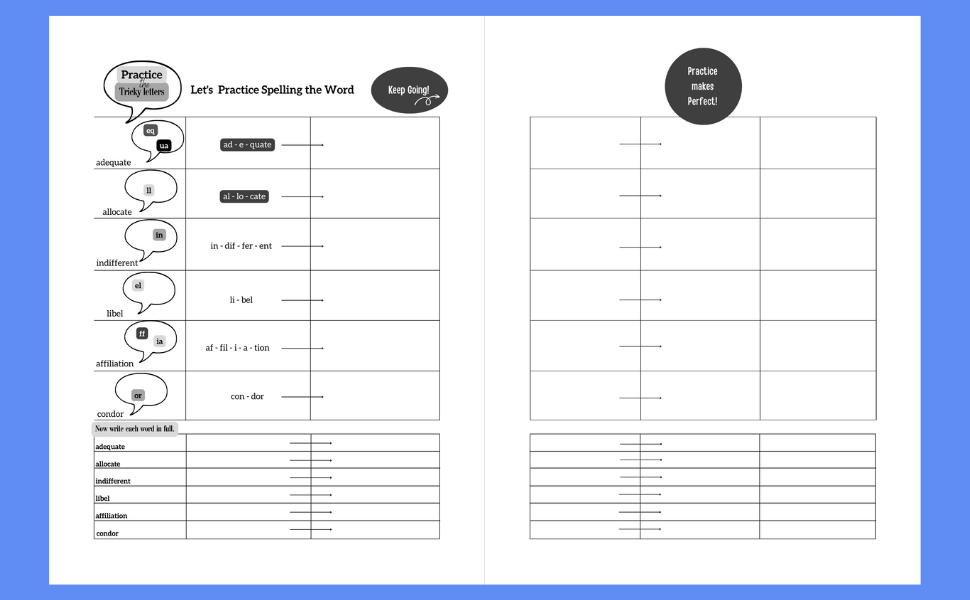
Eighth graders are expected to spell words like exaggerate, mischievous, and conscientious. These are words that trip up adults too. The most reliable strategy for tackling these is deliberate syllable drilling: students say the word aloud, clap or tap each syllable, write the word one syllable at a time, then reassemble it.
This works especially well for students who are strong readers but inconsistent spellers, because it slows down the visual processing and forces attention to internal word structure. The Spelling Practice Workbook for 8th Grade incorporates syllable drills as a dedicated practice activity within each of its 20 structured lessons, which gives you a ready-made model for how to sequence this with 8th grade word lists.
Activity 5: Synonym Word Search with a Twist
A standard word search is low-effort, low-return. But a synonym word search raises the cognitive bar significantly. Instead of hunting for the spelling word itself, students search for a synonym of the word, then write the original target word next to it. To do that correctly, they have to know what the word means, identify a synonym, and then spell the target word from memory.
This three-step process — meaning, synonym recognition, independent spelling — engages vocabulary and spelling simultaneously. It’s a format used in The Spelling Practice Workbook for 8th Grade as one of its four practice activity types per lesson. You can adapt the idea yourself by building a simple grid around a synonym set for any word list you’re already using.
Activity 6: Error Analysis Journals
This one is deceptively simple and highly effective for 7th and 8th grade spelling practice. Students keep a dedicated section of their writing notebook (or a separate small journal) where they record every word they misspell in their own writing. For each entry, they write the word incorrectly as they spelled it, then correctly, then circle or underline the exact letters that caused the error.
Over time, patterns emerge. One student might consistently drop the second e in words ending in -ement. Another might always swap i and e in certain combinations. When students identify their own error patterns, they become far more strategic about proofreading. This activity also gives you, as the teacher or tutor, diagnostic information that no standardized word list can provide.
Making Error Analysis a Habit
Build in two minutes at the end of any writing session for students to scan their work and add new entries. Once a week, ask students to look at their journal and write one “rule I’m working on” at the top of a new page. That metacognitive reflection is what separates students who improve steadily from those who keep making the same mistakes.
How to Sequence These Activities Across a Week
You don’t need to use all six activities every week. A practical middle school spelling practice schedule might look like this:
- Monday: Introduce new words with morpheme mapping (10 minutes).
- Tuesday: Word sort by pattern, done with a partner.
- Wednesday: Syllable drilling for the three or four hardest words on the list.
- Thursday: Sentence composition. (One original sentence per word.)
- Friday: Brief assessment, followed by two minutes of error journal updating.
The synonym word search and error analysis journal work well as independent or homework extensions. Rotate activities across grading periods to prevent predictability from becoming a shortcut.
Choosing the Right Word Lists for Grades 6–8
The activities above are only as strong as the words you pair them with. Generic lists pulled from the internet often skew too easy or too random for middle schoolers — they lack the morphological coherence that makes word study meaningful. Grade-appropriate, curated word lists tied to real spelling patterns give students the best return on their study time.
If you want a structured foundation for 6th grade, The Spelling Practice Workbook for 6th Grade covers 100 age-appropriate words across focused lessons with built-in activities, definitions, model sentences, and progress checks. This is exactly the kind of scaffolded sequence that complements the activity ideas above. Having a reliable word bank means you can focus your energy on delivering engaging instruction rather than sourcing and vetting vocabulary.
A Note on Consistency
Consistency matters more than intensity. Ten focused minutes of meaningful spelling practice four days a week will outperform a single cramming session every time. Keep the activities varied, keep the feedback specific, and keep the word study connected to real writing. That combination is what moves the needle for grades 6 through 8.
For ready-made free lesson samples to supplement your spelling instruction, visit our Free ELA Resources hub.
