How to Teach Homophones Through Meaning and Writing in Middle School
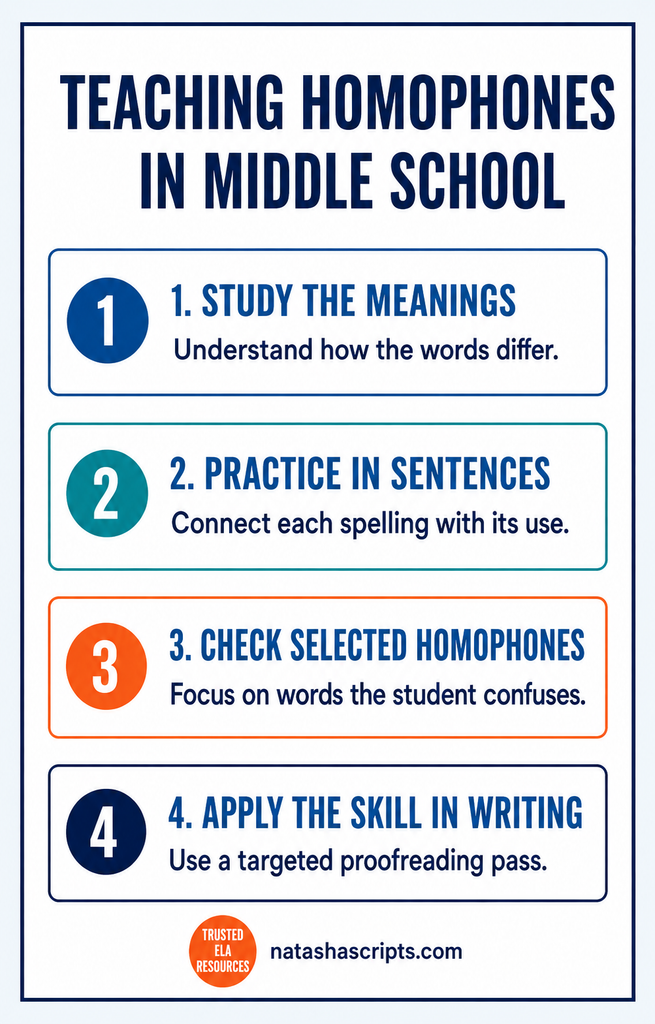
This article includes a free lesson and worksheet on homophones for middle school students.
Why Homophone Errors Reappear in Writing
By middle school, most students have already completed exercises on familiar homophones such as their, there, and they’re. Many can explain the difference when the words are presented together. The difficulty often returns when they begin writing a paragraph or essay. A student may select the correct word on a worksheet and then confuse the same pair in a piece of independent writing.
Writing places several demands on the student at once. Ideas must be developed, sentences organized, and decisions made about vocabulary, grammar, spelling, and punctuation. Since homophones sound alike, pronunciation does not help the student choose the correct written form. If the distinction between the words is not understood well or recalled quickly, the more familiar spelling may appear on the page before the student pauses to consider its meaning.
Students may need different kinds of support with homophones. One student may need to study the meaning of each word more carefully, while another can explain the difference but needs more practice applying it during independent writing. Identifying the source of the difficulty helps teachers and homeschool parents choose suitable practice.
Choosing the Correct Homophone While Writing
A focused homophone exercise asks students to make one main decision. When they write independently, that decision becomes one of many. They are developing ideas, organizing sentences, choosing vocabulary, and keeping track of grammar and punctuation at the same time.
Under these conditions, a homophone may be selected quickly according to its sound or the spelling the student uses most often. The student may understand the difference between your and you’re when the pair appears in an exercise, but that knowledge is not always recalled while attention is directed toward the content of the writing. Time limits can make this more noticeable, although the same errors also occur when students are absorbed in what they want to say.
This helps explain why correct answers on a worksheet do not always carry over immediately into paragraphs and essays. Students need practice that asks them to connect each spelling with its meaning and then apply that distinction in complete sentences and longer pieces of writing. The same difficulty can continue into later grades, as I discuss in Homophones in High School Writing: Why Fluent Writers Still Mix Them Up and How to Address It.
Build a Focused Homophone Check
A correction on a piece of writing shows students where they selected the wrong homophone and gives them an opportunity to fix it. When similar errors continue to appear, students also need a method for finding and correcting them independently.
A short homophone check can be added as a separate stage of proofreading. During this check, the student looks for a small number of homophones that have caused difficulty before. Each choice is checked against the meaning of the sentence. For sight, site, and cite, for example, the student considers whether the sentence refers to something seen, a place, or a source being acknowledged. The same meaning check can distinguish passed from past and peace from piece.
Teachers might select several words from recent student writing and ask the class to circle each occurrence before submitting an assignment. A list could include scent/sent/cent, heard/herd, or seam/seem. Homeschool parents can prepare a shorter list based on the words their learner confuses most often.
Keeping the list focused allows students to concentrate on one type of error at a time. As they compare each spelling with the meaning needed in the sentence, they gain practice making the same decision they will need to make in future writing.
The Role of Frequency and Familiarity
Not all homophone errors are equally persistent. The pairs that cause the most trouble in middle school writing tend to be the ones that appear most frequently in academic writing, which means students are making the choice dozens of times across a semester. Their, there, and they’re are the most commonly cited, but your and you’re appear at a comparable rate in persuasive and reflective writing, and its and it’s cause consistent difficulty because the apostrophe rule for possessives conflicts with the more general rule students have already internalized.
High-frequency errors deserve more sustained attention than occasional or one-off confusions. Rather than addressing every homophone pair with equal weight, it is often more productive to identify the three or four pairs that appear most often in a particular student’s writing and concentrate practice on those. For a student whose errors cluster around your/you’re and its/it’s, focused practice on those two pairs with repeated is likely to be more effective than a broad review of all homophones at once.
Use a Short Writing and Checking Routine
Once the target homophones have been selected, students can practice them through a short routine several times a week. Five to ten minutes is enough. The student reviews the meanings, writes three or four original sentences using the words, and then rereads each sentence to check that the spelling matches the intended meaning.
During this activity, it helps to keep the writing and checking stages separate. Students concentrate on composing their sentences first. They then return to the target words, circle each one, and explain why it belongs in that sentence. When practicing affect and effect, for example, students can check whether they need the verb affect, meaning to influence something, or the noun effect, meaning a result. These are their most common uses.
Regular practice gives students repeated experience with the same decision they must make in their independent writing. As the meanings and spellings become more familiar, students are more likely to notice these words during proofreading and select them accurately while writing. Progress may appear first in the practice sentences before becoming consistent in longer assignments.
Teachers and homeschool parents can find additional ideas in 6 Spelling Activities for Middle Schoolers That Build Accuracy. My article When Jordan Froze at the Board: A Spelling Wake-Up Call also considers why spelling that seems secure during study may be harder to recall when a student is writing or working under pressure.
A Free Introduction to Homophones Lesson
I have prepared a free Introduction to Homophones lesson for teachers and homeschool parents who would like a ready-made starting point for this work. It introduces homophones clearly and includes reference tables with meanings and example sentences for pairs and groups such as bear/bare, peace/piece, sight/site/cite, and scent/sent/cent.
Students do not need to practice every word in the lesson with equal attention. After reviewing the reference tables, they identify the homophones they find difficult or unfamiliar. They can look up the definitions when needed and record each word with an original sentence. This keeps the practice focused while asking students to connect spelling with meaning and use.
Teachers can review selected pairs with the whole class or a small group before assigning the written activity. Homeschool parents may divide the lesson into shorter sessions, using the reference pages first and the sentence-writing activity as a follow-up.
The free lesson is taken from Homophones and Tricky Spelling Words, a three-lesson pack that continues with advanced homophones and more challenging spelling words. The introductory lesson can also be used on its own for review, targeted practice, or support during a writing unit. You can download the free lesson by completing the form below.
Addressing the Apostrophe
Some homophone groups include a contraction, and the apostrophe gives students an additional way to check their choice. They can expand they’re to they are, you’re to you are, or he’ll to he will. If the expanded words make sense in the sentence, the contraction is correct.
This check also helps students distinguish contractions from possessive pronouns. The words their, your, and its show possession without an apostrophe. In the sentence “The dog wagged its tail,” replacing its with it is produces a sentence that does not make sense, so the possessive form is needed.
Students can add this short substitution test to the focused proofreading routine. After checking the contraction, they can use meaning to choose among the remaining homophones, such as heal and heel or there and their.
Make Homophone Checking Part of Proofreading
Homophone practice becomes more useful when students apply it to their regular writing. After completing a draft, they can reread it several times with a different focus for each reading. One check might concentrate on homophones, while later checks address sentence structure, punctuation, or another familiar difficulty. A narrow focus makes individual errors easier to notice.
This routine can begin with a few sentences or a short paragraph. As students move into longer assignments, they can use the same method without trying to correct every type of error at once. The homophone list should remain brief and reflect the words appearing in the student’s own work.
Corrections help students see where an error occurred. Regular writing and checking practice teaches them what to do when the same choice appears again. By connecting each spelling with meaning and making homophone checking part of proofreading, teachers and homeschool parents can help students use these words more accurately and independently.
Teachers and homeschool parents can also find ready-to-use lessons and worksheets for Grades 6–8 on my Free ELA Resources page.
