Colons and Semicolons in Middle School Writing: What Each Mark Actually Does
Middle school students often notice colons and semicolons in their reading without fully understanding what those punctuation marks do. In their own writing, they typically respond in one of two ways. Some avoid using them altogether because they have never received a clear explanation of when to use them. Others use them interchangeably because both marks look unfamiliar and seem to serve a similar purpose.
Short on time?
Quick Guide to the Main Points of This Article
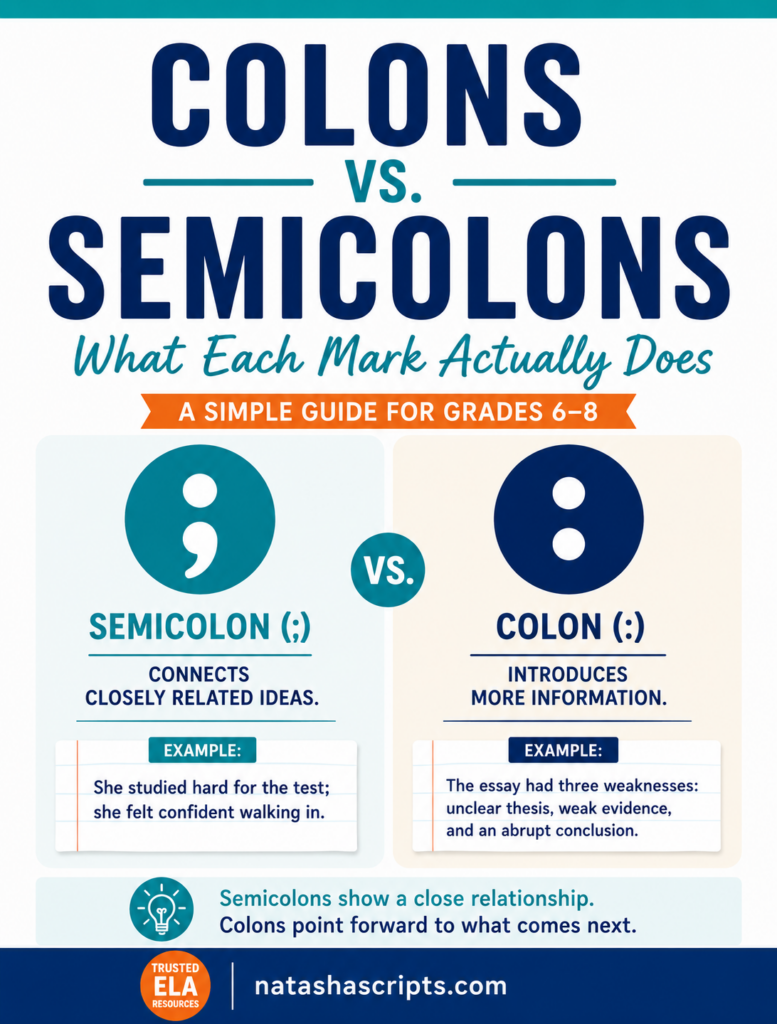
provides a simple visual summary of how colons and semicolons work in middle school writing.
Neither response is surprising. Students are often introduced to colons and semicolons through brief definitions and isolated examples, without enough attention to the specific job each mark does in a sentence.
Taking the time to teach the difference is worthwhile. As students move into more complex reading and writing in grades seven and eight, both punctuation marks become increasingly useful. When students understand the signal each mark sends to a reader, they can make purposeful punctuation choices instead of relying on guesswork.
Why These Two Marks Get Confused
Part of the confusion comes from the way colons and semicolons look. Both are made up of two dots, and both appear within a sentence rather than at the end. Students who have not been taught a clear difference between the two often assume they serve the same purpose. Others avoid using them altogether and rely on periods or commas instead.
In many cases, the comma becomes a catch-all punctuation mark. Students use it where a semicolon would be more accurate or where a colon would do a better job of preparing the reader for what comes next.
Another reason these marks get confused is the way they are sometimes taught. A student who learns that a semicolon “joins two sentences” may not understand how that differs from using a period. A student who learns that a colon “introduces a list” may not realize that colons can do much more than that.
When students understand the purpose behind the punctuation mark, the rule becomes easier to remember. Instead of memorizing definitions, they begin to see how each mark helps communicate meaning more clearly to the reader.
What a Semicolon Actually Signals
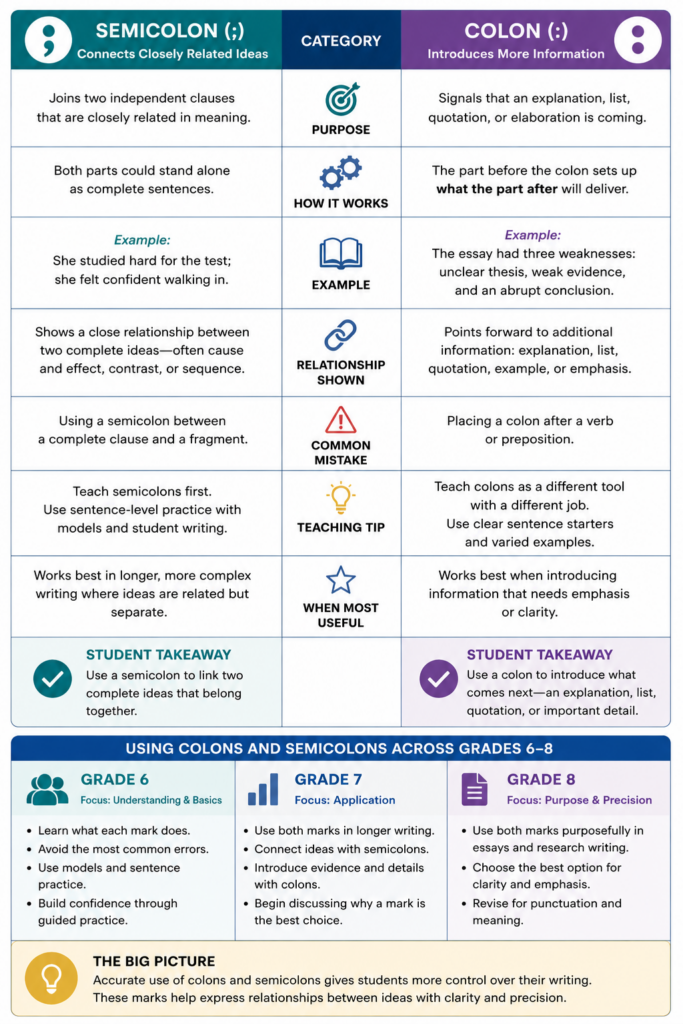
A semicolon connects two independent clauses, or two complete thoughts that could each stand alone as a sentence. Writers use a semicolon when those ideas are closely related and they want readers to see the connection between them.
Consider this example:
The first paragraph introduced the argument; the second paragraph developed it with evidence.
Both parts could stand alone as separate sentences. The semicolon tells the reader that the ideas belong together and should be read as part of the same larger point. A period would also be correct, but it would create a stronger separation between the ideas.
For middle school students, the most useful way to think about a semicolon is as a bridge between closely connected thoughts. When writers choose a semicolon instead of a period, they are showing that the second idea builds directly on the first.
One common mistake is placing a semicolon between a complete sentence and an incomplete thought.
Incorrect: She studied for the test; because she wanted a good grade.
The second part is not a complete sentence, so a semicolon cannot be used there.
A helpful strategy is to have students check both sides of the semicolon. If each side can stand alone as a complete sentence, the semicolon may be appropriate. If one side is incomplete, a different punctuation mark is needed.
If your student frequently struggles with fragments or run-on sentences, those sentence structure issues often lead to semicolon errors as well. My guide to run-on sentences and fragments explores those patterns in more detail.
A semicolon connects two independent clauses, or two complete thoughts that could each stand alone as a sentence.
What a Colon Actually Signals
A colon serves a different purpose from a semicolon. While a semicolon connects closely related ideas, a colon points forward. It tells the reader that additional information is coming.
A colon often introduces a list, an explanation, a quotation, or a more specific detail related to what came before.
Consider this example:
The essay had three structural weaknesses: an unclear thesis, insufficient evidence, and an abrupt conclusion.
The colon signals that a list is about to follow.
A colon can also introduce an explanation rather than a list:
The revision made one thing clear: the original argument had never been fully developed.
In this sentence, the colon signals that the writer is about to explain the statement that came before it.
The most useful way for students to think about a colon is as a signal that says, “Pay attention. More information is coming.”
One common mistake is placing a colon where it does not belong.
Incorrect: The ingredients are: flour, sugar, and butter.
Incorrect: She was interested in: history, science, and art.
In both examples, the colon interrupts the sentence unnecessarily. A helpful rule is to check whether the words before the colon form a complete sentence. If they do not, the colon is usually incorrect.
The most useful way for students to think about a colon is as a signal that says,
“Pay attention. More information is coming.”
Teaching the Difference in Practice
One approach that works well with middle school students is to introduce semicolons and colons separately rather than teaching them together. When students learn both marks at the same time, they often focus on how similar they look instead of understanding the different job each one does.
Teaching the semicolon first gives students time to become comfortable with its purpose. Once they understand how a semicolon connects closely related ideas, the colon can be introduced as a completely different punctuation mark with a different function.
Sentence-level practice is especially effective. In many cases, it is more useful than paragraph-level activities at the beginning. Students can practice combining two related sentences with a semicolon or rewriting a sentence so that a colon introduces an explanation or a list. These activities keep the focus on what the punctuation mark is doing. Once students can use each mark correctly in individual sentences, applying them in longer pieces of writing usually becomes easier.
Teachers and homeschool parents may also find it helpful to ask students to explain why they chose a particular punctuation mark. A simple explanation such as, “I used a semicolon because both parts could stand alone as complete sentences,” often reveals whether the student understands the purpose of the mark or is simply guessing.
The explanation does not need to be formal. The goal is simply to make the student’s thinking visible.
Students often learn punctuation more effectively when it is taught alongside sentence structure and writing. Rather than practicing punctuation only through isolated drills, they benefit from seeing how these marks help communicate meaning in authentic writing tasks. The Spelling, Writing and Reading, 7th and 8th Grade: Language Arts Curriculum covers grammar as part of a broader language arts program, giving students opportunities to encounter and apply punctuation within meaningful reading and writing activities.
One approach that works well with middle school students is to introduce semicolons and colons separately rather than teaching them together.
Colons and Semicolons in Student Writing Across Grades 6–8
In sixth grade, the primary goal is helping students understand what each punctuation mark does and avoid the most common errors. This includes using a semicolon between a complete sentence and a fragment or placing a colon where it does not belong. At this stage, students benefit from seeing clear models and then practicing similar sentence patterns themselves.
By seventh and eighth grade, students are usually writing longer and more complex pieces, including analytical paragraphs, essays, and research-based assignments. As writing becomes more sophisticated, both punctuation marks become more useful. A semicolon can help connect closely related ideas, while a colon can introduce evidence, an explanation, or a specific detail with greater clarity.
At this level, instruction can move beyond simply avoiding mistakes. Students can begin discussing why one punctuation mark works better than another in a particular sentence and how punctuation choices affect the reader’s understanding.
It is also helpful for students to recognize that punctuation choices influence the overall flow of a piece of writing. A student who knows when to use a colon to introduce evidence or a semicolon to connect related observations has greater control over sentence structure and meaning. This does not mean every piece of writing should be filled with colons and semicolons. Effective writers use them selectively, choosing them when they strengthen the sentence and help communicate ideas more clearly.
A similar idea is explored in our article on what one missing comma can teach students about meaning, which examines how a single punctuation choice can affect the way a reader interprets a sentence.
A Note on Avoidance
It is worth addressing avoidance directly because it is both common and understandable. When students are unsure about a punctuation rule, they often avoid the punctuation mark altogether. A student who is uncertain whether to use a semicolon or a period will usually choose the period, and in many cases that choice is not technically wrong.
The drawback is that the student’s writing becomes more limited. The issue is not correctness. The issue is that students miss opportunities to use a wider range of sentence structures and communicate relationships between ideas more effectively.
Encouraging students to try these punctuation marks, even when they are not completely confident, is often more productive than waiting until they feel certain. When students make a genuine attempt and then examine what worked and what did not, they have a chance to learn from the experience. Those attempts give teachers and homeschool parents something concrete to discuss during revision.
As students begin to understand that a semicolon connects closely related ideas and that a colon introduces an explanation, detail, or elaboration, the marks become easier to use. They stop feeling like arbitrary rules and start feeling like useful writing tools.
That shift from following rules to making purposeful writing decisions is often where confident punctuation use begins to develop.
Readers who would like to explore free sample lessons and worksheets on grammar and writing topics for middle school students can find them on the Free ELA Resources page.
Quick Guide to the Main Points of This Article