SQ3R Reading Method for Middle School: A Parent’s Guide to Active Reading at Home
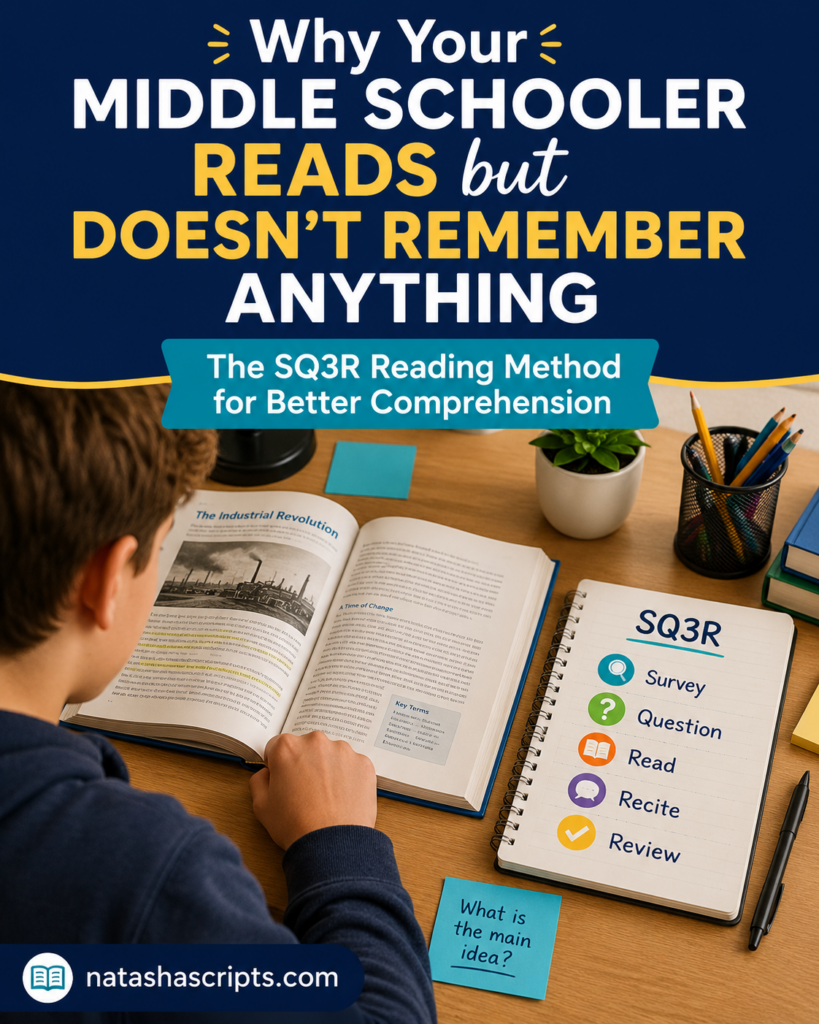
Reading assigned texts and actually remembering what was read are two very different things. Many middle school students can finish a chapter, turn the page, and then struggle to explain the main idea or answer basic questions about the text.
This challenge often becomes more noticeable in grades 6–8 as reading assignments grow longer and more complex across subjects such as science, history, literature, and social studies. Students are expected not only to read the material but also to understand it, recall important details, and apply what they have learned.
The SQ3R reading method offers a practical way to support this process. Rather than treating reading as a simple start-to-finish task, SQ3R guides students through five structured steps that help them engage with a text before, during, and after reading. The result is more active reading, stronger comprehension, and better retention of information.
Want the short version? Jump to the Quick Guide to SQ3R for a simple step-by-step overview you can use while reading.
What SQ3R Is and Where It Comes From
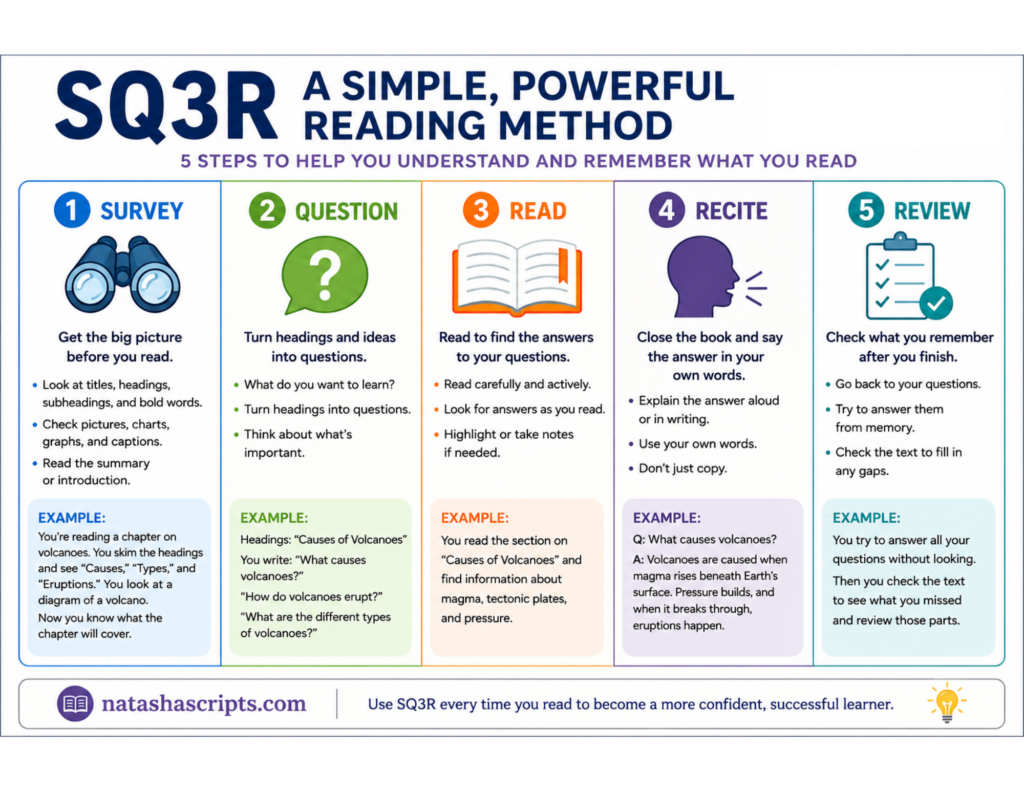
SQ3R stands for Survey, Question, Read, Recite, and Review. The method was developed by Francis P. Robinson in the 1940s as a study strategy to improve reading comprehension and retention. While it was originally designed for college students, its core idea remains useful for middle school readers: students understand and remember more when they approach a text actively rather than passively.
Each step in the process serves a specific purpose and builds on the one before it. By the time students finish reading a passage or chapter, they have already previewed the text, asked questions, looked for answers, recalled important information, and reviewed what they learned.
For parents supporting reading at home, SQ3R provides a clear and repeatable routine. Instead of telling a child to “pay attention” or “read more carefully,” parents can guide them through a series of concrete steps. With regular practice, these steps become more natural, helping students approach challenging texts with greater confidence and purpose.
Step One: Survey
Before reading the text, students take a few minutes to survey it. This means looking over headings, subheadings, bolded vocabulary words, images, charts, diagrams, captions, and any introductory or concluding sections. The goal is to get a general sense of what the text is about and how the information is organized.
For example, a student preparing to read a chapter about the American Civil War might notice sections on major battles, key leaders, and the causes of the conflict. Having this overview makes it easier to connect new information to the larger topic while reading.
Many students are tempted to skip this step because they want to begin reading immediately. However, spending just a few minutes surveying the text often improves comprehension and saves time later. Students are less likely to feel lost because they already have a basic roadmap of the material.
When introducing SQ3R at home, parents can model this process by briefly looking through a chapter together and discussing what stands out. After a few guided examples, most students can complete the survey step independently.
Step Two: Question
After surveying the text, students turn the headings and subheadings into questions. For example, a section titled “Causes of the Civil War” becomes “What were the causes of the Civil War?” A heading such as “How the Heart Pumps Blood” might become “How does the heart pump blood?”
The questions do not need to be complicated. Their purpose is to give students a clear reason for reading each section. Instead of simply moving through the text, students are actively looking for answers to specific questions.
This small shift can make a noticeable difference in comprehension. When students read with a question in mind, they are more likely to pay attention to important details and recognize information that answers the question they created. Reading becomes an active search for meaning rather than a passive task.
For middle school students, this step also encourages better focus. A student who begins a section by asking, “What were the main causes of the Civil War?” is more likely to notice and remember the key ideas than a student who starts reading without a clear purpose.
“After surveying the text, students turn the headings and subheadings into questions.”
Step Three: Read
Once the questions have been created, students read the text with the goal of finding answers. Instead of reading passively, they are actively looking for information that helps answer the questions they generated during the previous step.
Some students may choose to underline important details, highlight key ideas, or write brief notes in the margins. Others may simply pause occasionally to think about what they have read. The specific approach matters less than the purpose behind it. Students should be reading with focus and checking whether the text answers their questions.
It is also important for students to understand that the answers may not always be exactly what they expected. Sometimes a heading suggests one idea, but the section develops the topic in a different or more detailed way. When this happens, students can adjust their thinking and update their questions based on what they learn.
This flexibility is part of becoming a stronger reader. Good readers do not simply collect information. They continually compare what they expected to learn with what the text actually says and adjust their understanding as they read.
Good readers do not simply collect information.
They continually compare what they expected to learn with what the text actually says and adjust their understanding as they read.
Step Four: Recite
After reading a section, students pause and explain the answer to their question in their own words. This can be done aloud or in writing. The important part is that students are recalling the information without immediately looking back at the text.
For example, if a student asked, “What were the main causes of the Civil War?” before reading, they should be able to summarize the answer in a few sentences after finishing the section. Putting information into their own words helps strengthen understanding and memory in a way that simply re-reading the text does not.
For parents, this step provides a clear way to check comprehension. A student who can explain the main idea of a section has likely understood it. A student who struggles to explain what they just read may need to revisit the section before moving on.
Reciting also helps students catch misunderstandings early. Instead of reading an entire chapter and realizing later that important information was missed, they pause regularly to confirm their understanding. This makes reading more active and helps information stay with them longer.
Step Five: Review
After finishing the text, students return to the questions they created and try to answer them from memory. The goal is to check what they remember before looking back at the text. This final step turns reading into an active learning process rather than a one-time task.
Reviewing in this way helps strengthen retention because students are retrieving information rather than simply reading it again. A student who can answer most of their questions without looking at the text has likely developed a solid understanding of the material.
The Review step also helps students identify areas that need more attention. If they cannot answer a particular question, they know exactly where to return in the text instead of re-reading an entire chapter. This makes study time more efficient and helps students focus on the information they have not yet mastered.
Over time, regular review helps students become more aware of their own learning. They begin to recognize what they understand well, what they need to revisit, and which study strategies help them remember information most effectively.
At first glance, Recite and Review may seem similar. The difference is that Recite happens after each section to check understanding, while Review happens after the entire reading assignment to strengthen retention and identify gaps.
Introducing SQ3R at Home
For parents and tutors working with middle school students, SQ3R is often easiest to introduce one step at a time. Rather than teaching all five steps at once, start with Survey and Question using a short article or a single textbook section. Once students become comfortable previewing a text and creating questions, the remaining steps can be added gradually.
As students gain confidence, encourage them to apply SQ3R to different types of nonfiction reading. History chapters, science texts, informational articles, and social studies readings all provide opportunities to practice the process. The more students use the method across subjects, the more likely they are to see it as a general reading strategy rather than something tied to a single class.
SQ3R works especially well with informational and expository texts because these materials typically include headings, subheadings, and a clear organizational structure. Literary texts such as novels, short stories, and poems often require different reading approaches. For this reason, SQ3R is best viewed as a strategy for helping students manage the increasing amount of nonfiction reading they encounter in middle school.
Parents looking for a structured language arts program that combines reading, spelling, and writing instruction may also be interested in Spelling, Writing and Reading, 7th and 8th Grade: Language Arts Curriculum. Used alongside active reading strategies such as SQ3R, a comprehensive language arts program can help students build stronger comprehension habits and become more confident readers across subjects.
What SQ3R Builds Over Time
The benefits of SQ3R extend beyond a single reading assignment. With regular practice, students begin to develop habits that support stronger comprehension across all subjects. Instead of immediately diving into a text, they learn to preview its structure, think about what they want to learn, and monitor their understanding as they read.
These habits do not always develop naturally. Many students need explicit guidance and repeated opportunities to practice active reading strategies before they become part of their normal routine. SQ3R provides that structure, helping students move from simply completing reading assignments to engaging more thoughtfully with what they read.
This can be especially helpful during the middle school years, when reading demands increase in subjects such as science, history, and social studies. As texts become longer and more information-dense, students benefit from having a reliable process to guide them through unfamiliar material.
Over time, the goal is not for students to follow the five steps mechanically every time they read. Instead, the goal is for the habits behind the method—asking questions, reading with purpose, checking understanding, and reviewing key ideas—to become a natural part of how they approach new texts.
Quick Guide to SQ3R