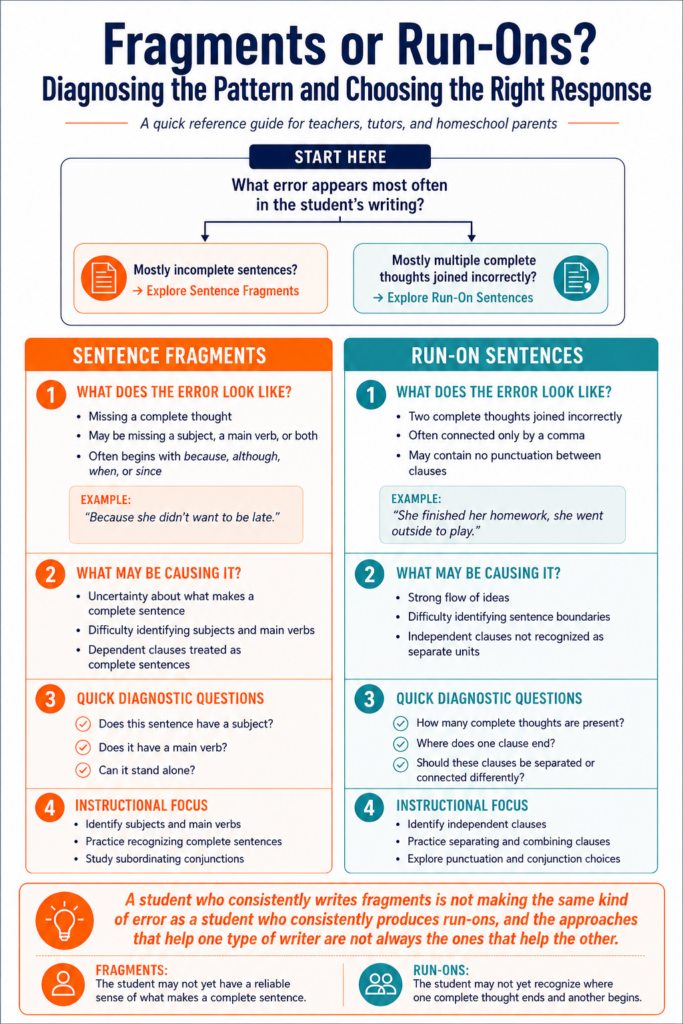
Run-On Sentences and Fragments in Middle School Writing: Identifying Which Error a Student Has and How to Address It
Run-on sentences and fragments are among the most common sentence-level errors in middle school writing, but they tend to be treated as a paired problem. In practice, they are quite different in origin and in what they require instructionally. A student who consistently writes fragments is not making the same kind of error as a student who consistently produces run-ons, and the approaches that help one type of writer are not always the ones that help the other. Before deciding how to address sentence-level errors in a student’s work, it is worth taking a closer look at which pattern is actually present and what may be driving it.
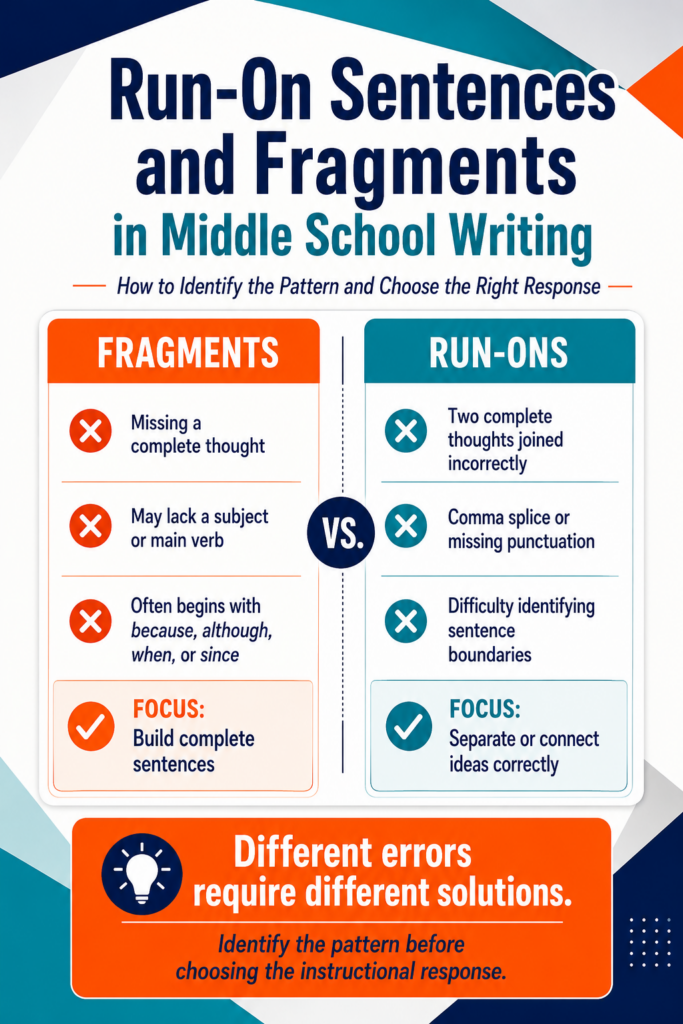
A student who consistently writes fragments is not making the same kind of error as a student who consistently produces run-ons,
and the approaches that help one type of writer are not always the ones that help the other.
If you’d like a quick visual summary of the key differences between fragments and run-ons, you can jump ahead to the Fragments or Run-Ons? Diagnostic Guide.
What Each Error Actually Looks Like in Student Writing
A sentence fragment is a group of words that has been punctuated as a sentence but is missing one or more of the elements required to function as one, typically a subject, a main verb, or both. In middle school writing, fragments often appear as dependent clauses that have been separated from the main clause they belong to, as in “Because she didn’t want to be late” written as a standalone sentence. They also appear as noun phrases without predicates (“The tall boy in the back row with the red backpack”) or as participial phrases that have drifted away from the sentence they were meant to modify.
Run-on sentences, by contrast, occur when two or more independent clauses are joined without adequate punctuation or a coordinating conjunction. The most common form in middle school writing is the comma splice, where a comma alone connects two clauses that each require their own sentence or a stronger connector, for example, “She finished her homework, she went outside to play.” A fused sentence, where the clauses run together with no punctuation at all, also appears but tends to be less common at this level than the comma splice. Both represent an over-connection of ideas rather than an under-connection, which is the opposite of what happens in fragment writing.
Which Error Tends to Appear More Often, and Why
In the middle school years, run-on sentences and comma splices in particular, tend to appear more frequently in student writing than fragments do, though this is not universal. One reason for this pattern is that middle school students are often writing with more ideas and more energy than they had in earlier grades, and the impulse to keep ideas moving can outpace their awareness of where one independent clause ends and another begins. A student who is engaged with what they are writing may not pause to assess sentence boundaries; they are focused on content rather than structure.
Fragments, when they do appear, often signal a different kind of challenge. Students who write fragments frequently may be uncertain about what constitutes a complete sentence at a grammatical level. They may not yet have a reliable sense of what a subject-verb relationship looks like, or they may be writing phrases that feel complete because they carry meaning, even though they lack the structural requirements of a sentence. Dependent clauses used as fragments are particularly common in this group, because a clause like “Although the weather was cold” does carry a clear idea, even if it is grammatically incomplete on its own.
There is also a third pattern worth noting: some students produce both errors, sometimes within the same piece of writing. This can occur when a student’s sentence sense, i.e., their intuitive feel for where sentences begin and end, is still developing unevenly. In those cases, the instructional approach may need to address sentence structure more broadly before focusing on either error in isolation.
Diagnosing the Pattern in a Student’s Work
A useful starting point is to read through several samples of a student’s independent writing. Looking across multiple pieces, rather than a single assignment, tends to give a clearer picture of which errors appear consistently and which may have been situational. It is also worth noting whether the errors cluster in particular kinds of writing, such as narrative versus expository, since some students manage sentence boundaries more reliably in one mode than the other.
When reviewing the writing, it helps to mark each group of words that has been punctuated as a sentence and ask two questions: Does it contain a subject and a main verb? And if so, is it an independent clause or a dependent clause that needs to be attached to something else? If most of the marked errors are groups of words missing one of those elements, the student’s primary challenge is likely fragment writing. If most of the errors involve two complete clauses joined by a comma or run together without punctuation, the primary challenge is more likely run-on construction.
A note for parents and tutors: this kind of review does not need to be exhaustive or clinical. Even a quick read-through of two or three writing samples, with attention to sentence endings, can reveal a consistent pattern that is worth addressing directly.
Addressing Run-On Sentences in Middle School
For students whose writing tends toward run-ons and comma splices, one useful approach is to build awareness of independent clauses as distinct units before introducing the various ways those units can be connected. A student who can reliably identify where one complete thought ends is better positioned to make deliberate choices about punctuation and conjunctions. This kind of clause-level awareness is sometimes underdeveloped even in students who have encountered grammar terminology before, because knowing the term “independent clause” does not automatically translate into recognizing one in the flow of their own writing.
A student who can reliably identify where one complete thought ends
is better positioned to make deliberate choices about punctuation and conjunctions.
Once a student can identify independent clauses, the range of options for connecting or separating them becomes more meaningful: a period to separate, a semicolon to join closely related ideas, a coordinating conjunction with a comma, or a subordinating conjunction to establish a relationship between the clauses. Presenting these as a set of choices rather than a set of rules to memorize tends to give students a more flexible sense of how to handle clause boundaries. Practice that asks students to take a run-on sentence and revise it in two or three different ways can reinforce this flexibility and help them see that there is rarely only one correct solution.
Addressing Sentence Fragments in Middle School
For students whose writing tends toward fragments, the instructional focus is somewhat different. The goal is to help the student develop a reliable test for sentence completeness — one they can apply to their own writing during revision. One approach that tends to be useful is teaching students to identify the subject and the main verb of each sentence as a habit of review, since a sentence that lacks either one is incomplete by definition. Students who write dependent-clause fragments often benefit from explicit attention to subordinating conjunctions — words like “because,” “although,” “when,” and “since” — and the understanding that these words signal a clause that needs to be connected to a main clause rather than standing alone.
It is worth noting that some fragment use in writing is intentional and stylistic. Professional writers use fragments deliberately for effect. At the middle school level, however, it is generally more productive to establish a clear understanding of what a complete sentence requires before introducing the idea of intentional fragments, since students who are still developing sentence sense may not yet have the control needed to use fragments purposefully.
How Instruction Can Address Both Within a Coherent Sequence
In a writing and grammar program that addresses sentence structure systematically, run-ons and fragments are often introduced together because they represent opposite tendencies: over-connection and under-connection. Contrasting them can help students see sentence boundaries more clearly. A student who looks at a fragment and a run-on side by side, and works through why each fails as a sentence, often develops a more nuanced sense of what a complete, correctly bounded sentence actually requires.
An integrated language arts curriculum for grades 7 and 8, such as the Spelling, Writing and Reading, 7th and 8th Grade: Language Arts Curriculum, can provide a structured context for this kind of sentence-level work, where grammar instruction is connected to writing practice rather than treated as a separate set of exercises. When students apply what they have learned about sentence structure to their own writing, rather than only to isolated drills, the understanding tends to be more durable and more transferable across assignments.
The broader point is that run-on sentences and fragments in middle school are indicators of where a student’s understanding of sentence structure currently stands, and they point toward what the next stage of instruction might usefully address. Identifying which pattern a student tends toward, and understanding something of why it appears, makes it considerably easier to choose an approach that will actually move their writing forward.
Fragments or Run-Ons? Diagnostic Guide