How to Teach Greek and Latin Roots in Middle School
Looking for the free printable lesson? Jump to the Greek and Latin Roots sample lesson and download a printable lesson from the Spelling, Writing and Reading for 7th and 8th Grade curriculum.

A student may not know the meaning of transportable, but if they understand that port means to carry, they’re already well on the way to working it out. The same root appears in words such as transport, export, import, portable, and porter, turning one small piece of knowledge into a tool for understanding many new words.
This is why teaching Greek and Latin roots can make such a difference in middle school vocabulary development. Instead of memorising words one at a time, students begin to recognise the patterns that connect them. This guide explains how to teach Greek and Latin roots step by step, with practical strategies that work equally well in the classroom and at home.
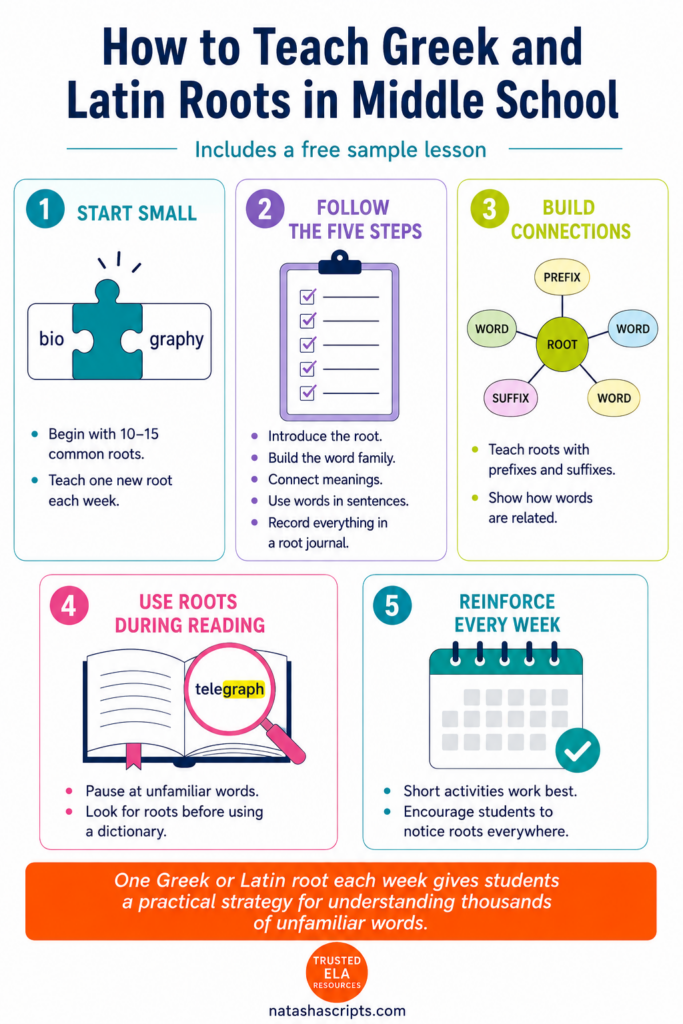
Looking for a quick overview? Jump to the Quick Reference Guide for a visual summary of the key teaching strategies.
Why Middle School Is the Right Time to Start
By middle school, students begin encountering many more academic words in science, social studies, mathematics, and literature. Words such as photosynthesis, democracy, hypothesis, and circumference can seem long and unfamiliar at first, but they become much easier to understand when students recognise the Greek and Latin roots inside them.
This is also the stage when students are ready to look beyond individual words and start making connections between them. Instead of seeing each new vocabulary word as something to memorise, they begin to recognise that many words share the same roots and therefore share related meanings. Once students understand that a root is a building block that appears in many different words, they have a much more effective way to expand both their vocabulary and their reading comprehension.
The Core Idea: Roots Connect Words
One of the greatest advantages of teaching Greek and Latin roots is that students quickly discover they are learning far more than a single word. When students understand the Latin root scrib/script (to write), they can begin making connections between words such as describe, prescribe, manuscript, inscription, subscribe, and transcript. Many of these words appear regularly across English, history, and even science, so one root can support vocabulary growth in several subjects.
The same principle applies to Greek roots. Understanding tele (far) helps students recognise the connection between telescope, television, telepathy, and telecommunication. Likewise, bio (life) appears in words such as biology, biography, antibiotic, and biodiversity. As students begin to notice these recurring roots, unfamiliar vocabulary becomes much less intimidating because they already understand part of the word’s meaning.
Where to Begin: Choosing Your First Roots
Do not begin with an overwhelming list of fifty roots. Start with ten to fifteen roots that appear frequently in middle school academic texts. Here are some useful options:
Latin roots: aud (hear), dict (say or speak), port (carry), rupt (break), scrib/script (write), vis/vid (see), struct (build), ject (throw)
Greek roots: bio (life), geo (earth), graph/gram (write or draw), hydro (water), micro (small), phon (sound), tele (far), therm (heat)
Introduce one root per week. This gives students time to encounter it across several words and contexts before moving on, helping the vocabulary become more secure.
How to Teach a Single Root: A Step-by-Step Lesson
The following five-step routine works well for both classroom teachers and homeschool parents. It can usually be completed in about twenty to thirty minutes and can be repeated each time you introduce a new Greek or Latin root.
Step 1: Introduce the Root and Its Meaning
Write the root where everyone can see it, whether on a whiteboard, in a notebook, or on an index card. Explain whether it comes from Greek or Latin and give its core meaning.
For example:
rupt — Latin — to break
Keep the explanation short. The goal is simply to give students a clear starting point.
Step 2: Build on What Students Already Know
Ask students to think of any words they already know that contain the root.
With rupt, they might suggest erupt or interrupt.
Write every suggestion down. Students are often surprised by how many words they already know, and this immediately shows that they are building on existing knowledge rather than starting from scratch.
Step 3: Expand the Word Family
Now introduce a few additional words, such as rupture, corrupt, disrupt, bankrupt, and abrupt.
Discuss briefly how the idea of breaking connects to each word.
For example:
- corrupt – morally broken
- abrupt – broken off suddenly
These connections help students remember the words because they understand the relationship rather than memorising each one separately.
Step 4: Use the Words in Context
Ask students to write two or three sentences using different words from the same word family.
Using the words in their own writing helps move them from recognition to confident use and strengthens long-term retention.
Step 5: Keep a Root Journal
Encourage students to keep a notebook or binder section where each root has its own page.
Include:
- the root
- its meaning
- its Greek or Latin origin
- related words
As students encounter new examples in their reading, they can continue adding to each page. By the end of the school year, they will have created a valuable vocabulary reference that reflects their own learning.
Teach Prefixes and Suffixes Alongside Roots
Greek and Latin roots become even more powerful when students also recognise common prefixes and suffixes. For example, if a student knows that rupt means “break”, dis- means “apart”, and -tion forms a noun, they can work out the meaning of disruption without relying entirely on a dictionary.
Useful prefixes:
un-, re-, pre-, dis-, mis-, sub-, inter-, trans-, anti-, over-
Useful suffixes:
-tion/-sion, -ment, -ful, -less, -ous, -ive, -ize, -ify, -able/-ible
Introduce these gradually alongside new roots so students see how word parts work together to build meaning.
Connecting Root Study to Reading
Learning Greek and Latin roots is most valuable when students begin using that knowledge during everyday reading. The goal is not simply to remember the meaning of a root during a vocabulary lesson, but to recognise it later when it appears in an unfamiliar word.
When your student comes across an unfamiliar word while reading, pause for a moment and ask questions such as, “Do you recognise any part of this word?” or “Can you spot a root, prefix, or suffix that you already know?” Working through the word together helps students develop the habit of looking for meaningful word parts before reaching for a dictionary. With regular practice, this becomes a natural part of how they approach unfamiliar vocabulary.
For students who benefit from structured practice, 7th Grade Vocabulary: 36 Weeks of Reading Passages and Word Activities combines carefully selected vocabulary with reading passages and follow-up activities across 36 weeks. Students meet new words in meaningful contexts, revisit them in different ways, and gradually build the confidence to apply their vocabulary knowledge while reading independently.
The goal isn’t for students to remember roots during a vocabulary lesson. It’s for them to recognise those roots naturally when they encounter unfamiliar words while reading.
Structured Resources for Continued Learning
If you’re looking for a more structured approach, Spelling, Writing and Reading for 7th and 8th Grade teaches Greek and Latin roots alongside prefixes, suffixes, spelling patterns, vocabulary, and writing activities. Rather than treating these skills separately, the lessons help students see how they work together to support reading, spelling, and vocabulary development.
To help you decide whether the approach is a good fit for your students, you can download a free sample lesson below. It includes the same style of explanations, activities, and guided practice used throughout the curriculum.
Free Greek and Latin Roots Sample Lesson
Explore a printable lesson from the Spelling, Writing and Reading for 7th and 8th Grade curriculum, complete with guided activities and structured student practice.
⬇ Download PDFFor students who are ready to expand their academic vocabulary further, Academic Vocabulary for Grades 7–10 focuses on high-frequency Tier 2 words that appear across a wide range of school subjects
Quick Activities to Reinforce Root Learning
Short, varied activities help students revisit Greek and Latin roots in different ways. Here are a few simple ideas to keep root study interesting throughout the week.
Root sorting: Give students a list of words and ask them to group them by root family. This works well as a quick lesson starter.
Word dissection: Choose a longer word, such as autobiography, and ask students to identify the prefix, root(s), and suffix before explaining the word’s meaning.
Root of the week: Challenge students to spot the week’s root while reading, listening, or talking throughout the week. It’s an easy way to encourage students to notice vocabulary beyond the lesson.
Create a new word: Invite students to combine roots and affixes to invent a new word and explain what it means. For example, aquaphon could describe a device that carries sound through water.
A few minutes of root study several times a week is usually more effective than one long vocabulary session.
A Worked Example: Teaching the Root graph/gram
Imagine you’re introducing the Greek root graph/gram, meaning “to write” or “to draw.”
Start by asking students to think of words they already know. They might suggest photograph, paragraph, autograph, diagram, or telegram. Write every idea down before introducing additional examples such as biography, geography, seismograph, choreography, monogram, cardiogram, and stenographer.
Next, explore how the root connects to each word’s meaning.
- A seismograph records earthquake movement.
- A cardiogram is a written record of heart activity.
- A choreographer creates and records the movements of a dance.
Finally, ask students to use one or two of the new words in their own sentences. For example:
The scientist used a seismograph to record the earthquake.
By the end of the lesson, students have learned much more than one root. They have discovered how a single Greek root connects a wide range of vocabulary across science, geography, history, and everyday language.
How to Measure Progress
It’s easy to measure vocabulary by giving a test, but that’s only part of the picture. Some of the most meaningful signs of progress appear during everyday reading and writing.
As students become more confident with Greek and Latin roots, you may notice that they begin trying to work out unfamiliar words instead of skipping over them. They may explain why they think a word has a particular meaning by referring to a root they recognise, or they may start pointing out familiar roots in books, articles, and classroom reading without being prompted. These small moments show that students are beginning to use their knowledge independently, which is exactly what root study is designed to achieve.
For families and teachers looking for a structured way to continue building vocabulary,Vocabulary Building 7th Grade helps students explore new words through reading, writing, and vocabulary activities that encourage them to understand how words are connected rather than simply memorising definitions.
Getting Started This Week
You don’t need to cover dozens of roots to make a good start. Choose just one from the list above. Aud is a great option because students are already familiar with words such as audio, auditorium, and audience.
Spend twenty minutes working through the five-step lesson, then add the root to a vocabulary journal. The following week, introduce another root and repeat the process. As students build their journal over time, they’ll begin to recognise familiar roots in the books they read and the vocabulary they encounter across different subjects.
If you’re looking for additional worksheets, sample lessons, and printable ELA resources, be sure to visit the Free ELA Resources page on Natasha Scripts.
Quick Reference Guide