How to Teach High School Grammar at Home
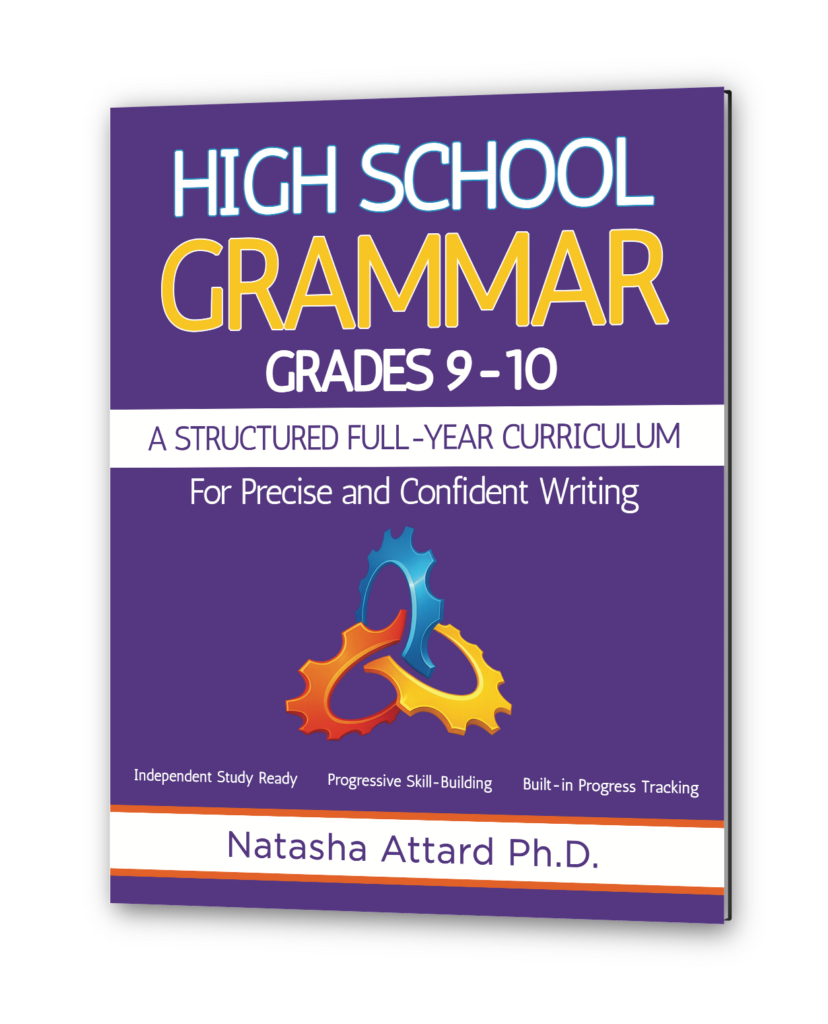
This article gives you two free sample lessons from High School Grammar Grades 9–10, plus a simple walkthrough and guidance on how to teach these lessons at home.
If you’re teaching high school grammar at home, one of the biggest challenges is knowing how much to explain and how much to leave to practice.
Many parents worry:
- “Do I need to teach everything myself?”
- “What if I’m not confident with grammar?”
- “How do I know if my child really understands?”
The good news is this: you don’t need to turn grammar into a long lecture. In fact, the best way to teach high school grammar is through short explanations and steady practice.
In this article, I’ll walk you through how to guide your child through the first two lessons of a structured grammar curriculum:
- Lesson 1: Verb Phrase
- Lesson 2: Adverbial Phrase
A Simple Way to Approach High School Grammar
Before we look at the lessons, here’s the mindset I recommend:
- You are a guide, not a lecturer
- Let the examples do most of the teaching
- Focus on recognition first, then use
Each lesson in the sample follows the same structure:
- Reference Guide (short explanation)
- Warm-Up (quick recognition)
- Practice (more focused work)
- Consolidation (deeper understanding)
Your role is simply to help your child move through these steps without rushing.
Lesson 1: Verb Phrase — How to Guide It
In this first lesson, students learn that a verb phrase = main verb + helping verbs
Step 1: Start with the examples (don’t over-explain)
Read one example together: She has been practicing piano every day.
Ask:
- What is the action?
- Which words go together?
Let your child notice that “has been practicing” works as one unit.
You don’t need a long explanation. Just make sure they understand: A verb phrase can be more than one word.
Step 2: Warm-Up (build confidence)
The warm-up is straightforward (e.g., is reading, will perform)
Let them answer independently first.
Then quickly check:
- If correct → move on
- If wrong → ask: “Which word shows the action? Are there helpers before it?”
Keep it light. This part should feel easy.
Step 3: Practice
In Practice 1 and 2, students start identifying:
- verb phrases with helpers
- single-word verbs
- negation (not)
- infinitives (to call, etc.)
What you should do:
- Ask them to explain why they chose the answer
Step 4: Consolidation
The final section asks students to find all verb phrases in longer sentences.
This can be challenging.
Tips:
- Let them do 3–5 sentences at a time
- Check together
- If they miss one, ask: Is there another action happening?
If you find these sample lessons helpful for your child, you can find the book on major online bookstores.
Lesson 2: Adverbial Phrase
Step 1: Focus on meaning, not terminology
An adverbial phrase answers: how, when, where, why, and to what extent.
Start with this idea: These phrases add extra detail to a sentence.
Ask:
- What does this tell us? (how? when? why?)
Step 2: Show that they are optional
This is an important concept from the lesson: You can remove the phrase and the sentence still works.
Do this together:
- Read the sentence
- Remove one phrase
- Ask: “Does it still make sense?”
This helps students see the role of the phrase.
Step 3: Practice that helps them spot patterns
In Practice 4 and 5, students identify adverbial phrases in context.
Encourage them to:
- Look for groups of words (not single words)
- Ask: What question does this answer?
For example:
- in the gym → where
- before the big game → when
If they get stuck, guide with questions instead of answers.
Step 4: Rewriting Practice
Practice 6 asks students to turn adverbs into phrases.
Example:
politely → in a polite manner
Here’s how to guide your child:
- Ask: “How could we say this in more detail?”
- Encourage them to expand the idea, not just replace the word
- Accept more than one correct answer
What this does:
- It helps students move from single-word answers to fuller expression
- It strengthens their ability to vary sentence structure
- It improves clarity and precision in their writing
Over time, this kind of practice helps students write in a more natural, developed way instead of relying on basic or repetitive wording.
This type of grammar practice helps your child move beyond memorizing rules and start actually using them in writing. With short explanations and steady practice, they learn to recognize patterns and express ideas more clearly. Your role is to guide them, ask questions, and slow things down when needed. Over time, this builds real confidence and accuracy in their writing.
If you find these sample lessons helpful for your child, you can find the book on major online bookstores.