When to Double the Final Consonant: A Spelling Guide for Teens
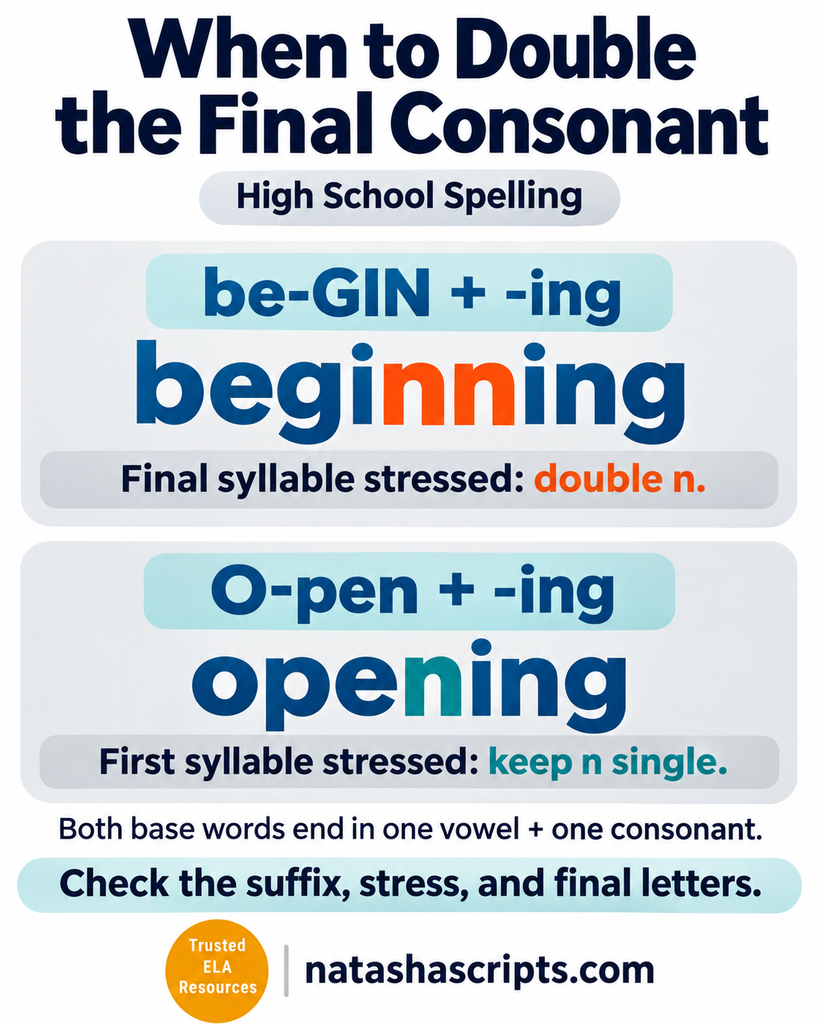
A student may spell beginning correctly and then hesitate over referring or committed. Should the final consonant be doubled? Looking at the last few letters helps, but with longer words we also need to listen for the stressed syllable.
I like to explain this through a short sequence: check the suffix, say the base word, and examine the ending. We can begin with familiar examples, then use the same questions with words that students encounter in high school reading and writing. Teachers and homeschool parents can work through the examples together with students before asking them to try the routine independently.
The examples below follow American spelling and focus mainly on -ing, -ed, -er, and -est. There are exceptions and variations, which I explain later in the article.
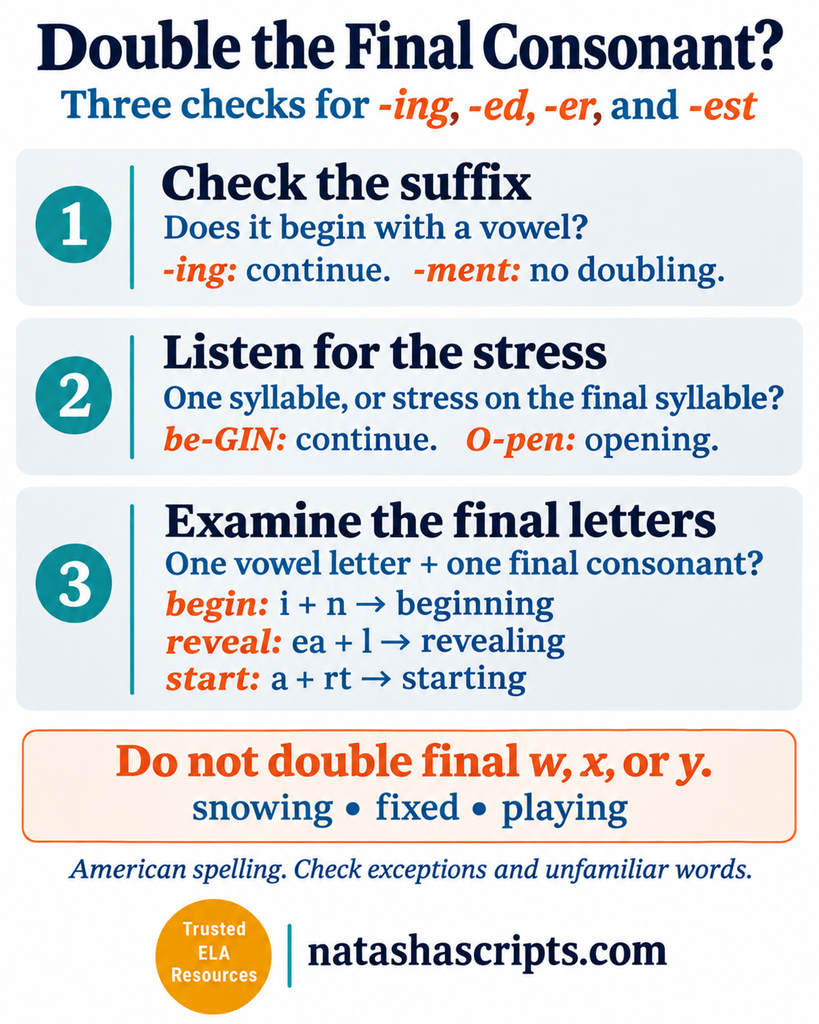
I’ve included a visual reminder of the three spelling checks. You can jump ahead to the
Quick Reference Guide.
Three Checks Before Adding a Suffix
1. Does the Suffix Begin with a Vowel?
First, identify the suffix, the ending we are adding to the base word. In admit + -ing, the suffix is -ing, which begins with the vowel i. Endings such as -ed, -er, and -est also begin with vowels, so we continue to the next check.
If the suffix begins with a consonant, we do not double the final consonant under this rule. Compare commit + -ed → committed with commit + -ment → commitment. The base word is the same, but -ed begins with a vowel and -ment begins with a consonant. That first letter makes a difference.
Other spelling changes may still be needed. For example, happy becomes happiness, with y changing to i. At this point, we are checking only whether to double the final consonant.
commit + -ed → committed
commit + -ment → commitment
Check the first letter of the suffix before deciding to double.
2. Where Is the Stress in the Base Word?
For a one-syllable word such as stop, move to the final-letter check. With a longer word, say it aloud and listen for the syllable that we emphasize most.
In begin, we say be-GIN. The final syllable is stressed, so we continue checking. In open, we say O-pen. The stress falls on the first syllable, and the final n stays single in opening and opened.
I find it useful to place refer and offer side by side. Both end in er, but we say re-FER and OF-fer. This helps explain why we write referring with rr and offering with one final r before -ing.
Students may need help hearing the stress. Say the word naturally in a sentence, then repeat it on its own. A dictionary pronunciation is useful if there is any uncertainty. The capitals here mark the stressed syllable; they are not part of the normal spelling.
For more discussion of syllables and spelling, see How Syllables Help Teens Spell Long Words.
3. What Letters Come at the End?
Now examine the written ending of the base word. The usual doubling pattern has one vowel letter followed by one final consonant letter. For this check, the vowel letters are a, e, i, o, and u.
In begin, the final letters are i + n. The suffix -ing begins with a vowel, the final syllable is stressed, and the ending fits the pattern. We double n, giving beginning.
The same checks give us admit → admitted, occur → occurring, and control → controlling. In each case, the stressed final syllable ends with one vowel letter followed by one consonant letter.
Compare these with reveal → revealing and start → starting. In reveal, ea gives us two vowel letters before the final l. In start, there are two final consonants, rt. Neither ending fits the single-vowel, single-consonant pattern, so we do not add another consonant.
There is also an important reminder: we do not double final w, x, or y when adding these suffixes. For example, we write snowing, fixed, and playing.
Work Through a Few Examples Together
Here is a selection of words to examine with students. The explanations show where each decision comes from.
| Base word and suffix | What to notice | Complete spelling |
|---|---|---|
| refer + -ing | Final stress: re-FER. The ending is one vowel + one consonant, e + r. | referring |
| open + -ed | First-syllable stress: O-pen. Keep the final n single. | opened |
| admit + -ed | Final stress: ad-MIT. The ending is i + t. | admitted |
| offer + -ing | First-syllable stress: OF-fer. Keep the final r single. | offering |
| control + -ing | Final stress: con-TROL. The ending is o + l. | controlling |
| commit + -ed | Final stress: com-MIT. The ending is i + t. | committed |
| happen + -ing | First-syllable stress: HAP-pen. Keep the final n single. | happening |
| omit + -ing | Final stress: o-MIT. The ending is i + t. | omitting |
| reveal + -ing | Two vowel letters, ea, come before the final l. | revealing |
| start + -ing | The word already ends in two consonants, rt. | starting |
Ask students to explain one pair before moving to the next. For referring, for example, they can say, “The suffix begins with a vowel, the stress is on the last syllable, and the word ends in e + r, so I double the r.”
A Few Spellings Need a Separate Check
The routine is a useful starting point, but I do not present it as a rule that settles every spelling.
Some words ending in c need k before -ed and -ing. For example, panic becomes panicked and panicking. We add k rather than writing a double c.
Other vowel suffixes also deserve attention. In regret → regrettable, we double t before -able. However, prefer → preferable keeps a single r. When introducing endings beyond the main practice set, compare the complete words and confirm the spelling in a dictionary.
American and British spelling can also differ. In American English, we normally write traveling, traveled, and canceled. British English normally uses travelling, travelled, and cancelled. Students may encounter both in their reading. Explain which convention you are using for the assignment rather than treating the other convention as a mistake.
American: traveling, traveled, canceled
British: travelling, travelled, cancelled
Both conventions are valid. Use the one expected for the assignment.
Quick Reference Guide
Use the Routine in Short Spelling Practice
For a first practice set, I prefer a small mixed group: refer + -ing, offer + -ing, omit + -ing, open + -ed, reveal + -ing, and commit + -ment. These give students several reasons to double or keep a single consonant. Including both types is useful because we want them to make a choice for each word.
Begin with one example together. Then ask students to identify the suffix, say the base word, and examine the final letters. If they are unsure about stress, listen to the pronunciation together before continuing.
When a spelling is incorrect, ask the student to explain the choice. A spelling such as openned gives us a reason to revisit the stress in open. For begining, we can return to the three checks and show where the extra n is needed. The explanation helps us decide what to review; the misspelling alone does not tell us how the student reached it.
Finish with a sentence that uses one of the words. For example: “The writer is referring to an earlier event.” Students can check referring and explain why it has rr. We can use the same questions when a relevant word appears in their own writing.
The related article on Double Consonant Spelling Rules for High School offers further discussion of double consonants and spelling practice.
Spelling Practice from Grade 8 Through High School
I like to keep spelling practice connected with word meanings, reading, and writing. My spelling workbooks provide activities for this broader practice, and you can choose the level that suits your students.
For students preparing for high school, The Spelling Practice Workbook 8th Grade introduces 100 words through 20 lessons, with five words in each lesson. Definitions, model sentences, syllable work, synonyms, and sentence writing give students different ways to study and use the words. Three free sample lessons are available through the book details page.
For the age group discussed in this article, Spelling High School Workbook Grades 9–10 combines reading passages, definitions, syllable work, and written activities. Nine accompanying online games and quizzes provide additional review. You can use the routine in this article alongside the lessons whenever a suitable word and suffix come up, then ask students to check the complete spelling in their written work.
For older students, Spelling High School Workbook Grades 11–12 continues spelling and vocabulary practice with more advanced academic words, creative writing tasks, and online quiz activities. A free sample lesson includes access to an accompanying online quiz, a spelling journal, and an answer key.
The sample lessons give teachers and homeschool parents a chance to look through the activities before choosing a workbook. You will find the sample links on the relevant book details pages.
When students hesitate over a final consonant, we can return to the same questions: What suffix are we adding? Where is the stress? What letters come at the end? Working through a word together gives them a way to explain the spelling and something specific to check the next time it appears in their writing.
You are welcome to visit my Free ELA Resources page for sample lessons from my books and additional spelling, vocabulary, reading, and writing practice. You can look through the material and choose what is useful for your students.
