How to Diagnose Dependent Clause Errors in Grades 6–12
Dependent clauses allow students to connect related ideas and create more varied, detailed sentences. As students learn to use them, their writing often reveals which parts of the skill they understand and which still need further instruction.
Some students write a dependent clause and punctuate it as a complete sentence. Others rely mainly on simple sentences and rarely use subordination to connect their ideas. A third group can construct complex sentences but remains unsure about comma placement when the dependent clause changes position.
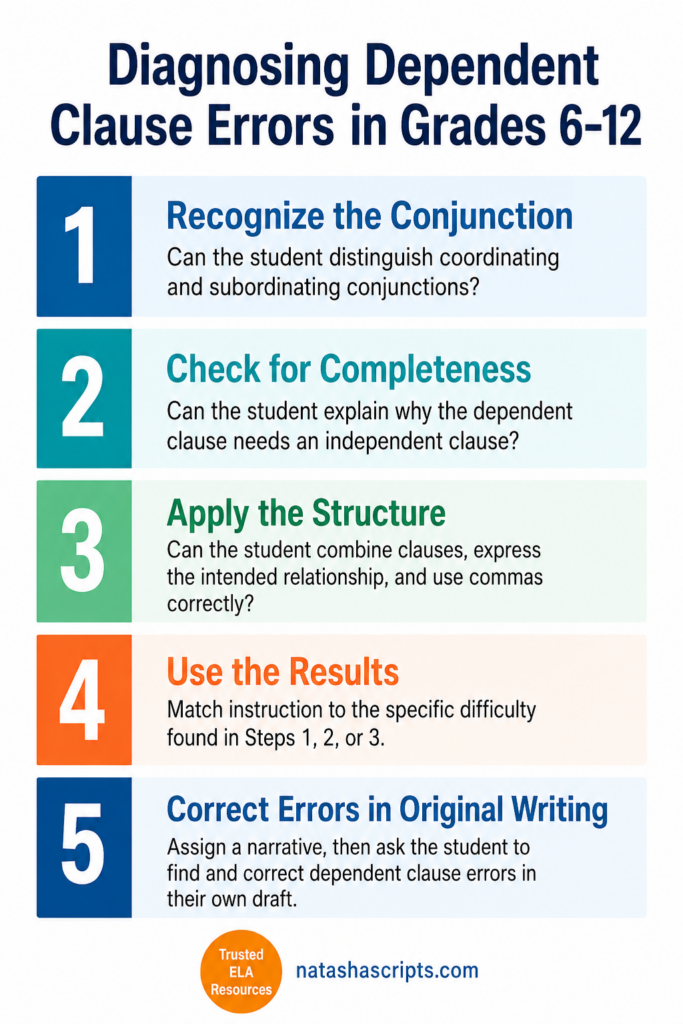
Each pattern points to a different instructional need. A short diagnostic can help determine whether a student:
- recognizes common subordinating conjunctions;
- understands why a dependent clause cannot stand alone;
- can combine dependent and independent clauses; and
- knows how clause position affects comma placement.
The sections below explain how to assess each skill and what the student’s responses may reveal.
What the Errors Actually Look Like
Dependent clause errors tend to appear in three main forms. Recognizing the pattern helps determine whether the student needs support with sentence completeness, clause connections, or comma placement.
Error 1
Error 2
Error 3
For a broader discussion of sentence fragments and run-on sentences, see Run-On Sentences and Fragments in Middle School Writing: Identifying Which Error a Student Has and How to Address It
Diagnostic Step One: Recognizing Subordinating Conjunctions
Begin by checking whether the student can distinguish subordinating conjunctions from coordinating conjunctions. The diagnostic should assess more than whether the student has memorized two lists. It should show whether the student understands the role each type of conjunction performs.
Give the student the following two categories:
Then provide a mixed list:
because, and, although, but, since, or, unless, so, whenever, yet, if, nor, while, though
Ask the student to place each word under the description that best explains its role. The student should use the definitions to make each decision rather than rely only on a memorized list.
A student who understands the difference should recognize that but can join two independent clauses of equal importance:
The weather was cold, but they went outside.
By contrast, although makes the clause it introduces dependent:
Although the weather was cold, they went outside.
The contrast between these sentences helps reveal whether the student understands what subordination does. Both conjunctions express contrast, but they create different grammatical relationships between the clauses.
Next, provide five or six sentences and ask the student to underline the subordinating conjunction and identify the dependent clause:
Whenever the bell rings, students stop working.
She finished the assignment before the period ended.
Unless the rain stops, the game will be canceled.
You may borrow the book as long as you return it tomorrow.
Some students recognize familiar conjunctions such as because and although but miss whenever, unless, provided that, or as long as. Look at which conjunctions the student misses and whether the dependent clause is identified correctly. This provides more useful information than the total score alone.
Diagnostic Step Two: Understanding Why the Clause Is Incomplete
The second step checks whether the student understands why a dependent clause cannot stand alone as a sentence. Some students can identify subordinating conjunctions but do not understand how those words affect the clauses they introduce.
Give the student a mixture of dependent and independent clauses:
- After the game ended.
- The coach spoke to the team.
- Because the instructions were unclear.
- She revised her paragraph three times.
- While the younger students waited in the hallway.
Ask the student to label each example as a complete sentence or a fragment and briefly explain each choice.
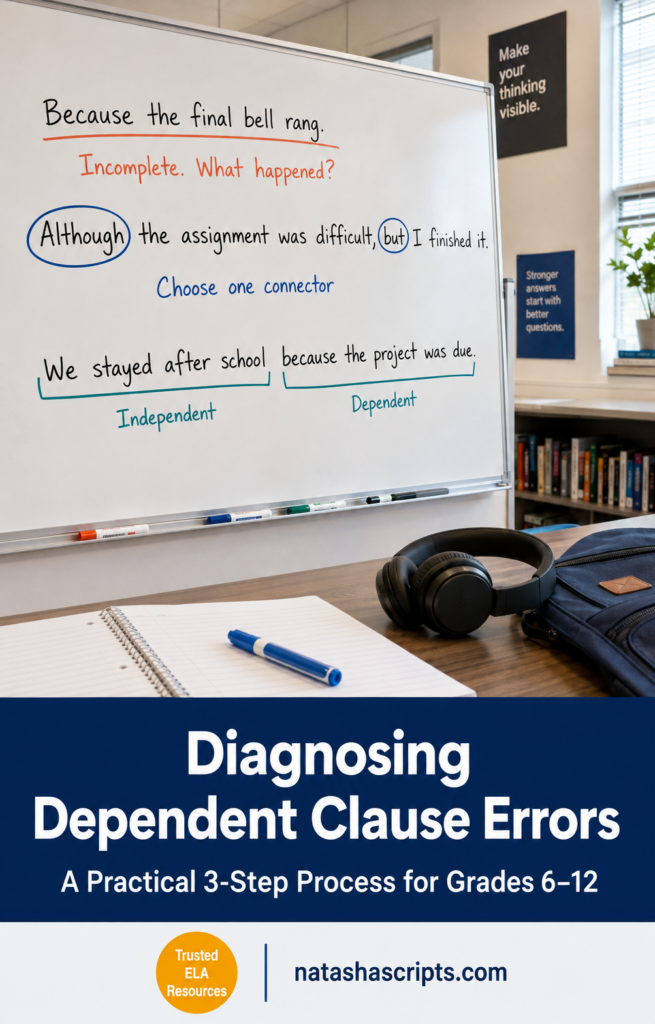
A student may mark a dependent clause as complete because it contains both a subject and a verb. For example, After the game ended contains the subject game and the verb ended. However, the subordinating conjunction after makes the reader expect more information. The clause does not tell us what happened after the game ended.
A useful follow-up question is:
When you read this clause aloud, what are you still waiting to hear?
This question helps the student notice the missing main idea:
After the game ended, what happened?
The student may recognize that the thought is incomplete before being able to explain the grammar. You can then connect that response to the grammatical structure: the subordinating conjunction introduces a dependent clause, which needs an independent clause to complete the sentence.
In a tutoring session or homeschool lesson, the student can explain each answer aloud. In a classroom, ask students to record their answers independently before discussing two or three examples as a group. Their individual responses will show who understands the difference and who is relying only on the presence of a subject and a verb.
Dependent Clause Diagnostic: Steps One and Two
Use this layout to prepare a short diagnostic sheet for the student.
Part A: Sort the Conjunctions
Ask the student to place each word under the definition that explains its function.
because, and, although, but, since, or, unless, so, whenever, yet, if, nor, while, though
Coordinating Conjunctions
A coordinating conjunction connects two words, phrases, or clauses that perform the same grammatical role in a sentence.
Subordinating Conjunctions
A subordinating conjunction introduces a clause and makes it subordinate to an independent clause.
Part B: Identify Complete Sentences and Fragments
Ask the student to classify each example and briefly explain the answer.
| Clause or Sentence | Complete Sentence or Fragment? | Explain Your Answer |
|---|---|---|
| After the game ended. | ||
| The coach spoke to the team. | ||
| Because the instructions were unclear. | ||
| She revised her paragraph three times. | ||
| While the younger students waited in the hallway. |
Diagnostic Step Three: Applying Clauses in Writing
The third step checks whether the student can use dependent clauses correctly in original writing. Two short tasks can reveal whether the student understands clause relationships, sentence structure, and comma placement.
Task One: Combine two simple sentences
Give the student two related simple sentences and a subordinating conjunction to use:
The rain started. We went inside.
Use: because
A suitable response is:
Because the rain started, we went inside.
This sentence shows that the student understands which event caused the other and can place the dependent clause correctly.
A response such as the following reveals a problem with the logical relationship:
The rain started because we went inside.
The sentence is grammatically complete, but it says that going inside caused the rain to start. This response suggests that the student can form a dependent clause but needs more practice deciding which idea the subordinating conjunction should introduce.
Use several sentence pairs involving different relationships, such as time, cause, condition, and contrast. This will show whether the student can do more than repeat one familiar sentence pattern.
Task Two: Change the position of the dependent clause
Ask the student to write three original sentences:
- one with a dependent clause at the beginning;
- one with a dependent clause at the end; and
- one with a dependent clause interrupting an independent clause.
Examples of the three structures are:
Although the weather was cold, the team continued practicing.
The team continued practicing although the weather was cold.
The team, although the weather was cold, continued practicing.
Changing the position of the dependent clause checks whether the student adjusts the punctuation rather than applying the same comma rule to every complex sentence.
For example, a student may correctly place a comma after an opening dependent clause but also insert one automatically before a final clause beginning with because or since. This identifies a specific difficulty with clause position and punctuation, which can then be addressed directly.
Using the Diagnostic Results to Plan Instruction
Once the student has completed all three steps, use the responses to decide where instruction should begin.
If the Student Struggles with Step One
Begin with the functions of subordinating conjunctions. Group the conjunctions according to the relationships they express:
- Time: after, before, when, whenever, while, until, as soon as
- Cause: because, since, as
- Condition: if, unless, provided that, as long as
- Contrast or concession: although, even though, though, while
Grouping the words by meaning helps students understand why a particular conjunction is used instead of treating subordinating conjunctions as one long list to memorize.
If the Student Struggles with Step Two
If the student recognizes the conjunctions but struggles with Step Two, focus on why the clause is incomplete. Ask the student to read the dependent clause aloud and identify the information that is still missing:
After the lesson ended . . . what happened?
Although the task was difficult . . . what happened?
The independent clause supplies the main idea that completes the sentence. Begin with oral examples and then move to written sentence completion.
If the Student Struggles with Step Three
If the student understands Steps One and Two but struggles with Step Three, use the writing responses to identify the precise difficulty. The student may need practice with:
- choosing a conjunction that expresses the intended relationship;
- attaching the dependent clause to the correct main idea;
- avoiding two connectors such as although and but; or
- adjusting comma placement when the dependent clause changes position.
For comma practice, begin with the two most common structures:
Because the library was closed, we returned the following day.
We returned the following day because the library was closed.
A short exercise in which the student adds or removes commas can reinforce the difference between opening and closing dependent clauses.
For further discussion of clause structure, see Phrases and Clauses in Middle School Grammar.
When Dependent Clause Errors Continue in Writing
If a teacher, tutor, or homeschool parent continues to see dependent clause errors in the student’s longer writing, assign a short narrative essay specifically for further practice. Narrative writing is particularly suitable because students naturally describe when events occurred, why something happened, what changed, and how they responded. These relationships encourage the use of dependent clauses.
Choose a topic connected to the student’s own experience. Possible narrative titles include:
- The Day My Plans Changed at the Last Minute
- A Time I Had to Make a Quick Decision
- The Moment I Realized I Had Forgotten Something Important
- A Day That Began Normally but Ended Unexpectedly
- A Time I Continued Even Though Something Went Wrong
- What Happened When I Tried Something New
- The Day I Had to Solve a Problem on My Own
- A Time Things Did Not Go as I Expected
After the student completes the first draft, ask them to proofread their own narrative one paragraph at a time. The student should:
- circle every subordinating conjunction;
- underline the dependent clause introduced by each conjunction;
- locate the independent clause that completes the thought;
- check that the conjunction expresses the intended relationship;
- correct any dependent clause fragment; and
- check whether the punctuation matches the position of the dependent clause.
The teacher or parent can then review the corrections with the student. Repeating this process with later narrative assignments will help the student apply the rule while writing and become more independent when proofreading.
For help placing dependent clause instruction within a broader grammar and writing sequence, see Back-to-School ELA Roadmap: How to Fit Spelling, Vocabulary, and Grammar into the Curriculum. The article helps teachers and homeschool parents identify which language skills need more structured instruction and build them into a manageable routine.
Free sample lessons and worksheets covering grammar and other middle and high school ELA skills are available on the Free ELA Resources
Quick Reference Guide