How to Improve Reading Comprehension in Middle School
This article includes a free 3-week sample from 7th Grade Vocabulary: 36 Weeks of Reading Passages and Word Activities.
Students in grades 6, 7, and 8 are usually familiar with common reading techniques. They have learned to make predictions, visualize, summarize, make connections, and ask questions. Many can name these techniques and explain what they involve. However, they may still struggle to understand a complex text, identify the central idea of a nonfiction passage, or answer questions that require them to think beyond the words on the page. Instead, they may scan the text for a phrase that appears to match the question.
This gap often develops when students learn to complete these reading tasks without understanding when or why each one might help. In this article, we will examine why applying them mechanically can limit comprehension and how students can learn to choose the technique that best helps them understand a particular text.
The Technique Is Not the Goal
When reading comprehension strategies are presented as a checklist, students may begin to treat them as tasks to complete. A student might pause to write a prediction, note a connection in the margin, and circle unfamiliar words without any of these actions improving their understanding of the passage. The student has followed the instructions, but has not necessarily thought more carefully about the text.
This becomes more noticeable when students are asked questions that go beyond information stated directly in the passage. A student may write a prediction at the beginning but still be unable to explain why a character made a particular decision or why an author presented ideas in a certain order. The student recorded the prediction but did not return to it, compare it with new information, or revise it as the text developed.
This often happens when completing the technique becomes the goal. If students are simply told to make a prediction, they may believe the task is finished once they have written one down. However, a prediction is useful only when they continue reading to see whether it is supported, needs to be changed, or should be rejected. Students need clear guidance and practice to understand how this process can help them follow and make sense of a text.
The Text Must Provide the Right Level of Challenge
Reading comprehension techniques are most useful when students encounter something they do not immediately understand. They may need to work out the meaning of an unfamiliar word, follow a complex sentence, connect ideas across several paragraphs, or identify information the author has implied rather than stated directly.
The level of difficulty matters. If a text presents very little challenge, students may complete assigned reading tasks simply because they have been told to do so. If the text is far beyond their current reading ability or background knowledge, making a prediction or asking questions will not provide all the support they need.
For students in grades 6 through 8, the most useful texts are usually those that require some careful thought while remaining accessible. Students should be able to understand enough of the passage to follow its main ideas, while still encountering places where they need to pause, reread, make a connection, or draw a conclusion.
Unfamiliar vocabulary is one common obstacle. When students encounter too many unknown words, they can lose track of an explanation or narrative before they understand how its ideas fit together. The related article Vocabulary in Context in Middle School: The Reading Mistakes That Hold Students Back provides a practical process students can follow to infer unfamiliar word meanings, check their conclusions against the text, and use the words accurately.
Keep the Focus on the Text
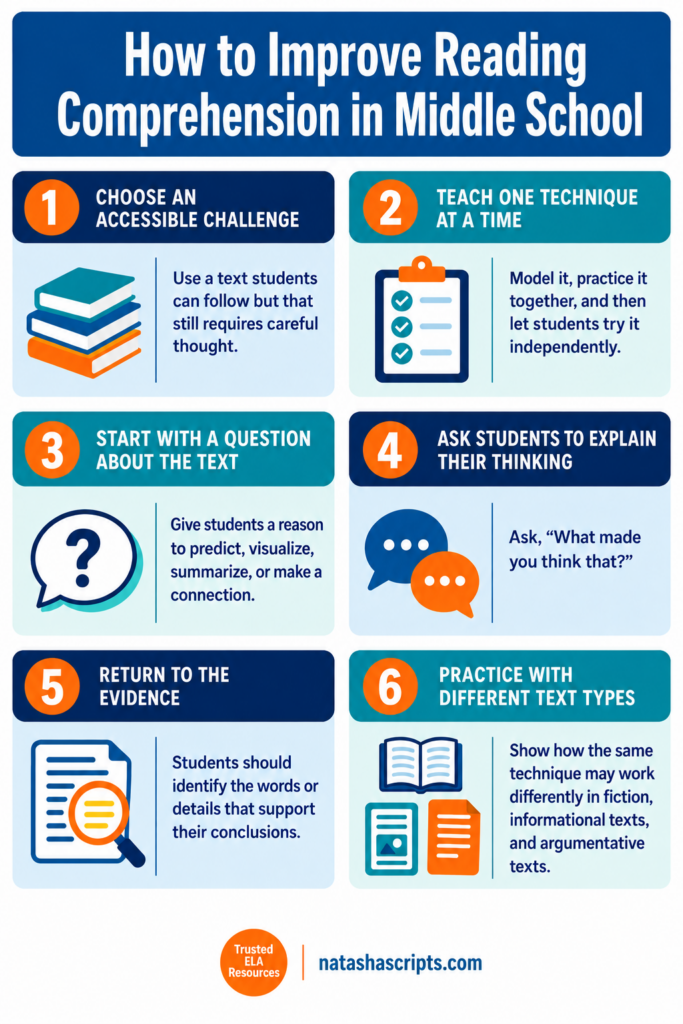
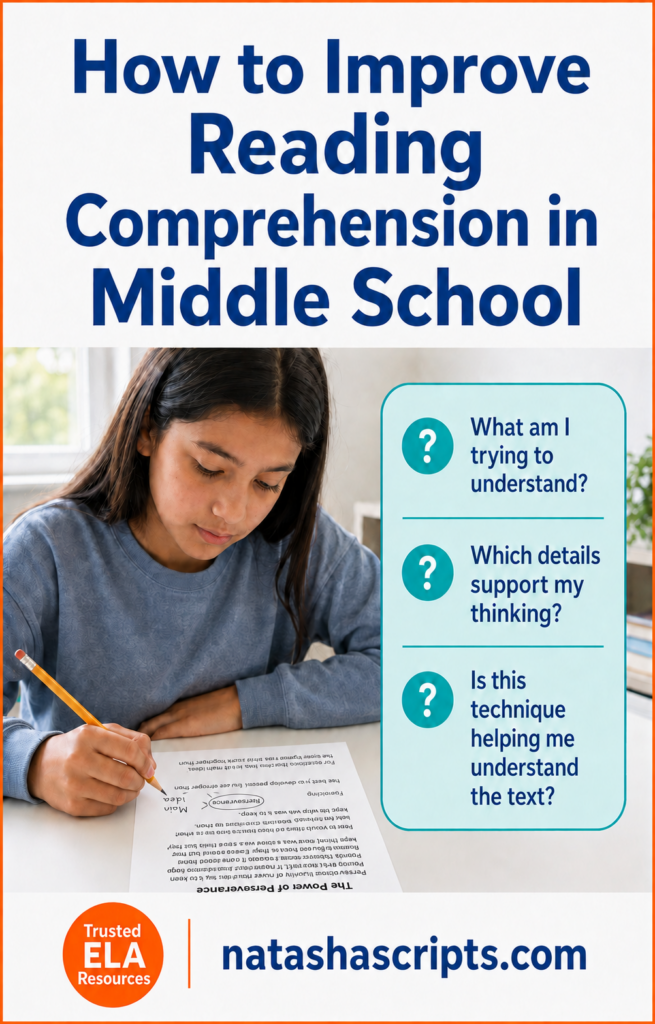
Reading comprehension practice should help students think carefully about a particular text. Each technique needs to serve a clear purpose within the reading. Instead of simply asking a student to “make a prediction,” a teacher or homeschool parent might ask, “What do you expect to happen in the next section, and what have you read so far that makes you think this?” Instead of “make a connection,” the question might be, “Does this passage remind you of something you already know, and does that knowledge help you understand the author’s point?”
These questions require students to return to the text and support their thinking with specific details. A student who visualizes a scene can describe it and identify the words that helped create that picture. A student who summarizes a paragraph can point to the key details included in the summary and explain why they are important. In this way, the technique helps the student examine the text instead of becoming a separate task to complete.
Teachers and homeschool parents do not need elaborate materials to provide this kind of practice. The questions they ask are more important. After a student reads a section, ask, “What made you think that?” or “Which part of the passage supports your answer?” These questions encourage students to explain their reasoning and check it against the text. They can be used in a classroom discussion or in a one-on-one conversation at home.
Inference: Using Evidence to Reach a Conclusion
Inference is one of the most frequently taught and misunderstood parts of middle school reading comprehension. Students are often told to “read between the lines,” but this does not explain what they should look for or how they should reach a conclusion. Without further guidance, they may rely on their own experiences or make a reasonable-sounding guess that the text does not support.
A clearer approach divides inference into two parts. Students first identify what the text states directly and then consider what it suggests through its word choices, details, structure, or tone. For example, repeated descriptions of a cold, empty setting may help students infer the mood of a passage. However, they need to identify the details that led them to that conclusion and explain the connection.
The related article Why Middle Schoolers Struggle to Make Inferences While Reading (And How to Help) examines common difficulties, including confusing personal opinion with textual evidence, overlooking important vocabulary, and reading too quickly. It also provides a simple routine that teaches students to locate relevant details before deciding what those details suggest.
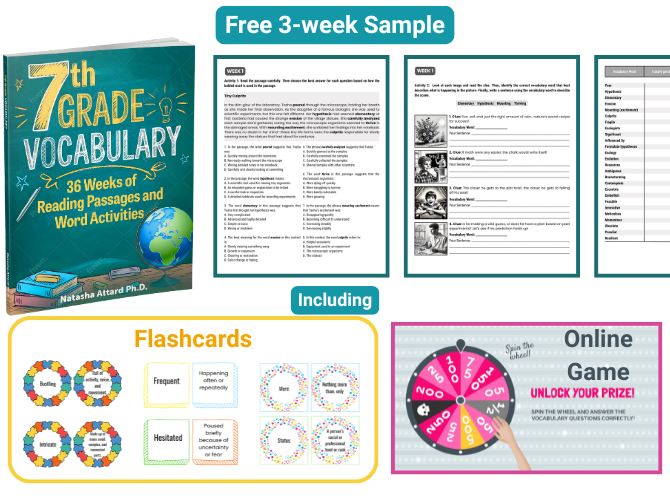
My book, 7th Grade Vocabulary: 36 Weeks of Reading Passages and Word Activities, gives students regular practice with this process. Each week begins with a short passage that introduces vocabulary in context. Students answer reading comprehension questions and complete varied vocabulary activities, including synonym matching, sentence writing, image interpretation, and creative writing. The book also includes vocabulary check-ins and goal-setting every three weeks, word lists for review, online quiz games, downloadable vocabulary flashcards, and a complete answer key.
You can download a free three-week sample to try the approach before using the full book. The sample includes the short passages and word activities from the first three weeks, together with a word list, colorful vocabulary flashcards, an online game, and the Week 3 check-in.
Practice One Technique at a Time
Students are sometimes introduced to prediction, visualization, summarizing, questioning, and making connections within a relatively short period. They may learn the names of all five techniques without receiving enough practice to use any one of them effectively when a text becomes difficult.
A better approach is to introduce one technique and demonstrate how it can help with a particular passage. The teacher or homeschool parent can model the thinking involved, guide students as they try it, and then provide opportunities for them to work independently. Students do not need to spend months on each technique, but they do need enough practice to understand when to use it and how it can improve their understanding.
During the first few demonstrations, returning to the same passage can help students concentrate on the reading process without also having to become familiar with a new text. They should then practise with different passages so they learn to choose and apply the technique without being prompted each time.
Students also need practice with different types of texts. Making an inference in a story may involve examining a character’s words, actions, or feelings. In a science article or historical text, students may need to connect facts, interpret the author’s word choices, or use what they already know about the subject. By working with narrative, informational, and argumentative texts, students learn that the same reading technique may need to be applied differently according to the text and the question they are trying to answer.
The Goal is to Understand the Text
Reading comprehension instruction should help students understand what they read. Knowing the names of several techniques or completing the required activities does not necessarily show that this understanding has developed. For example, a graphic organizer can help a student examine each chapter of a novel more carefully. However, if the student simply copies information from the chapter into a different format, the activity adds little to their understanding.
Effective reading practice in middle school requires students to pay close attention to particular passages, explain their reasoning, and support their answers with evidence. They also need regular opportunities to make inferences in fiction and nonfiction and to work out the meanings of unfamiliar words as they read. These activities do not require complicated materials. What matters is that students use each technique when it helps them answer a question, resolve confusion, or understand the text more fully.
Teachers and homeschool parents looking for free sample lessons and worksheets that support reading comprehension and vocabulary practice at the middle school level can find them on the Free ELA Resources page.
Quick Reference Guide