Why Students Forget Vocabulary Words After a Test and How to Improve Retention
This article includes a free Week 1 academic vocabulary resource for Grades 7–10.
Students often perform well on a vocabulary test but struggle to remember the same words two weeks later. This happens in both classrooms and homeschool settings, and it is usually not because students have failed to make an effort. They may study their word lists, read the definitions, and complete every assigned exercise. The problem is that these activities often prepare students to recognize a word on a test rather than remember and use it independently. A student may choose the correct meaning in a multiple-choice question but still be unable to use the word naturally in speech or writing. To build lasting vocabulary knowledge, we first need to understand why this gap between recognition and retention occurs.
The Difference Between Recognizing a Word and Remembering It
Recognizing a word on a worksheet is not the same as understanding it well enough to remember and use it later. Students may read a definition several times, match a word to its meaning, or review a vocabulary list the night before a test. These activities can help them become familiar with the word, but they do not always require students to retrieve its meaning or use it independently.
This is why a student may select the correct definition from four options without knowing the word particularly well. The answer choices provide clues, and partial knowledge may be enough to choose the right one. Once those clues are removed, however, the student may struggle to explain the word, recognize how it is being used in a new passage, or include it naturally in writing.
Consider the word ambivalent. A student who understands it well can recognize it in an unfamiliar text, explain what it means in context, use it appropriately in an essay, and distinguish it from related words such as indifferent and conflicted. A student who has encountered it only in a matching exercise may remember enough to pass the test but not enough to use the word confidently afterward.
Recognizing a Word vs. Remembering It
- Recognizing a word
- Being able to identify a word or choose its meaning when the word, definition, context, or possible answers are provided.
- Remembering a word
- Being able to recall what a word means and understand or use it in a new context without depending on answer choices or notes.
Why Retrieval Practice Helps Students Remember Vocabulary
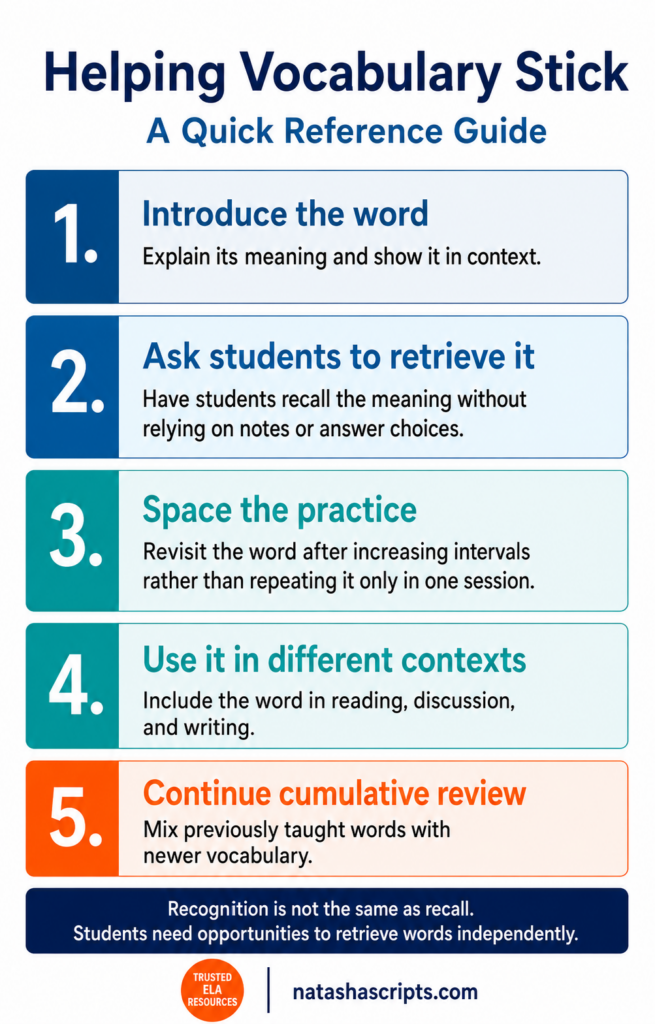
Retrieval practice asks students to recall something from memory instead of simply reading it again. In vocabulary instruction, students might recall a word from its definition, explain its meaning in their own words, or use it in a sentence without first looking at their notes. In each case, they have to retrieve what they know rather than select or copy an answer that is already visible.
This effort helps strengthen a student’s ability to remember the word later. For example, reading the definition of reluctant several times may make it look familiar. Trying to explain the word without checking the definition requires the student to search their memory, decide what the word means, and express that meaning clearly. If they cannot do this yet, the attempt also reveals that they need more practice.
This has a practical implication for teachers and homeschool parents working with middle and high school students. Rereading vocabulary lists, highlighting definitions, and copying words may help students become familiar with new vocabulary, but these activities should not make up the whole learning process. Students also need opportunities to recall meanings, choose words independently, and apply them in new contexts.
Retrieval practice will often feel more difficult at first because students have to pause and think before responding. That difficulty is useful when it requires them to recall and apply what they have learned. As their knowledge becomes stronger, accurate recall should gradually become easier and faster.
For a closer look at two common approaches to vocabulary practice, my article on Flashcards vs. Vocabulary Journals for High School examines the type of learning each one encourages.
How Spaced Practice Helps Students Remember Vocabulary
Retrieval practice is most effective when students return to the words over several days or weeks. Studying twenty words for two hours the night before a test may help a student remember them temporarily, but much of that knowledge can disappear soon afterward. Spaced practice divides the same learning time into shorter sessions and gives students repeated opportunities to recall the words after a gap.
For example, students might begin working with a set of words on Monday, revisit them briefly on Wednesday, and return to them again the following week. Each session should ask students to retrieve or apply what they have learned. They might recall a word from its meaning, complete a sentence without referring to their notes, or choose the most suitable word for a new context. The exact schedule can vary, but the important point is that students encounter and retrieve the words more than once.
This approach does not necessarily require more teaching or study time. Instead of using one long session, teachers and homeschool parents can divide the available time into several shorter periods. A five-minute vocabulary warm-up, a brief review at the end of a lesson, or a few previously learned words included in a later activity can all provide useful spaced practice.
Homeschool parents may be able to adjust these review sessions according to an individual student’s progress. If one word is proving particularly difficult, they can revisit it sooner or include it in an additional activity. In a classroom, teachers can apply the same principle through short, low-stakes warm-ups or by regularly including earlier vocabulary alongside new words.
What Low-Stakes Retrieval Practice Look Like
“Low-stakes” means that students can practise recalling vocabulary without worrying that every mistake will affect their grade. The purpose is to strengthen memory and identify words that need further attention, rather than formally assess what students have learned. Making this clear can help middle and high school students approach the activity as an opportunity to practise rather than another test they must pass.
The following retrieval activities work well in classrooms and homeschool settings:
- Blank-page recall: Students close their notes and write down as many words as they can remember from the current list. They then add a brief definition or example sentence. Any words they cannot recall become the focus of further practice.
- Meaning-first prompts: Students are given a definition, description, or example and asked to recall the correct word. This reverses the usual format in which they see the word first and select its meaning.
- Original sentences: Students write a sentence that clearly demonstrates the meaning of the word without consulting its definition. A sentence such as “I used the word ambivalent today” does not show whether the student understands the word. A stronger example would be: “Olivia felt ambivalent about changing schools because she was excited about the new opportunities but reluctant to leave her friends.”
- Cumulative review: Instead of practising only the current week’s words, students also retrieve a small selection from previous weeks. This keeps earlier vocabulary in use and helps prevent students from forgetting one set of words as soon as they begin the next.
These activities can usually be completed in ten to fifteen minutes as a classroom warm-up or a short home study session. What matters most is that students attempt to recall the answer before checking their notes. Once they have tried, they should receive feedback or check the answer so that misunderstandings are not reinforced.
Connecting Retrieval Practice to Relevant Contexts
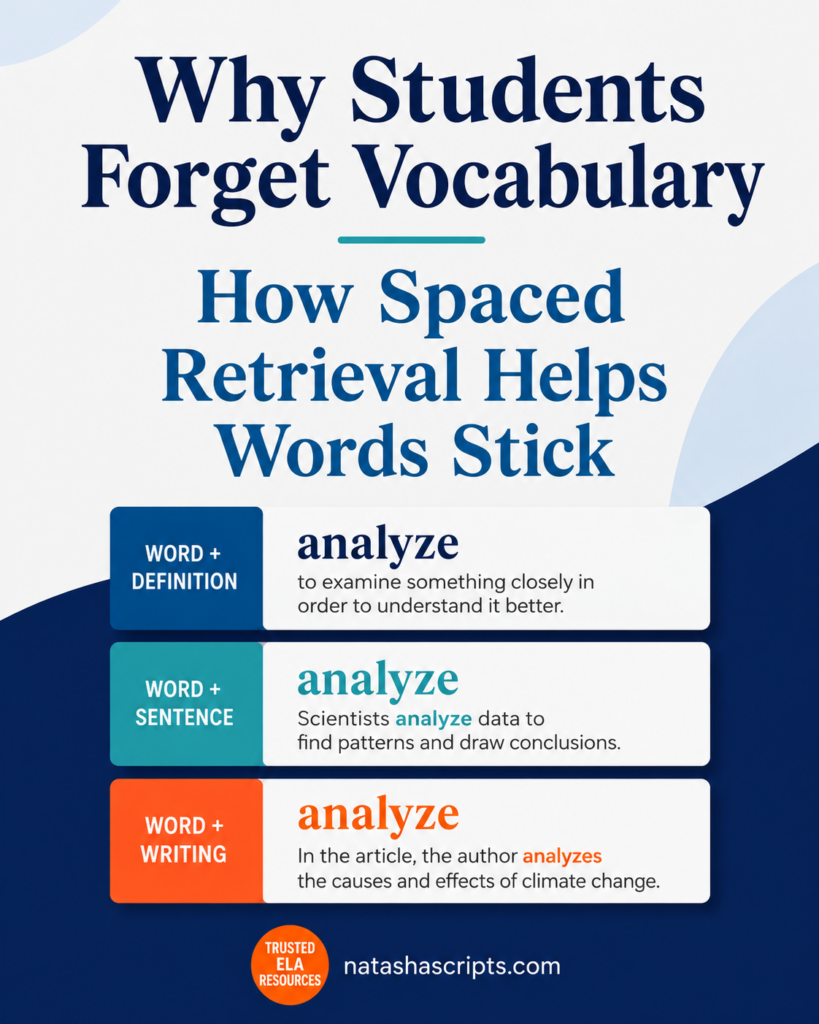
Retrieval practice helps students remember vocabulary, but they also need opportunities to encounter and use the words in relevant contexts. A student may recall the meaning of juxtaposition during a vocabulary activity. Encountering the same word later in a literary passage, discussing its effect, and using it in an analytical response help the student develop a fuller understanding of how the word works.
Teachers and homeschool parents can support this by connecting vocabulary practice to the texts students read and the writing they complete. Words may be drawn from a class novel, an informational text, or a topic being studied in another subject. Students can then revisit those words through retrieval activities before applying them in discussion or writing.
This does not require a complete change to an existing vocabulary program. Teachers and homeschool parents might select one or two relevant words from the week’s reading and add them to the words students are already practising. They can also look for natural opportunities to use previously learned vocabulary in later reading and writing tasks.
My related articles, Vocabulary in Context Middle School: The Reading Mistakes That Hold Students Back and 7 Vocabulary Activities for High Schoolers That Actually Stick provide practical activities that combine vocabulary recall with contextual use.
Building a Vocabulary Routine That Is Easy to Maintain
For most teachers and homeschool parents, the challenge is finding a way to use spaced retrieval consistently without creating too much additional work. Keeping the sessions short and following a predictable schedule can help vocabulary practice become part of the weekly routine. Students might spend ten minutes retrieving words at the beginning of a lesson, revisit them briefly later in the week, and complete a cumulative review that includes vocabulary from previous weeks.
A simple record can also make the sessions easier to manage. Teachers and homeschool parents can keep a running list of the words that have been introduced and note which ones students recall confidently, which ones they partly understand, and which ones need further practice. This allows them to focus on words that are causing difficulty while continuing to revisit older vocabulary at suitable intervals.
Students should also understand why this practice may feel more demanding than rereading a list or matching words to definitions. Having to pause and search their memory is part of the learning process. At the same time, retrieval practice should remain supportive. Students need an opportunity to check their answers, correct misunderstandings, and try difficult words again.
For further guidance and practical ideas, see How to Teach High School Vocabulary at Home: A Parent’s Guide and 8 Vocabulary Activities for Middle Schoolers That Actually Stick. Together, they offer approaches for helping middle and high school students build and practise vocabulary in different learning settings.
Helping students remember vocabulary is not simply a matter of giving them more time to study. How they use that time also matters. When students retrieve words regularly, meet them again over several weeks, and apply them in reading, discussion, and writing, they have a better chance of developing vocabulary knowledge that lasts beyond the test.
Teachers and homeschool parents looking for ready-to-use lessons and worksheets on vocabulary instruction for grades 9–12 can find free samples at the Free ELA Resources page.
Already subscribed? You can still download the resource, and you will not receive duplicate emails.
Quick Reference Guide