Flashcards vs. Vocabulary Journals for High School
What Each Method Actually Does for Word Knowledge
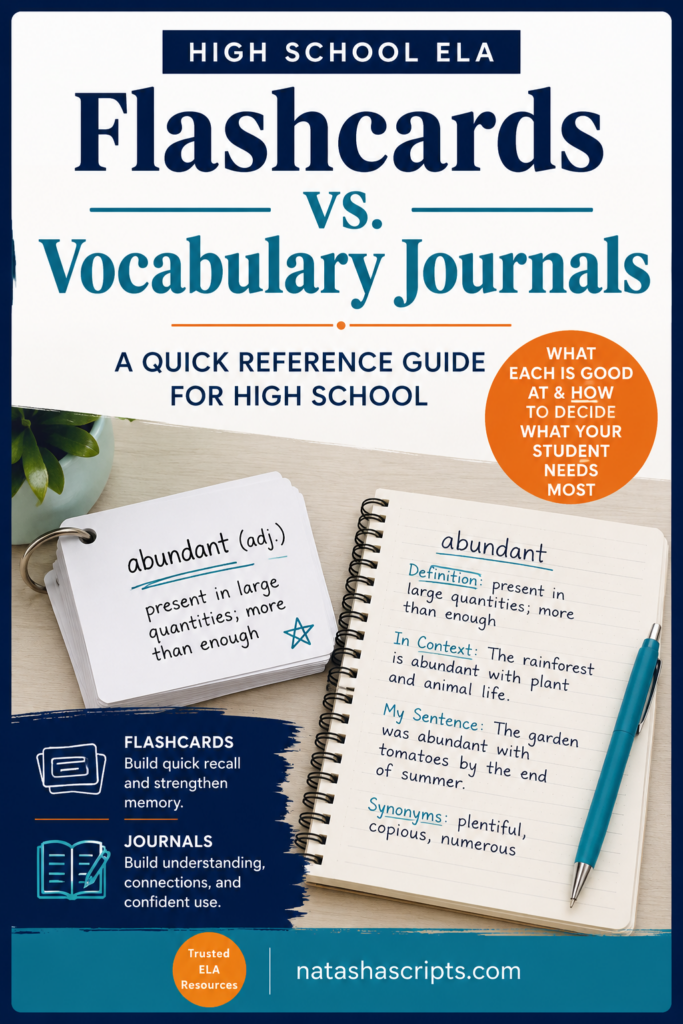
Both vocabulary journals and flashcards are common tools in high school word study, but they do not build the same kind of word knowledge. A student who can correctly identify a word’s definition on a flashcard may still hesitate when asked to use that word in an analytical essay. On the other hand, a student who has written about a word in multiple contexts may still struggle to recall it quickly during a quiz or timed assignment.
Understanding what each method does well, and where each tends to fall short, can help teachers, homeschool parents, and tutors make more deliberate decisions about vocabulary instruction in grades 9–12.
Prefer a quick overview? Jump straight to the Quick Reference Guide.
What Flashcards Are Actually Good At
Flashcards work well for a specific and limited purpose: building quick, reliable recall of a word’s core meaning. The format is essentially a retrieval practice tool, and retrieval practice has a reasonably well-established place in memory research. When a student sees a word, attempts to recall its definition, and then checks whether the answer is correct, the act of retrieval itself tends to strengthen the memory more than passive re-reading would. For this reason, flashcards can be genuinely useful in the early stages of encountering a new word, when the goal is simply to establish that a word exists and has a particular meaning.
In a high school context, this matters most when students are working through a set of academic or domain-specific words — the kind of Tier 2 vocabulary that appears across subject areas in college-preparatory reading. A student preparing for a standardized exam, for instance, may need to move through a substantial list of words efficiently, and flashcards can support that kind of systematic exposure. The format also lends itself to spaced repetition, where words that are recalled easily are reviewed less frequently and words that are not yet secure are returned to more often. Used in this way, flashcards function as a sorting mechanism as much as a study tool.
Even so, flashcards have a ceiling. A student who knows that perfidious means “treacherous” or “disloyal” has acquired a definition, but that is not the same as knowing the word in any full sense. The word’s connotations, its register, the contexts in which a writer might choose it over a simpler synonym — none of that is captured in a two-sided card. For students in grades 9–12 who are expected to use academic vocabulary in their own writing, this gap tends to become apparent fairly quickly.
What a Vocabulary Journal High School Students Keep Actually Builds
Flashcards work well for a specific purpose: building quick, reliable recall of a word’s core meaning. The format is essentially a retrieval practice tool. When a student sees a word, attempts to recall its definition, and then checks whether the answer is correct, the act of retrieval tends to strengthen memory more effectively than simply re-reading a list of words. For this reason, flashcards can be especially useful in the early stages of learning new vocabulary, when the goal is to establish a basic understanding of a word and its meaning.
In a high school setting, this is particularly helpful when students are studying academic or subject-specific vocabulary. These are often the Tier 2 words that appear across literature, science, history, and other college-preparatory courses. A student preparing for a standardized test, for example, may need to learn a large number of words efficiently, and flashcards can support that kind of systematic review.
Flashcards also work well with spaced repetition. Words that are recalled easily can be reviewed less often, while words that are still unfamiliar can be revisited more frequently. Used this way, flashcards function as a sorting system as much as a study tool, helping students focus their time where it is needed most.
Even so, flashcards have limitations. A student who knows that perfidious means “treacherous” or “disloyal” has learned a definition, but that is not the same as fully knowing the word. The word’s connotations, level of formality, and the situations in which a writer might choose it over a simpler synonym are difficult to capture on a two-sided card.
For students in grades 9–12 who are expected to understand vocabulary deeply and use it effectively in their own writing, this limitation often becomes apparent fairly quickly.
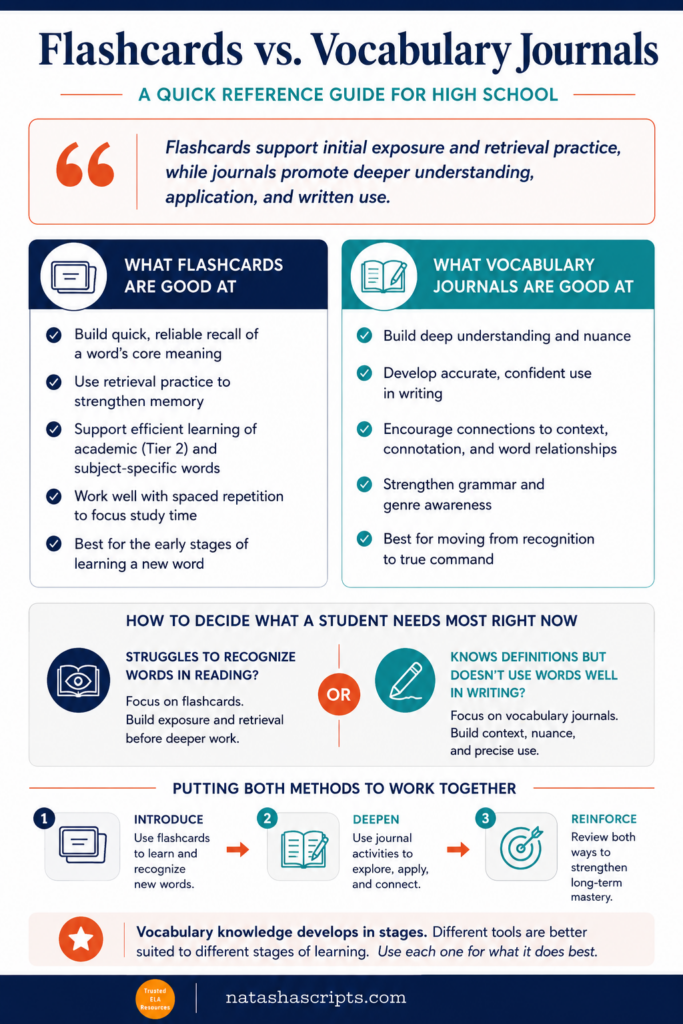
Flashcards support initial exposure and retrieval practice, while journals promote deeper understanding, application, and written use.
Where Each Method Falls Short
Flashcards, as discussed above, tend to build recognition more readily than deep understanding. A student who studies vocabulary exclusively through flashcards may perform well on a matching quiz but struggle to use new words naturally and accurately in writing. This is a common pattern in grades 9–12, especially when vocabulary instruction focuses heavily on test preparation. Students learn the words in isolation, and that knowledge does not always transfer easily to tasks such as analytical essays, short responses, or classroom discussions.
Vocabulary journals have a different limitation: they require a significant investment of time. In a high school program where multiple subjects compete for attention, that time commitment can become a challenge. A thoughtful journal entry for a single word might take five to ten minutes to complete. A student studying twenty words in a week could therefore spend nearly two hours on journal entries alone, before completing any additional vocabulary activities.
There is also a risk that journal entries become routine. Over time, some students may simply fill in the required sections without thinking carefully about the word itself. When journaling becomes a mechanical exercise, its effectiveness begins to decline. The greatest benefits tend to come when students actively reflect on meanings, examples, and connections rather than simply completing a template.
Readers interested in a broader look at effective vocabulary instruction may also enjoy 7 Vocabulary Activities for High Schoolers That Actually Stick. That article explores several practical approaches that help students move beyond simple memorization while continuing to strengthen long-term word knowledge.
How the Two Methods Relate to College-Ready Vocabulary
College-ready vocabulary involves more than simply knowing a large number of words. Students must understand when to use a word, how to use it correctly in a sentence, what it suggests beyond its dictionary definition, and how it contributes to an argument or discussion.
For example, a student who writes “the character’s perfidious behavior” in an essay has demonstrated some understanding of the word. A student who writes “the character’s perfidious loyalty to his own ambitions undermines every relationship in the novel” has demonstrated a much deeper level of understanding. That kind of precision typically develops through repeated exposure to a word in meaningful contexts rather than through memorization alone.
This is one reason vocabulary instruction in grades 9–12 often benefits from combining flashcards and vocabulary journals rather than treating them as competing approaches. Flashcards can support the initial learning stage by helping students recognize a word and recall its basic meaning. Vocabulary journals can then deepen that knowledge by encouraging students to explore usage, examples, word relationships, and connections to their reading and writing.
In practice, a student might use flashcards during the first few days of learning a new set of words and then shift toward journal activities as the week progresses. The journal entries can build on words that have already been introduced through flashcard review, allowing students to move from simple recognition to confident, purposeful use.
Readers looking for a practical way to implement this type of vocabulary routine may also find How to Teach High School Vocabulary at Home: A Parent’s Guide helpful. That article outlines a week-by-week framework that combines both recognition and application, making it particularly useful for homeschool families and parents supporting vocabulary development at home.
Deciding Which Method a Student Needs Most Right Now
When deciding which method to prioritize, it helps to identify where a student’s vocabulary knowledge is breaking down. If a student consistently struggles to recognize unfamiliar words while reading, then the recognition-building function of flashcards is likely the more immediate need. The student needs additional exposure and retrieval practice before deeper work with those words will be productive.
On the other hand, a student may perform well on vocabulary quizzes but rarely use new words in writing, or may use them inaccurately because they sound academic rather than because they fit the intended meaning. In that case, vocabulary journals are likely to be more beneficial. This pattern is common among students who have spent significant time studying vocabulary for tests and have accumulated many definitions without developing a deeper understanding of how those words are used.
In a classroom or homeschool setting, this often becomes visible in student writing. The vocabulary words are present, but they feel slightly out of place because a simpler or more precise word would have been a better choice.
One useful diagnostic is to ask a student to write two or three sentences using a recently studied word without referring to notes or definitions. If the sentences are grammatically correct but semantically thin, such as “The villain was very perfidious,” the student likely understands the word’s general meaning but has not yet developed a strong sense of its nuance or range of use.
Vocabulary journal activities can help address this gap. Entries that require students to write in a particular genre, explain why a word fits a specific context, or compare it with related words tend to deepen understanding more effectively than additional flashcard review alone.
For students working with structured vocabulary materials, Advanced Vocabulary in High School provides short contextual readings alongside vocabulary practice. This combination can support both flashcard-based and journal-based routines by supplying the authentic context that neither method always provides on its own.
Putting Both Methods to Work Together
In practice, the most effective high school vocabulary programs tend to treat flashcards and journals as complementary rather than competing tools. Each serves a different purpose. Flashcards support initial exposure and retrieval practice, while journals promote deeper understanding, application, and written use.
The sequence matters. Asking a student to write a thoughtful journal entry about a word they have never encountered before is likely to produce frustration rather than learning. On the other hand, spending large amounts of time reviewing flashcards for words that are already familiar may provide little additional benefit.
Whether the setting is a classroom working through a shared vocabulary list or a homeschool program built around independent reading, the same principle applies: vocabulary knowledge develops in stages, and different tools are better suited to different stages of learning.
Rather than choosing between flashcards and vocabulary journals, it is often more productive to consider how the two can work together. When each method is used for the purpose it serves best, students are more likely to move from simple word recognition to confident and precise word use.
Teachers and homeschool parents looking for free sample lessons and worksheets that support high school vocabulary practice in grades 9–12 can find a range of materials on the Free ELA Resources page.
Quick Reference Guide