Homophone Mistakes High Schoolers Keep Making (And How to Fix Them)
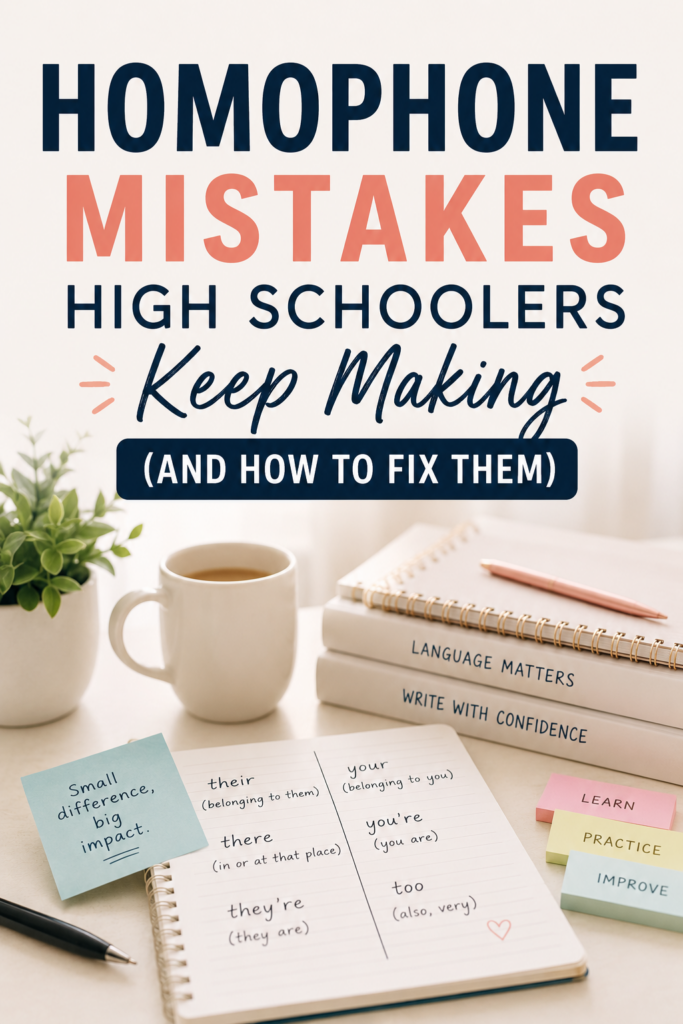
A 10th grader has just handed in a personal essay she worked on for two weeks. Her first sentence reads, “Their going to see a whole new side of me this year.” Her teacher circles it in red. She stares at the mark, genuinely confused. She knows the word “their.” She’s seen it a thousand times. So why does she keep getting it wrong?
That confusion is at the heart of homophone mistakes high school students make. It’s rarely about not knowing the words exist. It’s about not having a quick, reliable test to reach for under pressure, during a timed essay, a rushed revision, or a late-night draft.
Why Homophones Trip Up High School Writers Specifically
Younger students get drilled on homophones in elementary school, but by high school, teachers assume the lesson has stuck. It often hasn’t, especially for words that appear constantly in academic writing. When a student types quickly, muscle memory takes over, and the wrong homophone slips through before the brain catches it.
Spell-checkers make this worse, not better. Because their, there, and they’re are all correctly spelled words, no red underline appears. The error sails past every automated tool and lands directly in front of an AP teacher or college admissions reader.
The Most Damaging Homophone Errors in Grades 9–12 Writing
Not all homophone mix-ups carry equal weight. Some are minor; others undermine a student’s credibility in formal writing. These are the ones worth addressing directly.
Their / There / They’re
This trio causes more spelling errors in high school writing than almost any other set. Students often default to their because it feels “serious,” even when they mean they’re (they are) or there (a place or filler word).
The fix: Teach a two-step test. First, try substituting they are. If it works, use they’re. If it doesn’t, ask: does this word point to a location or introduce something? If yes, use there (here). If neither test fits, use their (possession).
Example:
“They’re going to present their project over there.”
(They are going → they’re | ownership → their | location → there)
Your / You’re
This is the second most common pair to appear in spelling errors in high school writing. The apostrophe version (you’re) signals a contraction (you are), but students frequently use your as a catch-all.
The fix: Same substitution trick. Replace the word with you are. If the sentence still makes sense, the apostrophe belongs: you’re. If it breaks the sentence, it’s possessive: your.
Its / It’s
This one confuses even strong writers because it seems to defy the normal rule that states that usually an apostrophe signals possession. Here, the apostrophe signals a contraction (it is or it has), and its without an apostrophe is the possessive form.
The fix: Read the sentence aloud, substituting it is. “The dog wagged it is tail” sounds wrong immediately — so no apostrophe. “It’s raining” = It is raining. The apostrophe stays.
To / Too / Two
Most students know two is the number. The confusion lives between to and too. Too means “also” or “excessively” and is easy to test: if you can replace it with “also” or “excessively,” it needs the double-o.
Affect / Effect
Technically a near-homophone pair (the vowel sounds differ slightly), but in fast speech they blur together, and students mix them constantly in analytical and argumentative writing.
The fix: Affect is almost always a verb (to influence). Effect is almost always a noun (the result). The mnemonic RAVEN helps: Remember, Affect is a Verb, Effect is a Noun.
Then / Than
These two appear in every comparison and every sequence, which means they show up constantly in high school essays. Then relates to time or sequence; than makes comparisons. A quick test: if the sentence involves a comparison between two things, reach for than.
A Practical Classroom Routine for High School Spelling Practice
Isolated drills rarely fix the problem long-term. What works is building a habit of self-editing that students can apply independently. Here’s a simple routine that takes under five minutes per writing session:
- Flag the danger words first. Before revising anything else, students do a targeted search (Ctrl+F in a document) for their personal problem homophones. They check every instance deliberately.
- Apply the substitution test. For each flagged word, they mentally swap in the long form (they are, you are, it is) and listen for whether the sentence still works.
- Read the sentence aloud. The ear catches what the eye skips. A sentence with the wrong homophone often sounds slightly off when spoken.
- Keep a personal error log. Students write down the pairs they consistently mix up. Seeing a pattern — “I always write your when I mean you’re” — makes the error conscious and correctable.
Why These Errors Matter More in High School Than Earlier Grades
A homophone mistake in a 3rd-grade story is a learning moment. The same mistake in a college application essay, an AP Literature response, or a dual-enrollment research paper sends a different signal. Readers, teachers, admissions officers, employers, interpret homophone errors as a sign that a writer doesn’t proofread or doesn’t understand basic grammar. Neither impression serves a high schooler well.
This is one reason Why Spelling in High School Still Matters is worth putting in front of skeptical students. Teenagers sometimes need to hear the why before they’ll invest in the how, and the case for spelling accuracy in grades 9–12 is genuinely strong.
How to Build Long-Term Accuracy, Not Just Short-Term Fixes
Memory tricks and substitution tests are useful in the moment, but they need to be reinforced through regular writing practice where the words appear in context. Seeing their/there/they’re in a grammar exercise is one thing; using them correctly in a timed argumentative essay is another.
For students in grades 9 and 10 who need structured, context-rich spelling work, the Spelling High School Workbook Grades 9–10 builds spelling accuracy through passages and writing prompts. This is the kind of practice that transfers to real assignments. Students aren’t just memorizing; they’re applying words in sentences they construct themselves.
For 11th and 12th graders preparing for college-level writing, the Spelling High School Workbook Grades 11–12 takes a similar approach with more advanced vocabulary, including the Tier 2 words that show up in standardized tests and college coursework.
What Teachers and Tutors Can Do Right Now
If you’re working with a student who makes homophone mistakes regularly, start with diagnosis before intervention. Look at a recent piece of writing and note which pairs are causing problems. Not every student struggles with the same words: one teen might nail their/there/they’re but consistently write your for you’re.
Targeted correction beats blanket review every time. Once you know the specific pairs giving a student trouble, you can build those words into writing prompts, editing exercises, and revision checklists until the correct choice becomes automatic.
A Note for Homeschool Parents
If your high schooler rolls their eyes at spelling work, reframe it around editing rather than memorization. Most teenagers respond better to the idea of “catching your own mistakes before anyone else does” than to the idea of drilling word lists. Position the substitution tests above as self-editing tools — something a professional writer would use — rather than remedial grammar lessons.
Short, consistent practice beats long, infrequent sessions. Even five minutes of focused homophone review built into a weekly writing routine will produce visible improvement within a few months.
The Bottom Line on Homophone Mistakes in High School Writing
Homophone mistakes in high school aren’t a sign of low intelligence or laziness. They’re a sign that a student hasn’t been given a reliable, repeatable strategy for distinguishing words that sound identical. Give them the substitution test, build in a self-editing habit, and reinforce it through writing practice in context, and the errors start to disappear.
The goal is to build the habit of catching and correcting these mistakes before the writing leaves a student’s hands. That habit, more than any single grammar rule, is what separates polished high school writing from writing that gets circled in red.
Looking for more tools to support high school spelling practice? Browse the free resources available at Natasha Scripts’ free ELA resource hub for activities you can use right away.
