How to Teach Syllabification to Middle Schoolers (Grades 6–8)
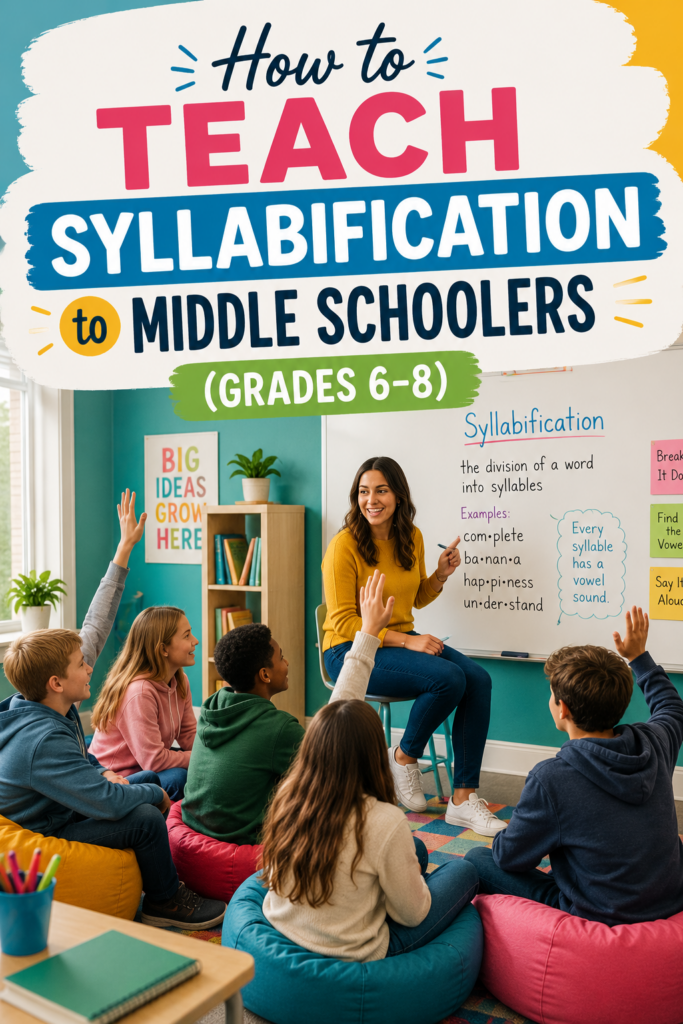
If you want to know how to teach syllabification to middle school students in a way that actually sticks, start by recognizing why so many teachers skip it: it feels mechanical. But that mechanical quality is exactly what makes it powerful. Once a sixth, seventh, or eighth grader can reliably divide an unfamiliar word into syllables, they can decode it, spell it, and write it with far greater confidence. That’s a return worth the investment.
Why Syllabification Matters More in Middle School Than You Might Think
By the time students hit sixth grade, the words they encounter in content-area reading — photosynthesis, parliamentary, infrastructure — are long and morphologically complex. Many students stall on these words not because they lack intelligence but because they’ve never been given a reliable system for attacking multisyllabic words.
Syllabification gives them that system. When students can chunk a word into manageable pieces, reading fluency improves, spelling accuracy climbs, and writing hesitation drops. It’s one of those foundational skills that subtly upgrades everything else.
Start With the Core Concept: What Is a Syllable?
Before teaching division rules, make sure every student has a rock-solid definition. A syllable is a unit of sound that contains exactly one vowel sound. That’s it. The word cat has one syllable; basket has two; celebration has four.
A reliable classroom anchor is the “chin drop” test: place your hand under your chin and say the word naturally. Each time your chin drops, that’s a syllable. It’s low-tech, works for every student, and requires zero materials. Use it as a quick check throughout your lessons.
The Six Syllable Division Rules Worth Teaching in Grades 6–8
Middle schoolers can handle all six major syllable types and division patterns. Teach them in this sequence — moving from most common to most nuanced — so students build confidence before they hit edge cases.
1. VC/CV (Closed + Closed)
When two consonants sit between two vowels, divide between them: bas-ket, nap-kin, hap-pen. This is the most common pattern and should be your starting point. Students usually grasp it within a single lesson.
2. V/CV (Open Syllable)
When a single consonant sits between two vowels, try dividing before the consonant first: ti-ger, ro-bot, mu-sic. The first syllable is “open” — it ends in a vowel and usually says its long sound. If the result doesn’t sound like a real word, try the VC/V split instead.
3. VC/V (Closed Syllable Exception)
Sometimes the V/CV split produces an unrecognizable pronunciation, so you divide after the consonant instead: cab-in, hab-it, mod-el. Teach students to try V/CV first, then flip to VC/V if the word sounds wrong. This trial-and-error approach mirrors what fluent readers do automatically.
4. Consonant + LE
When a word ends in a consonant followed by -le, that final consonant joins the -le to form the last syllable: ta-ble, sim-ple, puz-zle. Middle schoolers often over-divide these, so explicit practice here pays off.
5. Prefixes and Suffixes as Their Own Syllables
Morpheme boundaries are natural syllable breaks. Un-hap-pi-ness divides cleanly once students recognize the prefix un- and suffix -ness. Connecting syllabification to morphology gives students two tools at once and reinforces vocabulary work they’re already doing.
6. Vowel Teams and Diphthongs Stay Together
Vowel digraphs (ea, oa, ai) and diphthongs (oi, ou) are never split: rain-coat, poi-son, sea-son. Students who don’t know this rule will divide rain into two syllables. A simple reminder — “vowel teams travel together” — is usually enough.
A Step-by-Step Classroom Sequence
Knowing the rules is one thing; building a teaching sequence that works in real classrooms is another. Here’s a five-phase approach that works well across grades 6–8.
- Introduce one rule at a time. Don’t front-load all six patterns in a single lesson. Spend two or three days per rule, using word sorts, verbal practice, and written application before moving on.
- Use a word sort for each pattern. Give students a set of 12–16 words and have them sort by syllable type. Sorting forces active decision-making rather than passive recognition.
- Model the think-aloud process. Project a multisyllabic word and narrate your own thinking: “I see two vowels with two consonants between them — that’s a VC/CV pattern, so I’ll divide between the consonants: pil-grim.” Explicit modeling demystifies the process.
- Move to application in context. Have students divide words pulled directly from their current reading or content-area texts. Authentic words matter more than decontextualized lists.
- Build in cumulative review. Every week, include a short mixed-pattern review so earlier rules stay fresh while new ones are introduced.
Practical Classroom Strategies That Work
Syllable Mapping
Give students a word and ask them to draw a box for each syllable, then write the letters inside. This visual-kinesthetic approach helps students who struggle with purely auditory methods. It also makes syllable boundaries concrete and correctable.
Color-Coding
Have students use two alternating colors to highlight syllables in a passage — one color for the first syllable, a second for the next, then back to the first. This works beautifully in paired reading and makes syllable structure visible at a glance.
Whiteboard Quick-Checks
Call out a word, give students 15 seconds to write it on a small whiteboard with syllable divisions marked, then hold up boards on your signal. You get immediate whole-class formative data, and students get low-stakes practice with instant feedback.
Peer Syllable Challenges
Students write three words from their independent reading, divide them into syllables, then swap papers with a partner who checks the work and challenges any division they disagree with. Disagreements become mini-discussions that deepen understanding more than silent worksheets ever could.
Connecting Syllabification to Spelling Practice
Syllabification and spelling are two sides of the same coin. When students learn to divide mis-er-a-ble into four syllables, they’re also learning to spell it — because they’re forced to attend to every vowel sound rather than guessing from the word’s overall shape.
Structured spelling workbooks that integrate syllable drills alongside vocabulary and sentence work make this connection explicit. The Spelling Practice Workbook for 8th Grade does exactly this — its 20 structured lessons include dedicated syllable drills alongside definitions, model sentences, and sentence composition practice, so students aren’t just memorizing word lists but internalizing the internal structure of words.
For seventh graders, the Spelling Practice Workbook for 7th Grade builds phonetic awareness and confidence with longer, more complex words — the same skills that syllabification instruction targets. Using a structured workbook alongside your syllabification lessons gives students the repetition and variety they need to move from recognition to automaticity.
For students who may benefit from additional foundational spelling support, the Spelling Practice Workbook for 6th Grade provides structured practice through short, varied activities designed to reinforce spelling patterns, multisyllabic decoding, and word retention without overwhelming the learner. Each lesson includes definitions, model sentences, and flexible practice activities that support consistent review and independent learning.
Addressing Common Student Mistakes
Even after solid instruction, a few errors show up repeatedly. Knowing them in advance helps you anticipate and address them quickly.
- Splitting vowel teams: Students divide re-ad instead of keeping read intact. Reinforce the “vowel teams travel together” rule with a quick visual anchor.
- Forgetting the open/closed syllable flip: Students always apply V/CV and never try VC/V when the first attempt fails. Teach the flip explicitly and practice it with words like cab-in and hab-it.
- Ignoring morpheme boundaries: Students divide un-hap-py as u-nhap-py. Connect prefix and suffix recognition to syllabification early, and this error largely disappears.
- Over-dividing single-syllable words: Some students divide strength into two syllables because it looks long. Remind them to count vowel sounds, not vowel letters.
Using a Comprehensive Curriculum to Tie It All Together
Syllabification instruction is most effective when it sits inside a broader language arts framework rather than being treated as a standalone unit. When syllable division rules connect to phonetics, root word study, and spelling patterns, students see the system — not just isolated tricks.
The Spelling, Writing and Reading, 7th and 8th Grade: Language Arts Curriculum integrates syllabification lessons alongside prefixes, suffixes, Greek and Latin roots, and guided essay writing. That integration matters because students who understand that trans-port-a-tion breaks into four syllables AND that trans- means “across” and port means “carry” are building vocabulary knowledge at the same time as spelling and decoding skills. That’s the kind of compounding return that makes syllabification instruction worth prioritizing.
Assessing Syllabification Skills Without Over-Testing
You don’t need a formal test to know whether students have internalized syllable division. Build assessment into daily instruction through whiteboard checks, word sorts, and the peer challenge activity described above. When you do want a more structured check, a simple 10-word division task — covering two or three different patterns — gives you reliable data without eating class time.
Look for accuracy across pattern types, not just the easiest VC/CV words. A student who can divide basket but consistently fails on open-syllable words like robot needs targeted reteaching on that specific pattern, not a repeat of the whole unit.
Making Syllabification a Habit, Not a Lesson
The goal isn’t for students to consciously think through syllable rules every time they encounter a new word — it’s for the process to become automatic. That automaticity comes from consistent, low-stakes exposure over time, not from a single intensive unit.
Build brief syllabification moments into your routine: a word-of-the-day divided on the board, a quick whiteboard check as a bell-ringer, or a two-minute partner activity before independent reading. Frequency beats intensity when it comes to building spelling skills for middle schoolers. Give students a reliable system, practice it regularly, and watch their confidence with complex words grow steadily across the year.
For ready-made free lesson samples to complement your syllabification instruction, visit our Free ELA Resources hub.
