How Syllables Help Teens Spell Long Words
Free Lesson Included: scroll down to Lesson 1 to download it instantly.
High school writers often misspell longer words because they guess the middle. Vowels disappear, double consonants are misplaced, and endings are swapped. A short, consistent syllable routine solves most of these problems. This article keeps the focus on spelling high school priorities and gives ready-to-use high school spelling activities that you can run in five minutes. The examples below come from Lesson 1 of my Spelling High School program, which you can download free in this post to help improve spelling for teenagers.
The “middle of the word” problem
Teens read quickly and write quickly. When a word is four or five syllables long, they tend to anchor the beginning and the ending, then guess the middle. That guesswork leads to near-miss spellings that repeat across essays. Teaching students to slow down, chunk the word, and check the pattern removes the guesswork and replaces it with a method.
Why Syllables Matter in High School
Multisyllabic accuracy shows up everywhere: literary analysis, lab reports, history essays, and applications. Correct spelling improves clarity, grades, and confidence. Syllable work is efficient because it targets the high-value skills behind accuracy: base word integrity, suffix patterns, and vowel team placement.
The 3-step chunk-and-check routine
1) Tap and chunk
Say the word aloud once, then say it slowly while tapping out syllables on the desk or with your fingers. Mark the syllable breaks on paper.
2) Write, cover, write, check
Write the word from your chunking. Cover it. Write it again from memory. Uncover and check. Two correct repetitions make the pattern stick.
3) Spot the pattern
Underline the base word and circle the suffix. Watch for common endings such as -ous, -able/-ible, –ence/-ance. Note the y → i change before -able and -ous when a base ends in y.
Mini-models using Lesson 1 words
We will apply the routine to several Lesson 1 targets. Read them aloud. Chunk them. Then do one quick write-cover-write-check.
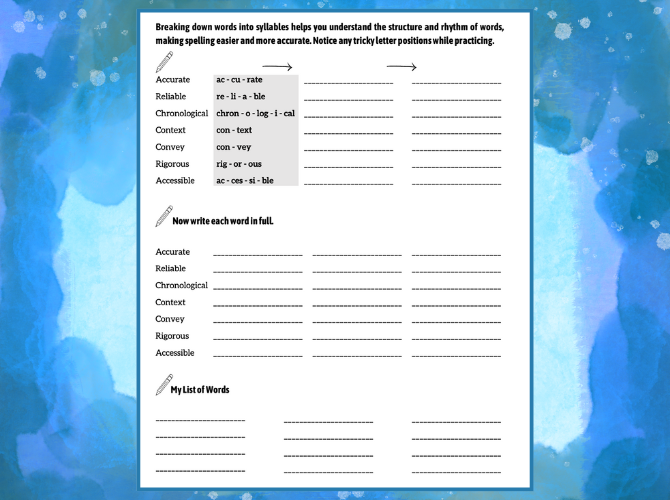
- chronological → chron-o-log-i-cal
Tip: keep chro- at the start and spell the full -logical ending, not -logcal. - accessible → ac-ces-si-ble
Tip: notice double c and s. End with -ible, not -able. - reliable → re-li-a-ble
Tip: base rely + -able. The y shifts to i when you add the suffix. - rigorous → rig-or-ous
Tip: base rigor + -ous. Avoid extra g. - accurate → ac-cu-rate
Tip: listen for the middle vowel. Keep cu together.
Students learn that long words are predictable once you respect base words and endings. The chunk-and-check routine makes that predictability visible.
Five-minute plans: class and home
Class warm-up (daily, 5 minutes)
- Teacher says four target words from this week’s list.
- Students tap and chunk each word for 10 seconds.
- Students do one write-cover-write-check cycle.
- Quick pair check. Mark one thing to watch next time (for example “watch the -ible”).
At-home routine (3 to 5 minutes)
- Put 10 focus words on the fridge or a note on the desk.
- Student highlights suffix patterns.
- Student does one write-cover-write-check cycle for three words.
- Keep a personal error log. Rewrite any misspelling correctly two times.
Transfer to writing
- Ask students to write a three or four sentence paragraph using any two targets.
- Peer underline target words and verify chunking choices.
Download and try it with your students or teen
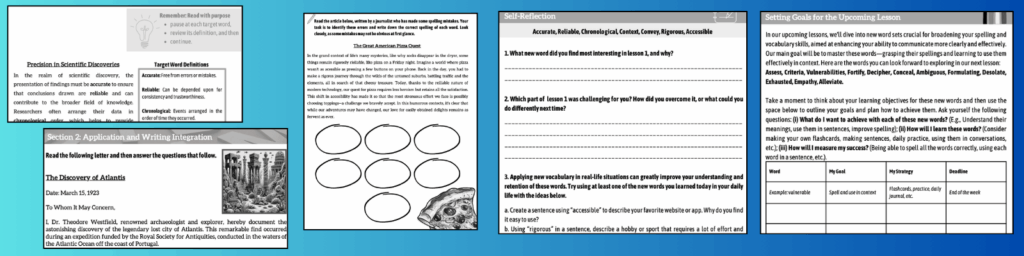
You can run all of these routines with the full set of Lesson 1 materials. That includes the target word list, syllabification tables, a context passage, an application activity, an error-spotting exercise, an online quiz game, and an answer key.
Try these routines this week (Free Download)
Quick progress check
Invite students to self-assess at the end of the week.
- I can syllabify long words quickly and correctly.
- I can choose between -able and -ible for common targets.
- I keep the base word intact when I add -ous or -able.
- I can correct a near-miss in one try using write-cover-write-check.
A short check builds metacognition. It also shows students that improvement is measurable.
Next steps and resources
Keep reinforcing multisyllabic accuracy with short routines as discussed above.
- Try the full Lesson 1 with your class or at home.
- Continue with my books for structured practice:
Questions or collaboration? Reach me at [email protected].