High School Grammar in 15 Minutes: Free Lessons to Try
This article covers grammar for high school for grades 9–10, with quick routines plus three free lessons to try complete with answer key.
Between you and me, I never use a full period for grammar instruction. The first fifteen minutes are for crisp instruction because this is where the learning sticks. Lay the key rules clearly, then move students into short, engaging work where they apply what they just learned. After that, we move into a 20-minute workshop where students practice in pairs or groups, then do a quick Knowledge Checkpoint so I know who needs support.
The plan below is the routine I use, and it matches the free lessons you can download in this post, taken from my book Grammar High School Grades 9–10: A Simplified Visual Guide with Knowledge Checkpoints. Each lesson includes the visual explainer, worked examples, a quick Knowledge Checkpoint, and an answer key. I’ll also share a few engaging solo or group activities you can run before the final checkpoint.
The Lesson Frame I Use Every Time
Instruction: 15 minutes
Independent work: 20 minutes
Knowledge Checkpoint: 5-10 minutes
Process: Notice → Name → Apply → Checkpoint
- Notice: Show the infographic-style explainer and one or two model sentences. The free lessons are built for this, with step-by-step definitions and examples.
- Name: Define the target and tie it to the question it answers.
- Apply: Give an individual or group task that is short and engaging.
- Knowledge Checkpoint: Use the mini multiple-choice items already provided to see who needs more practice.
Below are three phrase lessons you can run this week. Each includes fresh activity ideas and a quick checkpoint.
Grammar Lessons CCSS-Aligned
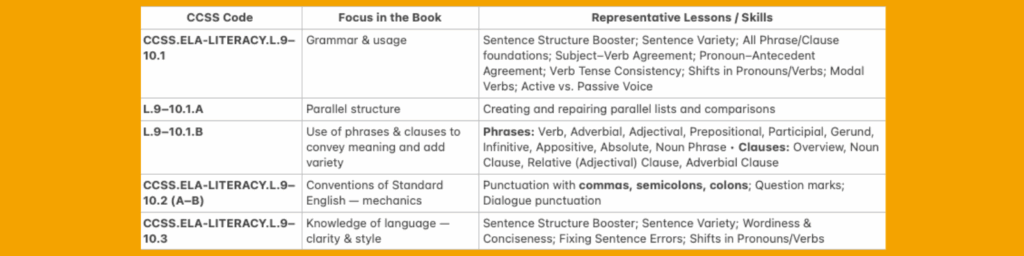
My grammar lessons are aligned with the Common Core State Standards (CCSS). I build each unit on what students already know, and I am happy to revisit key topics when a quick reset helps. A short primer on phrases and clauses is one of those essential reviews. I start the high school sequence here to refresh the basics and prepare students for the phrase and clause work emphasized in CCSS L.9–10.1. It clears the runway for the next grammar lessons.
Free Lessons: Phrases and Clauses (primer); (1) Verb Phrase; (2) Adverbial Phrase; (3) Adjectival Phrase
Primer: Phrases and Clauses
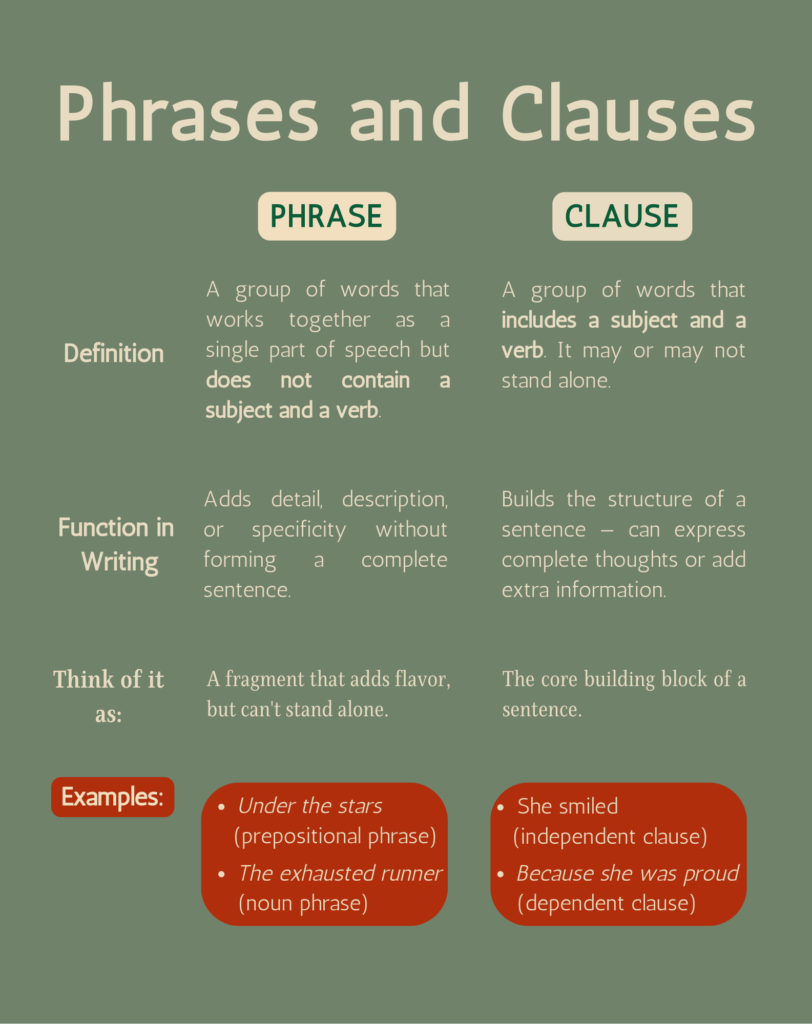
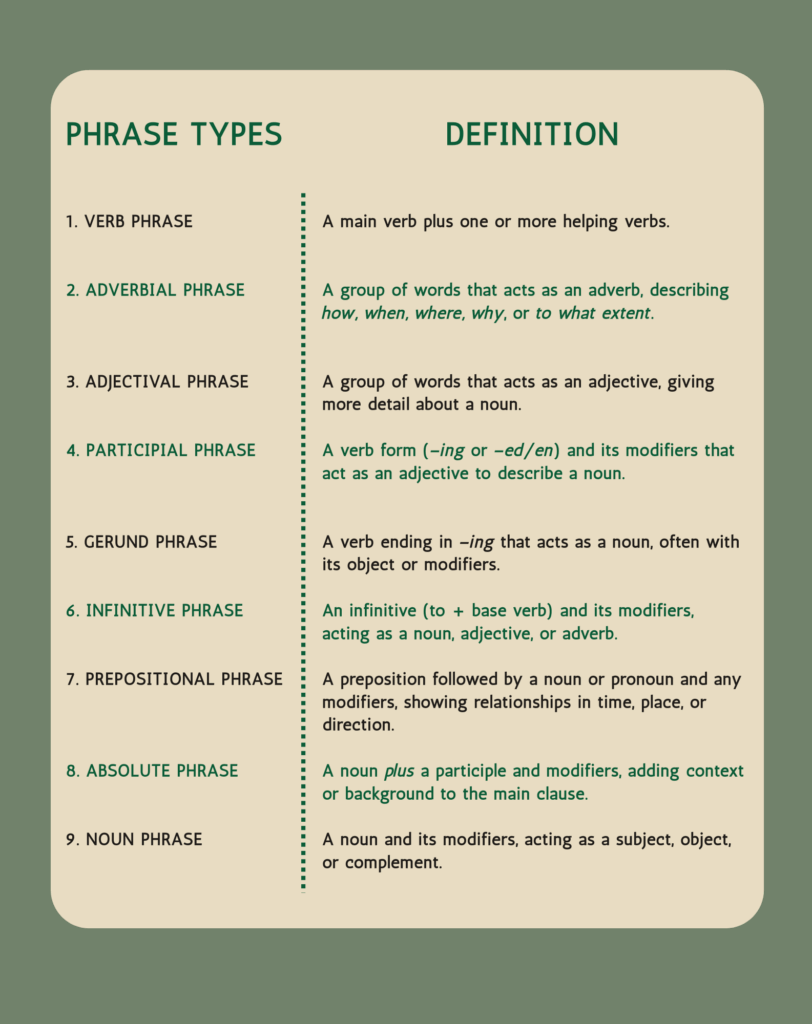
Use the downloadable lesson for the instruction. You can project the PDF on your board or share it digitally so everyone follows the visuals.
- Notice. Show the side-by-side explainer. Read two examples aloud and ask, “Where is the subject? Where is the finite verb?”
- Name. A clause has a subject and a finite verb. A phrase adds detail and cannot stand alone.
- Apply (≈20 minutes). Give each group a set of slips*. On your signal, they sort into Phrase vs Clause, circling the subject and finite verb on clauses and underlining the head word on phrases. Keep score for three to four minutes; rotate sets for a quick peer-check. Highest score earns a printed “Phrase vs Clause Champion” badge or trophy where each student signs their name. Use the ready-made phrases and clauses list below.
*Prepare the slips the evening before on Word: set the font to 30–36 pt and type one item per line. Add a simple cutting line after each item. The next day, print once and photocopy enough sets for your groups. Hand a sheet to each group and ask students to cut the slips.
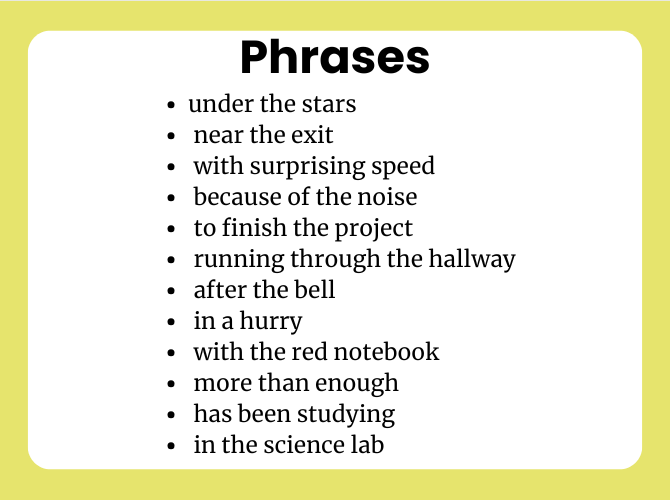
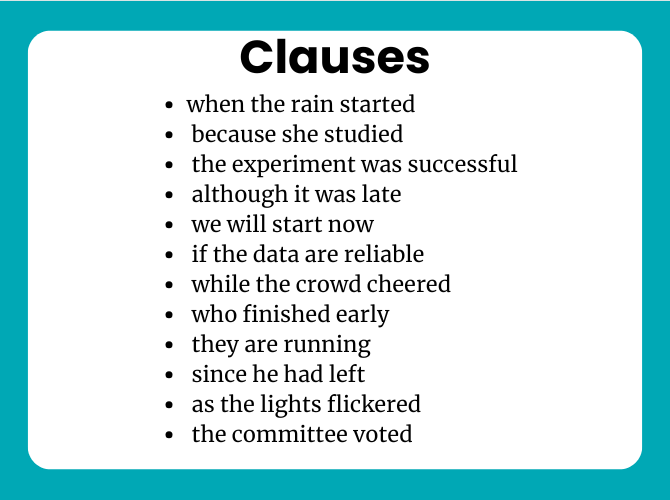
- Knowledge Checkpoint (5–10 minutes). Use the mini multiple-choice items in the lesson to see who is ready to move on and who needs a short reteach.
Lesson 1: Verb Phrase
1) Ask first: “What do we look for in a verb phrase?”
Board prompt: Find the helpers and the main verb. Then tell what they show.
Students should name: auxiliaries (be, have, do) and modals (can, will, must, etc.), the main verb form, and whether the phrase marks time/tense, aspect (progress or completion), voice (active or passive), and negation.
2) Explain the function of a verb phrase
A verb phrase is the spine of the clause. It locates the action in time, shows whether the action is ongoing or completed, sets active or passive voice, and carries negation.
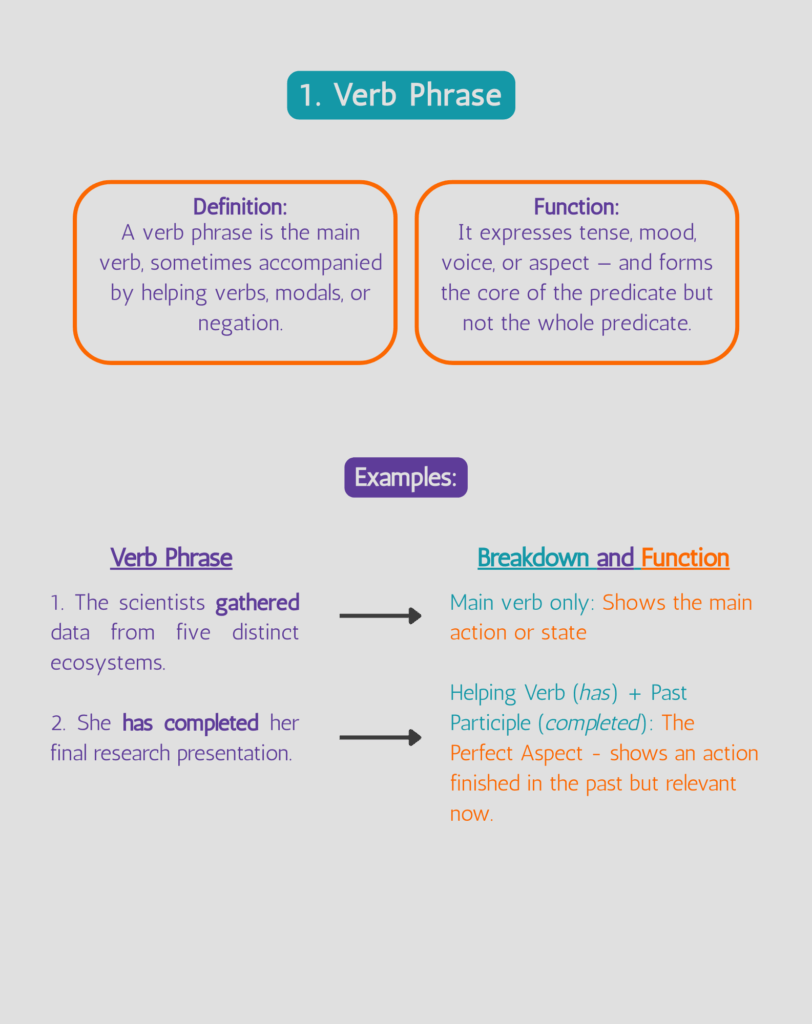
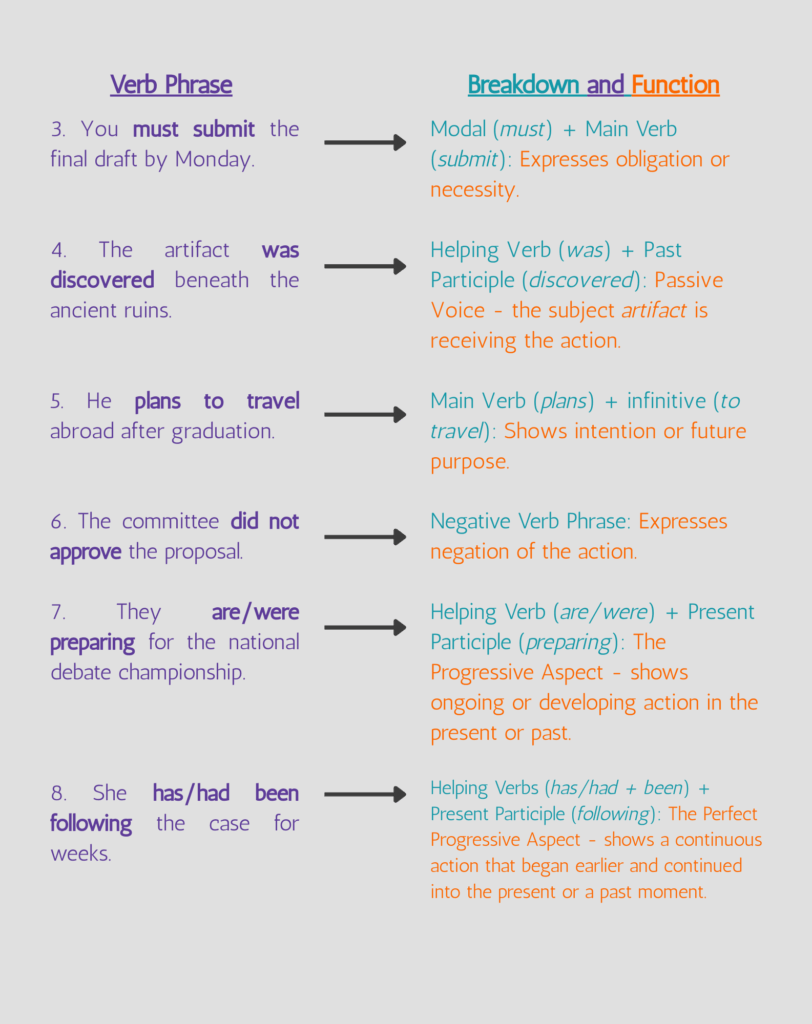
3) Clarify two scopes: Narrow vs Expanded Definition of Verb Phrase.
- Narrow definition (what we use for identification): auxiliaries + main verb only.
- Examples: has been preparing, were recorded, must revise, did not approve.
- Expanded definition (often used in linguistics and some textbooks): the verb with its complements and modifiers attached.
- Example: wrote the report yesterday → expanded verb phrase; wrote → narrow core.
I start with the narrow definition and stay there until students have clearly grasped it. If they’re still struggling, I keep the focus narrow. Once they’re confident, we switch to the expanded
- Example: wrote the report yesterday → expanded verb phrase; wrote → narrow core.
4) Read a few examples together.
On the board:
- has been preparing (perfect progressive, active)
- were recorded (passive, simple)
- must revise (modal, active)
- did not approve (simple past with do support and negation)
Ask students to mark one they find tricky. They underline auxiliaries, circle the main verb, and annotate what each helper shows.
5) Assign a short writing task
Ask each student to choose three verb phrase types (e.g., modal + base, perfect, progressive, perfect progressive, passive, negation) and write one sentence for each. Under each sentence, have them label: tense carrier, aspect, voice, and where “not” would go.
- Invite two or three students to read one sentence aloud. Use this mini-script to check understanding:
- Q: Which word marks perfect aspect?
- A: has.
- Q: What marks progressive aspect?
- A: been + the -ing form (preparing).
- Q: Voice?
- A: Active (no be + past participle).
- Q (if needed): Where would not go?
- A: has not been preparing.
- Q: Which word marks perfect aspect?
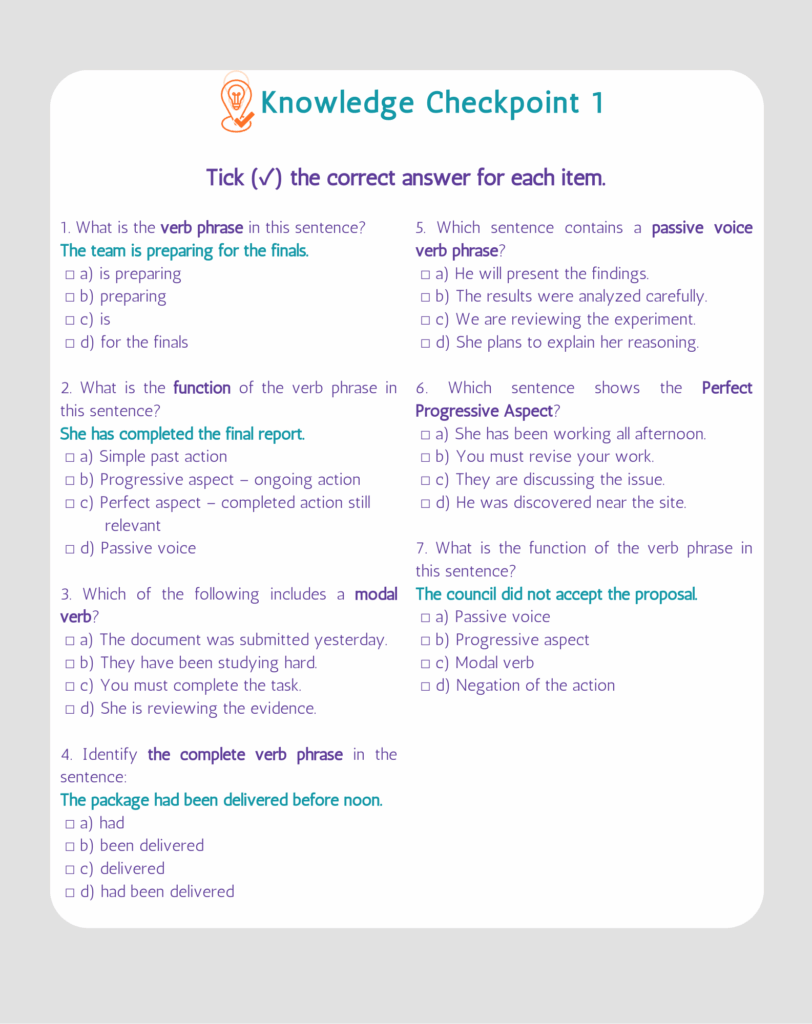
6) Knowledge Checkpoint (5–10 minutes). Use the mini multiple-choice items in the lesson to see who is ready to move on and who needs a short reteach.
Lesson 2: Adverbial Phrase
1) Notice and Name (instruction ≤ 15 minutes).
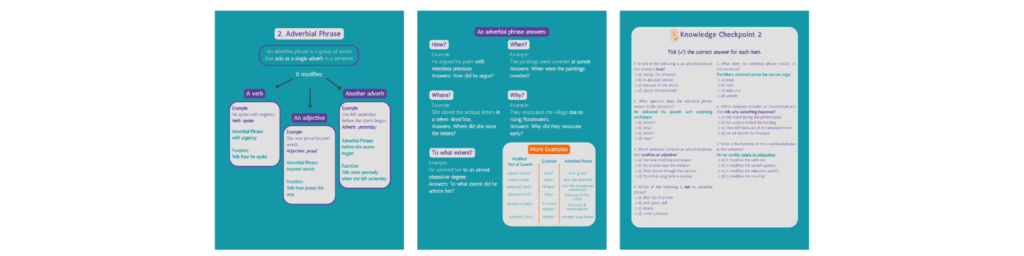
I keep this simple: “An adverbial phrase tells how, when, where, why, or to what extent, and it can move.” I read three quick models and we name the function out loud.
- After the experiment, we analyzed the charts. → when
- The team presented with careful attention to detail. → how
- In many cases, the outcomes remained stable. → extent
2) Apply (workshop ~20 minutes).
Five corners is my go-to because students get to stand, move with purpose, and still stay on task. Label corners How, When, Where, Why, To what extent. Give a bare clause (for example, “The class discussed the article”). Groups invent an adverbial phrase, walk to the matching corner, and read it to you. I keep it brisk and run two rounds. Then I do a quick move-it test: we front the adverbial and add the comma when needed.
3) Knowledge Checkpoint (5–10 minutes).
I use the packet’s mini questions to confirm three things: which question the phrase answers, what it modifies, and whether a comma is needed when fronted. I mark one or two items together so everyone hears the reasoning, then I note who needs a quick reteach.
4) Quick writing.
Students add one fronted adverbial to a sentence from today’s draft and punctuate it. I ask a partner to check both clarity and the comma.
Lesson 3: Adjectival Phrase
1) Notice and Name (instruction ≤ 15 minutes).
I underline the noun and bracket the phrase that sharpens it. Then I give the line I always use: “An adjectival phrase answers which one or what kind. Park it next to the noun it belongs to.”
- Examples:
- The article [about climate policy] sparked debate.
- Several responses [in the comment section] raised concerns.
- A solution [with fewer side effects] (was proposed).
2) Apply (workshop ~20 minutes).
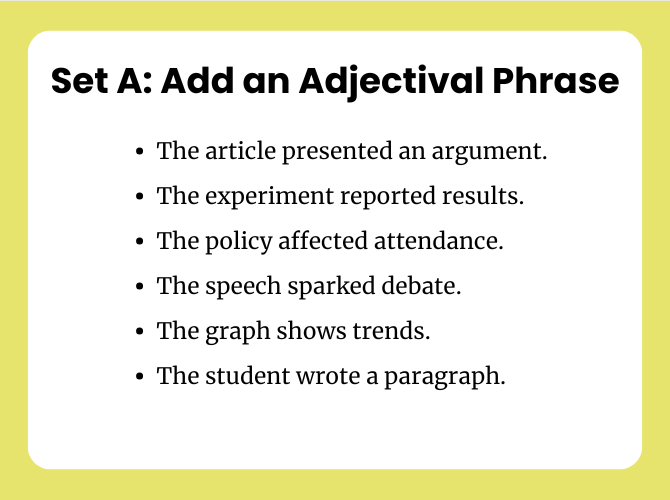
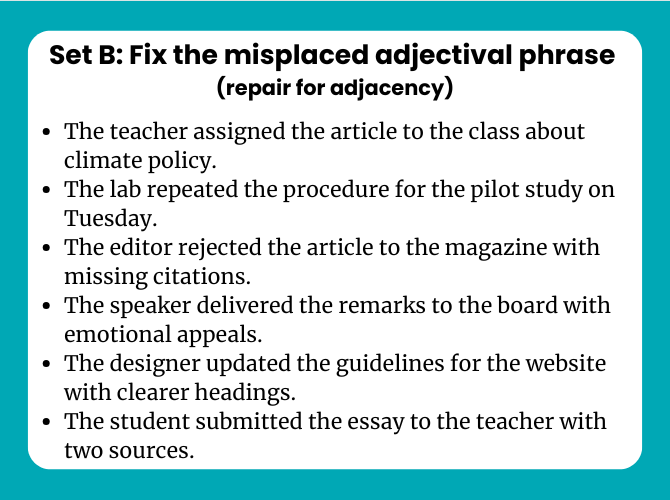
During the workshop I focus on two skills: (i) using adjectival phrases to enhance the noun and (ii) placing the phrase in its correct place next to the noun it modifies. I prepare two short sets (below) as slides the evening before. We work through both quickly.
3) Knowledge Checkpoint (5–10 minutes).
I check three things: the function question (which one or what kind), the exact noun being modified, and correct placement next to that noun. The packet’s items make this very quick.
Thank you for reading. I hope this article and the free lessons are genuinely useful in your classroom or at home.

All of the lessons outlined above appear in Grammar High School Grades 9–10: A Simplified Visual Guide with Knowledge Checkpoints, with visuals, quick Knowledge Checkpoints, and full answer keys. If the free sample lessons fit your curriculum, the full book is available on:
Aligned CCSS coverage (Grades 9–10):
Questions or feedback? [email protected]