The Greek Root “Chron”: Teaching Time Words in High School
I’ve prepared three free printable posters with an extended list
of chron words for high school and college vocabulary study.
Click here to get the posters.
Enter your name and email in the form below to receive
instant access.
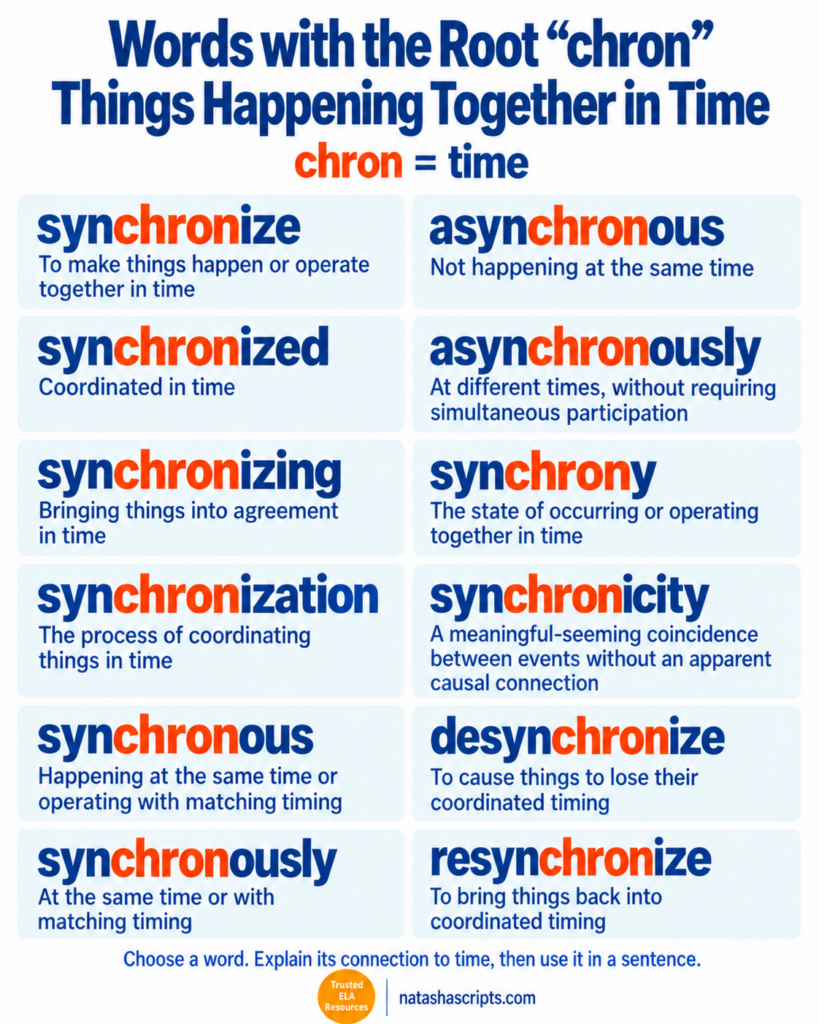
The Greek root chron means “time,” and it gives us a useful starting point for exploring words that high school students encounter in their reading. Words such as chronological, anachronism, and synchronize may look quite different at first, but they all have a connection to time.
I like to make that connection clear through examples. When we arrange events in chronological order, we place them in the order in which they happened. An anachronism is something that belongs to a different time, such as a character wearing a digital watch in a story set in ancient Rome. When we synchronize two clocks, we set them to show the same time.
Studying these words together allows us to return to the meaning of chron while discussing what each complete word means. In this article, I’ll explain how teachers and homeschool parents can use this root to introduce related vocabulary, discuss examples, and give students practice using the words.
Why Teach Words with the Root “Chron” Together?
One reason I like teaching words with a shared root is that we can keep building on something students already know. Once we have established that chron means “time,” we can return to that meaning as we introduce another word. The root gives students a clue to explore, although they will still need to examine the rest of the word and its use in the passage.
These connections are useful across school subjects. In history, students may arrange events in chronological order. In literature, they may identify an anachronism and explain why it does not belong in the time period of the story. In science and technology, they may read about systems that synchronize, or operate together in time. The word chronic also belongs to this family. A chronic condition lasts a long time or keeps recurring, so here the connection is to duration.
I would bring these examples into our vocabulary discussion so students can see how the idea of time takes different forms in each word. We can then examine the other word parts, check the complete meanings, and practice using the words in sentences.
For an earlier introduction to this approach, see my article on teaching Greek and Latin roots in middle school. With high school students, we can extend the discussion by choosing more demanding words and asking them to explain how each word fits the passage they are reading.
Words with the Root
“Chron”:
Meanings and Examples
I would introduce these words a few at a time, discussing their meanings and examples together. In each case, we can ask students to explain how the word connects to the idea of time.
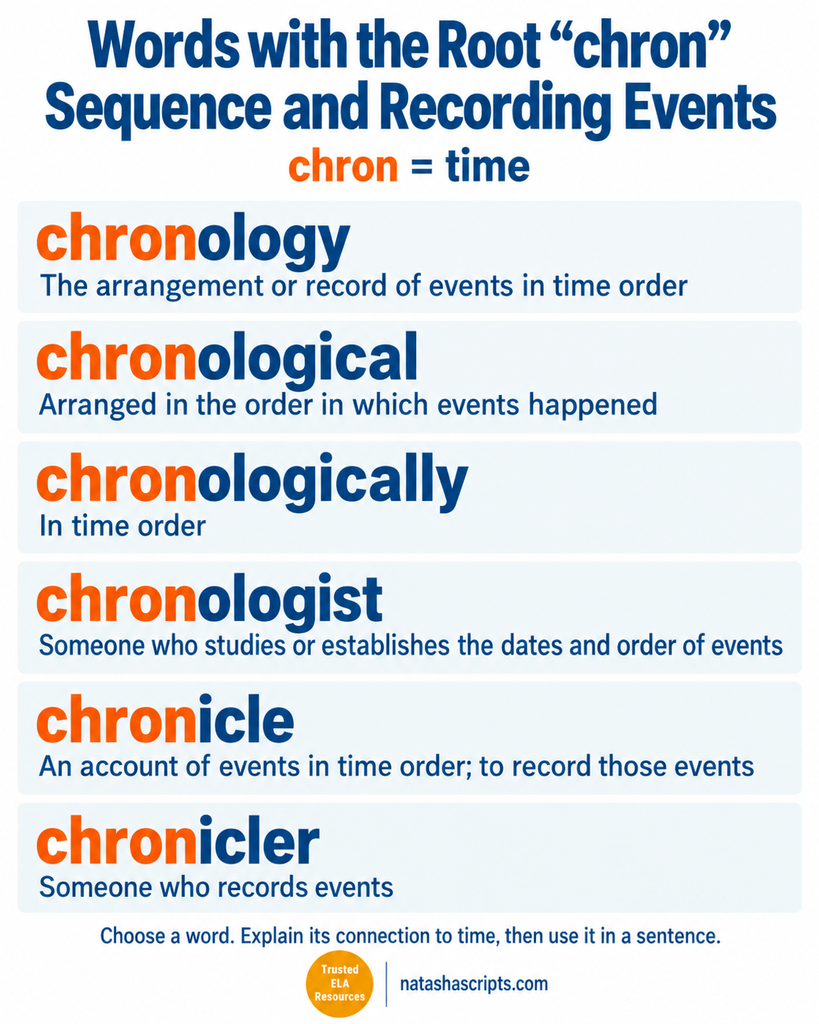
Chronological (adjective): arranged in the order in which events happened. A historical account might begin with the earliest event and work forward. We describe this as chronological order. Here, the connection to time is the sequence of events.
Chronology (noun): a record or arrangement of events in time order. Students might create a chronology of a person’s life, listing important events alongside their dates. Comparing this noun with the adjective chronological also gives us an opportunity to discuss how related words function in a sentence.
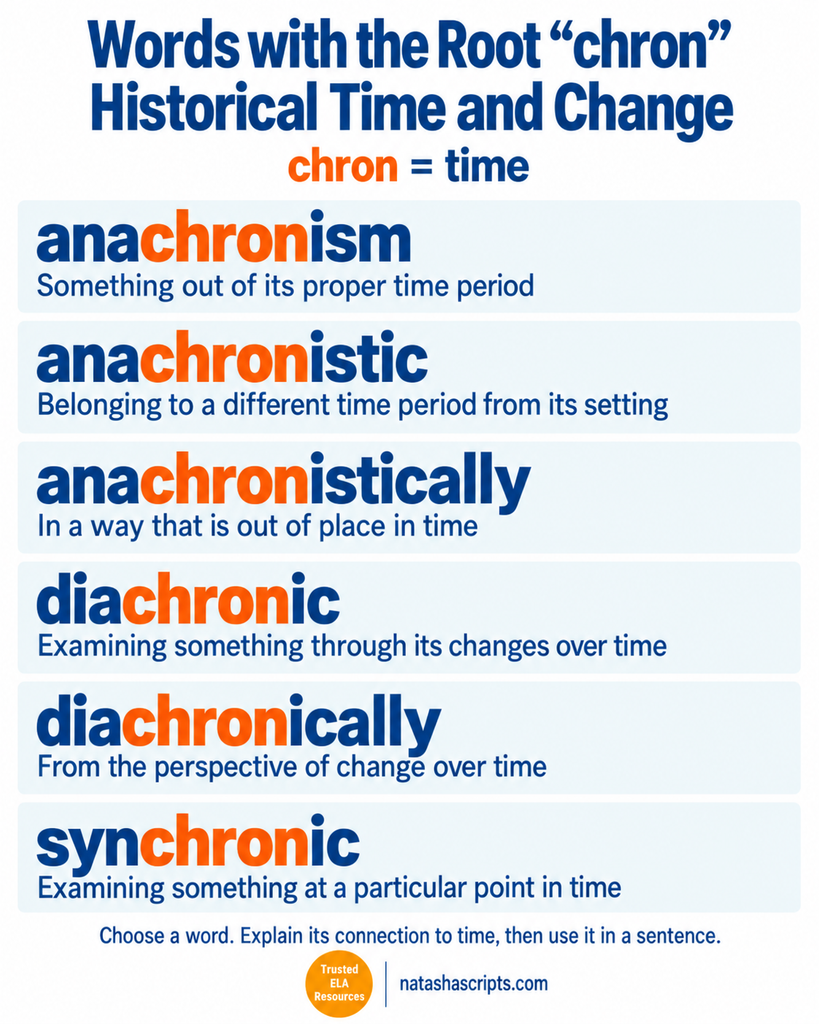
Anachronism (noun): something placed in a time period where it does not belong. A digital watch worn by a character in a film set in ancient Rome would be an anachronism, because digital watches did not exist then. We can also use the word for something that seems to belong to an earlier era.
Anachronistic (adjective): out of place in time. Using the same example, we could say, “The character’s digital watch is anachronistic.” I would compare this sentence with “The watch is an anachronism” so students can see how the adjective and noun are used.
Synchronize (verb): to make things happen or operate together in time. Two students might synchronize their watches so both show the same time. The prefix syn- means “together,” which helps explain the connection.
Synchronous (adjective): happening at the same time, or operating with matching timing. A live online lesson is synchronous when the teacher and students take part at the same time. In this example, everyone shares the same lesson time.
Asynchronous (adjective): not happening at the same time. A recorded lesson that students watch at different times is an example of asynchronous learning. The prefix a- means “not,” so we can compare synchronous and asynchronous to show how adding a prefix changes the meaning.
Chronic (adjective): lasting a long time or recurring over time. A chronic health condition continues over an extended period or keeps returning. Students may also encounter phrases such as chronic stress or chronic shortages. Here, the connection to time is how long something lasts or how often it returns.
Chronicle (noun and verb): a written account of events in time order, or the act of recording those events. A school might keep a chronicle of its history. Students could also chronicle the development of a community garden, recording what happened from its first planting through its first harvest.
Chronometer (noun): an instrument designed to measure time very accurately. The word part -meter means “measuring instrument,” so students can connect the two parts: time and measurement. Marine chronometers were used in navigation to help sailors determine their longitude at sea.
How Prefixes Change the Meaning
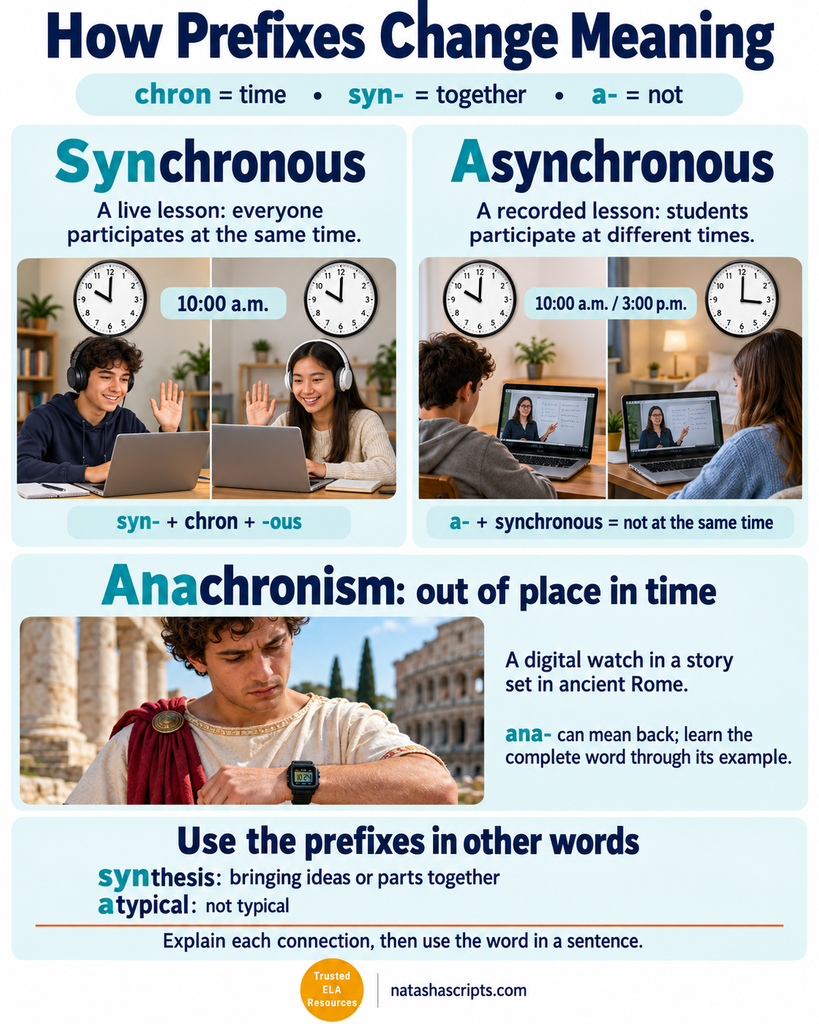
Once students are familiar with the words, I would look more closely at their prefixes. We can begin with syn-, meaning “together.” When we synchronize two clocks, we bring them into agreement so they show the same time. In synchronous, we see the same idea of things happening together in time.
Adding a-, meaning “not,” gives us asynchronous. I would place synchronous and asynchronous side by side and return to the online lesson examples: a live lesson brings everyone together at the same time, while a recorded lesson allows students to participate at different times. This makes the effect of the prefix clear.
Anachronism needs a little more explanation. Its Greek prefix ana- can carry the sense of “back,” but I would avoid teaching the word as “against time.” For students, the useful meaning is that something is out of its proper time period. We can identify the word parts, then return to an example to explain the complete word.
These prefixes also give us connections to vocabulary beyond the chron family. The syn- in synthesis carries the idea of bringing things together, while a- means “not” in atypical, meaning not typical. I would ask students to explain these connections in their own words and check their understanding with a sentence.
For more discussion of vocabulary practice and review, see Why Students Forget Vocabulary Words After a Test and How to Improve Retention.
A Teaching Sequence for the “Chron” Word Family
I would spread this work over a few short lessons so students have time to discuss the words, read them in context, and use them in their own writing. The amount we cover each time will depend on how familiar the vocabulary is to the students.
1. Introduce the Root and Group the Words
Begin by writing chron in the center of a page or on the board, with its meaning, “time,” beside it. Ask students which related words they already know and what they think those words mean. I would discuss their suggestions before adding unfamiliar words from our list.
We can then organize the words into smaller groups. Chronology, chronological, and chronicle all connect to recording or arranging events in time. Synchronize, synchronous, and asynchronous give us a useful comparison about timing. Anachronism and anachronistic belong together because they describe something out of its proper time period. We can introduce chronic through duration and chronometer through measuring time.
There is no need to introduce all ten words in one lesson. I would choose a few, discuss their meanings, and ask students to explain the connection to time before moving on.
2. Read the Words in Context
Next, give students a short passage containing some of the words they have studied. This might be a historical account that presents events in chronological order, a description of live and recorded online lessons, or a discussion of an anachronism in a historical film.
Ask students to identify the target words and explain what each means in that passage. I would also ask them to point to details that support their explanation. For example, if a passage describes asynchronous lessons, what tells us that students can complete the work at different times?
Return to the word parts where they help clarify the meaning. Students can explain how adding a- changes synchronous to asynchronous, then check that explanation against the passage.
3. Use the Words in Writing
I would begin with sentences that give students something specific to explain. They could describe an anachronistic detail in a book or film, explain why two devices need to synchronize, or describe a problem that could be called chronic. Their sentences should include enough detail to show what the word means.
For a longer task, students could write a short paragraph explaining the chronology of events in a text they have read. Ask them to describe what happened first, what followed, and how the author presented those events. They can use the vocabulary that fits their explanation without trying to include every word from the list.
When reviewing the writing together, check both the meaning of the word and its place in the sentence. If the meaning is unclear, return to an example, discuss it, and give students an opportunity to revise.
Connecting the Words to Reading and Writing
Several words in the chron family give students useful language for discussing what they read. Once they understand the vocabulary, I would bring it into our conversations about a text and then into their written responses.
For example, we can examine how an author presents events. Does the account follow chronological order, or does it begin with a later event and then return to an earlier time? Students can explain that choice and discuss what it helps the reader understand. In a historical account, following the chronology may help them establish which events preceded others, although the order alone does not prove that one event caused another.
Anachronisms give us another opportunity for discussion. If a student notices an object, expression, or custom that seems out of place in a historical story, I would ask them to check when it first appeared. They can then explain why it does not fit the setting, using both anachronism and anachronistic in their discussion.
These tasks give students a reason to use the vocabulary. They are explaining something about the text, and the words help them make that explanation more precise.
A High School Workbook That Explores the Words Behind the Spellings
In my Spelling High School Workbook for Grades 11–12, I give students more than a list of spellings to learn. The lessons explain the roots of the chosen words, giving students an opportunity to explore their meanings and understand how they were formed.
I also wanted the book to speak to teenagers in language they would enjoy reading. There is humor in the lessons, alongside activities that ask students to think about the words and use them. Although it is a spelling workbook, vocabulary development is an important part of what students practice.
Try a Free Sample Lesson
If you would like to see how the book might suit your high school students, you can download a free sample lesson here. The sample includes an answer key, a self-reflection and goal-setting activity, a Spelling Journal for Teens, and access to an online quiz game. This is one of six games accompanying the workbook, which give students another way to review and practice what they have learned.
Please complete the name and email form on the sample page, even if you already receive my emails. You will not receive duplicate emails. The form helps me keep track of interest in my sample lessons so I can include interested readers in future free book review offers.
Checking How Students Use the Words
After students have practiced the vocabulary, I would ask them to explain an example or use a word in a sentence. Their definitions give us a starting point, and these additional tasks help us see what may need further discussion.
For anachronism, we could give students a short passage containing a detail that does not belong in the setting. Ask them to identify it and explain why it is anachronistic. For synchronous and asynchronous, students could describe a learning activity that fits each word and explain the difference in timing.
I would also return to their writing. Does the sentence make the meaning clear? Has the student used the correct form of the word? Comparing “The watch is an anachronism” with “The watch is anachronistic” gives us a simple way to check the noun and adjective forms together.
A vocabulary journal can provide a place to keep these examples, along with definitions, related words, and useful notes about prefixes. Students can return to an entry and improve it as their understanding develops. For further discussion, see Flashcards vs. Vocabulary Journals for High School.
I like to finish by asking students to choose a few words from the family and explain their connection to time. We can then revisit those words when they appear in another lesson or reading passage, giving students another opportunity to check their understanding and use them.
You are welcome to explore my Free ELA Resources page for sample lessons from my books. You can review the material and choose spelling, vocabulary, reading, or writing practice suited to your students.
Download Your Free Chron Vocabulary Posters