How to Teach French-Origin Spelling Words in Middle School
Words such as chandelier, bouquet, and technique give us a useful reason to discuss word origins with middle school students. The ch in chandelier sounds like sh, the final t in bouquet is silent, and technique ends in -ique. Knowing these features gives students something specific to notice when reading and spelling the words.
I prefer to introduce a few related words together, discuss their meanings and pronunciation, and then examine the letters they share. We can follow this with written practice and return to the words in later lessons. This article explains several French-origin spelling patterns and a routine you can use with your students.
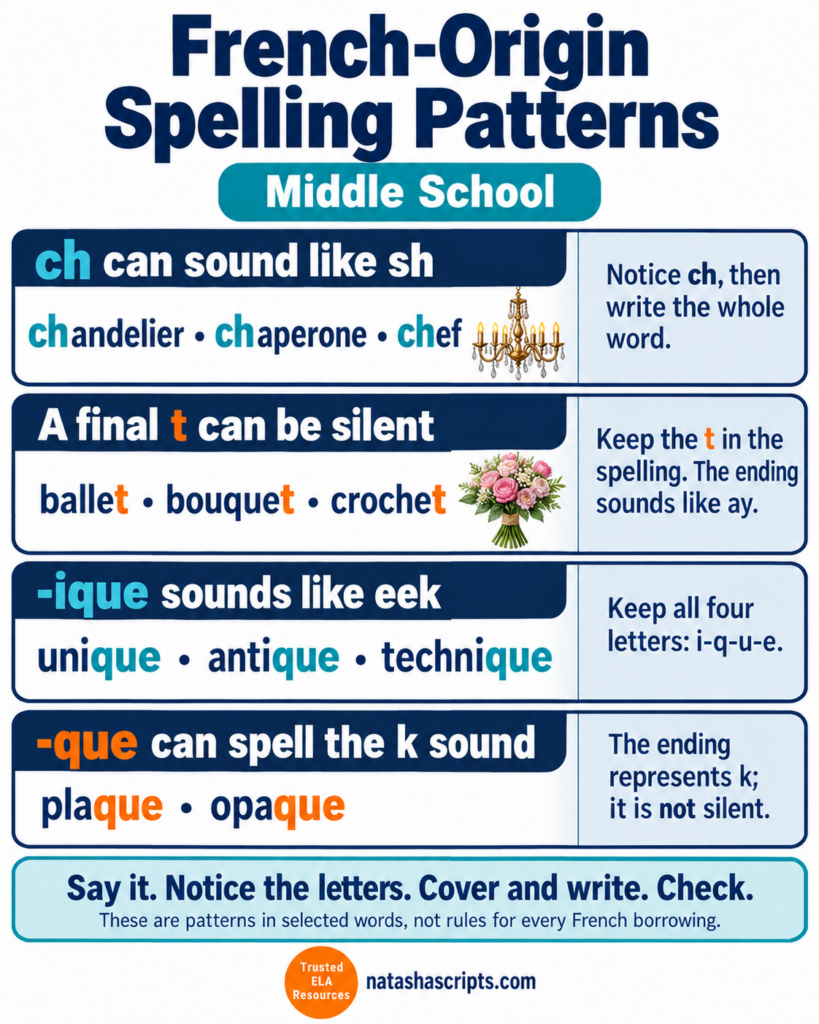
If you would like a reminder of the patterns discussed here, you can jump to the Quick Reference Guide.
Why the French Connection Helps Explain the Spelling
English has borrowed words from French over many centuries. Some have kept spellings and pronunciations that reflect that history. A brief explanation of the origin can help students understand why familiar letters have a different sound in a particular word.
A student who knows the ch sound in cheese may need us to explain that these letters can also represent the sh sound, as they do in chandelier. I would then introduce other words that English has borrowed from French, such as chef and chaperone. Reading these words together gives students more examples of the French ch spelling and helps them recognize the sound it represents.
When we describe a word as French in origin, we mean that English borrowed it from French, although its history may go further back to another language. Some words came through French from Latin or Greek. This is worth explaining briefly when students are also studying roots, so they understand that a word can have more than one stage in its history.
Four Spelling Patterns to Study
1. The ch Spelling for the sh Sound
I would begin with chef, chaperone, and chandelier, explaining that English borrowed these words from French. As we read them aloud, I would ask students to underline the opening ch and listen to its sound. In all three words, ch represents the sound we usually spell sh.
Compare: Chef, challenge, and character begin with the same two letters, but we hear a different sound in each: sh in chef, ch in challenge, and k in character.
Students can sort the words by their opening sound and read each group aloud. This helps them see why they need to look at the whole word and check its pronunciation when it is unfamiliar.
For spelling practice, I would return to our French-derived words. Students can look closely at each word, say it aloud, cover it, and write it from memory. When they check their spelling, I would ask them to pay particular attention to the opening ch. We want them to connect the sh sound they hear with the letters they need to write in these words.
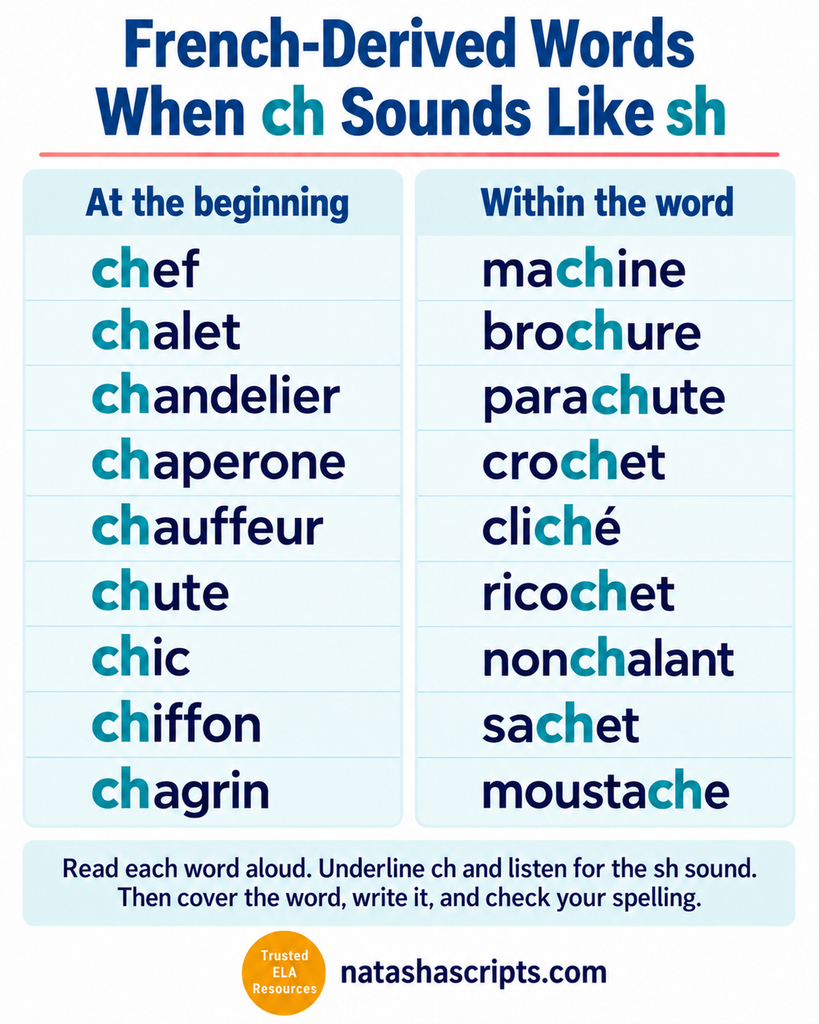
You can save this word list or take a screenshot to use with your students. I would choose a few words at a time, read them aloud together, and ask students to underline ch as they listen for the sh sound. Discuss any unfamiliar meanings before moving on to spelling practice. Students can then cover each word, write it from memory, and check it against the list.
2. A Silent Final t
In ballet, bouquet, and crochet, the final t is written but not pronounced. Each word ends with the vowel sound heard in day.
Read the words aloud while students look at their spellings. Then mark the final t and discuss why it needs particular attention: they will not hear a separate t sound when writing the word from dictation.
In bouquet, the final t is silent. The whole ending is not silent: the word ends with the sound ay.
Students can say the word normally, name its final letter, and write the complete spelling. I would keep the normal pronunciation clear throughout the activity, particularly for students who are meeting the word for the first time.
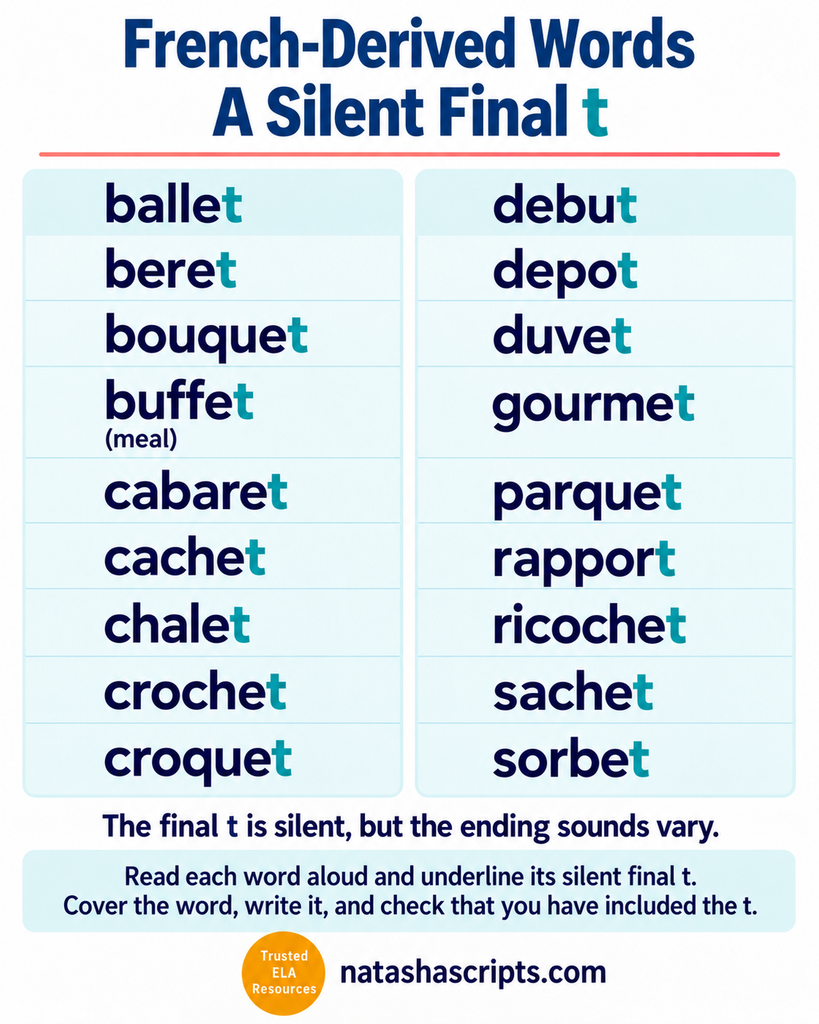
In many words on this card, the -et ending sounds like ay, as in ballet. These three words have different ending sounds:
- Debut: day-BYOO, ending with the yoo sound in view.
- Depot: DEE-poh, ending with the oh sound in go.
- Rapport: ruh-PORE, rhyming with more.
Read these words aloud with students so they can hear the different endings. The final t is silent in all three.
3. The -ique Ending
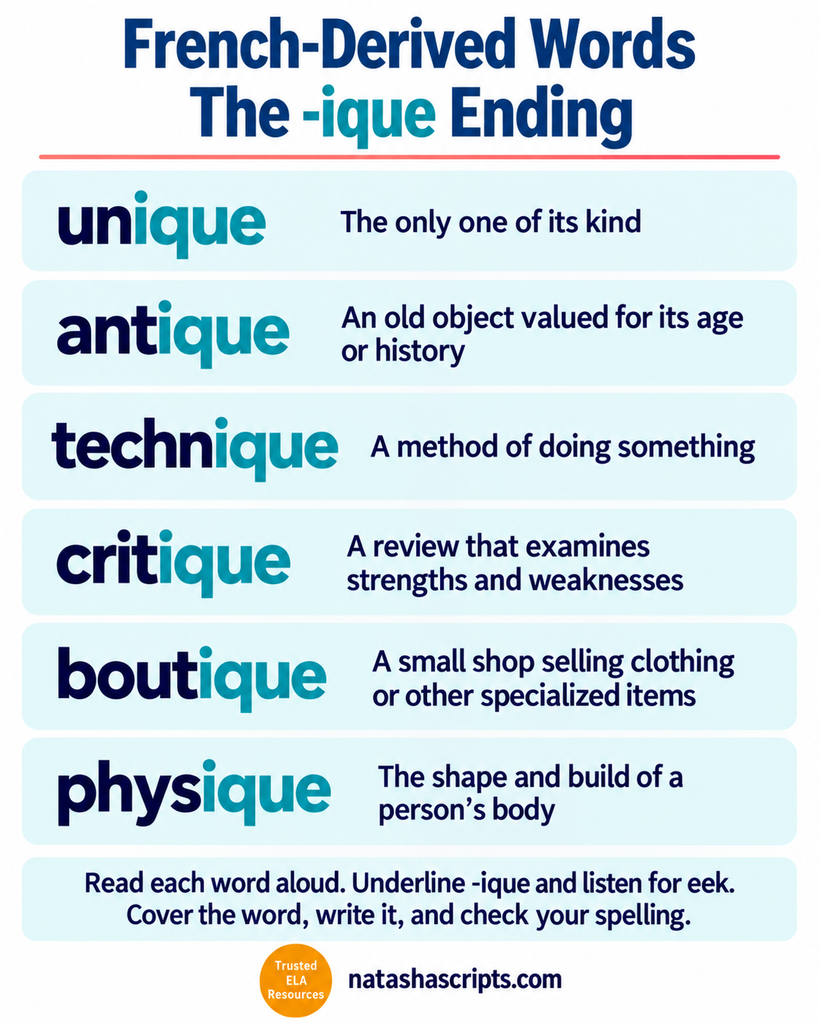
Unique, antique, technique, and critique share the ending -ique, pronounced like eek. Looking at these words together gives students a repeated letter sequence to practice.
I would underline all four letters, i-q-u-e, and say the ending before writing the whole word. This keeps the vowel sound as well as the final consonant in the explanation. Describing -ique only as a spelling for k leaves out part of what students hear.
The class learned a new technique for shading a drawing.
Discuss the meaning of technique in the sentence, then ask students to write another sentence using the word. They can check the ending again after writing.
4. The -que Spelling for the k Sound
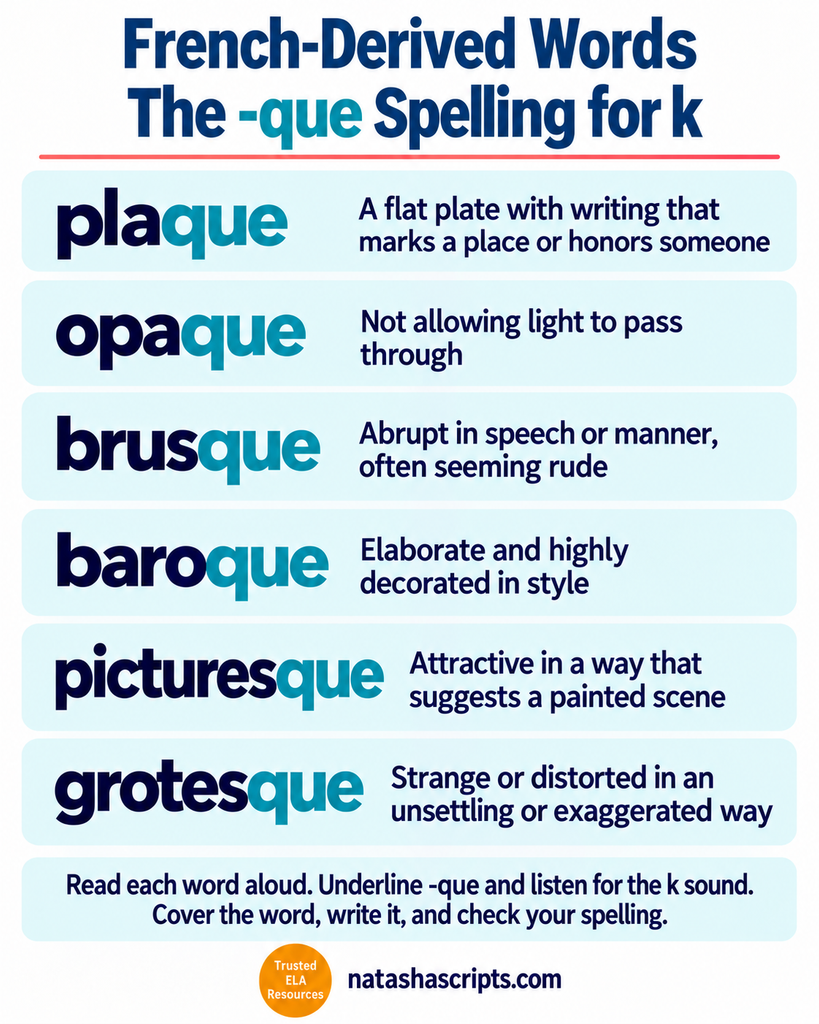
Plaque and opaque both end in -que, which represents the k sound in these words. The ending is not silent, and it does not have the usual kw sound students hear at the beginning of queen.
Place plaque beside technique. Both end in que, but technique has an i immediately before it, making the longer ending -ique. Students can mark the shared letters and then identify the extra vowel letter.
Use a picture of a name plaque or an award plaque to establish the meaning. For opaque, compare a clear window with a solid cover that blocks light. These examples give students a meaning to connect with the spelling.
Words That Need More Individual Attention
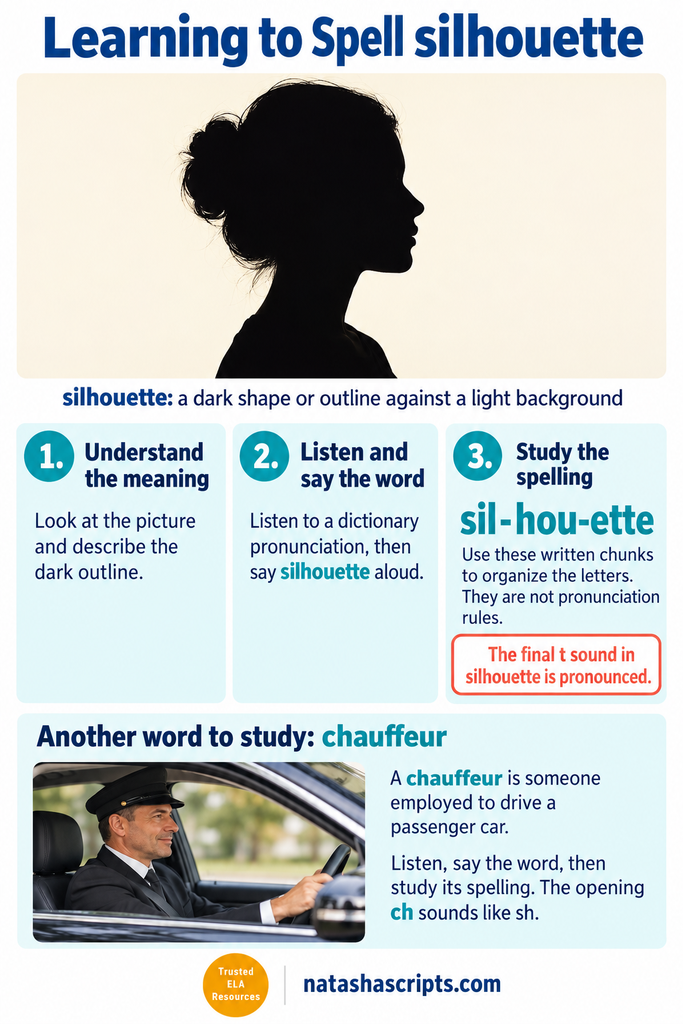
Some words have several features to examine. Chauffeur, for example, begins with ch for the sh sound, contains a double f, and ends in -eur. We can point out the familiar opening pattern and then give attention to the rest of the spelling.
For a word such as silhouette, I would first establish its meaning with a picture of a dark outline against a light background. Students can listen to a dictionary pronunciation, say the word, and examine the sequence sil-hou-ette as written study chunks. These chunks help organize the letters; they are not a set of pronunciation rules. The final t sound in silhouette is pronounced.
Students may find it useful to mark a difficult section, write it separately, and then reconstruct the complete word. A longer word can be studied in smaller parts, with the whole spelling checked at the end. My article on teaching syllabification to middle schoolers discusses further ways to examine longer words.
A Short Routine for Reading, Spelling, and Review
Choose a small group of words from one pattern, preferably including words students have met in their reading. I would begin with three or four words and use the following sequence.
- Read and discuss. Say each word, establish its meaning, and read a sentence that shows how it is used. A picture may help with a word such as chandelier or bouquet.
- Notice the spelling. Underline the letters being studied and compare them across the group. Students can sort word cards by spelling feature and explain their choices. A word can belong in more than one group.
- Cover and write. Let students study the word, cover it, and write it from memory. Compare the attempt with the model and identify the part that needs another look.
- Use and review. Ask students to use a word in a sentence of their own. Return to a few of the words in the next lesson and again in later weeks, including some brief dictation or sentence writing.
Give a word with more than one meaning in a sentence when using dictation. This helps students connect the spelling with the meaning you are teaching. After checking the work, revisit the particular letters causing difficulty rather than asking the student to copy the entire list again.
You can adjust the amount of practice to the students and the words. There is no need to wait until a particular grade to discuss a useful word from a passage. Explain the feature when it is needed, model the spelling, and provide support with the parts that are unfamiliar.
Quick Reference Guide
Connecting Word Origins with Broader Spelling Work
Word origins are also part of the spelling and vocabulary work in my Spelling, Writing and Reading, 7th and 8th Grade: Language Arts Curriculum. The book includes Greek and Latin roots, prefixes, suffixes, spelling patterns, and reading and writing activities.
That root study helps students examine meaningful word parts. In this article, we have concentrated on spelling features in words borrowed through French. Both give us reasons to look more closely at how words are formed, but they involve different kinds of explanation. You can use the French-word groups here alongside the broader work in the curriculum.
For additional general practice, my Spelling Practice Workbook for 7th Grade contains 120 words across 20 lessons, while the Spelling Practice Workbook for 8th Grade contains 100 words across 20 lessons. Both include definitions, model sentences, syllable practice, and sentence writing. They provide structured practice with their own word lists and can be used alongside the word groups you select for this activity.
For further discussion of how I connect these activities, see Why Spelling Practice Still Matters in Middle School.
Choosing the Next Words to Practice
Begin with a few words your students need for their current reading or writing. Check their meanings and pronunciation, identify the spelling features you can teach together, and allow time to write and review them. When the same letters appear in another word, return to the earlier examples and compare them.
You are welcome to explore my Free ELA Resources page for sample lessons from my books. You can review the material and choose spelling, vocabulary, reading, or writing practice suited to your students.
