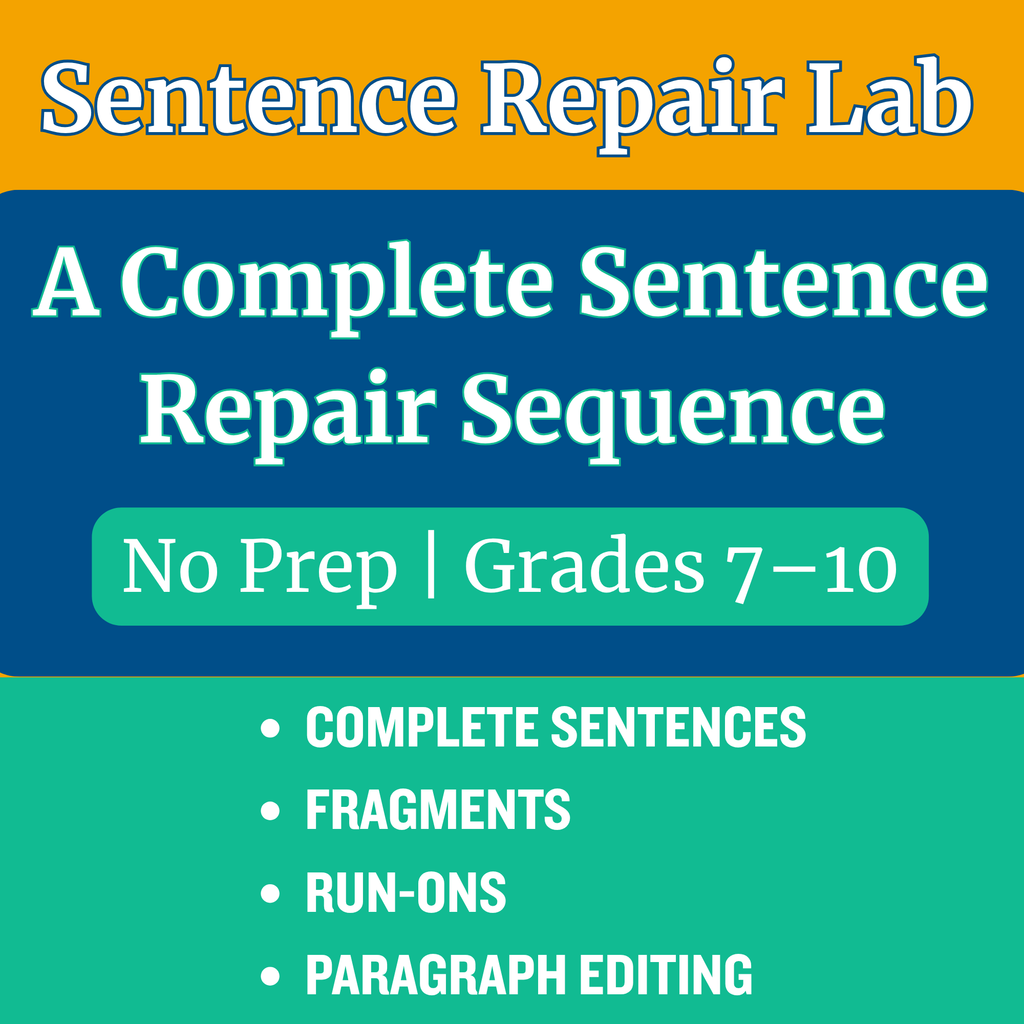
Help Students Understand and Repair Sentence Errors
This article includes a paid resource for teachers and homeschool parents
working with students in Grades 7–10.
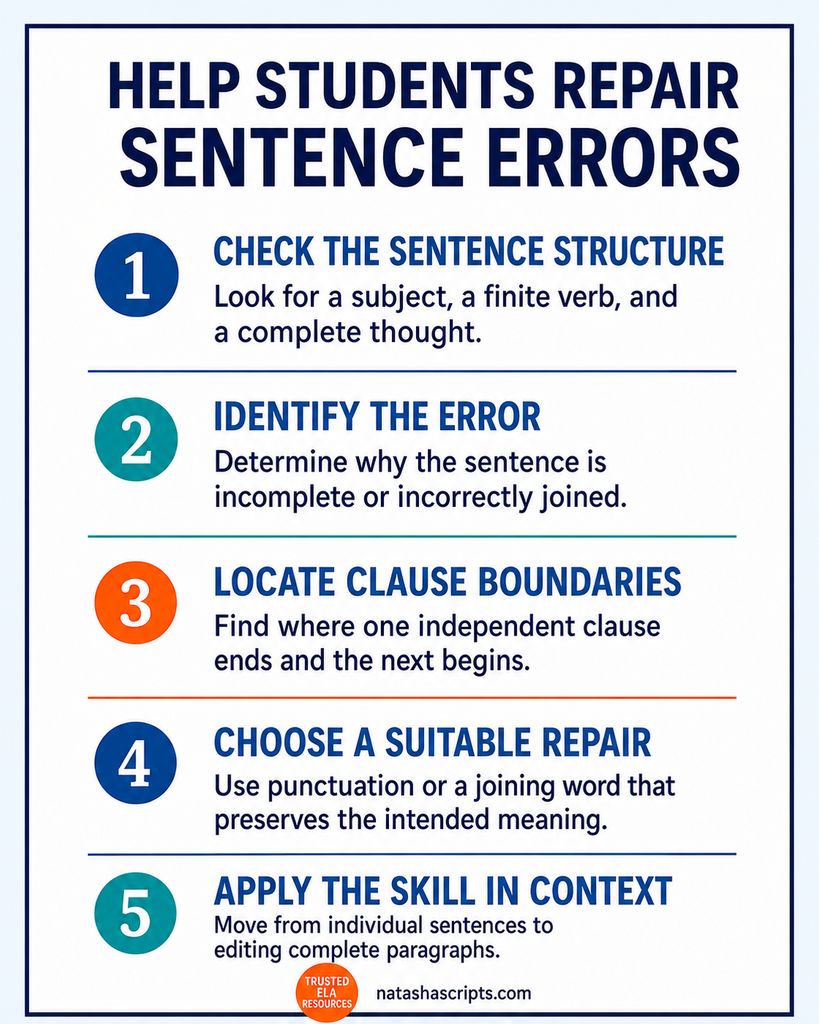
Correcting a fragment or run-on sentence fixes the immediate problem, but students also need to understand what was wrong. They should be able to identify the error, explain why the sentence is incomplete or incorrectly joined, and choose a repair that preserves the meaning they intended.
I created Sentence Repair Lab because I believe that understanding an error is one of the most effective ways to prevent it from recurring. As students learn to diagnose fragments and run-on sentences, they develop a process they can apply to their own writing instead of correcting individual sentences without understanding the reason for each change.
Why Students Need to Understand the Error
Fragments and run-on sentences are often taught through rules followed by punctuation exercises. This gives students useful practice, but choosing the correct answer does not always mean that they understand the reason for it.
Students need to know what makes a sentence complete. They also need to recognize the different reasons a sentence may be incomplete. A fragment may be missing a subject or a finite verb, but it may also be a dependent clause or a phrase that has been punctuated as a sentence. Identifying the type of fragment helps the student determine what the sentence needs. The repair must then create a complete, meaningful sentence that communicates the intended idea.
Run-on sentences require the same attention to structure. Students need to locate the point where one independent clause ends and another begins. They can then decide how the ideas should be connected and select suitable punctuation or a joining word. This gives them a clear reason for the correction they make.
As students become familiar with this process, fragments and run-on sentences become easier to recognize during revision. They begin to notice the structure of their own sentences and can apply the same checks independently.
How the Five Lessons Build the Skill
The five lessons in Sentence Repair Lab follow a carefully planned sequence. Students begin by examining the elements of a complete sentence and distinguishing complete thoughts from fragments. They then learn to identify different types of errors and understand what causes each one.
The lessons next introduce boundaries between independent clauses. Students practice locating those boundaries before deciding which punctuation mark or joining method best expresses the relationship between the ideas. They then apply what they have learned while repairing individual sentences and editing longer paragraphs.
Each stage prepares students for the work that follows. The complete sequence is intended for initial instruction because it teaches the skill step by step without leaving gaps in understanding. Once students have learned the earlier concepts, teachers and homeschool parents can select individual lessons for review or additional practice with a particular difficulty.
I prepared a focused presentation for each lesson so that students can concentrate on one part of the skill at a time. The presentations are deliberately concise. Students receive the instruction they need and then use it immediately in the accompanying practice.
Using Sentence Repair Lab
Each lesson takes approximately 30 minutes. Teachers and homeschool parents can begin with the presentation and then have students complete the corresponding printable or digital practice. The teacher materials provide instructional guidance, answers, and acceptable alternatives where more than one repair may be correct.
The lessons can be used with a class, a small group, or an individual learner. Students who are new to sentence repair will benefit from completing all five lessons in order. A student who already understands sentence completeness but continues to struggle with comma splices, for example, may need only the relevant review and practice.
The final paragraph work asks students to apply several skills within a longer piece of writing. This work may take more time because students must read for meaning, locate each error, and consider the most suitable repair. It can be divided across two sessions when needed.
Clearer Sentences Support Clearer Expression
Sentence fragments and run-on sentences can make a student’s meaning difficult to follow. Learning how sentences are formed helps students organize their ideas, show connections between them, and communicate those ideas more clearly.
These skills matter throughout school. Students need them when writing explanations, essays, reports, and responses across different subjects. The ability to organize and connect ideas can also support clearer contributions to discussions and presentations. The same habits remain important in college writing and later professional communication.
My aim with Sentence Repair Lab is to help students understand their corrections. When they can identify the error, explain why it is incorrect, and examine how the sentence is structured, they are much less likely to continue making the same error in their own writing.