Introduction to Phrases and Clauses Grades 7-10
1. Begin with the Grammatical Difference
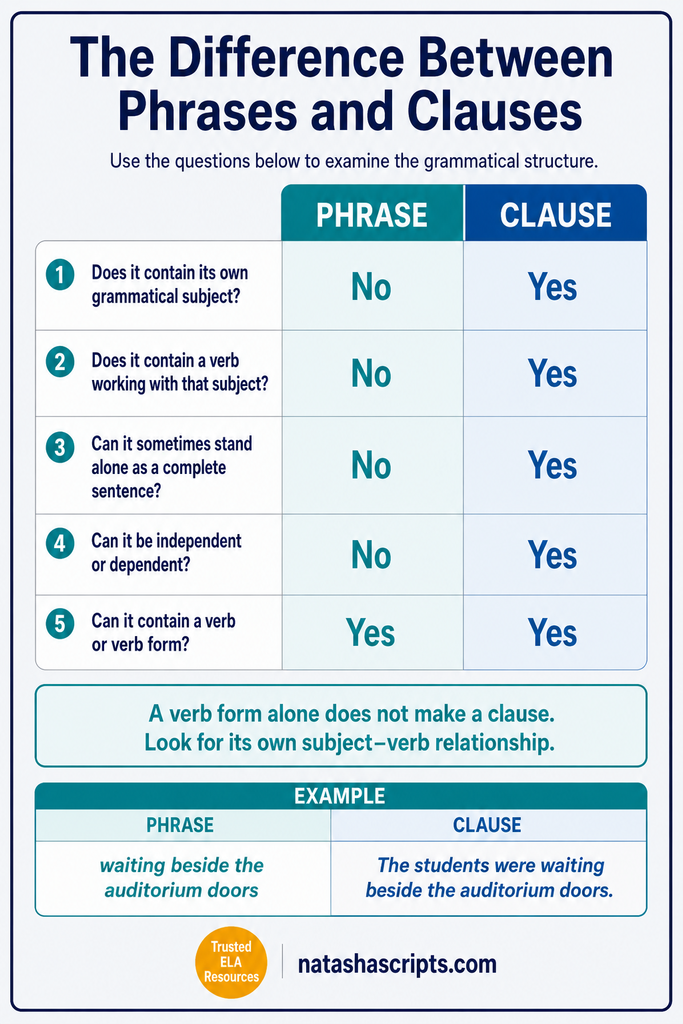
The clearest way to distinguish a phrase from a clause is to look for a subject–verb relationship.
Students sometimes mistake a phrase for a clause because the phrase contains a verb or a word formed from a verb:
waiting beside the auditorium doors
The word waiting expresses an action, but the phrase does not contain its own subject or a verb showing tense. Adding these elements turns it into a clause:
The students were waiting beside the auditorium doors.
The same distinction applies to a verb phrase:
might have forgotten
These words form a verb phrase, but they do not tell us who might have forgotten something. When a subject is added, they become part of a clause:
Jordan might have forgotten the permission slip.
Students should therefore look beyond the presence of an action word. The important question is whether the group of words contains its own subject and a verb working together.
2. Use a Three-Step Verification Process
Students can use the same three questions whenever they need to decide whether a group of words is a phrase or a clause. The process moves from locating the verb to checking for a complete subject–verb relationship.
Three Steps for Identifying a Phrase or Clause
Find the Verb or Verb Form
Look for a word that expresses an action or state. If there is no verb or verb form, the group of words is a phrase.
beneath the auditorium balcony
This group contains no verb or verb form. It is a phrase.
Find Who or What Performs the Action
If the group contains a verb form, look for its own grammatical subject. Ask who or what is performing the action or being described.
carrying the stage equipment
The verb form carrying is present, but the words do not tell us who is carrying the equipment. This is still a phrase.
Check the Subject–Verb Relationship
Decide whether the group contains its own subject and a verb working with that subject. If it does, the group is a clause.
while the stage crew carried the equipment
Stage crew is the subject, and carried is its verb. The group is a clause. The word while makes it dependent.
Compare Similar Examples
Similar examples help students see the structural change that turns a phrase into a clause. Some phrases contain nouns, verbs, or verb forms, so students need to check how the words work together rather than identify them by appearance alone.
| Phrase | Clause | What to Notice |
|---|---|---|
| after the final rehearsal | after the final rehearsal ended | The phrase contains no verb. In the clause, rehearsal is the subject and ended is the verb. The word after makes the clause dependent. |
| waiting near the gym entrance | the athletes were waiting near the gym entrance | Waiting is a verb form, but the phrase does not contain its own subject or show tense. The clause adds the subject athletes and the helping verb were. |
| might have forgotten the sign-up sheet | Liana might have forgotten the sign-up sheet | The first group contains the verb phrase might have forgotten, but it has no subject. Adding Liana creates a subject–verb relationship. |
| because of the power cut in the science wing | because the power went out in the science wing | Because of is followed by a noun phrase. In the clause, power is the subject and went out is the verb. |
| to complete the mural before lunch | the art club completed the mural before lunch | The infinitive phrase begins with to complete but has no grammatical subject of its own. The clause contains the subject art club and the verb completed. |
| the designer of the class logo | who designed the class logo | The first group is a noun phrase. In the relative clause, who acts as the subject and designed is the verb. |
A Ready-to-Use Lesson for Grades 7–10
Introduction to Phrases and Clauses Grades 7–10
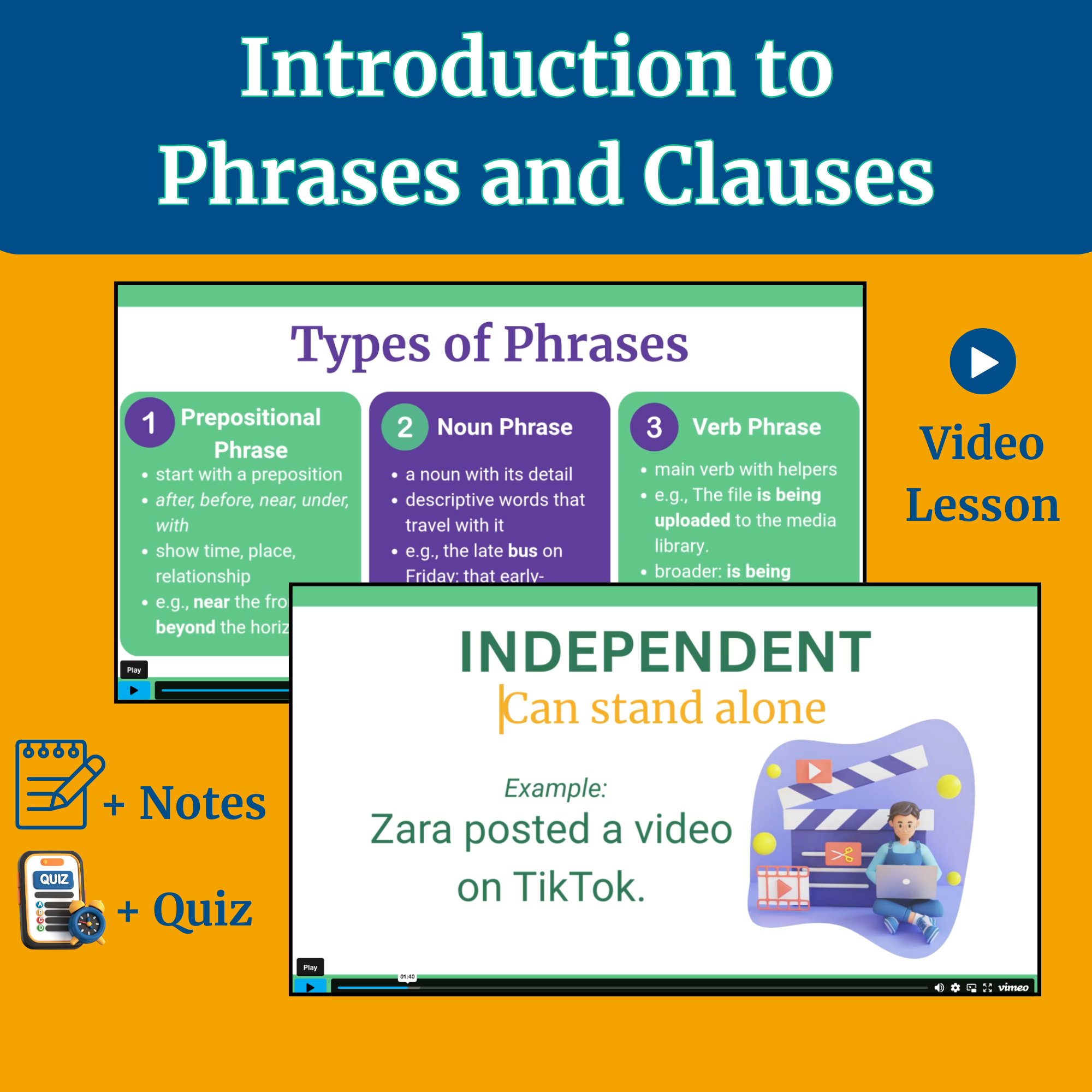
I created this resource for teachers, tutors, and homeschool parents who want a clear and structured way to teach the difference between phrases and clauses. You can use it as a standalone lesson when the concept is new or as a refresher when students need to revisit it.
The colorful 14-minute video is carefully paced and uses examples to reinforce the key distinctions. As students watch, they complete guided notes arranged in a format similar to Cornell notes. I believe that combining watching with writing helps students process the explanation more carefully and retain it for longer.
Students can then apply what they have learned through the included worksheets. In a classroom or at home, the activities can be completed digitally as fill-in exercises or printed for written practice.
This is a paid resource.
Why the Difference Matters in Academic Writing
Understanding the difference between phrases and clauses helps students see how sentences are constructed. A phrase can add detail, describe a noun, or explain when, where, or how something happens. A clause contains a subject–verb relationship and forms the structural basis of a sentence.
This knowledge becomes particularly important as students begin writing longer essays, reports, and text-based responses. They need to recognize which groups of words can carry a main idea, which ones depend on another clause, and where punctuation is required. Without this distinction, students are more likely to produce sentence fragments, comma splices, misplaced modifiers, or sentences in which the intended relationship between ideas is unclear.
The skill also supports sentence variety. Students who understand phrases and clauses can add detail without creating fragments, combine related ideas, and choose structures that suit the meaning they want to express. This gives them greater control when explaining evidence, developing an argument, or describing events in a narrative.
Knowledge of phrases and clauses is also assessed indirectly on the SAT. Questions within Standard English Conventions ask students to make decisions about sentence boundaries, structure, and punctuation. To answer accurately, students often need to determine whether a group of words is a phrase, a dependent clause, or an independent clause. State assessments may test the same knowledge through editing, sentence-combining, punctuation, and revision questions.
The aim is for students to use this understanding whenever they read, write, or revise a sentence. Once they can recognize the subject–verb relationship, they have a reliable way to distinguish phrases from clauses and make more accurate decisions in their own academic writing.
