How to Plan a Long Writing Project in High School Without Falling Behind
Does your student stare at a four-week writing assignment, do nothing for three weeks, then panic? Most high school students have never been shown how to plan a long writing project in high school as a sequence of small, connected steps. Once they see the structure, the whole thing becomes far less intimidating.
This article gives you a concrete framework: (i) phases, (ii) weekly tasks, and (iii) practical checkpoints. This framework works for research papers, extended essays, literary analyses, and any other multi-week writing assignment in grades 9–12.
Why Long Projects Feel Impossible
Many students struggle with long writing projects because they focus on the finished product rather than the individual steps required to complete it. A ten-page research paper due in four weeks can feel overwhelming when viewed as a single task.
Breaking the project into smaller daily and weekly goals makes the workload more manageable. Each completed step provides a sense of progress and helps students maintain momentum throughout the project.
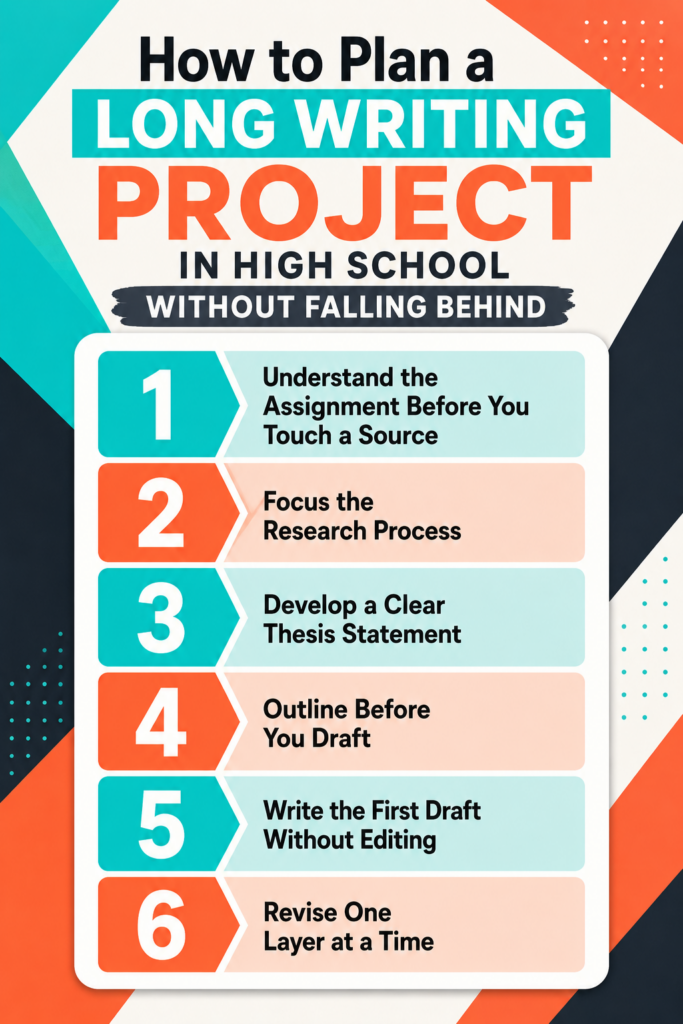
Phase 1 — Understand the Assignment Before You Touch a Source
Before any research begins, the student needs to read the assignment prompt carefully, more than once. This sounds obvious, but many students begin researching before they have taken the time to understand exactly what the assignment requires.
What to do in Phase 1
- Highlight the key requirements: length, format, citation style, source minimums.
- Identify the type of writing: argumentative, analytical, informational, comparative.
- Write the due date on a calendar, then count backward to map out available weeks.
- Draft one or two rough topic ideas. The goal is simply to identify a possible direction for the project.
This phase should take no more than one focused 30–45 minute session and should leave the student with a clear understanding of the assignment.
Phase 2 — Focus the Research Process
Students often spend a great deal of time reading sources that ultimately contribute very little to their paper. One reason for this is that students often begin researching before they have identified a guiding question. A guiding question comes before the thesis. It helps define the issue the thesis will eventually address.
Example: Instead of researching broadly on “climate change,” a student might ask, “How have coastal cities adapted infrastructure in response to rising sea levels?” Once a guiding question is in place, students can evaluate sources more efficiently because they have a clearer sense of what information they are looking for.
Research tasks for this phase
- Write one guiding question at the top of every research session.
- Take notes in your own words — don’t copy-paste paragraphs you’ll never reread.
- Record full source information the moment you use a source. Trying to reconstruct citations at the end of the project is often far more time-consuming.
- Stop when you have enough to form an opinion. More sources don’t always mean a better paper.
Depending on the project length, this phase typically spans one to one-and-a-half weeks of a four-week assignment.
Phase 3 — Develop a Clear Thesis Statement
Many students begin with a topic statement rather than a thesis. A topic statement identifies the subject of the paper, while a thesis presents a specific claim that the paper will support.
Example
Topic Statement:
“Social media affects teenagers in many ways.”
Thesis Statement:
“Social media use should be limited during the school day because it distracts students from learning and reduces face-to-face interaction.”
A strong thesis gives the paper direction. It tells the reader what the paper will argue and why the topic matters. Every body paragraph should support, explain, or develop the central claim. If a paragraph does not contribute to that goal, it may need to be revised or removed.
Phase 4 — Outline Before You Draft
One common reason students struggle during the drafting stage is that they begin writing before they have planned the structure of the paper. An outline provides a clear structure for the paper and helps students organize their ideas before drafting begins.
A Simple Outline Structure for a Research Paper
Introduction
Hook, background context, thesis statement
Body Paragraph 1
First supporting point + evidence + analysis
Body Paragraph 2
Second supporting point + evidence + analysis
Body Paragraph 3
Third supporting point + evidence + analysis
Counterargument Paragraph
Address an opposing viewpoint and explain why the thesis remains stronger.
Conclusion
Restate the thesis in fresh language, synthesize the main points, and leave the reader with a final insight or thought.
For longer papers, each Roman numeral above might expand into two or three paragraphs. Before students begin drafting, they should have a clear sense of what each section of the paper is intended to accomplish.
Phase 5 — Write the First Draft Without Editing
Many high school students find drafting difficult because they try to write and revise at the same time. They write one sentence, delete it, and rewrite it. As a result, students may spend a great deal of time on the opening section while the rest of the paper remains unwritten.
During the first draft, the priority should be getting ideas onto the page. The goal of a first draft is completion, not perfection. Spelling errors, awkward sentences, gaps where a citation needs to go — all of that is fine. Mark unclear spots with a bracket like [check this] and keep moving.
A practical target: if the paper is due in four weeks, the full first draft should exist by the end of week three. That leaves sufficient time to improve organization, clarity, and supporting evidence before submission.
Phase 6 — Revise One Layer at a Time
Revision involves examining the overall effectiveness of the paper. Does the argument hold together? Is the evidence convincing? Does each paragraph stay focused? Does the conclusion do more than repeat the introduction?
A Layered Revision Approach
Pass 1: Big Picture
Does the thesis still match what the paper argues? Revise any section that drifts from the central claim.
Pass 2: Paragraph Level
Does each paragraph have a clear topic sentence? Does the evidence connect clearly to the analysis?
Pass 3: Sentence Level
Are sentences varied in length and structure? Are vague words such as “things,” “stuff,” or “very” replaced with more precise language?
Pass 4: Mechanics
Check grammar, punctuation, citation format, and spelling.
Revising in separate passes, even on separate days, helps students focus on one type of improvement at a time instead of trying to fix everything at once.
A Week-by-Week Schedule for a Four-Week Project
Here’s how the phases map onto a realistic four-week timeline. Adjust the proportions for shorter or longer projects.
Week 1
Understand the assignment, develop a guiding question, complete primary research, and record all sources.
Week 2
Finalize the thesis, build a detailed outline, and begin drafting the body paragraphs.
Week 3
Complete the full first draft, from introduction through conclusion.
Week 4
Revise in layers (big picture → paragraph → sentence → mechanics), format citations, and conduct a final read-aloud check.
Notice that drafting does not begin until week two. By the time students begin writing, they should already have a guiding question, a working thesis, and a clear outline. This makes it easier to stay focused and maintain momentum throughout the drafting stage.
How Grammar Fits Into Long Project Planning
Grammar is often one of the last things students think about when working on a major writing project. However, during the revision stage, it plays an important role in helping ideas come across clearly and professionally. Errors such as comma splices, pronoun-antecedent agreement problems, and misplaced modifiers can distract the reader and weaken an otherwise strong piece of writing.
For this reason, it can be helpful to include a brief grammar review as part of the revision process, particularly if a student is still developing confidence with the conventions expected in high school writing. Grammar High School Grades 9–10: A Simplified Visual Guide with Quick Checks provides concise explanations of key grammar concepts commonly used in academic writing, along with short self-check activities that students can use to assess their understanding.
Students who benefit from ongoing review may also find Quick Daily Grammar for High School useful. The short practice activities are designed to reinforce grammar skills gradually throughout the school year, making it easier to apply those skills during larger writing assignments.
Neither resource is intended to replace writing instruction. Instead, they can serve as practical reference tools during the revision stage of a long-term writing project.
Planning Checkpoints
Long writing projects are often easier to manage when progress is reviewed at regular intervals. Whether the project is being completed in a classroom, with a tutor, or as part of a homeschool program, brief check-ins can help ensure that each stage of the process is completed before the next one begins.
A simple schedule might look like this:
End of Week 1: Review the guiding question, preliminary research, and source list.
End of Week 2: Review the thesis statement and completed outline.
End of Week 3: Review the full first draft.
Two days before the deadline: Review the revised draft, citations, and final edits.
These checkpoints provide opportunities to identify gaps in the project before the final deadline. They can also help students maintain a steady pace rather than leaving multiple stages of the writing process until the last minute.
What to Do When a Student Gets Stuck Mid-Draft
Most students encounter moments where progress slows or stops during the drafting process. When this happens, it is often helpful to identify the source of the difficulty before continuing.
If a student is unsure what to write next, the outline may need further development. Returning to the outline and adding additional details can often provide a clearer direction for the next section of the paper.
If a student knows what they want to say but is struggling to put the ideas into writing, discussing the paragraph aloud can help. Many students find that speaking through an idea makes it easier to translate into written form.
If the paper feels unfocused or difficult to develop, it may be worth revisiting the thesis statement. A clear thesis often provides the direction needed to make decisions about evidence, organization, and analysis.
The Habit That Makes Future Projects Easier
Students who learn how to plan a long writing project gain more than a strategy for completing a single assignment. They develop a process that can be applied to future research papers, essays, and extended writing tasks.
As students become more familiar with the stages of planning, researching, outlining, drafting, and revising, those steps begin to feel more manageable. Over time, they are able to approach longer projects with greater confidence and organization.
The ability to break a complex task into smaller, achievable stages is a valuable skill that extends beyond a single writing assignment. It can support success across a range of academic subjects and prepare students for the larger projects they will encounter later in high school and beyond.
If you’re looking for additional free planning tools and ELA resources to support your student’s writing, visit the free ELA resources hub for ready-to-use materials you can put to work right away.
