When Jordan Froze at the Board: A Spelling Wake-Up Call
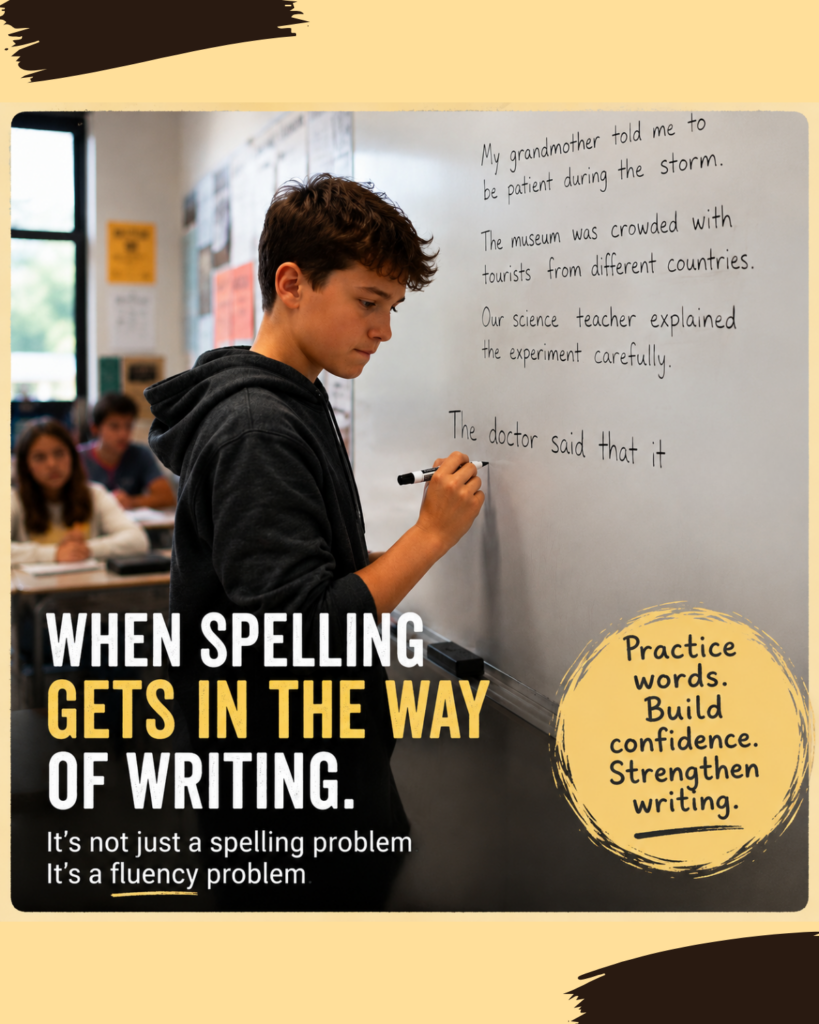
Sunday night: Jordan aces his spelling list, twenty out of twenty. Thursday afternoon: he’s standing at the whiteboard, marker in hand, and the word necessary has simply vanished. He stares at the board. The class waits. He writes nessesary and sits down fast.
That gap between a perfect weekend quiz and a Thursday blank is the central problem with how spelling is often taught at the middle school level. Spelling practice for middle school has to do more than load words into short-term memory. It has to wire those words into the kind of automatic recall that survives an essay deadline, a science lab report, and a distracted Tuesday morning.
Why Rote Memorization Breaks Down After Fifth Grade
In the early grades, a weekly word list works reasonably well. The words are short, the patterns are predictable, and students encounter them constantly in reading. By sixth, seventh, and eighth grade, the vocabulary load explodes. Words grow longer, Latin and Greek roots multiply, and students are expected to spell accurately while managing complex ideas in writing.
Memorizing a list in isolation treats spelling as a retrieval task: find the word in memory and copy it out. But fluent spelling under pressure is a production task. The student has to recall the word, apply it to meaning, and generate it in real time without pausing to think. Those are two very different cognitive demands, and a Sunday-night drill only trains the first one.
What “Transfer” Actually Means in Spelling
Transfer is the goal: the student uses correct spelling not just on a dedicated spelling test, but in every piece of writing across every subject. Transfer is blocked when spelling is treated as its own isolated subject with no connection to meaning, morphology, or actual writing practice.
Jordan could retrieve necessary in a low-stakes, closed-context quiz. He couldn’t produce it in an open, high-stakes moment because his brain had filed it under “spelling list” rather than “word I use and own.” The fix is building multiple, varied pathways to the same word.
The Role of Word Structure in Middle School Spelling Strategies
One of the most reliable middle school spelling strategies is teaching students to see inside a word rather than memorize its surface. Necessary has one collar and two socks (one c, two s‘s). That mnemonic works because it attaches a visual image to a structural fact. More powerfully, teaching students that necessary shares a root with necessity gives them a morphological anchor.
At the middle school level, morphology — roots, prefixes, suffixes — is the highest-leverage spelling tool available. When a student knows that -tion always sounds like “shun” but is never spelled “shun,” an entire category of spelling errors disappears.
Quick Morphology Moves That Stick
- Root families: Group words by shared Latin or Greek roots (port, rupt, spec) and study them together rather than randomly.
- Prefix/suffix walls: Keep a running class chart of affixes and their meanings. Students add to it all year.
- Transformation drills: Give students a base word and ask them to build three related forms — create → creation → creative → creativity. Spelling patterns become visible across the family.
Seven Types of Activity That Build Real Spelling Accuracy
The research consensus among literacy specialists is clear: varied, meaning-connected practice beats repetitive copying. Here are the activity types that actually move the needle on spelling accuracy in middle school.
- Look–Say–Cover–Write–Check: A classic for a reason. It forces retrieval rather than copying, which is the mechanism that builds memory.
- Syllable segmentation: Students break the target word into syllables, spell each syllable separately, then reassemble. This slows down the word and exposes where errors cluster.
- Sentence writing with constraints: The student writes an original sentence using the target word and at least one other word from the current lesson. Meaning and spelling practice happen simultaneously.
- Word sorting: Students sort words by pattern, not just by list number. Open sorts (student-generated categories) build deeper analysis than closed sorts.
- Error analysis: Students keep a personal “spelling demons” log. They record words they’ve misspelled in writing and study those specifically.
- Peer dictation: Partners dictate sentences to each other using target words in new contexts.
- Editing practice: Students receive a passage seeded with deliberate misspellings of words they’ve studied and must identify and correct them. This trains the proofreading eye.
For a deeper look at how to sequence and balance these approaches, 6 Spelling Activities for Middle Schoolers That Build Accuracy walks through six structured activities with practical classroom examples.
What a Strong Spelling Lesson Actually Looks Like
A well-designed lesson for a seventh grader introduces the word with its definition and a model sentence, breaks it into syllables, connects it to related forms, and then asks the student to use it in writing, from memory, in a new context.
Here’s a condensed example for the word exaggerate:
Step 1 — Introduce: Exaggerate means to describe something as larger, better, or worse than it really is. “She exaggerated the size of the fish she caught.”
Step 2 — Syllables: ex · ag · ger · ate (four syllables; note the double g in the middle).
Step 3 — Morphology: The prefix ex- means “out” or “beyond.” To exaggerate is to push something beyond its true size.
Step 4 — Write it: Cover the word. Write it from memory. Check. Write a sentence of your own.
That four-step sequence takes about four minutes per word and produces far better retention than a list of twenty words copied three times each.
Structured Workbooks as a Consistent Practice Framework
One challenge teachers and homeschool parents face is consistency. Activity-based spelling practice is effective, but designing it from scratch for every lesson is exhausting. A well-structured workbook can carry the scaffolding so the instructor focuses on discussion and feedback rather than design.
The Spelling Practice Workbook for 7th Grade addresses exactly this. It works through 120 grade-appropriate words across 20 lessons, six words at a time. This is a perfect pace for students to learn and master each word before moving on. Each lesson includes syllable exercises, whole-word practice, a word search, and a sentence-writing component, so students encounter each word through multiple pathways rather than a single drill.
For students who need vocabulary development alongside spelling, The Vocabulary and Spelling Practice Workbook for 7th Grade integrates connotation work, definition study, model sentences, vocabulary application in varied exercises and spelling practice of the targeted vocabulary. The combination of these activities dramatically improves retention and transfer.
Addressing the “I Knew It on Sunday” Problem Directly
When Jordan froze at the board, the issue wasn’t effort or intelligence. It was encoding. His brain stored the word in a thin, context-dependent trace which was accessible in the quiet of his bedroom on a Sunday night, but inaccessible under the mild pressure of a public writing task.
The solution is what cognitive scientists call elaborative encoding: connecting new information to existing knowledge through meaning, structure, and varied use. Every activity in this article works because it forces that deeper connection. The student isn’t just recognizing the word they studied on a list but they are analyzing it and applying it in writing.
Making Spelling Practice Stick: Practical Classroom Habits
Structural changes in how you run spelling practice will compound over a semester. A few habits that make a measurable difference:
- Distribute practice over the week rather than cramming on Sunday. Even ten minutes of review on Tuesday and Thursday doubles retention compared to a single long session.
- Hold students accountable for spelling in all writing, not just on spelling tests. A brief proofreading protocol at the end of every draft keeps spelling accuracy in students’ minds as a real-writing skill.
- Return to words students have already studied. Cumulative review, revisiting words from two or three lessons ago, is one of the most powerful retention tools available.
- Celebrate error analysis. When a student catches their own misspelling and adds it to their personal log, that’s a win.
The Bigger Picture: Spelling as a Writing Skill
Jordan’s freeze at the board was a sign that he had not yet practiced using the word necessary often enough in meaningful writing for it to become automatic. The issue was not simply a spelling mistake in isolation. It reflected a deeper problem with writing fluency. When students are uncertain about spelling, the cognitive load of writing increases. They hesitate, lose momentum, or avoid more precise vocabulary altogether. A seventh grader who writes big instead of significant because they are unsure how to spell the latter is paying a genuine academic price.
The purpose of spelling practice is not only to prepare students for a weekly test. It is to make words familiar enough that students can use them naturally in real writing situations. By the time Jordan reaches the board, necessary should feel like a word he owns, not one he has to stop and puzzle over.
For additional strategies and free classroom resources, visit the free ELA resources hub — a growing collection of printables and activities you can use immediately.
