7th Grade Vocabulary: How Short Reads, Smart Inference, and Quick Games Build Word Power
Download a free 3-week sample with short passages, word activities, colorful flashcards, a word list, an online game, and a Week-3 check-in.
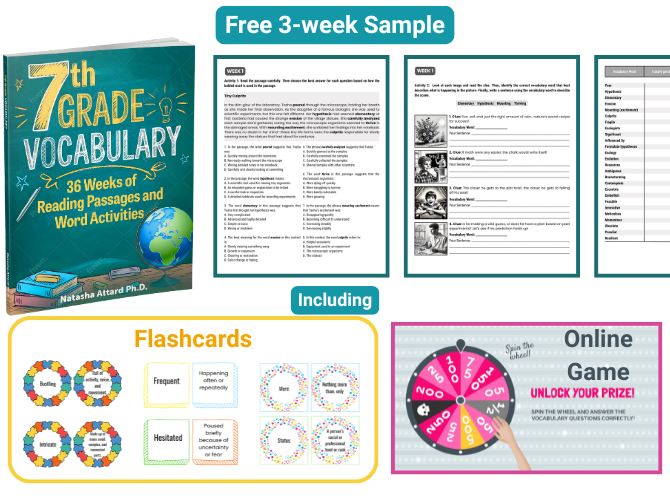
This guide shows how I use the free 3-week sample lessons in class, but the same routine adapts easily for homeschooling.
Strong vocabulary grows when students read a short text, infer a target word from context, and then confirm the meaning in clear language. That is the core method in my book 7th Grade Vocabulary: 36 Weeks of Reading Comprehension and Word Activities. Each week students read a brief passage, focus on one or two skills for inferring meaning, define the targeted words precisely, and then play short games that keep meaning and form in memory. The goal is simple: make 7th grade vocabulary instruction efficient, engaging, and transferable to real reading and writing.
Free Lesson Samples (Weeks 1-3)
- Three weekly passages with text-dependent prompts that lead students to inference and, finally, to a concise definition.
- Targeted word activities that connect meaning to usage and form.
- A printable word list covering all targets in the 3 weeks.
- Color flashcards with student-friendly definitions.
- A quick end-of-cycle check-in for Week 3 (progress you can see).
- A fun online game that recycles the same words for retrieval practice.
The flow I use with the Free 3-Week Pack
I keep the routine calm and predictable so the thinking can be lively. We read a short passage together, pause on the target words, and help students figure out the meaning. Then we practice in small ways that stick: a picture to anchor the idea, a sentence that proves it, and a quick check so we know who needs help. The colorful flashcards and the online game are there for memory—use them like spices, not the whole meal.
Week 1
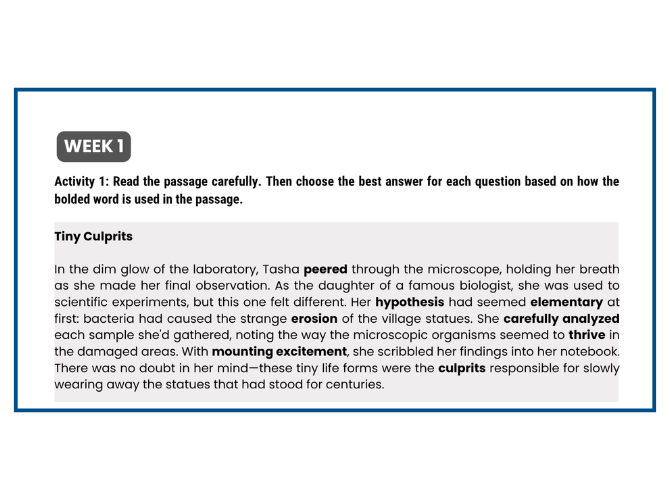
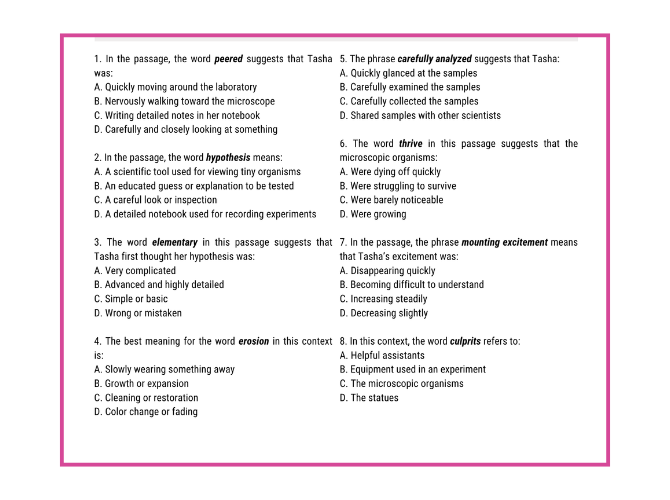
Start with the passage. Read once for gist, then again to slow down on the bolded words. Ask, “What in this line helps you infer the meaning of the bolded word?” Have students point to a specific clue, not a guess. Move to the image match next. Begin with what they notice in the picture, then choose the word that fits that detail. Keep the talk brief and purposeful. Then discuss the multiple-choice questions together, inviting students to justify the best option with a phrase from the text. Follow with the cloze passage, which students can complete orally or in writing. Finish with the application questions, which require students to use each target word from their own experience. This final step anchors both definition and usage because students must connect the word to something real and familiar.
1. Reading the Passage
- First read: one smooth read for gist.
- Second read: pause at each bolded word. Ask, “What in this line helps you infer the meaning?”
- What to mark: students underline the clue type (restatement, contrast, example, tone) and highlight the proof words.
- Quick share stem: The clue is [contrast/example/etc.]; the words “[proof phrase]” point to [student’s definition].
- Confirm: reveal the clean, one-sentence definition and adjust wording together.
2. Image-Vocabulary Match
- Describe first. Students say what they see in the picture, including any sensory details (sounds, textures, mood) or the specific situation it suggests.
- Choose the word. After the description, they pick the single best target that fits that scene.
- Confirm together. If there are two contenders, compare the descriptions and decide which detail settles it.
- Write it. For each picture, students write one sentence that captures the agreed description (the situation + a telling detail) and uses the target word correctly.

Finding the sample helpful? Move to the complete program, 7th Grade Vocabulary: 36 Weeks of Reading Comprehension and Word Activities.
3. Multiple-choice discussion
- Work in pairs. Read the item together, then agree on the most likely answer.
- Point to the text. Highlight the exact words in the passage that support your choice.
- Share briefly. Pairs report the supporting phrase only; then confirm the key.
4. Cloze passage (individual written)
- Assign individually as a short written task (about five minutes).
- Reveal the key when time’s up.
- Confer briefly with anyone who missed an item for a brief reteach.
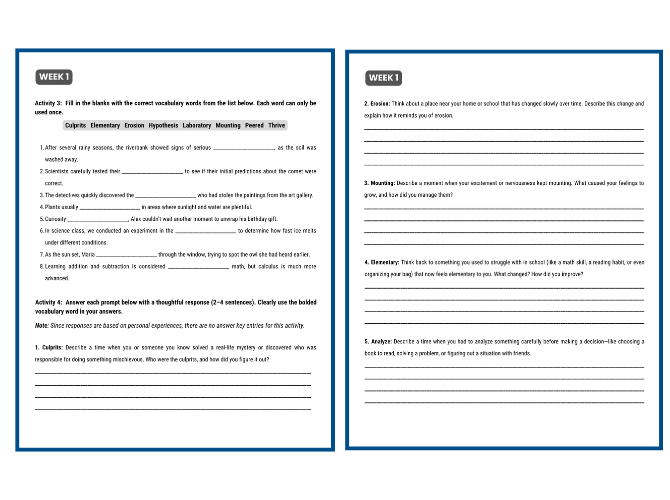
5. Application writing (own experience)
- Assign one sentence per target—either in class (independent) or as homework to be teacher-marked.
- Aim to use the exact word. However, accept a sentence without the word if the student’s writing clearly depicts the meaning and directly supports the definition from their own experience. The goal here is mental association: attaching the concept to something real so recall sticks.
- In class, discuss a few student lines and briefly celebrate precise fits and clarify any near-misses.
Free Lesson Sample (Weeks 1-3)
What’s inside: three passages, targeted activities, full word list, printable flashcards with definitions, a Week-3 check-in, and a link to the online game.
A. Using the printable flashcards
Your flashcards come in pairs. One side shows the target word, the other side shows the student-friendly definition. Keep sets small so practice feels quick and successful.

Quick activities using the flashcards
- Snap Explain: Hold up the word side. A student gives a one-sentence explanation or mini scene. Then read the definition out. You read the definition aloud, and the student self-checks by saying “Match” or “Almost” and, if needed, revises the line.
- Mix and Match: Mix the cards containing the target words with those containing the definitions. Ask the students to match the word to its corresponding definition.
- Word wall rotation: Hang the week’s cards in a visible spot and refer to them during any subject. Swap in new cards each Monday.
- Bell ringer: One card on the board and students write a 1-sentence example that fits the definition.
- Exit ticket: Hold up a card as they leave and each student gives a brief word mini-scene.
B. Spin the Wheel Online Quiz Game
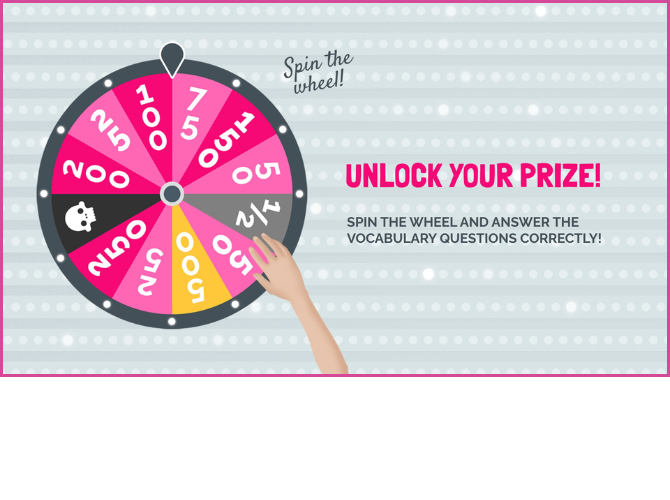
Use the link and password in the pack to open the Spin the Wheel game. It is a simple point game that rotates through the same target words from Weeks 1–3.
_________________________________________________________________________________________
7th Grade Vocabulary: 36 Weeks of Reading Comprehension and Word Activities

