Improve High School Writing in Grades 11–12: Free Download
Free Advanced Vocabulary Lesson and Spelling Practice Worksheets
The free lesson discussed in this article is taken from Lesson 1 of Spelling High School Grades 11–12: Advanced Vocabulary and Writing Practice for College Readiness. Scroll to download the free lesson instantly.
Strong writing in Grades 11–12 depends on precise word choice and accurate spelling. This post shares a free advanced vocabulary and spelling lesson with short reads, image prompts, and practical high school spelling activities you can run in 20 minutes. The goal is to build advanced vocabulary high school students can use in real assignments while strengthening spelling high school accuracy for college readiness writing.
Why focus on advanced vocabulary and spelling in Grades 11–12
- Advanced vocabulary improves clarity and tone in essays, lab reports, and applications.
- Image and scenario prompts help students choose the right word, not the almost right one.
- Spelling practice attached to each word reduces near-miss errors that distract from ideas.
Together these routines help improve spelling for teenagers while lifting the overall quality of college readiness writing.
How to run Free Lesson 1 (Grades 11–12): a simple, actionable guide
What you need: the printable lesson, a pen or highlighter, and a timer
Total time: 25–30 minutes in class, or 12–15 minutes at home
A. Before reading the definitions: quick prediction warmup
Goal: activate prior knowledge so the micro-reads land quickly.
- Write antithetical on the board. Ask: “What can we tell from the prefix anti?” Take one-sentence guesses first, then read one usage example to refine the guess.
- Repeat with disparate and egregious. Use one example for each to anchor meaning. Students say a plain one-sentence definition in their own words, then check the printed one.
Why this step works: the short, humorous micro-reads and example sentences are built to be memorable and teen-relevant; the quick prediction increases attention to the exact nuance when you reveal the definition.
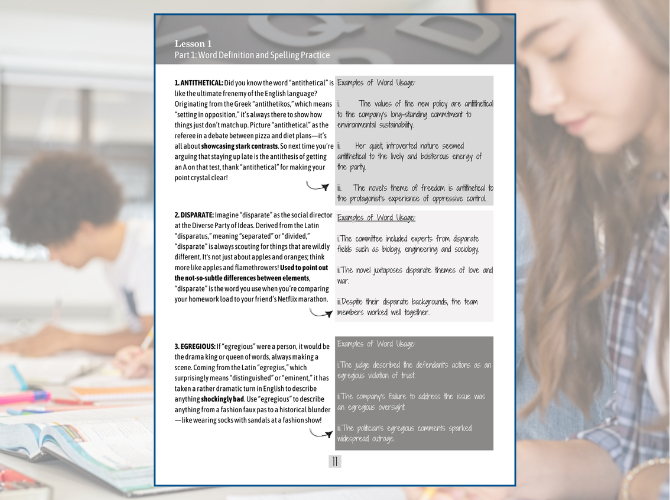
B. Read the micro-reads, then capture the “one idea”
Goal: take the humor, keep the precision.
- Students read the short explanation for antithetical, disparate, egregious, then empirical, exacerbate, juxtapose.
- After each, ask for a “one idea” summary in 7–12 words.
- Antithetical: “directly opposed, two ideas that cannot fit together.”
- Disparate: “clearly different kinds, not just a small difference.”
- Egregious: “shockingly bad or flagrant.”
- Empirical: “based on observation or data.”
- Exacerbate: “make a problem worse.”
- Juxtapose: “place side by side to show contrast.”
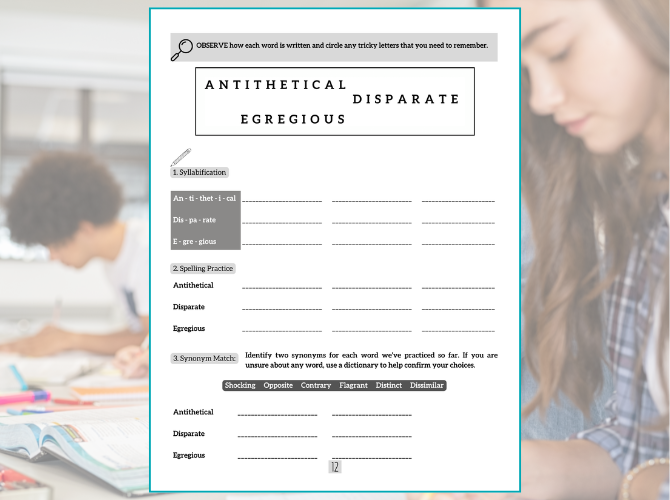
C. Shape the spelling from the syllables
Goal: make long words easier to spell by seeing the structure.
- Use the printed syllable lines. Students slice the word, then box the tricky chunk they often miss.
- An-ti-thet-i-cal, Dis-pa-rate, E-gre-gious, Em-pir-i-cal, Ex-ac-er-bate, Jux-ta-pose.
- One 60-second cycle: write once, cover, write again, check.
- Circle only the part that was wrong, then rewrite the full correct form once. The page already provides space for this practice.
Coach cue: “Say the chunks aloud as you write, for example juxta then pose.”
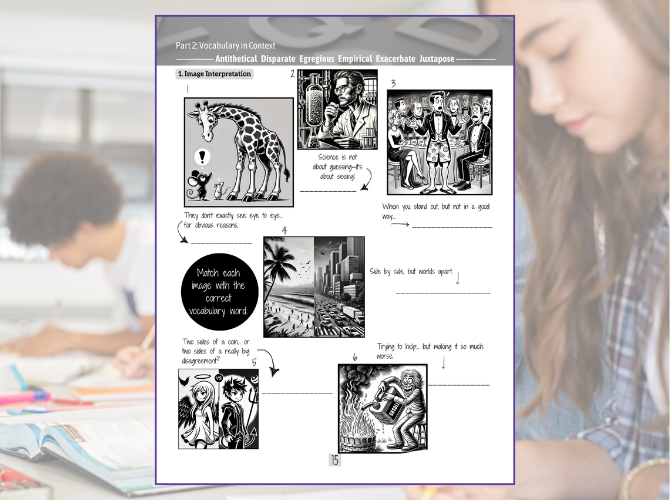
D. Image interpretation that proves the choice
Goal: pick the exact word and give evidence from the picture.
- Students look at one image for 20 seconds, then write one sentence that describes what they notice.
- From the word bank, they choose the single best target and add “because…” with one visual clue.
- If time allows, do two images. The answer key maps the set as Disparate, Empirical, Egregious, Juxtapose, Antithetical, Exacerbate, which you can use for a quick check or peer swap.
E. Synonym-in-sentences with bolded clues
Goal: choose the target that fits an academic sentence.
- Students replace the bold clue with the correct lesson word on the line, for example flagrant → egregious, observational → empirical, aggravate → exacerbate, contrast or compare → juxtapose.
- Do two together as a think-aloud. Students finish three more, then spot-check with the key.
Free Lesson/Worksheet – Instant Download
F. Quick transfer to writing
Goal: move a new word into the student’s own academic voice.
Give one prompt and a time limit of two minutes. Students write one or two precise sentences that use one target correctly.
- Literature or film:
In one or two sentences, explain how a scene places two ideas side by side to reveal a character’s conflict. Use juxtapose correctly. - Science or news literacy:
In one or two sentences, point out an empirical claim you’ve seen recently and name the observation or data that qualifies it as empirical. - School life problem-solving:
In one or two sentences, describe a habit that seems helpful at first but would actually exacerbate stress during exam week.
G. Fast feedback using the built-in key
Use the answer key to check the picture matches and the synonym-in-sentences. The key provides the image map and sentence answers for Lesson 1.
At-home version in 12 minutes
Parents can run this easily.
- Read one micro-read aloud and ask for a plain-language rephrase.
- Student marks the tricky letters and writes the word once, then checks.
- Look at one image, choose a word, and justify the choice in one sentence.
- Replace one bold synonym with the lesson word on the line.
Keep a tiny “tricky letters” list on the fridge. Ask for the correct spelling once before any homework writing that night.
What will improve after a week
- Students grab the right word more confidently because they have practiced fit, not just definition.
- Spelling errors drop on the target words.
- Short academic sentences sound more precise, which supports college readiness.
Free Lesson/Worksheet – Instant Download
Questions or collaboration? Reach me at natasha@natashascripts.com.
